The Smell of Molten Projects in the Morning

Ed Nisley's Blog: Shop notes, electronics, firmware, machinery, 3D printing, laser cuttery, and curiosities. Contents: 100% human thinking, 0% AI slop.

Category: Science

If you measure something often enough, it becomes science

  • OMTech 60 W Laser vs. Gentec ED-200 Optical Joulemeter: Long Pulse Duration Power

    OMTech 60 W Laser vs. Gentec ED-200 Optical Joulemeter: Long Pulse Duration Power

    The Gentec ED-200 Joulemeter is severely underqualified to measure the OMTech 60 W laser’s beam power, because the laser’s 1 ms minimum manual pulse width isn’t much shorter than the sensor’s 1.5 ms risetime and the maximum beam power is far too high for the sensor’s health. With that in mind, I set the PWM power to 50% = 30 W (grossly too high) and looked at the peak output voltage for a series of (far too long) pulse widths:

    Rounding the detector sensitivity to 11 V/J says the 1.3 V peak at 5 ms corresponds to 120 mJ and 24 W:

    Gentec ED-200 - 60W 50pct 5ms
    Gentec ED-200 – 60W 50pct 5ms

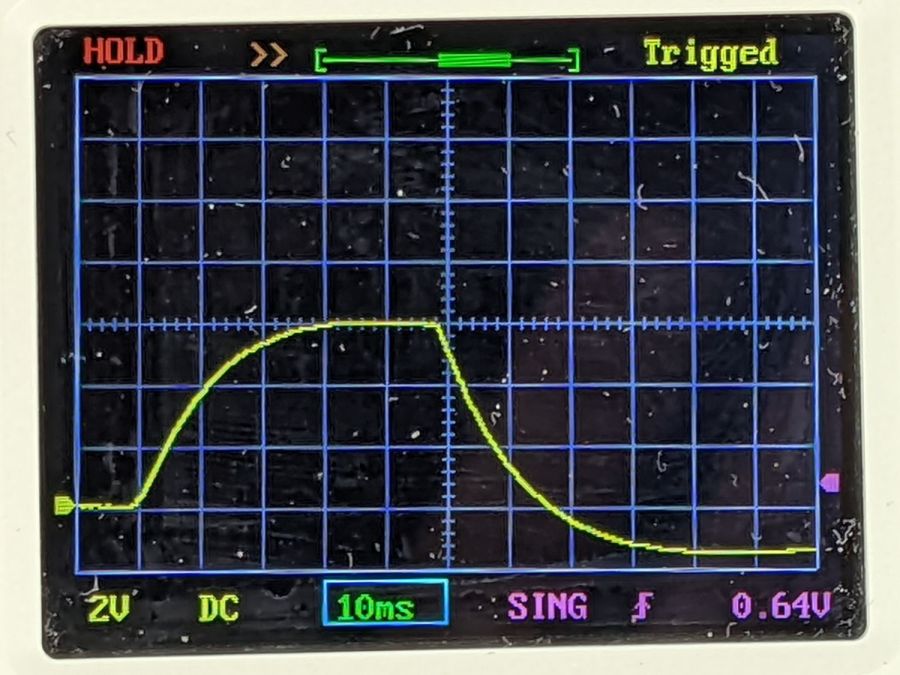
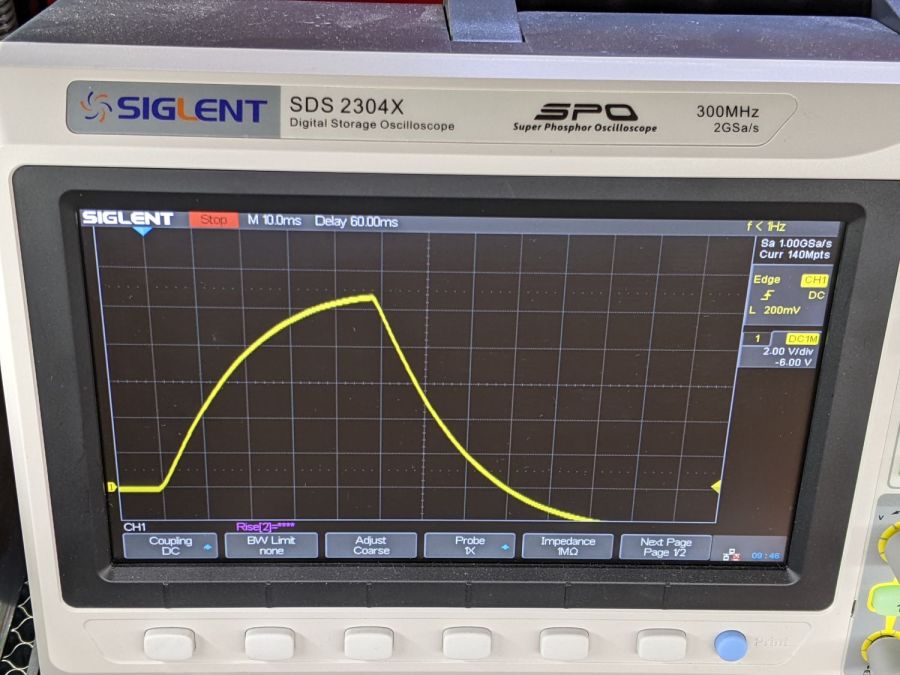
    The 3.3 V peak at 10 ms is 300 mJ and 30 W:

    Gentec ED-200 - 60W 50pct 10ms
    Gentec ED-200 – 60W 50pct 10ms

    The 3.4 V peak at 15 ms is 310 mJ and 21 W suggests the PWM power output is not nearly as constant as one might expect, although the pulse width looks fine:

    Gentec ED-200 - 60W 50pct 15ms
    Gentec ED-200 – 60W 50pct 15ms

    The 6 V peak at 20 ms is 550 mJ and 27 W, although the on-screen display obscures the top:

    Gentec ED-200 - 60W 50pct 20ms OSD
    Gentec ED-200 – 60W 50pct 20ms OSD

    Another 20 ms pulse without the OSD produces a peak eyballometrically close to 6.4 V for 580 mJ and 29 W:

    Gentec ED-200 - 60W 50pct 20ms
    Gentec ED-200 – 60W 50pct 20ms

    The KT332N controller in the OMTech 60 W laser has a pulse duration setting showing tenths of a millisecond, but (based on some additional measurements) the beam power can vary by 25% for successive pulses in the low millisecond range, so the pulse width resolution doesn’t seem to provide useful control.

    Despite the over-long pulses, the calculated power corresponds surprisingly well with the nominal laser output power.

    The 1 ms pulses used in LightBurn’s Dot Mode are consistent enough to punch essentially identical 0.2(-ish) mm holes in manila paper to mark the graticule:

    OMTech 60W laser - beam alignment - focus detail - 2022-03-22
    OMTech 60W laser – beam alignment – focus detail – 2022-03-22

    They’re on 0.25 mm centers, with slight variations showing the difference between stepper resolution and positioning accuracy. The shorter graticule lines have three holes on one side of the center lines and four on the other, despite the design’s 1 mm length on both sides; I think there’s a missing dot on the side where the head starts the line, perhaps due to a picket-fence error.

    The large beam hole came from two 10 ms pulses, one at the focal point and another 10 mm lower.

  • Gentec ED-200 Optical Joulemeter: Specs

    Gentec ED-200 Optical Joulemeter: Specs

    The Gentec ED-200 optical joulemeter from the Box o’ Optical Stuff is so thoroughly obsolete that no datasheet exists for it anywhere online:

    Gentec ED-200 - measurement setup
    Gentec ED-200 – measurement setup

    The best I could come up with, after many dead ends, is a 2001 capture from gentec-eo.com at archive.org with the barest hint of specifications:

    Gentec ED-200 specs
    Gentec ED-200 specs

    The Max Energy Density spec suggests longer pulses are allowed to deposit more energy, probably because more time gives thermal diffusion an opportunity to spread the heat across the target; at CO₂ laser wavelengths that may not apply.

    With the platform lowered as far as it goes, the ED-200 is 130 mm below the laser nozzle where the beam diameter is about 6 mm for an area of 0.3 cm². Ignoring the ideal Gaussian beam profile by smearing 60 W uniformly across the circle gives a power density of 200 W/cm², which means the laser pulse must be less than 0.5 W·s / 200 W = 2.5 ms to stay inside the power density limit.

    I sincerely hope Gentec overbuilt and underspecified their detector.

    Also, there’s a useful overview document from Genetc-eo.com, wherein it is written:

    The Voltage Response
    The result is a voltage pulse that rises quickly with the response time of the device to a level proportional to the laser energy (Figure 2). It then decays exponentially over a longer period of time that is a function of the pyroelectric device and load impedance. Figure 2 also shows that there is a longer recovery time to return to the initial state of the detector. This is a function of thermal phenomena and is not affected by the load impedance as are the rise and decay times. The integrated pulse energy over this period is proportional to the peak voltage.

    Pulse Width Versus Rise Time

    Usually the applied laser pulse must be shorter than the rise time of the detector for all of its energy to be represented by the peak voltage. Pulse energy received after the detector voltage has peaked will not be fully integrated into that value. For very long pulses, the peak voltage will actually represent peak power rather than pulse energy.

    Gentec Energy Detectors, page 2

    Figure 2 shows the overall waveform:

    Gentec Energy Detectors - Figure 2
    Gentec Energy Detectors – Figure 2

    Which looks a lot like this 10 ms pulse at 50% duty cycle:

    Gentec ED-200 - 60W 50pct 10ms
    Gentec ED-200 – 60W 50pct 10ms

    The pulse was 10 ms long, much longer than the 1.5 ms ED-200 risetime spec, but the overall shape looks right. Dividing the 3.3 V peak by the detector’s 10.78 J/V calibration value (11 J/V works for me) says the pulse delivered 300 mJ = 300 mW·s. Dividing 300 mJ by 10 ms gives 30 W, a beam power astonishingly close to the expected value.

    The OMTech laser has a nominal 60 W output, although the tube life drops dramatically with regular use over 70% = 40 W. Power does not scale linearly with the laser tube current displayed on the power supply milliammeter, with the maximum value presumably preset to the tube’s 20 mA limit producing 60 W. The 20 kHz PWM duty-cycle chopping applied by the controller should linearly scale the average power downward from there.

    It looks like the ED-200 might deliver reasonable results for millisecond-scale pulses at low PWM duty cycles, but it was obviously intended for much milder lasers.

    On the other paw, it’s fully depreciated …

  • Gentec ED-200 Optical Joulemeter: Accessories

    Gentec ED-200 Optical Joulemeter: Accessories

    The Box o’ Optical Stuff disgorged an ancient Gentec ED-200 Joulemeter:

    Gentec ED-200 - measurement setup
    Gentec ED-200 – measurement setup

    It’s an optical pyrometer producing, sayeth the dataplate, an output of 10.78 V per joule of energy applied to its matte black absorber. Whether it’s accurate or not, I have no way of knowing, but aiming the business end toward the sun and waving my fingers over it produced a varying voltage, so there was hope.

    It has a 1/4-20 socket on one side and my spare magnetic mount expects a 3/8 inch rod, so I drilled a suitable hole in a suitable aluminum rod and cut the head off a suitable bolt:

    Gentec ED-200 mounting rod - parts
    Gentec ED-200 mounting rod – parts

    A dab of Loctite intended to secure bushings completed the assembly:

    Gentec ED-200 mounting rod - assembled
    Gentec ED-200 mounting rod – assembled

    I later replaced the nut with a finger-friendly nylon wingnut.

    Which allows a measurement setup along these lines:

    Gentec ED-200 - measurement setup
    Gentec ED-200 – measurement setup

    The white disk atop the sensor is a homebrewed target to indicate the active sensor area and its center point:

    Gentec ED-200 target - scorches
    Gentec ED-200 target – scorches

    The 1 mm graticule lines give a jogging suggestion to hit the center, assuming you (well, I) manage to hit anywhere on the target at the first shot. The beam is supposed to fill most of the central region, which is obviously not going to happen here, and it must not be focused to a pinpoint. The previous owner (or his minions) put a few scars on the surface and I expect to make similar mistakes.

    Early results look encouraging:

    Gentec ED-200 Joulemeter - first pulse
    Gentec ED-200 Joulemeter – first pulse

    The SVG image as a GitHub Gist:

    Loading
    Sorry, something went wrong. Reload?
    Sorry, we cannot display this file.
    Sorry, this file is invalid so it cannot be displayed.

    I added the two mounting ears in anticipation of putting the joulemeter in the beamline between the mirrors to measure their loss.

  • OMTech 60 W Laser: Air Assist Flowmeter

    OMTech 60 W Laser: Air Assist Flowmeter

    With the solid state relay switching the air assist pump, an air flowmeter seemed like it would come in handy:

    OMTech Laser - air flowmeter installed
    OMTech Laser – air flowmeter installed

    It’s stuck to the lip inside the top hatch on the right side of the cabinet, which may not be the most convenient location, but keeps it out of the way and doesn’t require much additional tubing.

    The 6 mm tube kit included some (1/8 NPT?) push fittings that came heartbreakingly close to matching the flowmeter’s internal threads:

    OMTech Laser - air flowmeter - push tube fittings
    OMTech Laser – air flowmeter – push tube fittings

    Given that the air pump doesn’t produce much pressure, two snippets of 1/4 inch silicone tubing suffice to couple the blue 6 mm tubing to the flowmeter’s barbs:

    OMTech Laser - air flowmeter - silicone tube adapter
    OMTech Laser – air flowmeter – silicone tube adapter

    The run from the air pump to the flowmeter is now new blue tubing, with the original black tubing running through the drag chain to the laser nozzle:

    OMTech Laser - air flowmeter - tube layout
    OMTech Laser – air flowmeter – tube layout

    Replacing a number of overly tight cable ties along the way may remove enough restrictions to counterbalance the additional tubing.

    Opening the flowmeter’s valve all the way puts 14 l/m = 0.5 CFM through the nozzle. I have no idea of the proper rate, other than more is better while cutting and less is better for engraving.

    Four years ago, Russ Sadler laid out the plumbing required to automatically select high and low flow air assist, which seems like a worthwhile project.

  • Kodak 750H Slide Projector: Tin Whiskers!

    Kodak 750H Slide Projector: Tin Whiskers!

    Mary’s folks asked me to figure out why the carousel on their Kodak 750H projector no longer turned. Some initial poking around suggested a problem with the solenoid, which only clunked when the projector was upside-down on the desk. I thought it might just have gummed up after all those years, but disassembling the thing (per the Service Manual and the usual Youtube videos) produced the root cause:

    Kodak 750H Projector - broken solenoid link
    Kodak 750H Projector – broken solenoid link

    That explained the yellowish plastic fragments rattling around inside.

    As predicted, it’s impossible to remove the solenoid without breaking the equally brittle focus gear in the process:

    Kodak 750H Projector - stripped focus gear
    Kodak 750H Projector – stripped focus gear

    This is a sufficiently common projector to make repair parts cheap and readily available, at least for now.

    Some of the interior sheet metal has a dark surface, likely heavy tin plating, covered with a thick coat of whiskers:

    • Kodak 750H Projector - tin whiskers
    • Kodak 750H Projector - tin whiskers
    • Kodak 750H Projector - tin whiskers
    • Kodak 750H Projector - tin whiskers

    Touching a whiskered surface with masking tape captures the culprits, whereupon zooming the microscope and camera all the way in makes them just barely visible: they’re a few millimeters long and a few atoms wide:

    Kodak 750H Projector - tin whiskers - detail
    Kodak 750H Projector – tin whiskers – detail

    I have surely contaminated the entire Basement Laboratory with tin whiskers. Makes me itchy just thinking about them …

  • OMTech 60 W Laser: Improved Electronics Bay Fan

    OMTech 60 W Laser: Improved Electronics Bay Fan

    The OMTech laser arrived with a 120 VAC fan blowing air out of the electronics bay on the right side of the cabinet. It runs continuously, because the stepper drivers remain active even when idle, and gave off an annoyingly high-pitched whirrrrr.

    The Big Box o’ Fans produced a 24 V tangential blower which (felt like it) moved about the same amount of air with a quieter and lower-pitched hmmmmmm, so I made an adapter to fit it into the original cabinet opening:

    OMTech laser - improved electronics fan - mounting
    OMTech laser – improved electronics fan – mounting

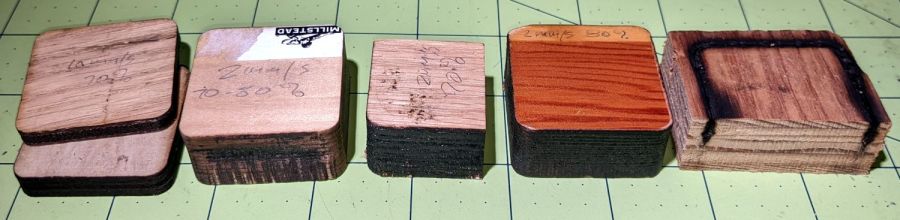
    Yeah, it’s hot-melt glued to a stacked pair of laser-cut cardboard plates. Fight me.

    The white square of retro-reflective tape came from its previous life as a test item.

    The black cardboard makes it rather low-key from the outside:

    OMTech laser - improved electronics fan - grille
    OMTech laser – improved electronics fan – grille

    I reused the original grille, mostly because otherwise I’d have to put it somewhere else.

    The anemometer suggests 5 m/s airflow an inch from the grille. Rounding downward from the 25×35 mm opening says it’s pulling 9 CFM from a compartment with a little over a cubic foot of free volume, which sounds enough good to me. For whatever it’s worth, this airflow calculation disagrees with all of the specs and my handwaving calculation in that old blog post.

    The cabinet hatch has slits distributing the incoming air over all the active ingredients (somewhat visible inside behind the flash glare):

    OMTech laser - improved electronics fan - hatch
    OMTech laser – improved electronics fan – hatch

    The SVG image as a GitHub Gist:

    Loading
    Sorry, something went wrong. Reload?
    Sorry, we cannot display this file.
    Sorry, this file is invalid so it cannot be displayed.
  • Duct Fan: Pipe Flow Test

    Duct Fan: Pipe Flow Test

    A crude test setup to measure the duct fan’s air flow against resistance from plausible lengths of 6 inch duct and fittings:

    Duct fan test setup
    Duct fan test setup

    The orange stripe (upper left corner) marks the blast gate mounted on the steel plate closing off the fireplace: when the stripe is visible, the gate is open. It’s hot-melt glued into a plywood square reducing the 8 inch hole in the plate.

    I won’t be using five feet of steel duct, but [handwaving] it’s what I have on hand and should produce results similar to a shorter length of flexible duct [/handwaving].

    A useful conversion factor from the anemometer’s air flow in meter/sec to the corresponding volume flow in ft³/min (colloquially CFM), based on a 6 inch diameter opening with uniform airflow:

    38.6 ft³·s/m·min =  0.196 ft² × 3.28 ft/m × 60 s/min

    The air flow up the chimney depends strongly on basement temperature, outdoor temperature, and wind speed. On a midwinter’s calm-but-freezing evening it ran around 1.5 m/s → 57 CFM and the next day I measured 0.7 m/s → 27 CFM with wind gusts pooting old-fireplace smell into my face.

    A picture being worth a kiloword:

    Vent fan CFM
    Vent fan CFM

    The upper line is the duct fan mounted as in the picture and the lower line is the bare fan as measured on the bench.

    One might reasonably conclude something has gone horribly wrong, as the ductwork seems to contribute negative resistance and increased airflow. I think it’s a combination of the natural flow up the chimney, combined with a bit of flow straightening through the pipe directing air into the fan’s blades and measuring the (mostly uniform) inlet stream instead of the (somewhat segmented) outlet stream.

    Anyhow, the controller has eight speeds with surprisingly linear output. I doubt the upper line’s slope of 50 CFM/click means anything, but the consistency of both suggests a 4:1 flow range, from which I can pick the lowest speed that provides enough fume extraction.

    The basement has enough air leaking in (and out) that opening the exterior door had no discernible effect on the flow through the fan and up the chimney. At top speed the fan will produce two air changes per hour, chilling the basement something awful in the winter and introducing too much warm+moist air in the summer. This may call for a separate duct for outdoor makeup air, but that’s a problem for another season.