The Smell of Molten Projects in the Morning

Ed Nisley's Blog: Shop notes, electronics, firmware, machinery, 3D printing, laser cuttery, and curiosities. Contents: 100% human thinking, 0% AI slop.

Category: Recumbent Bicycling

Cruisin’ the streets

  • Tour Easy + BOB Yak = Useful Cargo Capacity

    Tour Easy + BOB Yak Leaf Hauling
    Tour Easy + BOB Yak Leaf Hauling

    As mentioned there, I use a BOB Yak trailer to tote stuff that doesn’t fit into the panniers on my Tour Easy recumbent bike.

    We shred dry autumn leaves, bag up the chips, store the bags under a tarp beside the garage, and then Mary mulches the weeds to death in her gardens in the spring. I usually haul a pair of bags to the garden when we ride out for groceries: never waste a trip.

    The Yak’s rear fender is a nice stiff aluminum arch with stout steel stays, built to take exactly this sort of abuse. The trailer is utterly reliable and tracks perfectly: highly recommended.

    It does turn the ‘bent into a 12-foot-long vehicle, so urban assault riding is pretty much out of the question. On the other hand, nobody begrudges me a parking space of my very own. Which is a good thing, as puny little bike racks quake at my approach.

    This looks scarier than it really is, although having the center of gravity up that high does tend to make the trailer shimmy a bit over 20 mph… which speeds I reach only going downhill.

    Update: I have a pair of Nashbar cargo nets (their deep links rot quickly, so site-search for net) to hold bulky stuff in place. One normally does the deed, but some loads demand both!

  • Tone Encoding/Squelch vs. APRS Packet Reception Reliability

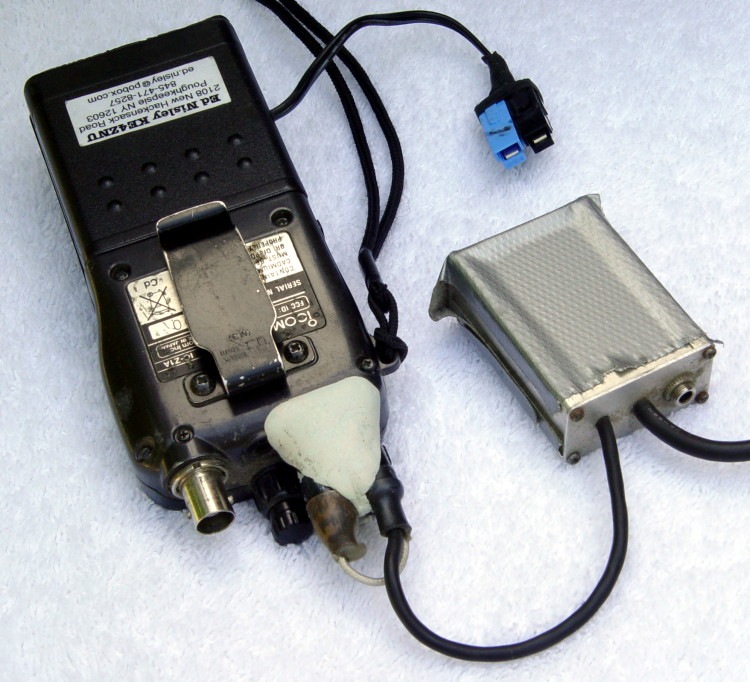
    We’ve been using ham radios on our bikes for years, but last year I put together an interface that connects a TinyTrak3+ GPS encoder to the helmet mic amp. This year I’m building two more, about which I’ll write later.

    The problem is that listening to APRS data bursts isn’t all that pleasant, although it’s bearable, but it’ll get much worse when we use 144.39 MHz as our intercom frequency so we can both talk and be tracked: we’d hear all the APRS traffic within digipeater range.

    Now, admittedly, talking on 144.39 isn’t standard. The local APRS wizards have given tentative approval, as we can’t figure out a better way to talk, give position reports, and not carry two radio / battery / antenna / electronics packages on each bike. As long as we don’t do a lot of yakking, we shouldn’t interfere with the digital traffic very much… and we don’t do a lot of talking while riding.

    So I figured I’d send a 100 Hz tone under the audio and enable tone squelch, so we wouldn’t hear packets from anybody else. We’d still hear each other blatting away, but if I set the TT3+ encoders to send a position report every 10 minutes, it ought to be bearable.

    The catch with this is that some receivers / APRS decoders can’t handle subaudible tones. I considered Digital Coded Squelch, but one of our radios doesn’t include that feature, alas.

    To get some idea of how tone would work with the APRS setup around here (which is where we do most of our riding), I set up an HT on the bench with the TT3+ and my interface. The antenna is an HF/VHF discone, indoors, on the basement floor, beside a window. The GPS receiver can see a slice of sky from its perch just outside the basement window under an awning. That’s about as terrible a setup as we have on our bikes: low power, bad antenna, obscured line-of-sight.

    Each test ran 10-14 hours, the TT3+ sent a packet every 5 minutes, and I checked the raw packet results on aprs.fi.

    With tone off and the TT3+ waiting for 3 seconds of audio silence before transmitting, 39% of the packets got through to the APRS-IS backbone.

    With tone on and, thus, the TT3+ unable to hear / avoid other traffic, 47% of the packets got through on one test and 42% on another. The higher rate was overnight, when (I think) there’s less traffic on 144.39.

    Putting the gadgetry back on the bike, parking it beside the garage, and letting it run for 5 hours on a Saturday afternoon showed that 81% of the packets made it to the backbone. Some of the packets were received by stations over 30 miles away, which probably coincided with the the closer receivers hearing transmitters hidden from the more distant ones.

    The only conclusion I can come to is that tone squelch isn’t going to hurt anything around here, where the APRS wizards have done a great job of getting the decoders to cope with subaudible tones. How it’ll work elsewhere is up for grabs, but we’ll burn that bridge when we come to it.

    And it turns out that the radios take about half a second to wake up and activate the audio output with tone squelch enabled, so we don’t actually hear the data bursts: they’re almost always finished and we may hear dead air for a fraction of a second. Because the TT3+ can’t do collision avoidance, we sometimes hear other packets from other transmitters before the squelch closes again, but it’s not objectionable. Whew!

    Update: with the TT3+ set to transmit every 3 minutes, it works fine!

  • BOB Yak Trailer: Storage Thereof

    Grocery Hauling Setup
    Grocery Hauling Setup

    Bicycles, in general, aren’t set up for heavy load carrying, so I use a BOB Yak trailer for groceries, garden goodies, recycling, dead PCs, and this and that and the other thing. It works surprisingly well, tracks nicely, and tends to push cars another half-lane to the left.

    Word: if you want plenty of clearance in traffic, haul a 20-pound propane cylinder in your bike trailer!

    Anyhow, storing the trailer is a bit of a nuisance, as it’s not particularly stable on its own and takes up a remarkable amount of floor space.

    BOB Yak on garage door rail
    BOB Yak on garage door rail
    BOB Yak hanging against shelves
    BOB Yak hanging against shelves

    I finally figured out that it would hang neatly from the garage door tracks, just beyond where the door stops at the top of its travel. There’s a set of shelves against the wall, filled with the usual crap found on garage shelves (well, maybe you don’t have beekeeping supplies, but you get the idea), so the trailer isn’t blocking anything really important.

    I lean my bike against those same shelves and the trailer hangs neatly between the seat and the fairing. The ladies’ bikes are just out of sight to the right.

    We have a two-car garage that’s the right size for one minivan and three Tour Easy recumbents…

  • Byonics TinyTrak3+ GPS Power Control

    GPS power from MOSFET relay
    GPS power from MOSFET relay

    The Byonics TinyTrak3+ GPS encoder has a “Power Control” output that can switch the power to a radio or GPS interface. J6 provides the interface: pin 1 = common, pin 2 = high active.

    With the “Power Switch” option enabled in the config program, you can set the number of seconds to allow the GPS unit to get up to speed before the next scheduled transmission.

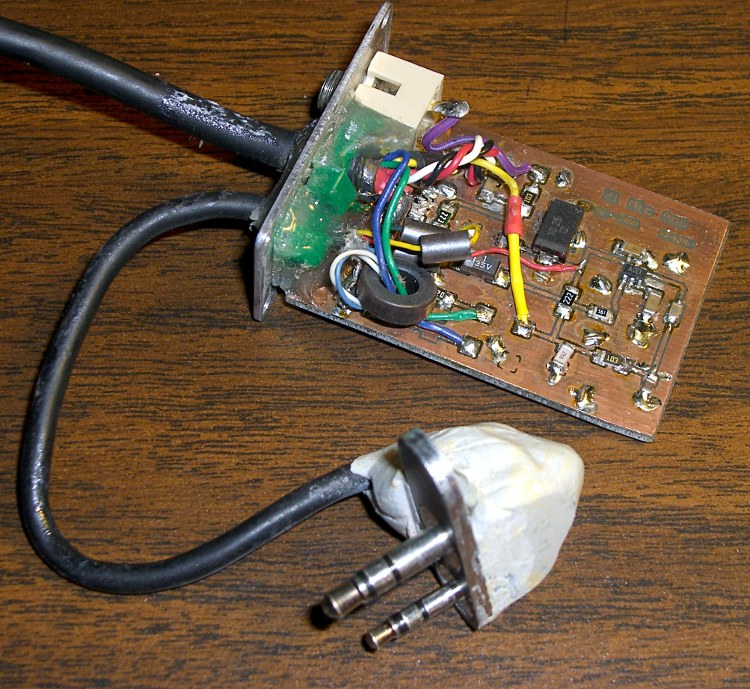
    I glued a surface-mount MOSFET relay to the back of the PCB with urethane adhesive; it fits neatly between the DIP microcontroller’s pins with one output lead soldered to the 5V pad of J7. The other lead goes to the center +V pad; because the relay uses back-to-back MOSFETs, the polarity doesn’t matter.

    That replaces the normal solder bridge across J7 that provides power (on pin 4) to the GPS2 plugged into the DB9 connector. When the relay’s on, it connects the GPS to the power supply. When it’s off, the GPS goes dark.

    The relay input is an LED with a forward drop of 1.3 V max and requires 4 mA to turn on: figure 3.7 V / 4 mA = 925 Ω max. I kludged an 890 Ω resistor by paralleling (stacking!) 1.5 k and 2.2 k resistors; you could probably use anything near that and it’d work fine.

    The relay is an OMRON G3VM-21GR1, part number A11171 from Electronics Goldmine, but I suspect any teeny little solid-state relay would work. The max on resistance is about 1 Ω and the receiver draws about 65 mA. I measured about 20 mV of drop, so the actual resistance is a lot lower than the spec.

    I initially set the power-on delay to 10 seconds, which seemed to be OK: the GPS (green) LED would blink a few times, then go solid. Alas, the warm-start spec for the Byonics GPS2 (see the GPS3 for details) receiver is really 38 seconds, average, and it was definitely producing bogus position data. So I set the delay to 60 seconds and we’ll see how that works; early reports indicate the coordinates still have plenty of jitter.

    [Update: 60 seconds is iffy. 90 seconds seems to work pretty well. A bit of rummaging says that the satellites broadcast their ephemeris data every 30 seconds, so 90 seconds allows for two complete update cycles. Maybe 100 seconds would be even better. Some old background info for Garmin hand-held receivers is there.]

    It’s obviously a tradeoff between accuracy and battery life. This is for use on a bicycle and, believe me, I don’t want to tote a huge battery!

    If the control signal was low-active, then you could use a cheap PNP transistor as a high-side power switch.

    The white/orange wire routes regulated 5 V through an otherwise unused pin to the homebrew interface that combines the GPS data with helmet mic audio. The tiny rectangle is a 1 µF cap that helps cut down digital noise. There’s no need for a connector on that end, as it’s wired directly to the interface circuit board inside a small enclosure.

  • Tour Easy: Fitting Novara Transfer Bike Panniers

    Mary recently replaced her well-worn REI packs with a pair of Novara Transfer panniers, chosen because they’re just about the biggest packs available without insanely specialized world-touring features. They seem rather less rugged than the older ones, so it’s not clear how long they’ll last.

    They fit her Tour Easy recumbent fairly well, but there’s always a bit of adjustment required.

    Ramp on front edge of lower clamp rail
    Ramp on front edge of lower clamp rail

    She hauls tools and clothing and veggies to & from her gardens, food from the grocery store, and the Token Windows Laptop to presentations. She brings the packs inside, rather than leave them on the bike, so they get mounted & dismounted for every ride.

    The packs hang from the top bar of the rear rack, with a sliding clamp near the bottom of the pack that engages the rack’s vertical strut. I adjusted the clamp to the proper fore-and-aft position, but we found that the front end of the rail holding the clamp jammed against the seat support strut. That’s not a problem found on a diamond-frame bike.

    The top picture shows the solution: Mr Pack, meet Mr Belt Sander. A ramp chewed onto the front end of the rail lets it slide neatly over the strut and all is well. The only trick was to avoid sanding through the pack fabric: the line perpendicular to the rail is sanding dust, not a gouge!

    Acorn nut caps inside pack
    Acorn nut caps inside pack

    Each top rack hanger mounts to the plastic pack frame with three bolts covered by plastic acorn nuts on the inside; the acorns cover actual metal nuts, so it’s a lot more secure than it looks. Three more bolts secure the bottom rail to the frame, with three more acorns poking into the pack, for a total of nine acorn nuts.

    Most folks carry clothing and suchlike in their packs, so the 10 mm bump at each acorn presents no problem. Unfortunately, those things look like a nasty bruising hazard for soft veggies and groceries.

    Top hanger pad - outside view
    Top hanger pad – outside view

    I sliced up some closed-cell foam packing material (everybody saves some of that stuff, right?), punched holes at the appropriate locations, and tucked the pads over the acorns. An inner fabric layer covering the frame and nuts should hold the pads in place.

    Bottom pads with hole punch
    Bottom pads with hole punch

    It’s not clear the bottom pads will stay in position, but I wanted to try this without adhesives, mostly because I doubt any adhesive can secure polyethylene foam to whatever plastic the pack frame is made from or coated with. Perhaps double-sided foam tape will work?

    Top pad - with tools
    Top pad – with tools

    So far, the early reviews are good …

  • Tour Easy Coily Lock Holder

    Coily-cable bike lock holder
    Coily-cable bike lock holder

    Although I’m pretty sure nobody would think of stealing my Tour Easy (“How long did it take you to learn to ride that thing?”), it’d be a shame to be wrong. So I carry a coily-cord lock and lash the bike to a post or, for lack of anything better, the front wheel to the frame.

    If they can figure out how to get the back wheel out in less than ten minutes without a work stand, they’re a damn sight better mechanic than I!

    Anyhow, the trouble with a coily lock is that it’s far too heavy and sinks to the bottom of whatever pack you put it in, crushing the groceries on the way down.

    So I built a small plate, tucked into the corner above the bottom bracket, to hold the lock out of the way and within easy reach.

    dsc03596-lock-holder-right
    Lock holder – right side

    It’s a 1/16-inch aluminum plate held to the bike frame with a pair of padded clamps. I applied a hole saw to the middle to get a way to lash the lock to the plate with two more of those ubiquitous Velcro straps.

    The 2.5-inch 10-32 machine screws support the cable coils; the lock already has a plastic coating, so I didn’t bother putting any padding on the screws. Nuts on both sides compress the clamps and support the plate.

    The small aluminum plate sticking up prevents the lock coils from pressing the brake cable against the frame. If you forget that, your back brake won’t release completely.

    Lock holder - left side
    Lock holder – left side

    There’s nothing fancy on the left side…

    Put Loctite on the threads under the nuts to ensure nothing rattles loose!

    The black cable taped to the top frame tube carries the push-to-talk button back to the amateur radio behind the seat. That’s a story for another time.

  • Recumbent Bicycle Chain Catcher

    Chain catcher
    Chain catcher

    You’re puffing up a serious hill, finally downshift to the smallest chainring, and the chain falls off on the inside. You’re already at stalling speed, so you stop abruptly and gracelessly. If you haven’t used up your weekly luck allotment, you neither fall over nor get rammed by the rider behind you.

    Not to be endured, sez I.

    The solution is the Chain Catcher from Bike Tools Etc. It normally attaches to the seat tube of diamond-frame bikes and prevents the chain from falling off inside the smallest chainring, but it works fine on ‘bents, too.

    Alas, their smallest Chain Catcher, part number CC-04A, fits a 28.6 mm seat tube: it’s much too large for the 1-inch tube on a Tour Easy.

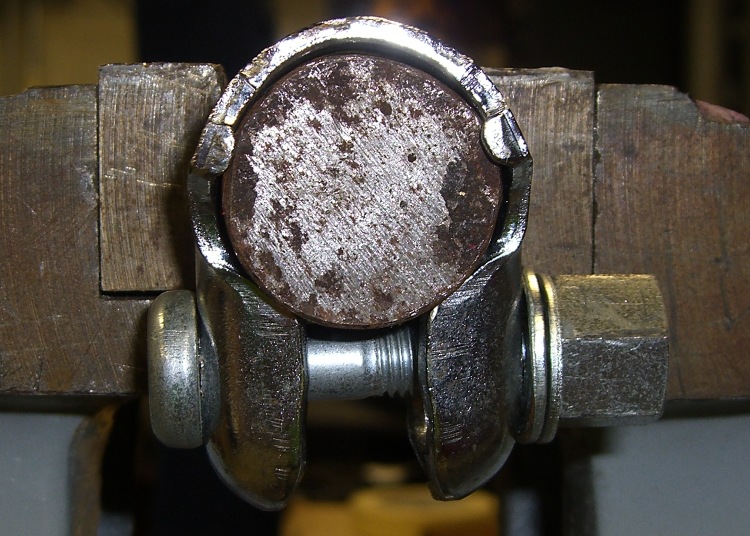
    Never fear! Go to your local home-repair store with ruler in hand and examine the plumbing aisle’s plastic fittings. I used a sink drain tailpiece, but any tube with an outside diameter over 1-1/4” and 1/16” walls will work. Buy one, take it home, cut off a ring as wide as the Chain Catcher with a saw or a razor knife, and smooth the edges. Cut the ring lengthwise, slip it over the bike tube, mark the spot where the ends cross, remove it, and trim to fit neatly on the tube.

    If you make a mistake, you have spares aplenty…

    (This is trivially easy with a lathe, but you need not go full-on geek for this project.)

    Install the Chain Catcher over your shim with its thumb pointing forward and align it with the chain’s rivets, not quite touching the chain on the smallest ring. Firmly tighten the Catcher’s mounting screw.

    This won’t fix a badly adjusted front shifter, but it does eliminate those occasional glitches.

    Ride on!