Ed Nisley's Blog: Shop notes, electronics, firmware, machinery, 3D printing, laser cuttery, and curiosities. Contents: 100% human thinking, 0% AI slop.
We spent four days biking along the Pine Creek Valley rail trail with a Rails-to-Trails Conservancy group ride on our Tour Easy recumbent bikes. Because a crushed-stone path creates a lot of noise that the fairings direct right into our ears and because we weren’t going very fast, we left the fairings at home. As a result, the bikes were wonderfully quiet.
Some years ago, Mary sewed up “bubble wraps” to store our fairings on those rare occasions when they’re not on the bikes. She had some red flannel left over from another project and a hank of cheery Christmas-themed edging, so they turned out to be rather conspicuous.
The trick is to get the size right when the fairing is rolled up. With the fairing in its natural bubble shape, the wrap is rather limp, so you need pockets on both ends to hold the wrap in place. The toes are, she admits, an affectation, but didn’t take much figuring to get right. The width is just slightly more than the fairing’s flat width; you find that by rolling it up and measuring the roll.
She actually made a paper template first to sort out all the curves, then transferred that to the flannel for final cutting.
Tuck in the fairing’s head & toes, roll it up toes first, tie the (attached) strap in a neat bow, and it’s done!
We have three fairings and they roll up together, each in its own wrap, into one tidy, albeit rather heavy, package.
We’ve been using Cateye Astrale “computers” on our bikes for decades, mostly to get the cadence function. After all this time, we pretty much know how fast to pedal, but old habits die hard.
The cadence sensor counts pedal revolutions per minute, which requires a magnet on the crank arm. They provide a small plastic-encased magnet with a sticky-tape strip that’s worked fine on our previous crank arms.
Our daughter’s Tour Easy arrived with fancy curved pedal crank arms that put the cadence sensor magnet much too far from the frame. You really want the magnet & sensor close to the bottom bracket so that it doesn’t get kicked and doesn’t snag anything as you pedal, but that just wasn’t going to work out here.
A turd of JB Weld epoxy putty solved the problem: mix up a generous blob, shape it into a pedestal, glom the magnet atop it, adjust so the magnet is parallel to and properly spaced from the sensor, then smooth the contours a bit.
Add the cable tie for extra security; you don’t want to lose the magnet by the side of the road!
The black electrical tape is mildly ugly, but serves the purpose of keeping the cable from flapping in the breeze. The adhesive lasts about a year, then it’s time for routine maintenance anyway.
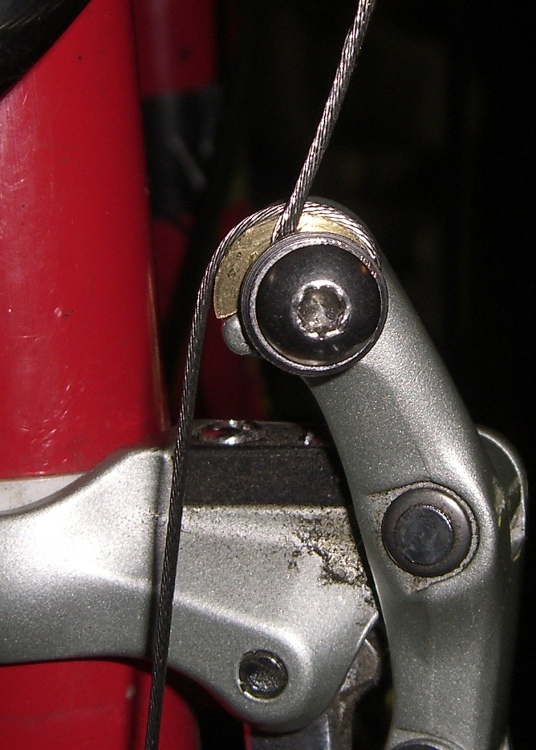
Although recumbent bikes use ordinary bicycle components, they tend to have somewhat different frame geometries (to put it mildly). Our Tour Easy ‘bents seem to put a particular strain on the front derailleur cables, perhaps because the cable enters from a different angle than the derailleur designers expected. The little finger that’s supposed to guide the cable actually concentrates all the bending force at one spot… precisely where the cable breaks.
If you look carefully, you’ll see a little brass disk (between the derailleur body and cable) that cradles the cable. I made that for the previous derailleur, but this one has Yet Another Geometry. I know there’s a difference between “high pull” and “low pull” front derailleurs, and perhaps this is the wrong one for this application, but there seems no algorithmic way to sort this stuff out.
Cable guide pulley
The solution is to make Yet Another Cable Guide Pulley, with a groove around the perimeter, an off-center hole, and a notch to clear the finger. It’s not exactly a pulley, but I’m not sure what else to call it. Maybe just a cable guide?
This was a quick-and-dirty manual lathe project, two days before leaving on a trip: turn down some brass stock, put a groove around the perimeter, part it off, drill a hole, and cut the notch. Not a trace of CNC to be found: all done by guess and by gosh, marked out with Sharpies on the actual part in real time running.
The general notion is that the cable rides the groove smoothly throughout the derailleur’s entire travel range and, thus, doesn’t bend around the finger. This changes the shift geometry just slightly, but, fortunately, long-wheelbase ‘bents have a sufficiently relaxed chainline that indexed front shifting isn’t much of a problem even with slightly misplaced positions. Besides, that’s why SRAM grip-shifter have all those clicky stops, right?
(The shifting is actually a bit goobered, with the outer chainring shift a bit too close to the middle. When we get back, I’ll re-do this with somewhat more attention to detail.)
Pulley in action
Here’s what it looks like in action. I’ve had good success with this sort of thing over the years, so I think this one will work just fine, too. It simply takes one broken cable on each new derailleur to spin up enough enthusiasm for making Yet Another Pulley…
The front ball joint on the mirror on Mary’s helmet loosened enough that the mirror blew out of position every time we got up to a decent traveling speed. I’ve repaired these mirrors several times before; they’re plastic and tend to fracture / wear out / break at inconvenient moments.
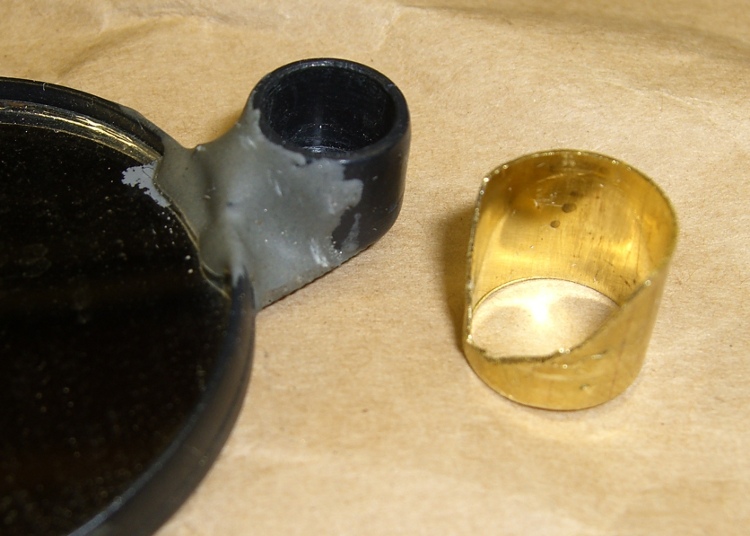
The first pic shows the mirror (the black surface is reflecting the dark floor joists overhead) with an old blob of epoxy that repaired a break in the outer socket. The socket originally had stylin’ curves joining it to the mirror, which proved to be weak spots that required epoxy fortification.
This time the socket split axially on the side away from the mirror, which released the pressure on the ball socket that seats into it. I found a chunk of brass tube that fit snugly over the socket, then carved some clearance for the existing epoxy blob. The key feature is that the tube remains a ring, rather than a C-shaped sheet. to maintain pressure around the socket.
Clamping the reinforcement ring
Here are the various bits, with the reinforcing ring clamped in place. I coated the socket exterior with JB Weld epoxy, slipped the ring in place, and tapped it down with a brass hammer to seat flush with the front face of the socket. That left gaps between the socket opening and the tube that I eased more epoxy into with an awl. A bit more epoxy around the exterior smoothed over that ragged edge.
The strut at the bottom of the picture ends in a ball joint held by a socket that slips into the mirror socket. The loose brass ring above the mirror is some shim stock that I added some years ago to take up slop between the ball socket and the mirror socket and tighten the ball joint. I suppose that pressure eventually split the outer socket, but so it goes.
Repaired mirror joint
The clamp squished the outer socket enough to snug it around the ball socket, so when I reassembled the mirror it was fine. To be sure, I dunked the ball in my lifetime supply of Brownell’s Powdered Rosin for a bit more non-slip stickiness.
I have a box full of defunct bike helmet mirrors, dating back to those old wire-frame square mirrors that clamped onto the original Bell helmets. The newer plastic ones just don’t last; we ride our bikes a lot and even fancy engineering plastic isn’t nearly durable enough. A few bits of metal here and there would dramatically improve the results!
I’m going to build some durable wire-frame mirrors, but … this will keep us on the road for a while. I suppose I should make a preemptive repair on my helmet mirror while I’m thinking of it…
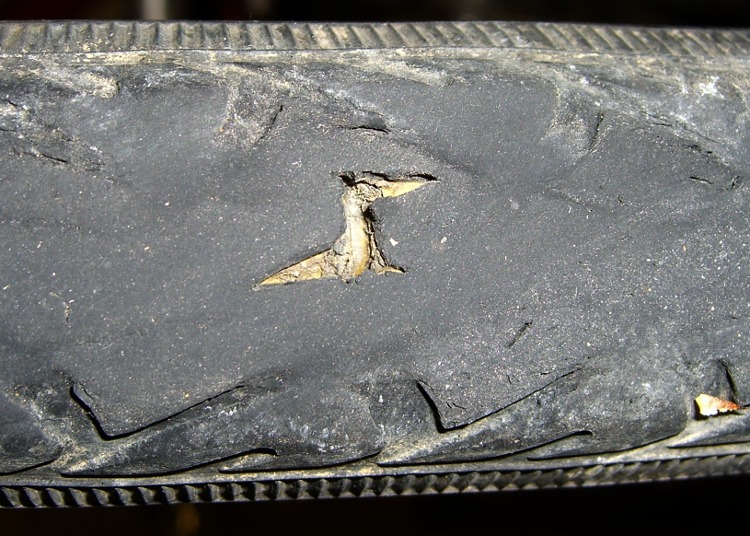
A glass chip gashed the front tire of my bike a while ago, but the slit didn’t cut the Kevlar belt underneath and I let it slide. The pre-ride check before our 50-mile day trip to Old Rhinebeck Aerodrome showed that things had gotten worse (the tire liner was peeking out through the belt), so I replaced the tire before we set out.
Tire liner abrasion
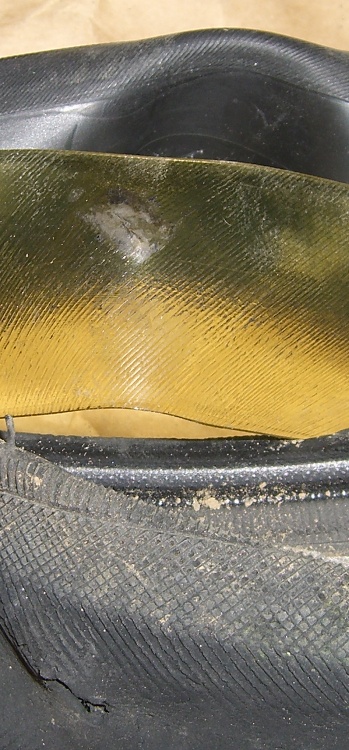
This pic shows that the tire liner was doing its job, although it was slightly abraded and had picked up some road grit. The tube had a barely visible mark.
I generally use fluorescent green Slime tire liners, but this one is a competing brand I picked up a while ago. Not much to choose between the two, although I think Slime liners have a better edge taper and tend to be more flexible.
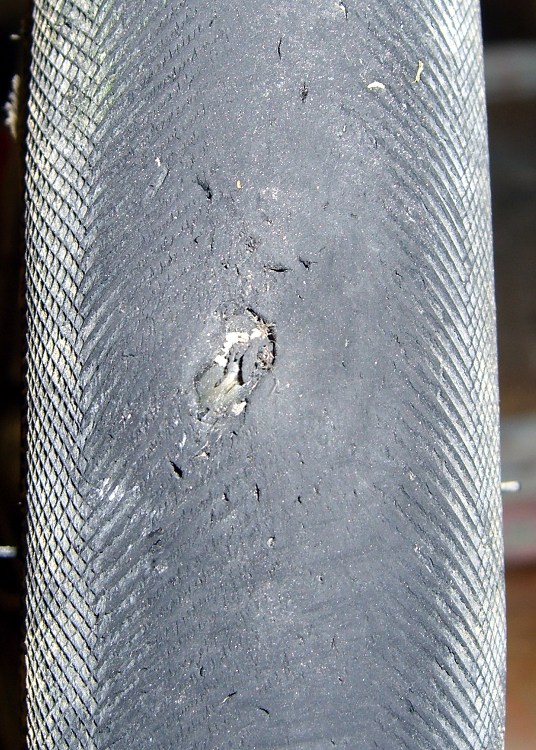
Notice the other nicks and gashes in the tire tread? We run Schwalbe Marathons on the rear and Primo Comets on the front, both have Kevlar belts. Flats are not a problem any more, even with plenty of sharp road debris; I replace the tires every two years or so when the tread wears smooth or a major gash worries even me. My rule of thumb: when I can see the liner, it’s time to replace the tire.
Tread gash – Schwalbe Marathon
There are riders who argue for very lightweight tires on the basis of performance: better acceleration and lower rolling resistance. I’m willing to trade all that off against not having to dismount a tire by the side of the road…
[Update: Plenty more posts on this general subject, with graphic illustrations of tire damage. Search for liner and you’ll find ’em.]
Here’s a quick-and-easy way to improve the odds of your arriving home safely after dark: add snippets of retroreflective tape to the inside of the rims on your bike.
Do half the rim in one color and leave the other half untaped (or taped in a contrasting color) so that the rim flashes as the wheel rotates. I originally applied orange tape, of which I have very nearly a lifetime supply, then added white when I got a sheet as part of a surplus deal.
At 15 mph the 20-inch front wheel blinks at about 4 Hz, which is wonderfully attention-getting. The rear wheel, a more common 700C size, blinks at 3 Hz.
It helps to measure the space between spokes, then set up a template to cut all the tape pieces the same length. Wipe the big chunks of dirt off the rim, then remove the remaining grunge with alcohol so the tape actually sticks.
New York State vehicle law considers reflectorized tires as equal to those in-the-spokes reflectors, which is a Good Thing.
The more you look like a UFO after dark, the less surprised the drivers are and the less hassle you get.
As I mentioned there, we have white LED bike headlights clamped to the amateur radio antennas on our bikes, facing rearward to eliminate the “But, Officer, I didn’t see him” line from the accident investigation. That works fine during daylight hours, but it’s rather blinding after dark and, in any event, taillights are supposed to be red (after 1 Nov 2009, they may also be amber).
The easiest way to get that result, without having to tote along Yet Another Light, is to slip a red filter over the white LED lens. This dramatically reduces the light output, because the yellow phosphor used to get white light out of what’s basically a blue LED doesn’t emit much energy in the red end of the spectrum, but it’s plenty good enough to be seen from the requisite 300 feet.
Amber filters would be a much, much better match to the phosphor and I’ll use them next year when they’re legal.
For what it’s worth, we’ve discovered that the more we look like UFOs after dark, the more clearance we get. The bikes are extensively reflectorized and lighted, plus we have reflective arm and leg bands. If somebody hits us, it’s because they did it intentionally; that’s usually the story with drunks and punks, alas.
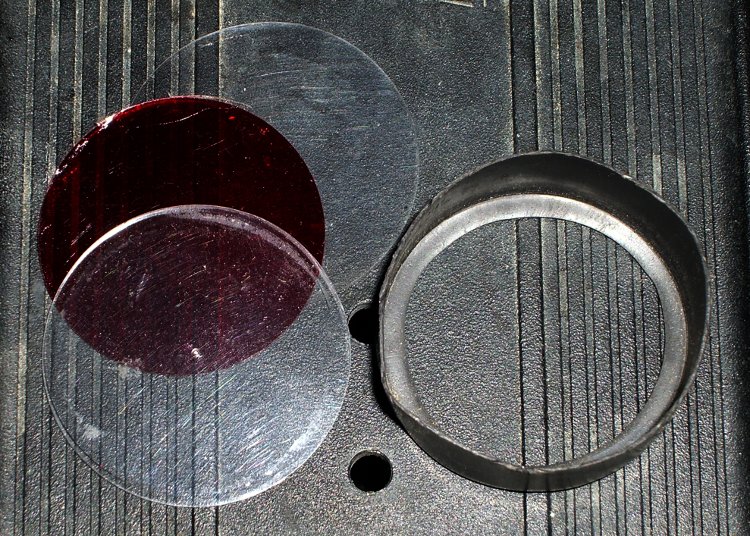
Red filter components
I cut two transparent disks from ordinary electronics packaging material, plus a red disk from the Primary Red filter material mentioned there, stacked them on the headlight, and fired some big heat stink shrink tubing around them. The tubing extended maybe 3 mm past the end of the headlight and shrank into a neat lip that matched the bezel around the lens.
The tool to have for this sort of job is an Olfa Compass Circle Cutter. It leaves a pin prick in the center of the circle, but if you’re gentle that won’t be a problem in this application.
The shrunken tubing will be exceedingly difficult to pull off the headlight, so you may want to wrap a layer of tape around the bezel before shrinking. Peel the tape off when you’re done and the tubing will have a few mils more clearance.
No adhesive on earth will stick to both the polypropylene disks and the heatshrink tubing, but you can try silicone snot if you want. I made the disks just slightly larger than the bezel so that the tubing captures them as it shrinks. These things spend much of their lives in a ziplock baggie, so durability isn’t an issue.
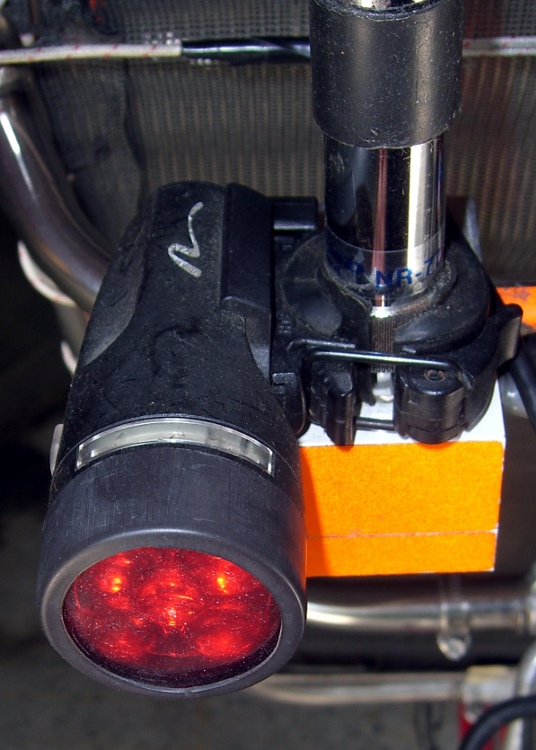
Red filter installed
In any event, the filter looks like this when it’s installed. Because of the odd way I mounted the headlights, the side lenses aren’t visible (and they’re white, not red), but we have plenty of other light visible from the side.
For the straight dope on current NYS bicycle laws, go there, click on the “Laws of New York” link, search for “bicycle”, then click on section 1236. It’s New York’s idea of a useful Web interface: get over it.
The bezels on our lights are beginning to crack, so it’s probably time to start thinking about a killer street-legal day/night amber taillight. High intensity LEDs are dirt cheap these days…