Ed Nisley's Blog: Shop notes, electronics, firmware, machinery, 3D printing, laser cuttery, and curiosities. Contents: 100% human thinking, 0% AI slop.
Every now and then I notice the pedals are getting further away on my Tour Easy recumbent, which means it’s time to snug up the seat lace again. The lace cord has a Kevlar core, so it’s not very stretchy, but over the course of a few thousand miles either it stretches or the seat mesh relaxes.
Here’s the only tool I’ve found that works for this purpose:
Stanley 82-113 Hook Tool: "The Hemorrhoid Picker"
That’s what a friend calls his, anyway.
It’s from Stanley and not in their current website listing, but they do offer the 78-393 – 4 Piece Hook and Pick Set, which looks to have a tool sporting the same hook end with a different (and much smaller) handle. IIRC, I got this one several-many years ago at Wal-Mart; maybe it’s a special-issue part number just for their shelves?
What you do is work your way from the bottom of the seat lacing on one side all the way to the top, pulling out the slack as you go. At the top of that side, pull the accumulated cord into the knot, then start at the bottom of the other side. When you’ve got both sides pulled taut, knot up the slack again and you’re done.
Needless to say, you can give yourself a King Hell puncture wound with that thing…
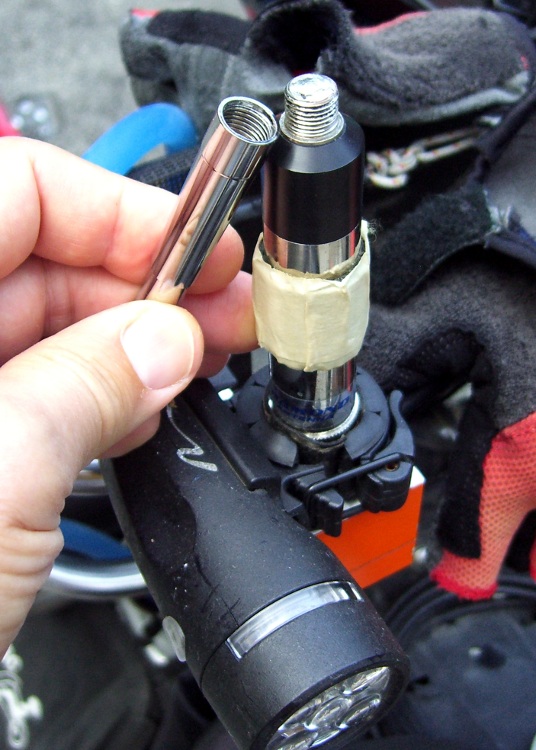
Vibration is a real killer for bike-mounted hardware. The antenna mast on my bike has been unscrewing itself, despite my repeated attempts to tighten it. Fortunately, I’ve managed to notice the rattle before the mast falls off into traffic.
We’ll see if a dab of medium strength (blue) Loctite will do the job.
One thing to worry about: this is an electrical as well as a mechanical joint. I hope there’s still enough metal-to-metal contact to get RF energy to the radiating part of the whip!
[Update: Yup, works just like you’d expect. Problem solved.]
The antennas on the other two bikes have remained tight, so maybe it’s just that my riding style generates more vibration? Hard to imagine; it’s not like I venture off-road.
More details on the homebrew mount are there and how commercial mounts fail are there.
The unsightly masking tape wrap is where I attached a reflector for a (rare) after-dark ride a while ago. Making a set of bushings for the reflector clamps is a low-priority job in the queue right now.
As mentioned there, I have a pair of ERRC’s Easy Reacher underseat packs. They’re supported by an Easy Reacher rack that’s specifically designed for Tour Easy bikes.
Perhaps because I carry dense stuff in the packs, they tend to flop side-to-side. I added a rear strut across the bike frame and a pair of lengthwise plastic (acrylic?) struts to stabilize the packs.
A pair of padded clamps holds the crosswise strut to the bike frame and a washer captures the rear fender’s mounting bracket.
Looks hideous, works fine.
The black tit hanging down from the strut clamp is a bit of heatshrink tubing that cushions the kickstand when it’s up; otherwise, it rattles against the stub end of the aluminum rod.
Yeah, the bike’s pretty grubby. I’d rather ride it than wash it… and, anyway, I follow my father’s advice: “If you have to move it to clean behind it, don’t move it!“
I have a pair of underseat packs on my Tour Easy that have sagged rather badly over the years. That might have something to do with the fact that my toolkit and other odds & ends weighs more than some bike frames; while I don’t need that stuff very often, it’s good to have around.
Tools & suchlike live in the left-side pack, the near one in the photo, and you can see the problem. The right-side pack holds HT batteries, my belt pack, and other relatively lightweight stuff; I’ll fix that one when I see whether this works. The panniers at the rear wheel are for groceries and other bulky items. The trailer, well, that’s how we do groceries…
Broken Pack Backplate
Anyway, the underseat packs have a black plastic (styrene?) backing that cracked under the stress of the stuff inside, allowing the top corners to cave in and the bottom to droop.
The hooks holding the pack to the underseat rack were riveted through the backing sheet and the hardware, but a couple of good shots with a punch broke them free.
Some rummaging in the Parts Heap turned up a big acrylic sheet (“100 times stronger than glass!”) that’s absolutely the wrong material for the job: it’s too brittle. However, I’d like to see whether a stiff backplate will solve the problem or if I’m going to have to get ambitious and build an internal pack frame.
Acrylic Plate and Aluminum Stiffener
It’s essentially impossible to get a picture of a project built largely from acrylic sheet, but here goes.
I traced the outline of the old backplate onto the new sheet’s protective paper, introduced it to Mr Belt Sander to get those nice round corners, then drilled the holes. It turns out to not be quite symmetric, so there’s a right way and a wrong way to insert it into the pack.
All the hardware is stainless steel. They used aluminum rivets, which is the only reason I could punch them out without too much difficulty, that I’m replacing with SS 10-32 machine screws & nuts.
The aluminum stiffener is a random chunk of ribbed extrusion from the Heap; the original was almost exactly twice as long as one backplate, so the two halves (one for the other pack) are precisely right. I milled out the center rib around the nuts to get enough clearance for a nut driver.
Stiffener Hardware Detail
Herewith, a closeup of the hardware. There’s an acrylic sheet in there, honest, it’s under the aluminum extrusion and fender washer. Really!
I put an automobile license plate in the bottom of each underseat pack to act as a floor for all the crap inside; it’s an almost perfect fit and should give you an idea of the pack’s size. It also maintains the bottom’s rectangular shape and keeps heavy stuff from sagging; there’s a hole scuffed in the bottom from the intersection of a high curb and just such an oversight.
Tour Easy Underseat Pack Detail
Having washed the pack while it was apart (there’s a first time for everything), it looks a lot better than it did before. The yellow block in the front pocket is the kickstand plate mentioned there. It used to have a mesh pocket along the side, too, but that snagged on something and got pretty well ripped, so Mary trimmed it off when she sewed a patch over the aforementioned hole.
It’s still saggy, but the top corners of the plate are holding it up a lot better now. If they crack again, I might just have to go with some aluminum sheet.
These packs seem to be obsolete. The ERRC Lloonngg panniers (search for them) seem to be, well, too long for most purposes; they look as though they would interfere with ordinary rack packs. If I were doing it over, I’d look into hacking a pair of smallish duffel bags.
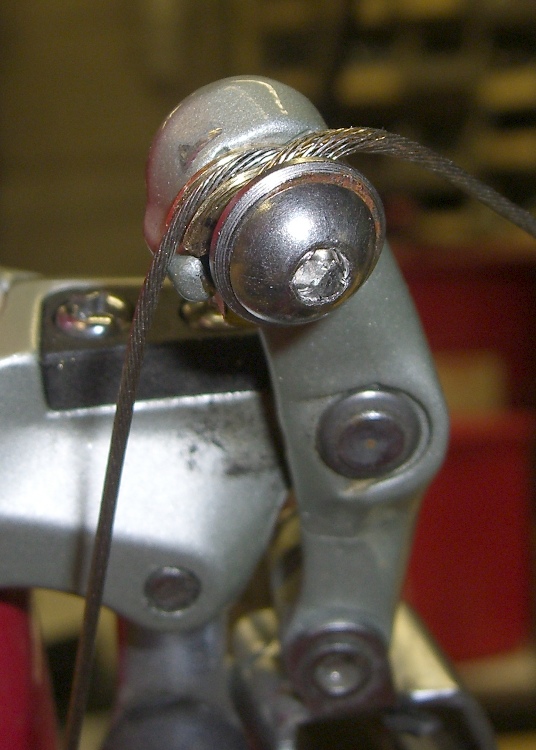
This cable guide / pulley may work better than the one described there, because it puts the cable a bit closer to the original location.
To recap, the problem is that the cable bends around the small finger at about 8 o’clock on the derailleur arm. After a few zillion shifts, the concentration of stress at that point breaks the cable, strand by strand, until it snaps at the most inconvenient moment.
The small brass disk (about 0.43″ dia) has a groove machined around the perimeter that’s roughly the size of the shifter cable. The hole (Number 8 or 9 drill) is a slip fit for the 5 mm bolts, but it’s off-center enough that the cable passes roughly where it would without the disk.
A notch in the side of the disk rests on the finger, guiding the cable over the finger without (I hope) bending it at that point.
The cable just wraps around the screw under the original stainless-steel washer, which pretty much crushes the poor thing flat.
Shift at Large Chainring
Here’s another look with the derailleur pretty much over the large chainring. You can see the disk and groove in action.
This was another quick-and-dirty lathe project, with everything done to eyeballometric accuracy. If it works better than the previous half-assed effort, I might actually get around to making a third one and recording the dimensions.
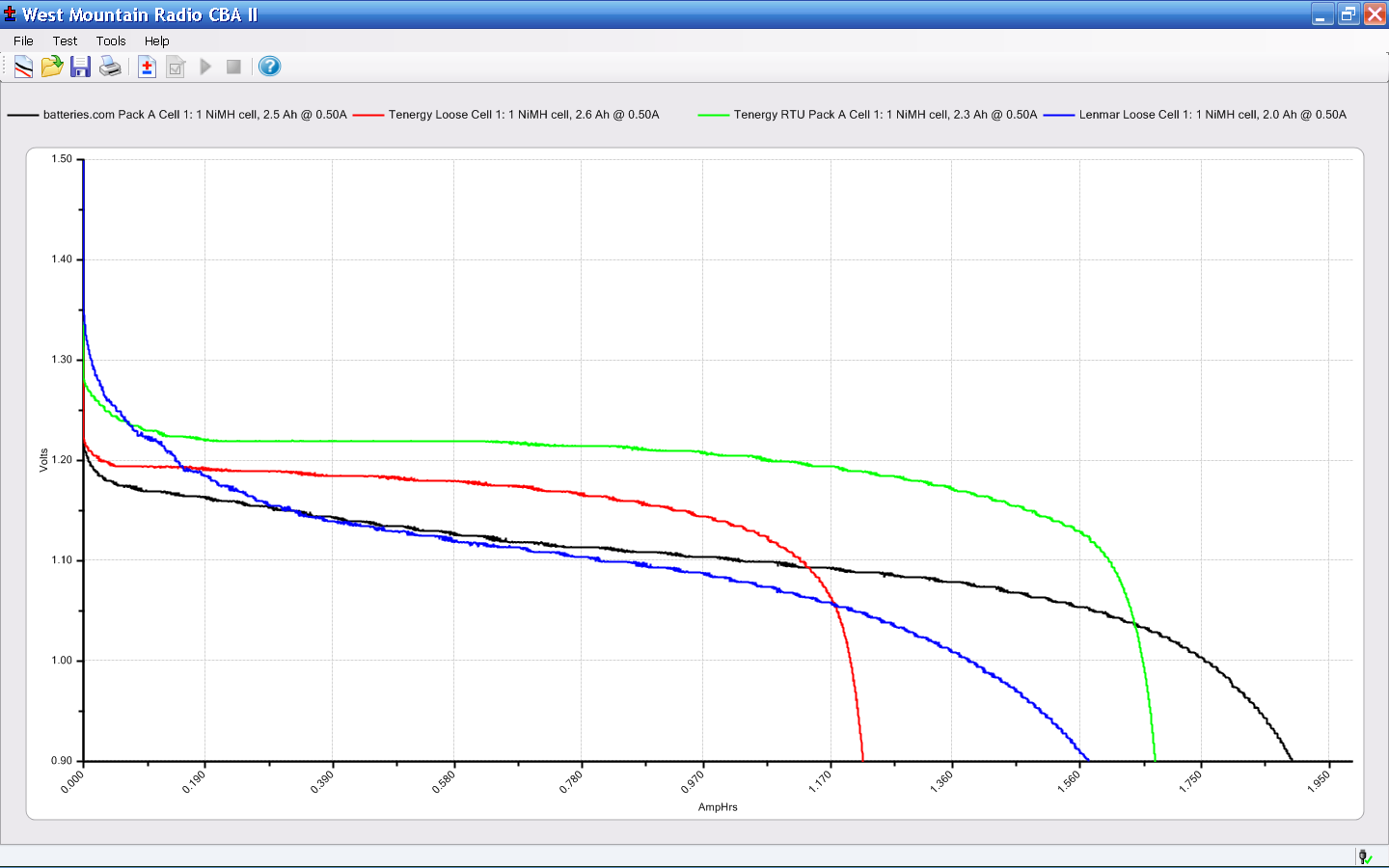
I collected some loose cells and pulled some cells from the packs to see how they compared individually.
These are discharging at 500 mA, rather than 1 A, mostly because there were fewer tests and I could run ’em overnight. Other than the Tenergy RTU cell, they’re all old and wearing out…
Single Cell Comparison – Aug 2009
The green line is a new Tenergy RTU 2.3 Ah cell; it has a higher voltage, but still isn’t delivering anything close to its rating even at a load only slightly higer than C/5. I have three packs of those that will be cycling through the amateur radios on the bikes, but I don’t like the relatively low capacity. I’ll run these eight cells through the fast charger and do some rundown tests to see if they improve; I have my doubts.
The black line comes from an old batteries.com 2.5 Ah cell. It has the highest capacity of the group, but a rather low voltage. I’ll start cycling those through the blinky lights on the bikes.
The red line is a Tenergy 2.6 Ah cell. I think these are a year or two old, so they’re not faring well at all. OK voltage, but very low capacity. I think the batteries.com cells will work better in the lights, as they have 50% more capacity at a slightly lower voltage.
The blue line is an ancient Lenmar 2.0 Ah cell. As a fraction of its rated capacity, it’s doing OK, but the low voltage is a dealbreaker. Scrap.
Given the poor results from the old & new Tenergy cells, I’m not sure quite what to do. The advertised ratings are obviously optimistic, shipping charges pretty much wipe out any incentive to sample a batch of new cells, and cells get reformulated often enough that old tests you find on the web (this one included!) are useless.
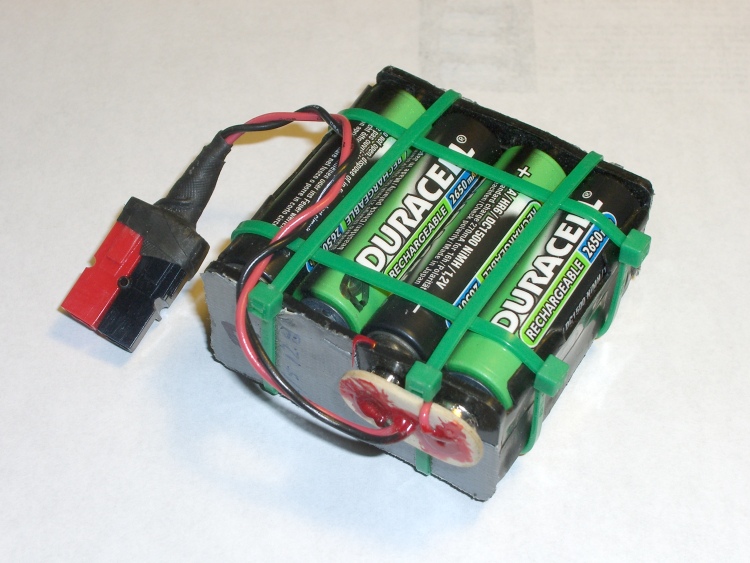
I’ve been using NiMH AA cells to power the amateur radio HTs on our bikes for the last several years, using homebrew 6- and 8-cell packs like this one. In addition, I cycle a handful of loose cells through the LED blinky headlights we use as rear markers.
I don’t lavish much care on the packs, although they generally get recharged before they’re completely flat… if only because the radios automatically enter a low-power mode that takes some fiddling to cancel. They’re charged on a homebrew C/10 charger, typically overnight, and are uniformly warm to the touch when I take them off the charger. Slow charging is reputedly bad for the cells, although everybody seems to agree that fast charging isn’t much better; I have a 4C charger that really puts the screws to 4 cells at once.
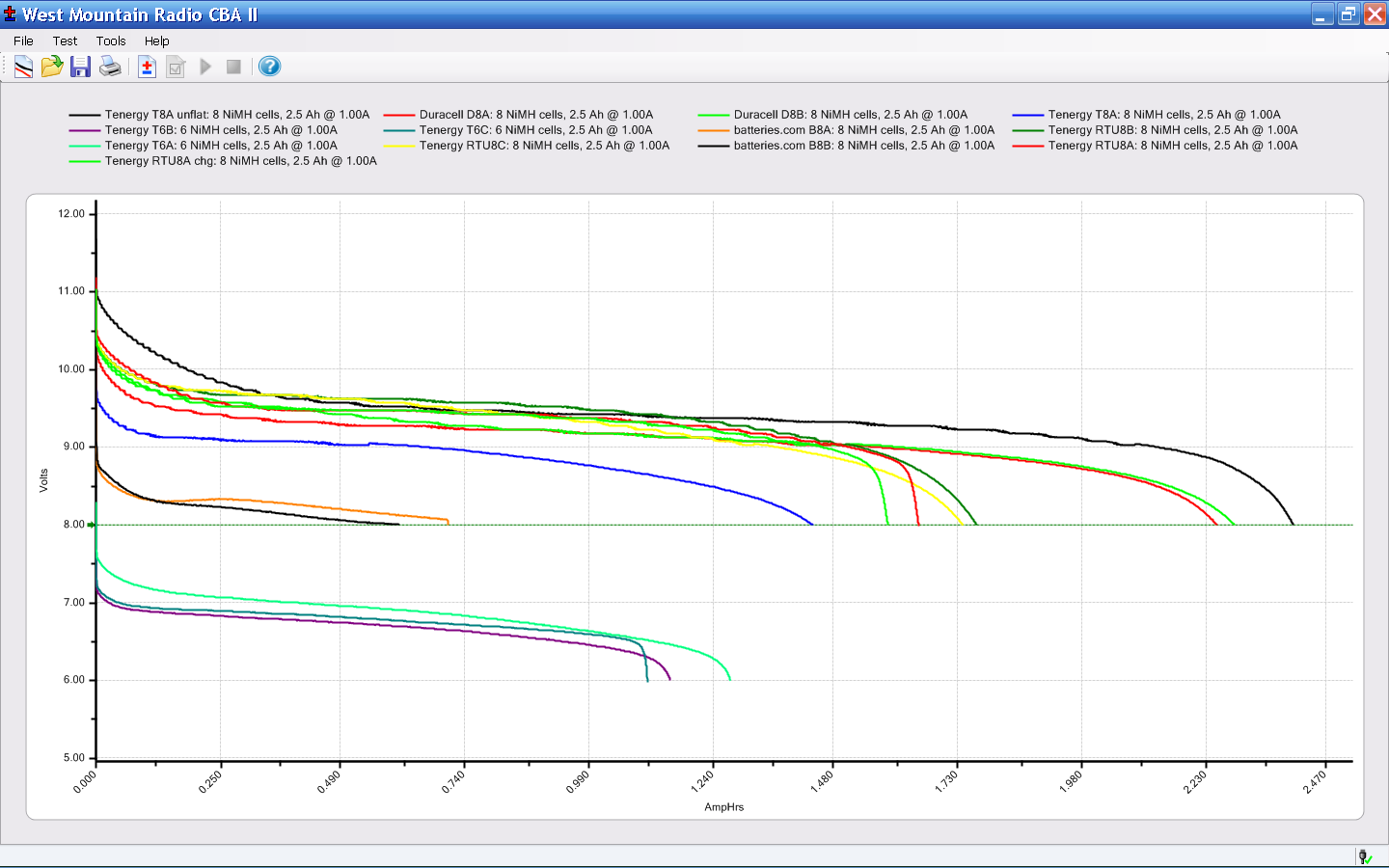
Over time the cells wear out and I’ve recently started figuring out which packs & cells to replace. I’m using a West Mountain Radio CBA II for the tests, running on our Token Windows Laptop. The X-axis divisions are its idea of how to do it; Gnuplot does a better job, but you get the general idea and exact numbers aren’t really important here.
Here’s a screen shot with all the discharge tests in one convenient lump. You’ll surely want to click on it for a legible legend…
Pack Comparison – August 2009
Some observations…
I’m using a 1 A (roughly C/2) discharge rate, because the radios draw about that much during transmit, although they run at 30-100 mA during receive. Battery capacity is inversely related to discharge rate and the usual highly over-optimistic advertised cell capacity is usually based on (at most) a C/5 or a much lower rate.
The shortest curves, the orange & black ones under 0.74 Ah, are two ancient 8-cell packs made from batteries.com cells. The cells actually have decent capacity, but the discharge voltage is much lower than it should be.
The black curve to the far right near 2.47 Ah is a freshly charged set of Tenergy 2.6 Ah cells that had been oops discharged completely flat. Other than this run, the Tenergy cells have been a major disappointment: the 6-cell packs near the bottom are running less than half their rated capacity and the 8-cell pack in blue isn’t much better.
The green & red traces out there to the right at 2.23 Ah are Duracell 2.65 Ah cells that are holding up remarkably well. Recent reviews indicate that Duracell (or whoever owns them these days) reformulated the chemistry early in 2009 and the new cells are crap. These cells are colored black-and-green, which seems to be different than the new ones.
The cluster of traces around 1.73 Ah are three 8-cell packs made from two dozen shiny-new Tenergy Ready-To-Use 2.3 Ah cells. I’m unimpressed so far, although they are still in their first dozen cycles. There’s obviously one weak cell in pack A that causes the abrupt fall-off in the two shortest times, but they’re all pretty much the same.
Given that we have three bikes and I want a backup pack for each bike, that works out to
8 cells/pack x 2 packs/bike x 3 bikes = 48 cells
I’d like to think that spending four bucks per cell bought you better cells, but the Duracell reformulation puts the kibosh on that notion. In any event, you can see this gets spendy pretty quickly…
I’ll run the best of the old cells in the blinky headlights, which run at a 50% duty cycle of 400 mA or so.




 The Smell of Molten Projects in the Morning