Ed Nisley's Blog: Shop notes, electronics, firmware, machinery, 3D printing, laser cuttery, and curiosities. Contents: 100% human thinking, 0% AI slop.
This pic shows that the mirror attaches to the boom through a clever ball joint that allows both rotation around the mirror’s long axis and a slight amount of tilt. Unfortunately, after a few years, the ball stem breaks and at least one of the socket petals snaps. It’s a nice plastic design that’s totally unsuited to a few years of more-or-less daily bicycle travel.
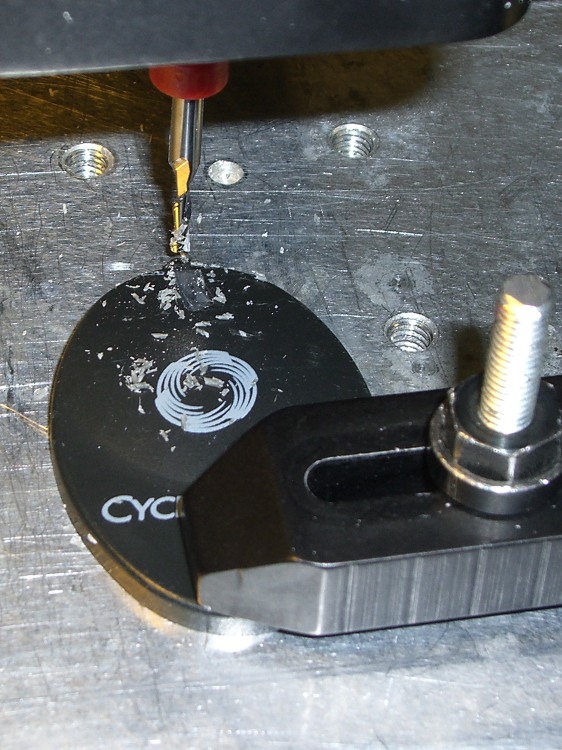
The repair was easy enough, particularly because I think the boom has enough adjustment range to handle the job on its own (and I don’t care about how it looks). I filed off the stem stub and milled a slot for a 2-56 machine screw along the back edge.
Milling slot for screw
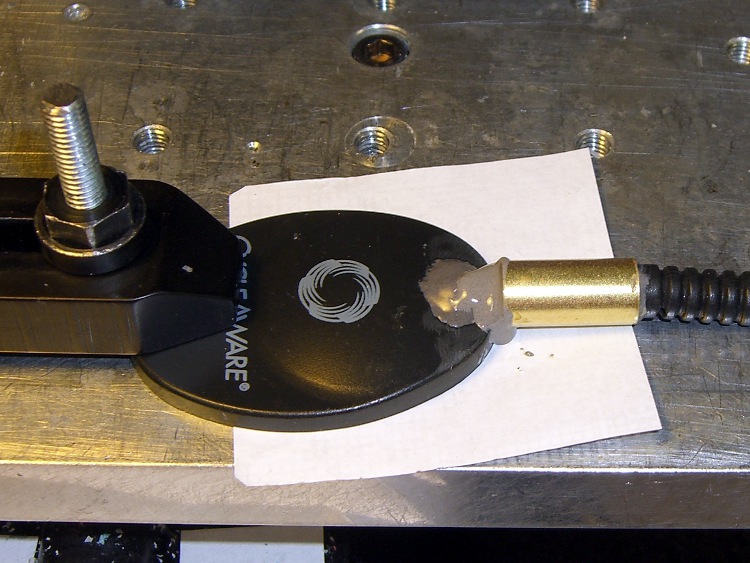
Then you just slide a brass tube from the cutoff box over the end of the boom around some JB Weld epoxy, shove the screw into the blob, align the mirror with the boom, and let it cure.
Reinforced attachment
Although it’s not shown here, the helmet attachment is aligned with the mirror at right angles to the helmet bracket. That puts it in roughly the proper position with the boom bent as usual.
I don’t actually plan to use this one for anything, but if I need a somewhat scuffed mirror in a pinch, well, it’s in the box!
This is my latest attempt to come up with a robust electret mic capsule mount for our bike helmets.
The general idea is to put the capsule in a small brass tube (from my box o’ random cutoffs) soldered to the end of a copper-wire boom lashed to the helmet. The tube provides alignment and physical protection, the boom doesn’t pose a poking hazard, and some decent electrical tape secures the mic cable to the boom.
The mic capsule has back vents that allegedly provide ambient noise reduction, so the brass tube must be open on both ends. This does not implement the “waterproof” part of the spec; I still haven’t figured that out yet.
I annealed a length of 12 AWG copper wire to make it easy to bend around the helmet’s contours; two passes with a propane torch to red heat does the deed. It will work-harden quickly and maintain its shape after that.
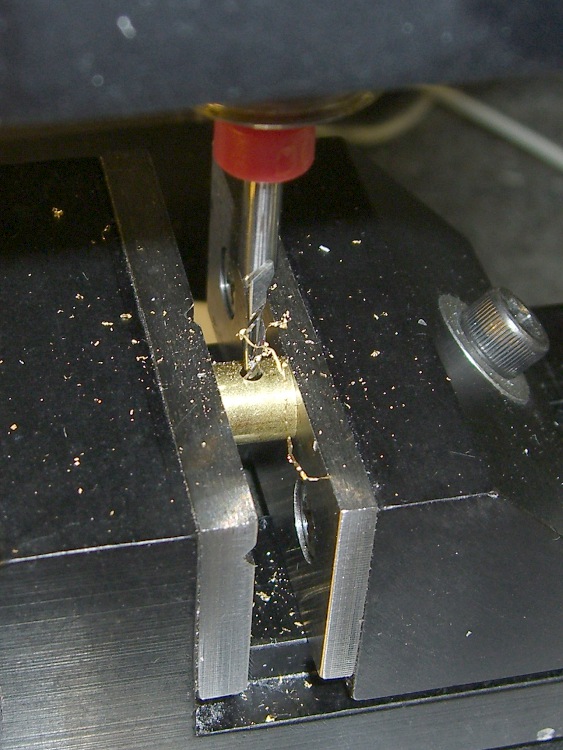
AWG 12 wire is 0.080 inches in diameter, close enough to 2 mm that I poked a hole in the brass tubing with a 2 mm end mill. Filed the end of the wire flat, stuffed it in the hole, fluxed the joint, applied the big soldering gun to the wire, flowed some silver solder, and it’s all good. Fairly obviously, this meets my “the bigger the blob, the better the job” soldering criterion…
Mic rear
The capsule has two layers of Kapton tape wrapped around it to snug up the fit, although I doubt that insulating it from the brass tube makes any difference.
Mic front
The windscreen is a ball snipped from an open-cell acoustic foam sound deadening panel that has contributed myriad mic windscreens over the years. The mic fits into a slit cut with an X-acto knife; no finesse required. The nylon cable tie will disintegrate from sun exposure at about the same time the foam rots away, which takes about two years.
Mic foam windscreen ball
Despite what you might think, the helmet attachment is dramatically less butt-ugly than in years gone by…
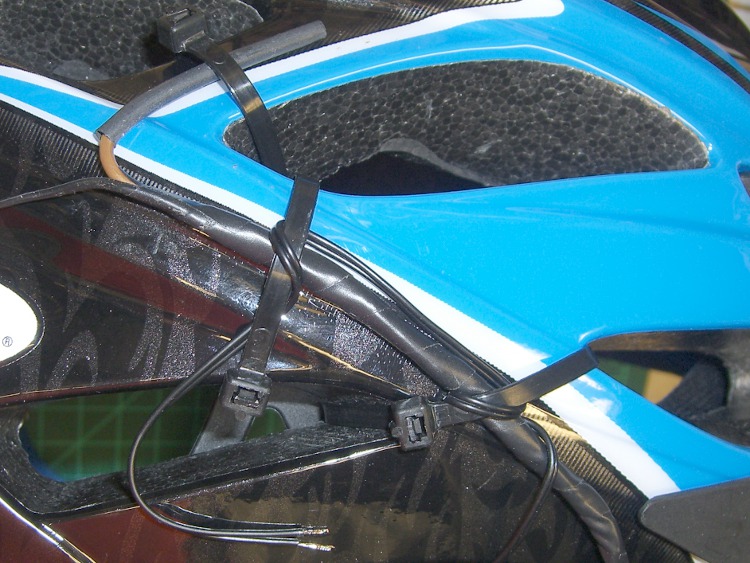
Boom-to-helmet detail
The trick is lashing the bent portion of the boom to the helmet, which prevents the entire boom from rotating around its long axis. That keeps the mic aimed directly at your mouth, regardless of how you bend the boom.
The earbud wire loops around the mic boom a few times, with the first loop over the boom to take advantage of its rounded surface. With any luck, that will delay the inevitable fatigue failure. Mary favors old-style cylindrical earbuds, rather than newer flat or round ones.
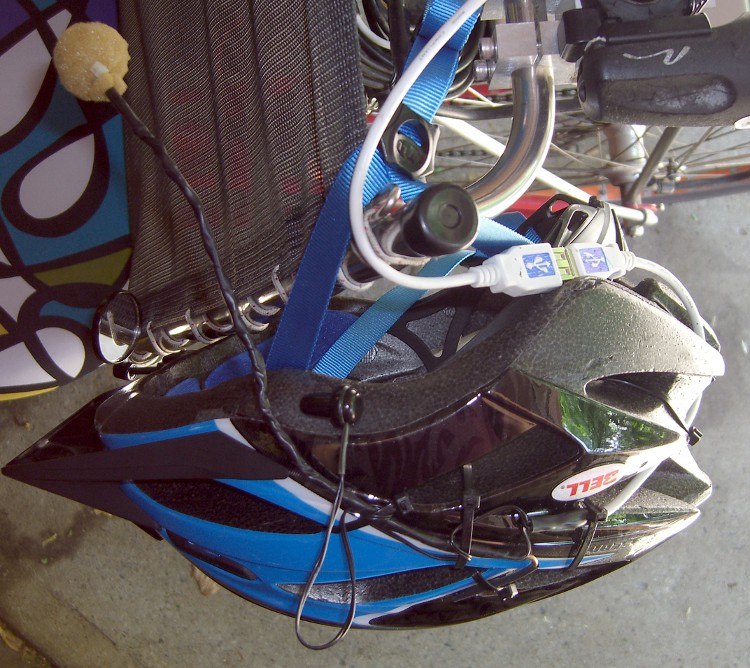
The USB cable (this is not, repeat not a USB headset) gets lashed to various parts of the helmet foam and routed out to the middle of the back, with the male connector a few inches below the helmet. That puts the cable over the back of the Tour Easy’s seat frame, leaving the bulk of the cable hanging behind the seat. The cable length from the female connector to the radio interface is a delicate trade off between being
Long enough to let you stand up and
Short enough to stay out of the rear wheel.
This vertiginous shot looks down at the helmet hanging on the seat of Mary’s bike. Yup, that’s her bright new homebrew seat cover to the upper left…
I’m in the process of reworking the interface box between the amateur radio HTs on our bikes and our helmet-mounted earbud & mic lashup. Mary needed a new helmet before I got the new interface ready, soooo there’s an adapter cable in the middle.
This time around, the helmet cable uses a male USB-A connector, rather than a female 6-pin Mini-DIN PS/2 keyboard connector. Either one is cheap & readily available as assembled cables, which gets me out of soldering teeny little connector pins. These days, though, USB cables are more common.
The motivation for a non-latching, low-extraction-force connector at the helmet is that when (not if) you drop the bike, the helmet doesn’t tie your head to the bike and snap your spine. Falls on a recumbent are much less exciting than on an upright bike, but you still want the bike to go that-a-way while you go this-a-way. Been there, done that.
The old helmet cable connector: female 6-pin mini-DIN. The wire color code is not standardized. Viewed from rear of female connector or the front of the male connector, with the key slot up:
 ear com - Gn   5  |_|  6  K - ear hot
 mic com - Or   3  key  4  Y - mic hot
        gnd - Bn  1   2  R - gnd
The new helmet cable connector: male USB-A. Mercifully, they standardized the wire colors. Looking at the front of the male USB-A connector with the tab down and the contacts up, the pins are 4 3 2 1:
1 – R – ear hot
2 – W – mic hot
3 – G – mic com
4 – K – ear com
The female USB-A connector is exactly the same.
That arrangement should produce the proper twisted pairs in a USB 2.0 cable, but all the USB cables I’ve seen so far lay all four wires in a common twist inside the shield. Maybe it’s the cheap junk I buy, huh?
It’s worthwhile to scribble some color in the background of the trident USB symbol so it’s easier to mate the connectors.
Easy-align USB connectors
Memo to Self: verify the connections & proper operation before shrinking the tubing!
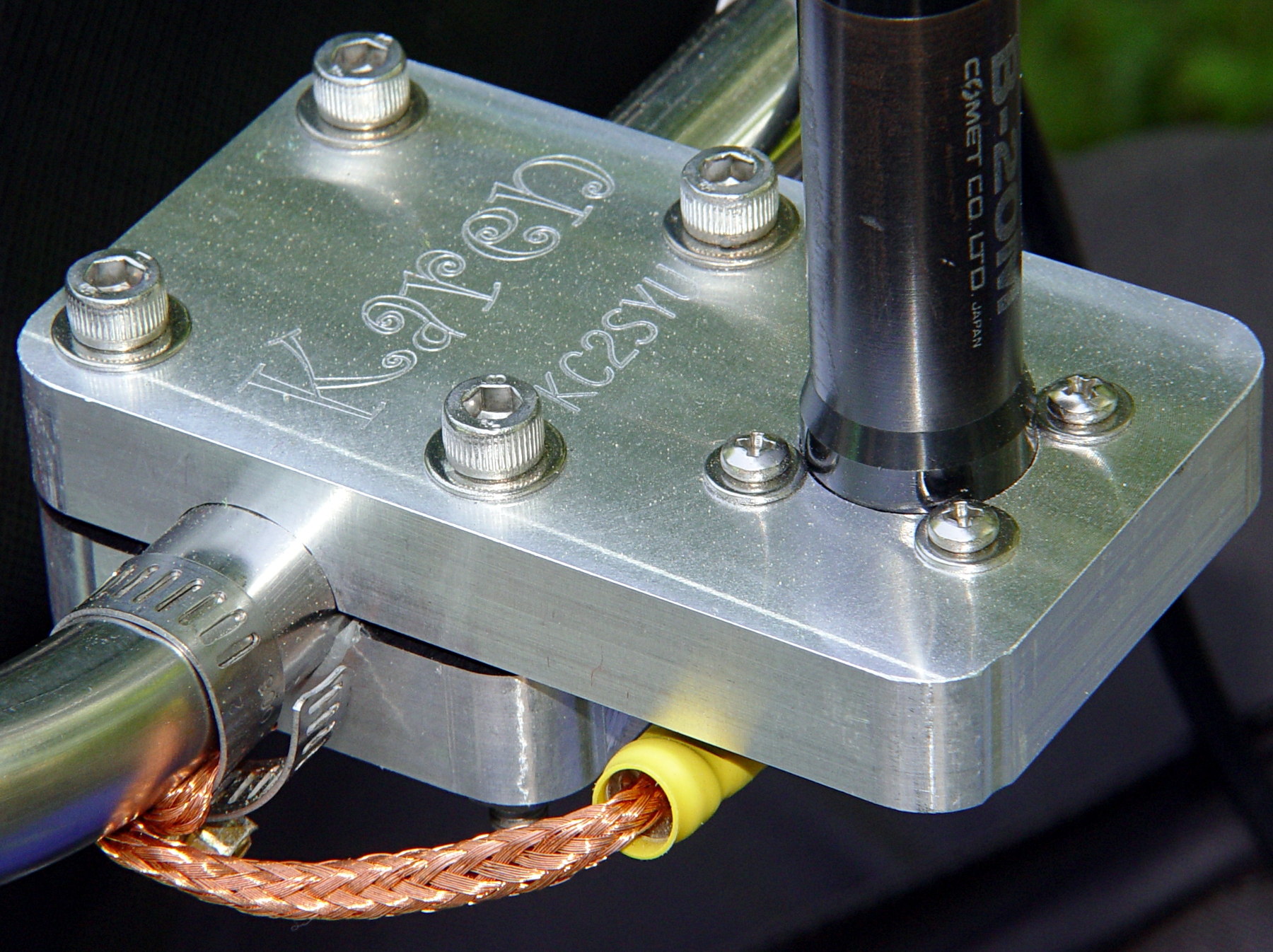
Quite a while ago, I built this slab mount to hold an amateur radio antenna on our daughter’s Tour Easy. It worked fine until the bike blew over and whacked the antenna whip against something solid, at which point the mast cracked.
The antenna screws into an ordinary panel-mount UHF connector secured to the bottom of the slab, with a hole through the slab just large enough to accept the antenna mast. That put all the mechanical stress on the slab, not the connector.
Modified antenna mounting plate
Alas, the new antenna had a slightly different mast outside diameter, so I machined a new adapter to clamp the connector atop the slab. The antenna screws down into the adapter against a brass washer, again keeping the strain on the fitting.
I recently found the commercial mobile antenna cable that I’d been meaning to use on her bike, which required Yet Another Modification to that slab. It turns out that the UHF connector on the cable expects to be secured to sheet metal found in a car body, rather than a half-inch aluminum plate: the threads aren’t long enough!
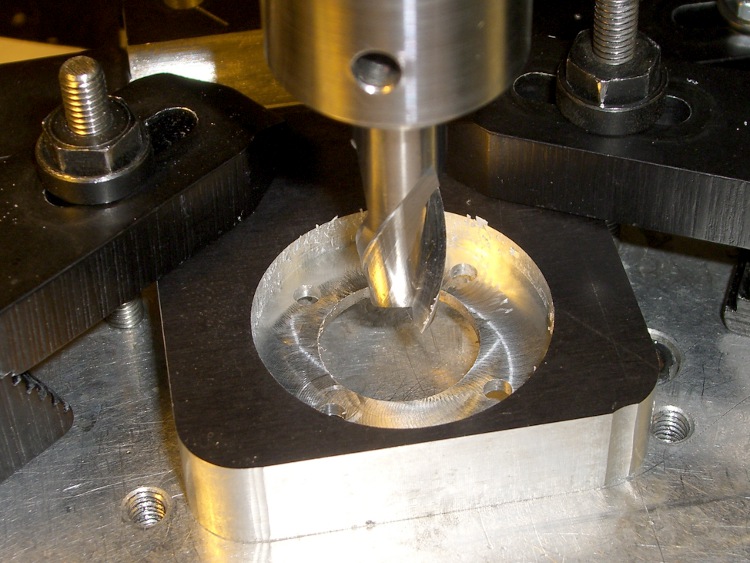
So I machined circular recesses on the top and bottom to hold the mounting nut and washer, respectively, with 2 mm of aluminum remaining in the middle of the slab.
Milling top recess
The recesses are just fractionally larger than the nut & washer, so most of the stress gets transmitted directly to the slab. Even in the high-vibration bicycle environment, I think there’s enough meat in there to prevent fatigue fractures.
Milling bottom recess
I recycled a G-Code routine I’d written to chew out circular recesses. It does a bit of gratuitous (for this application, anyway) spiraling in toward the center, but got the job done without my having to think too much.
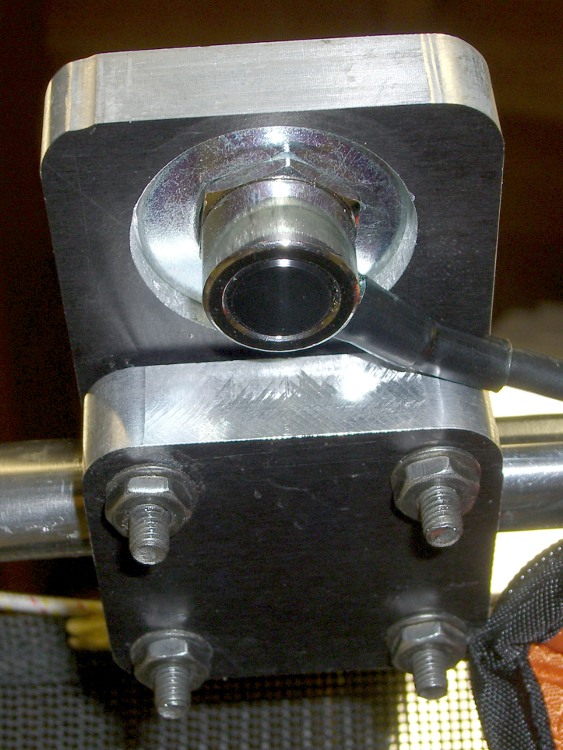
The bottom view shows the washer in action. The recess is deep enough that the cable just barely clears the slab.
Modified mounting plate – bottom
The top view shows the recessed mounting nut. The nut has an O-ring around the connector threads, but the water will probably drain out through the four through-holes left over from the old panel-mount connector.
Modified mounting plate
I turned the top nut down as far as I could with a wrench & (ugh) needle-nose pliers, then tightened the bottom nut about 1/3 turns with a wrench.
You’re not supposed to notice the crispy edges on the PVC bushing holding the reflector to the antenna mast. The high setting on that heat gun is a real toaster…
Here’s the status of the AA NiMH packs I’ve been using with the radios on our bikes, plus three packs I made up last year and have been keeping on the desk to measure their long-term storage characteristics. Click for more detail.
Bike Radio Pack Status – 2010-03
The “Tenergy 09 x” packs are new & unused with, frankly, disappointing capacity of about half their 2.6 Ah rating. That’s not much better than the used Tenergy packs (T9x and RTU x), which is either a Good Thing (they have good long-term stability) or a Bad Thing (they’re grossly over-rated to begin with).
The two Duracell packs are far better than any of the Tenergy packs.
The three 6-cell packs along the bottom are fading fast.
The previous test runs are there, albeit with a 1 A discharge.
This season I’ll use some Li-Ion packs that weigh twice as much with three times the capacity… plus a built-in charge gauge, pessimistic though it may be.
Mary & I did the weekly grocery run today, with a few add-on errands.
I’m (finally) shipping the Totally Featureless Clock to my friend and hauling a bag of shredded leaves (the first of a dozen) with which Mary mulches the plants in her remote garden plot. We dropped off the leaves and some garden gate fencing (from her bike), then continued on for groceries.
Trailer with Package and Shredded Leaves
Mary returned to the garden to spend the afternoon coaxing the plants to grow nicely, while I hauled the TFC (and the groceries) to the UPS inlet.
Trailer with Groceries and Package
And then I hauled the groceries home. Most of the four bags of chow fit in the trailer, with squishable fruit & veggies in the bike panniers. A whopping 13 miles, all told, but a good time was had by all.
The trouble with bicycles is that they have approximately the cargo capacity of your car’s glove box. Panniers help, but for bulk capacity you need a trailer. Think of it this way: these days, a good trailer costs maybe three or four tanks of gasoline.
If you keep coming up with reasons why you can’t get your butt on your bike and “I can’t haul X!” is one reason, a trailer might be the answer for reasonable values of X. It’s no good for plywood sheets and water heaters, but I’ve hauled plenty of other X that would ordinarily call for a car trip.
It’s an old B.O.B Yak. Works fine, tracks well, doesn’t wobble, carries more than you think possible.. Just do it!
We each put about 2000 miles a year on our bikes, most of it on errands just like this. That’s not many miles by bicycle fanatic standards, but we do lots of other stuff in addition to biking…
Search the blog for “trailer” and you’ll find a few other hints & tips.
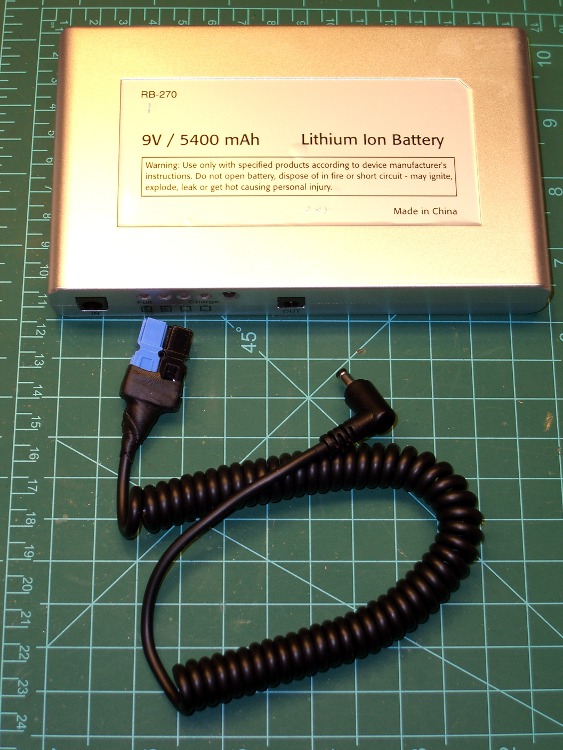
Finally got around to hacking PowerPoles into the coily cable from those Li-Ion packs, suitable for powering the amateur radio HT on my Tour Easy. The cable has surprisingly fat conductors, on the order of 22 AWG, that (when doubled over) half-filled the 30 A PowerPole terminals. I remembered to use the blue-and-black color code for 9 volt power on the second and third cables…
The right-angle connector activates a switch that turns on the pack’s voltage regulator, which means that leaving the cable plugged in slowly discharges the battery. They self-discharge by about half in two weeks, which means that it’s not absolutely urgent to unplug the battery at every stop, but … I’d rather have an actual power switch.
I also want to bypass that regulator, so as to get more voltage out of the pack. That may not be feasible, as I suspect they’re using the pass transistor as part of the over-current shutdown circuit, but it’ll be interesting to find out. So this is in the nature of a test to find out how well the lashup works before cracking the case.
This view of the installed pack is looking down on the butt end of the bike, which is leaning against the Shelf O’ Crap in the garage.
Battery on Tour Easy Rack
A four-inch length of adhesive-backed Genuine Velcro mates the battery to the rack, although I stuck both Velcro strips to some carpet tape in the hopes that’ll stick better than the OEM goo. Hooks on the bike and loops on the battery, which means the battery won’t affix itself to everything else in the universe while off the bike.