Ed Nisley's Blog: Shop notes, electronics, firmware, machinery, 3D printing, laser cuttery, and curiosities. Contents: 100% human thinking, 0% AI slop.
Went to roll the bike out of the garage and the rear tire was dead flat. You don’t even need to look at the tire, you just instantly know something’s wrong: the bike feels funny with a flat tire.
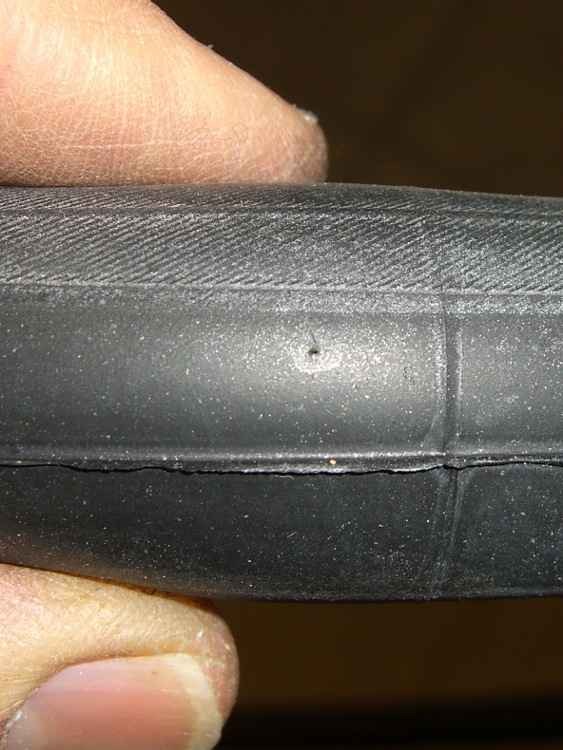
The picture shows the problem: a pinhole in the tube. Nothing penetrated the tire, nothing went wrong with the tire liner (you can see this was a few mm from the edge, so it’s not an abrasion flat), there are no problems anywhere. Just a tiny hole in the tube.
As nearly as I can tell, the tube simply failed at that point, without any external aggravation.
Popped in another tube and it’s all good, but … I guess it’s time to buy some new tubes: the new one came from a box dated May 90.
Finding a flat in the garage is much much better than finding a flat on the road.
After replacing the seat strut screws, I found a Round Tuit lying there on the workbench, right next to the rear reflectors I’ve been meaning to install for a truly embarrassing period.
Recumbents don’t have the usual assortment of standard-sized tubing in the usual road-bike places, making common items like reflectors difficult to attach. The ideal spot on our bikes is at the base of the VHF/UHF antennas, right next to the white blinky LEDs, but, alas, that’s 20 mm in diameter and the reflector clamp barely shrinks down to a bit under 28.
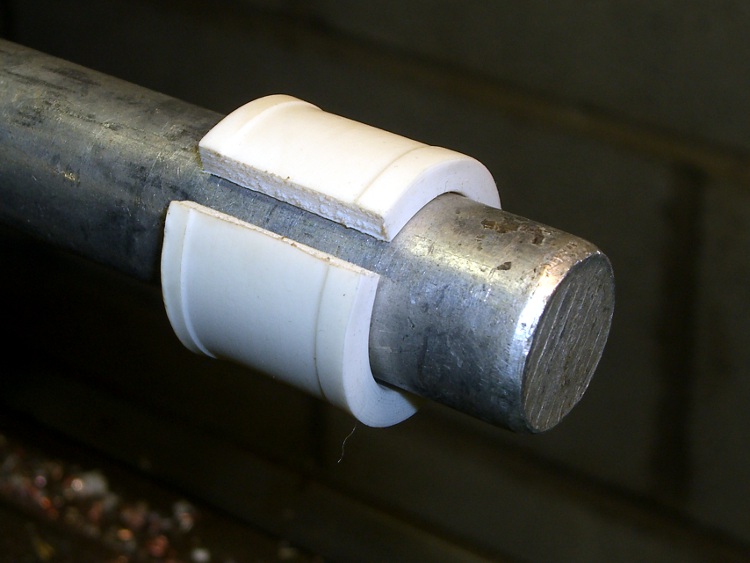
Turns out that a chunk of 1.5 inch PVC pipe has a 4 mm wall thickness, so wrapping a layer of that around the antenna base will do the trick. I whacked off a length of pipe, faced off both ends in the lathe, and put a shallow recess around the middle of the ring to capture the reflector clamp.
By another rare coincidence, 1.5 inch PVC pipe has an ID of exactly 40 mm… so cutting the ring exactly along a diameter produces the right length. The catch is that the pipe isn’t flexible at all, but brandishing a heat gun in a threatening manner solves that problem.
Reshaped bushing on mandrel
A random hunk of 3/4-inch aluminum rod is about 19 mm in diameter, so I chucked that in the lathe and shaped the saggy strip around it… wearing thick leather gloves.
It springs out to 20 mm with no problem, slides right on, and grips reasonably well. I may add a strip of tapeless sticky (think double-sided tape without the tape: just the adhesive!) under the bushing if it wants to walk away.
I made two of ’em, of course, and put a reflector on Mary’s bike while I was at it. Our young lady’s bike already has a reflector, although I should upgrade that bushing as well… it’s a layer of self-vulcanizing rubber tape that works perfectly, so this may take a while.
I suppose I should buy a length of gray or black PVC pipe, but that’s in the nature of fine tuning.
Straight up: this is about a stainless steel socket head cap screw I installed eight years ago, not the original Easy Racers screw, so this is not their problem.
I rode out for milk-and-eggs at the corner store, a flat one-mile ride, and stopped at the traffic signal. Light goes green, line of cars accelerates, so do I… and there’s a snap and the left side of the seat sags backwards. I am not a powerhouse rider and it’s March, so I’m not doing leg presses while getting up to cruising speed.
I continued the mission by sitting slightly to the right on the seat and pedaling gingerly, then diagnosed the problem in the corner store’s parking lot. If I’d been further away, I’d have done the repair right there, but I figured it’d hold together until I got home. It did.
The problem turned out to be a broken screw holding the left-side seat strut to the threaded eyelet on the rear dropout. The top picture shows the way I have it set up: seat strut clamp outboard, rack strut inboard, with a socket head cap screw extending all the way through, and secured with a pair of stainless nuts that went missing along with the broken screw end.
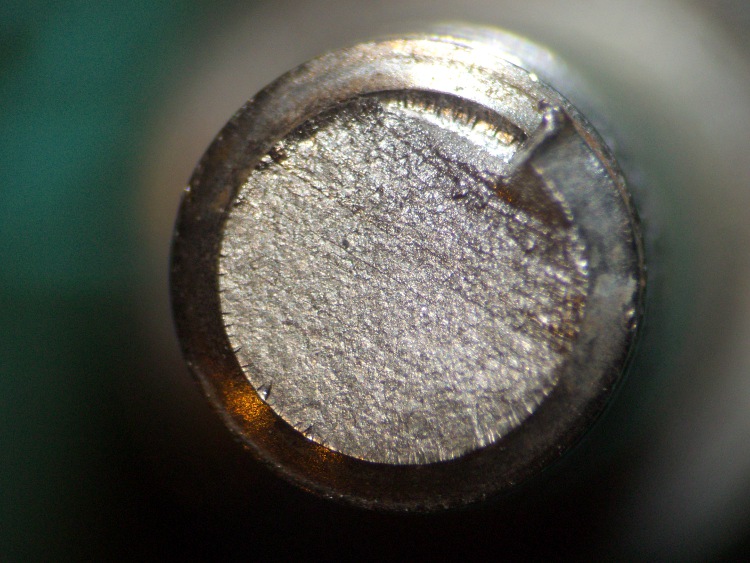
Screw fracture closeup
Here’s the fracture across the end of the screw, which shows no evidence of foul play. As nearly as I can tell, the whole thing snapped off in one event, with none of the crud that would indicate a progressive crack. Compared with that wheel stud, this is in pristine condition.
So it’s time to replace the right-side screw, as well, which means a trip to the Bike Repair Wing of the Basement Laboratory. While I had the bike up in the repair stand, I decided to reshape the head on the right-side screw for better chain clearance.
As nearly as I can tell, the usual practice puts both the seat strut and the rack strut outboard of the threaded eyelet on the dropout, but that seems wrong to me. The seat strut puts a tremendous amount of stress on the screw, so you really want that lever arm as short as possible: put the clamp against the eyelet. While the rack isn’t as heavily loaded, cantilevering it outboard of the clamp just doesn’t look right.
But putting the rack strut inboard of the eyelet means the screw head sticks out rather more than I’d like. Very rarely, the chain will snick against the head and even more rarely it jams between the head and the freewheel. Nothing much happens (it’s a freewheel, after all), but I think reducing the head thickness ought to help.
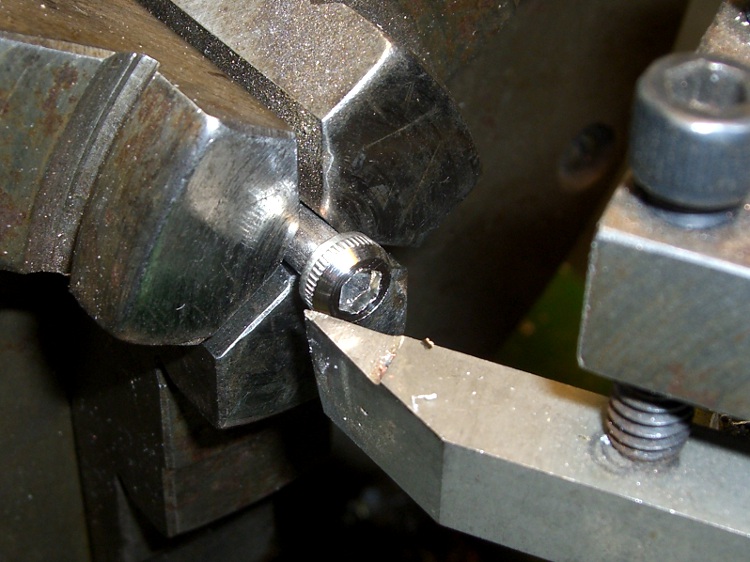
Reshaped socket head cap screw
So I chucked the screw in the lathe, shortened the socket by about half, and put a taper on the head. If I had a stock of round-head cap screws, one of those would be even better.
The shortened socket makes it a bit tricky to get enough bite with the hex key, but this isn’t something that requires much attention after it’s installed… and I get to do all that in the shop.
Dabs of Loctite in the eyelet and nuts, for sure!
By a truly rare coincidence, a standard 1-1/2 inch cap screw is exactly the right length.
Right-side mount
Here’s a view of the installed right-side screw, looking rearward along the upper rear triangle tube. Seat strut to the outside, rack strut to the inside, and reshaped head above the cluster.
Took the bike out for a 16 mile spin today and it’s all good.
A note for the weight weenies in the crowd: a rack on the back of the seat adds a redundant support structure. Without that, a failed seat strut can be a real showstopper. Even if you don’t use your bike as a pack mule, maybe you should add a rack.
After putting Mary’s newly covered seat on her Tour Easy, I replaced the tire liner in the front wheel; the previous tube had gone flat, as mentioned there, due to erosion from the end of the liner.
Here’s what the taped liner looked like: smashed as flat as you’d expect from 100 psi applied evenly over the surface. The tube had a rectangular imprint on it, with what looked like minute abrasions, around the outline of the tape. Nothing major, but it shouldn’t ought to look that way.
Taped tire liner
I rolled that liner up, popped it in the Bike Tire Stuff drawer and replaced it with a Slime liner. This picture shows the ends of the two liners: the brown one (bottom) is about 90 mils thick in the center, the Slime liner (top, fluorescent green) is 60-ish.
Tire liner comparison
As nearly as I can tell, I’ve never had an abrasion flat with a Slime liner, while various other brands have caused troubles.
I broke the edges of the Slime liner with a bit of sandpaper, just to see what that’ll do. Most likely, bad things, seeing as how I’ve never done that before…
A friend mentioned a sale at Overstock.com (likely gone by now) that offered an Initial RB-270 9 V, 5.4 Ah lithium-ion battery pack, with a built-in charger, for $16. The pack was intended to keep a DVD player alive for long enough to avoid back-seat mayhem on long trips (for those toting undisciplined brats, anyway), but I saw it as a plug-in replacement for the NiMH AA-cell packs I’ve been using with the HTs on our bikes.
The NiMH cells have been a major disappointment, as described there and there and there, with barely 1.5 Ah of capacity from nominal 2.4 Ah cells.
Much to my surprise, all three of the Li-Ion packs delivered pretty nearly their advertised ratings. I varied the discharge level, but they’re all quite close…
Initial External Li-Ion packs
It looks like the packs include an internal regulator and over-discharge monitor, as the voltage is bar-flat right up to the point where it drops to zero. I’m mildly surprised at the regulator; I’d expect that they’d just deliver whatever the cells were producing, rather than waste any energy in the regulator.
Notice that the 200 mA rate produced a lower total capacity than the 1 A rate. I’m guessing that’s power lost in the regulator over the protracted run time; 4.9 Ah at 200 mA added up to nearly a day of testing, far over the “up to six hours play per charge” rating.
Let’s see: 5.4 Ah @ 6 hours makes the nominal load about 900 mA. So it delivered maybe 4.8 Ah at 1 A. Not what’s claimed, but much closer than those Tenergy NiMH cells.
Next steps:
Butcher the nice coily-cord cables to add Powerpole connectors that will click right into the bike radios
Take one apart to see what bypassing the regulator would entail
Mary sewed up a new seat cover for her Tour Easy, so I dismantled the seat and cleaned things up. This is a good opportunity to show how I mounted an amateur radio HT on the bike…
Bottle holder on seat frameClamp mount detail
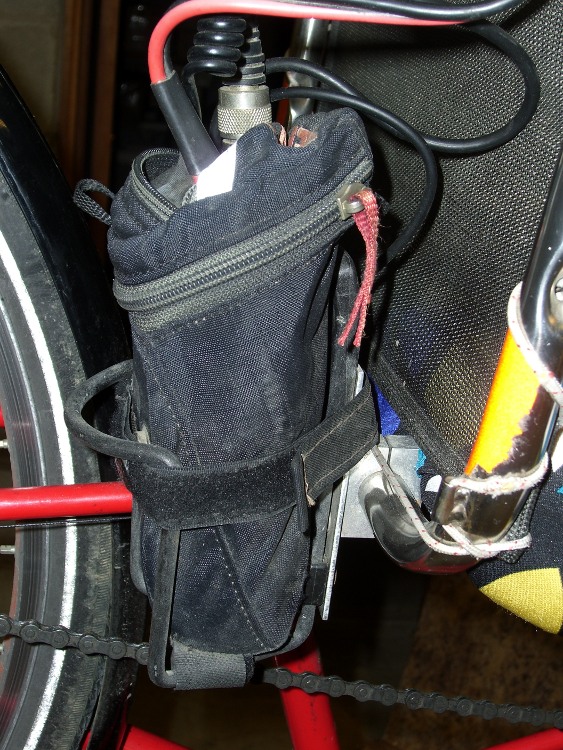
The general idea is simple: a water bottle holder attached to the lower seat rail with a circumferential clamp made from a chunk of half-inch aluminum plate. An aluminum spreader adapts the wider hole spacing on the bottle holder to the teeny little clamp.
With the bottle holder in place, I put the radio in a wedge seat pack, atop a block of closed-cell foam to more-or-less cushion some of the bumps. The wedge pack seatpost strap secures it to the bottom of the holder and the rail straps wind their way through the holder and lash around the aluminum spreader plate. It doesn’t move very much at all.
The radio is a long-obsolete ICOM IC-Z1A, bought specifically for this purpose: it has a remote head on the end of a coily cord. That puts the power, volume, and channel buttons out where you can actually use them.
Radio in seat wedge pack in bottle holder
The lump behind the seat looks moderately suspicious in this day & age: a black package with wires! The grossly oversized red-and-black pair in the foreground is the power coming from a 6-AA pack attached to the rack with a Velcro strap; it’s a jumper with Anderson PowerPoles on both ends. Coily cord to the HT head, BNC-to-UHF adapter to the mobile antenna mount, one skinny cord to the headset and the other to the PTT button on the handlear.
As expected, the uni-lens on Mary’s Rudy Project sunglasses cracked right up the middle as that stress crack above the nosepiece opened up. The sunglasses came with interchangeable lenses, so I swapped in the clear lens.
Having used urethane adhesive to mechanically lock the defunct gray lens in place, the broken bits were pretty firmly bonded. I applied a brass hammer and small drift punch to the remaining tabs, pried the debris out of the temples, cleaned the adhesive from the recesses, and snapped the new lens in place. Surprisingly, it popped in and locked securely.
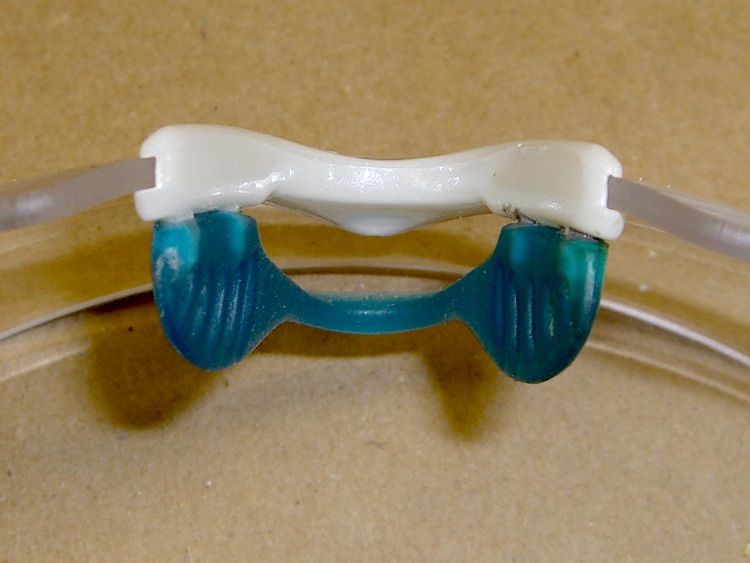
The nosepiece has never worked satisfactorily: there’s nothing locking the flexible blue-silicone pad to the straight-sided posts that are supposed to hold it. As a result, it tends to pop off at the most inopportune moments.
Rudy nosepiece
I dotted the posts on one side with cyanoacrylate and the other pair with epoxy to see if either will bond well enough to make a difference. If those fail, I’ll try urethane, although I’m not sure what will happen as the urethane expands in the sockets.
Anyhow, she now has glasses suitable for biking on cloudy and rainy days… which is much better than a sharp stick (or a bug) in the eye, as we see it.





 The Smell of Molten Projects in the Morning