The Smell of Molten Projects in the Morning

Ed Nisley's Blog: Shop notes, electronics, firmware, machinery, 3D printing, laser cuttery, and curiosities. Contents: 100% human thinking, 0% AI slop.

Category: Recumbent Bicycling

Cruisin’ the streets

  • Michelin Pilot City Tire Bead-Carcass Joint Failure

    A year or so ago, I picked up a Michelin Pilot City tire (700x32C) to see how they compare with the twice-as-expensive Schwalbe Marathons we’ve been using on the Tour Easy recumbents.

    Having replaced a worn-out Marathon last summer, this was unexpected:

    Michelin Pilot City Protek tire - blown bead
    Michelin Pilot City Protek tire – blown bead

    I’d blame that failure on overpressure, but I’ve been running the back tires around 70 psi, well inside their 87 psi (that’s a nice, round 6 bar) sidewall rating.

    Being able to swap a back tire in the Basement Laboratory Repair Facility made up for a lot…

  • Road Conditions: Rt 376 at Walker

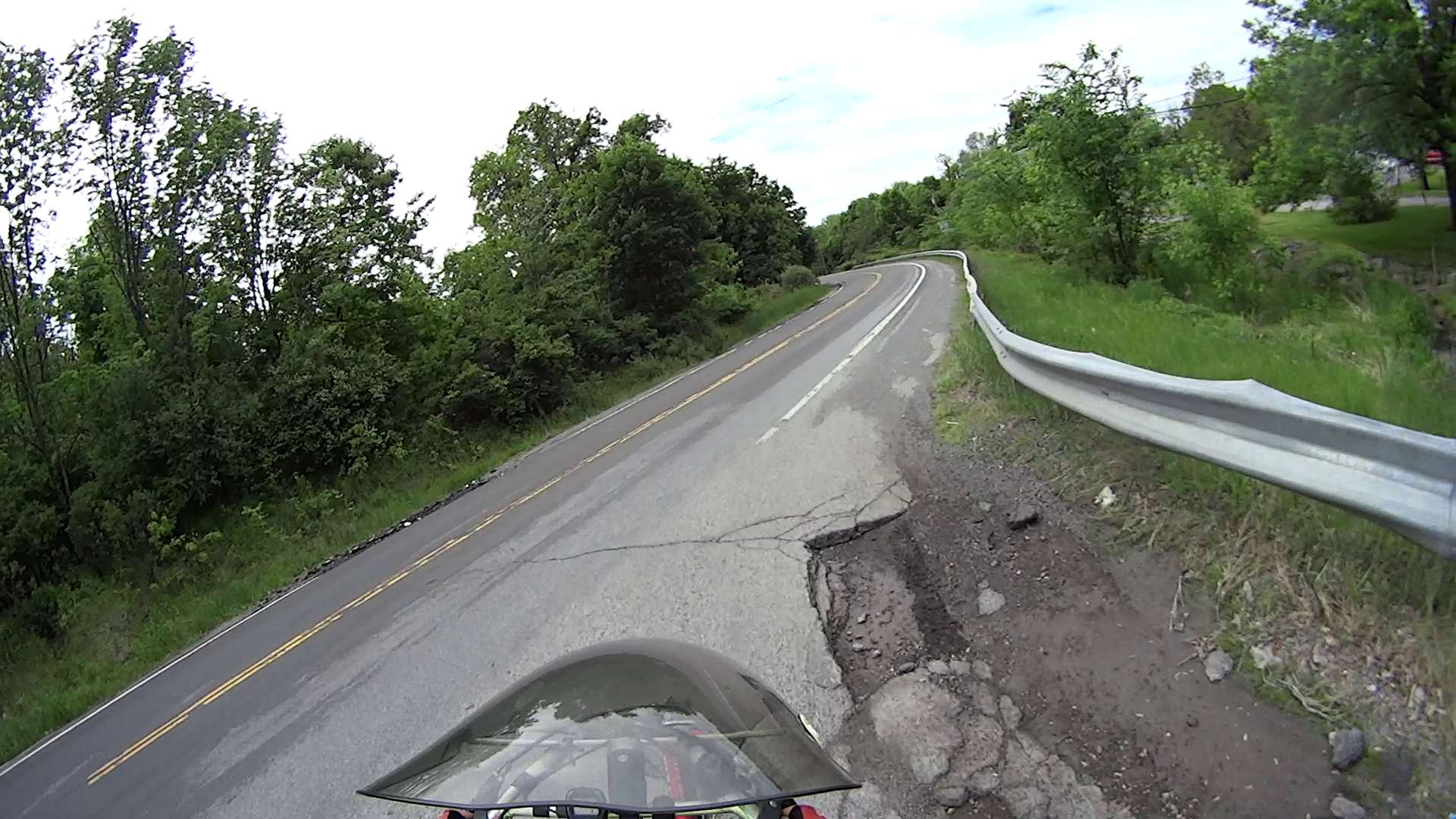
    Some years back, NYSDOT resurfaced Rt 376 by laying an inch of asphalt atop the crumbling surface, but the underlayer continues to deteriorate and the top coat delaminates.

    The situation at Westview Terrace, just south of Red Oaks Mill (clicky for more dots):

    Delaminated Asphalt - Rt 376 at Westview Terrace
    Delaminated Asphalt – Rt 376 at Westview Terrace

    The patch just to my right is a hand-tamped cold patch job, which obviously isn’t sufficient to repair the damage.

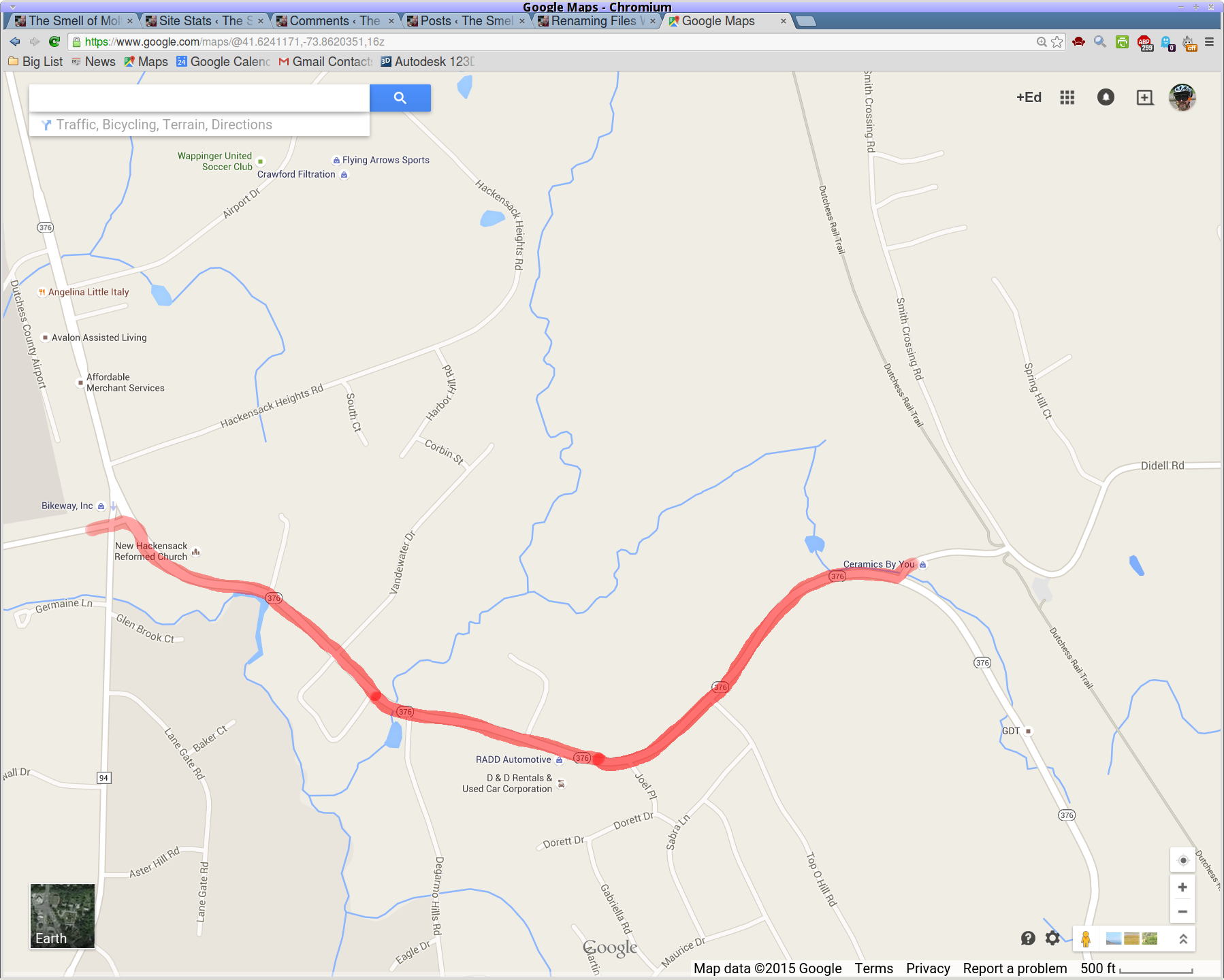
    Locator:

    Delaminated Asphalt - Rt 376 at Westview Terrace - map
    Delaminated Asphalt – Rt 376 at Westview Terrace – map

    We’ve been told that NYSDOT no longer does proactive maintenance: until somebody calls in a problem, it’s not their problem. I’m starting to document problems here as part of the record.

  • Action Camera Video Compression vs. License Plates

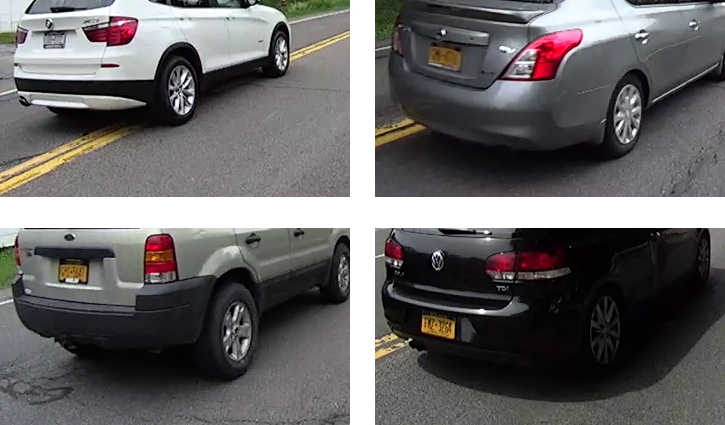
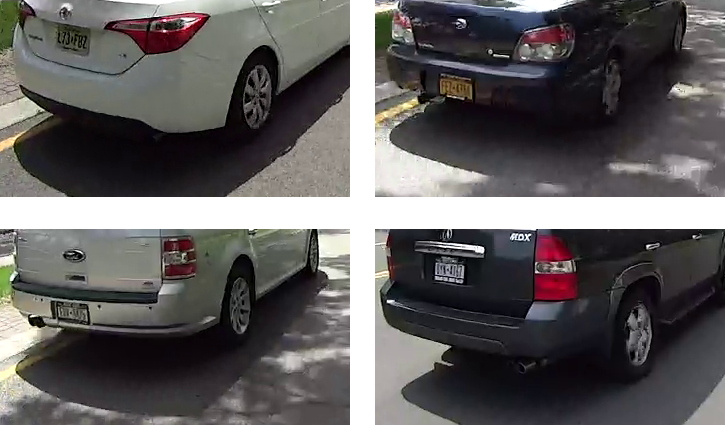
    Having recently mounted a Cycliq Fly6 rear-facing camera (more about this later) on my Tour Easy’s seat, I had high hopes it might produce more legible images than the Sony HDR-AS30V helmet camera. Although these still images have been compressed a bit, that doesn’t affect the conclusions; the video files aren’t any more readable.

    The Fly6 shows where the driver laid on the horn:

    Rt 376 at Cedar Valley - 2015-05-22 13:34 - Seat - 1
    Rt 376 at Cedar Valley – 2015-05-22 13:34 – Seat – 1

    The next two come from the Sony HDR-AS30V helmet camera:

    We couldn’t hear what the passenger said above the horn, but it didn’t sound friendly:

    Rt 376 at Cedar Valley - 2015-05-22 13:34 - Helmet - 1
    Rt 376 at Cedar Valley – 2015-05-22 13:34 – Helmet – 1

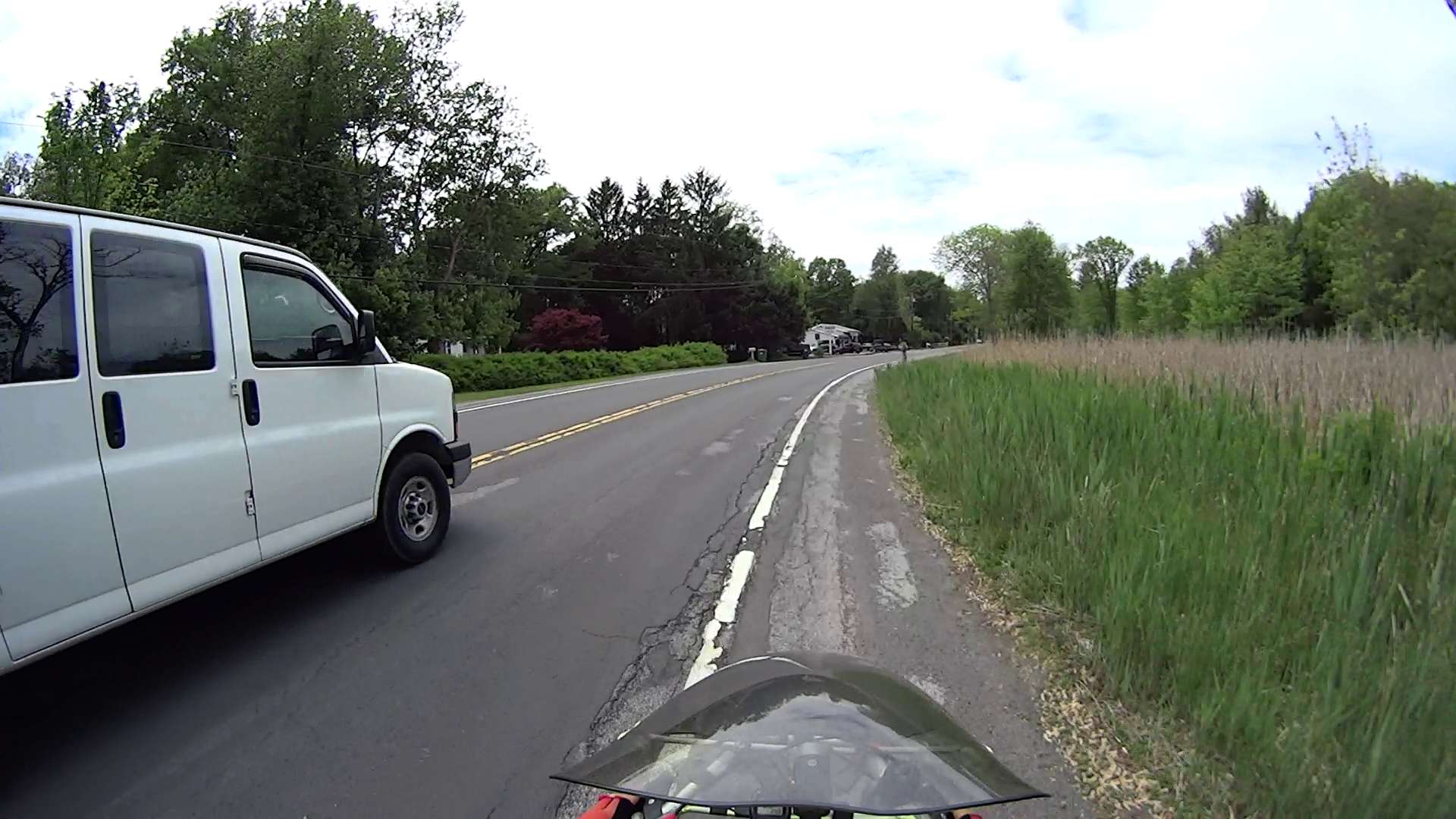
    However, the driver gave us about as much clearance as can reasonably be expected with oncoming traffic:

    Rt 376 at Cedar Valley - 2015-05-22 13:34 - Helmet - 2
    Rt 376 at Cedar Valley – 2015-05-22 13:34 – Helmet – 2

    Traffic generally hits the 40 mph = 60 ft/s speed limit on that curve and we’re rolling at 10 mph =  15 ft/s, so the relative motion might be upwards of 45 ft/s. The Fly6 runs at 30 frame/s = 1.5 ft and the AS30V at 60 frame/s = 0.75 ft. Although the exposure time is much shorter than the frame time, you can see plenty of motion blur in all the images.

    The Fly 6 captures 1280×720 video @ 30 frame/s with variable bit rate compression, saving a separate file every 10 minutes on the dot. The files range from 300 MB to 600 MB, more or less.

    The AS30V captures 1920×1080 @ 60 frame/s with constant bit rate compression, plopping a 4 GB file every 22 minutes and 43 seconds.

    The Fly6 seems to preserve more image detail than the AS30V, but it’s probably a factor of the native resolution and compression method. The cameras provide absolutely no control over any image functions or settings; they do what they do and you get what you get.

    The video compression algorithms seem overwhelmed by the number of pixels that change from frame to frame: asphalt and leaves generally have blocky compression artifacts, particularly in low light, and license plate text generally gets compressed into a blur.

    When the camera remains stationary and the image doesn’t change, the compression artifacts largely disappear and the images become crisp and beautiful. Unfortunately, that’s not generally the situation while we’re riding.

    I want to apply “low resolution OK here” masks to parts of the frame, leaving more bits for the critical parts. Perhaps applying thin tape to the top third of the frame would help?

    Meanwhile, back on the road, nearly all drivers understand the rules and act accordingly; this was a rare occurrence.

  • Tour Easy: Cracked Fork Autopsy

    A look inside the cracked fork lug from my Tour Easy shows that it really did fracture at the top of the fork blade:

    Tour Easy - cracked fork - interior flash
    Tour Easy – cracked fork – interior flash

    Minus the flash, plus contrast enhancement:

    Tour Easy - cracked fork - interior
    Tour Easy – cracked fork – interior

    Looks rather grotendous in there, doesn’t it? Yeah, show me the interior of your fork…

    The front is at the top, blade on the left and crown on the right. The little shiny rectangle at 1 o’clock on the crown was probably the last fragment holding the blade in place.

    Finished!

  • Right Turn On Red: After Stop, After Yield

    With the green left-turn arrow indicating red for opposing traffic, everybody’s in the proper position. I’m crossing the stop line and leaning into the turn at about 15 mph:

    Right On Red - Tucker at Friendly - 0 sec
    Right On Red – Tucker at Friendly – 0 sec

    New York State allows a right turn on red, but you’re supposed to stop and yield to other traffic. In that picture, the oncoming car is definitely stopped.

    Three seconds later:

    Right On Red - Tucker at Friendly - 3 sec
    Right On Red – Tucker at Friendly – 3 sec

    She hugged the curb to turn into the gas station entrance just to her right, which was the only thing that saved me. Braking hard in a turn slides you under the oncoming vehicle, ramming a school bus head-on is bad form, and sideswiping a car at speed never ends well.

    I suppose I just don’t look nearly as fast as I am. Which, given the fairing and spinning feet, is hard to imagine.

  • Honkers!

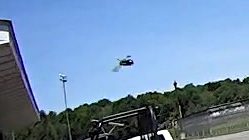
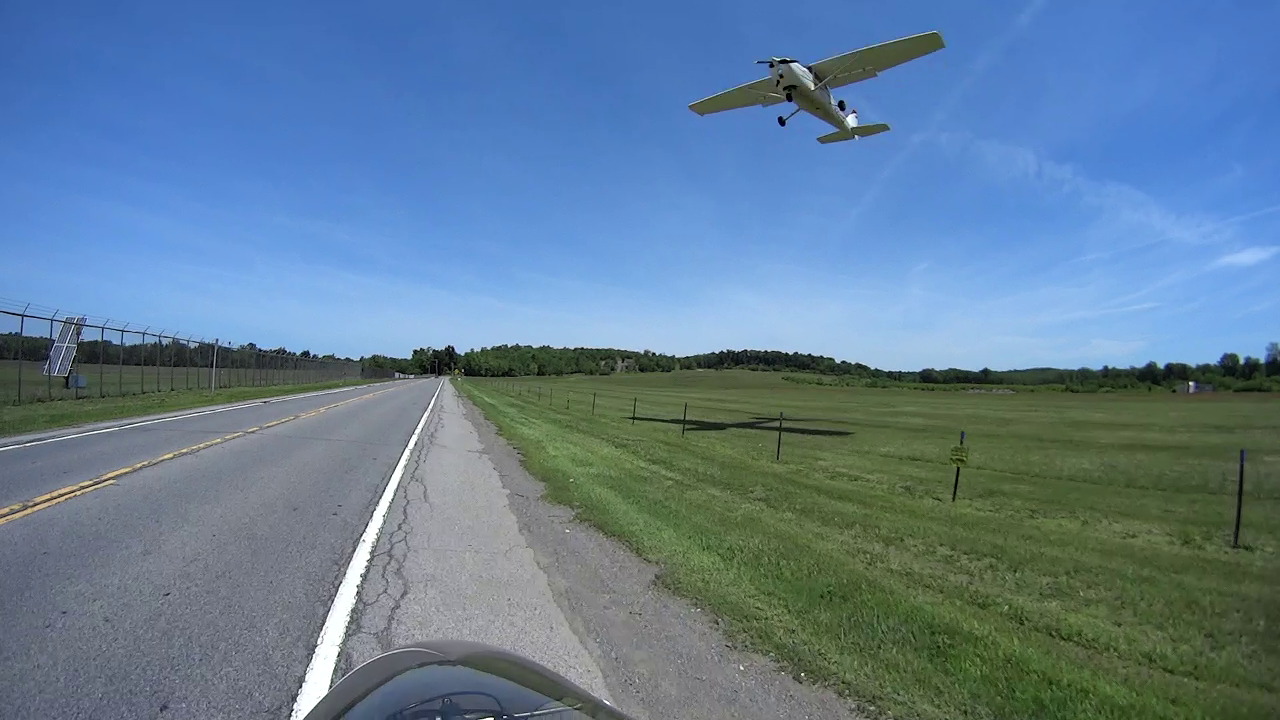
    Spotted these Canada Geese over Page Industrial Park on the Dutchess Rail Trail:

    Canada Geese over DCRT
    Canada Geese over DCRT

    They were discussing current events and seemed to be having a fine time.

    I was, too!

    An image from the HDR-AS30V helmet camera video, with just a touch of contrast adjustment.

  • Bicycle GPS Track: Diggin’ Deep and Flyin’ High!

    At first glance, I thought Mary had taken a tour of The Great Swamp south of the Vassar Farm gardens:

    APRS Bicycle Tracking - Flying High
    APRS Bicycle Tracking – Flying High

    Having helped put the fence up, I’m absolutely certain nothing growing in the garden could get her to 4373 feet, much less boost the bike that high.

    Before that, it seems she did some high-speed tunneling:

    2015-05-10 18:17:31 EDT: KF4NGN-9>T1TP4X,WIDE1-1,WIDE2-1,qAR,KB2ZE-4:`eP}nAIb/"/k}
       type: location
       format: mice
       srccallsign: KF4NGN-9
       dstcallsign: T1TP4X
       latitude: 41.67466666666667 °
       longitude: -73.88283333333334 °
       course: 345 °
       speed: 42.596 km/h
       altitude: -371 m
       symboltable: /
       symbolcode: b
       mbits: 101
       posresolution: 18.52 m
       posambiguity: 0
    

    The bike’s altitude began falling while she was on the way to the garden, from a reasonable 66 meters on the entrance road, bottoming out at -371 m as she hit 42.6 km/h (!), rising to 1341 meters with the bike leaning against a fence post, and returning to 53 meters as she started riding home.

    Obviously, you shouldn’t trust consumer-grade GPS tracks without verification: it can get perfectly bogus numbers from fixes with poor satellite geometry. Altitude values tend to be only close, at best, even when you’re not too fussy about accuracy.

    We experienced small-scale jitter in New Jersey and a friend carrying a commercial satellite link experienced similar randomization. Trust, but verify.