Trees along the Dutchess Rail Trail fall over for no obvious reason and sometimes block the path:

But my tool hand is strong:

The DPW folks can haul off the trunk, as it’s more than I can move.
The Smell of Molten Projects in the Morning
Ed Nisley's Blog: Shop notes, electronics, firmware, machinery, 3D printing, laser cuttery, and curiosities. Contents: 100% human thinking, 0% AI slop.
Cruisin’ the streets
Trees along the Dutchess Rail Trail fall over for no obvious reason and sometimes block the path:

But my tool hand is strong:

The DPW folks can haul off the trunk, as it’s more than I can move.
NYS DOT Region 8 Dutchess South recently did enough over-the-rail clearcutting to make Rt 376 bicycle-able from Red Oaks Mill to Maloney Rd!
To the best of our memories and judging from the tree stumps along the rail, it’s been a decade since DOT last clearcut that section; the Japanese Knotweed has definitely taken over since then.
Here’s what the Knotweed looked like in June, just north of Maloney Rd, after a trimming in May:

Now, it’s not nearly so snug out there:

Here’s a slide show starting with Dutchess North’s routine grass mowing in Red Oaks Mill and ending with Dutchess South’s clearcut just north of Maloney Rd:
The Wappinger Creek bridge seems to be a no man’s land between the two Residencies, but we can generally take the lane:

We hope Dutchess South’s over-the-rail maintenance will become an annual event and prevent the brush from taking over again.
After nigh onto 18 years, the pipe straps holding the Zzipper fairing struts to the handlebars of our Tour Easy recumbents finally shrugged off their plastic wraps:

Although they still worked, riding over broken pavement produced distinct rattles; alas, the roads around here feature plenty of broken pavement.
The solution is a rugged plastic block capped with aluminum plates to spread the clamping load:

The solid model is straightforward:

A slight bit of tinkering made the stack exactly the right height for 45 mm screws secured with nyloc nuts. No washers on either end, although that’s definitely in the nature of fine tuning.
The three sections print without support:

I reamed the smaller hole with a 3/8 inch drill to match the fairing strut rod. The as-printed larger hole fit the handlebar perfectly, although the first picture shows the tubing isn’t exactly round on the near side of the block, where it starts the outward bend toward the grips.
The cap plates cried out for CNC, but I simply traced two outlines of the block on 1/8 inch aluminum sheet, bandsawed near the line, introduced them to Mr Disk Sander for finishing & corner rounding, transfer-punched the holes from the plastic blocks, and drilled to suit:

Making two pairs of plates by hand counts as Quality Shop Time around here.
The first few rides confirm the fix: no rattles!
The OpenSCAD source code as a GitHub Gist:
| // Fairing strut mount for Tour Easy handlebars | |
| // Ed Nisley – KE4ZNU – 2019-08 | |
| Layout = "Show"; // [Show,Build,Block] | |
| Support = false; | |
| /* [Hidden] */ | |
| ThreadThick = 0.20; | |
| ThreadWidth = 0.40; | |
| HoleWindage = 0.2; | |
| Protrusion = 0.1; // make holes end cleanly | |
| function IntegerMultiple(Size,Unit) = Unit * ceil(Size / Unit); | |
| ID = 0; | |
| OD = 1; | |
| LENGTH = 2; | |
| inch = 25.4; | |
| //———————- | |
| // Dimensions | |
| // Handlebar along X axis, strut along Y, Z=0 at handlebar centerline | |
| HandlebarOD = 0.875 * inch + HoleWindage; | |
| StrutOD = 0.375 * inch + HoleWindage; | |
| PlateThick = 1.0 / 16.0 * inch; | |
| WallThick = 2.0; | |
| Screw = [3.0,6.8,4.0]; // M3 OD=washer, length=nut + washers | |
| RoundRadius = IntegerMultiple(Screw[OD]/2,0.5); // corner rounding | |
| ScrewOC = [IntegerMultiple(StrutOD + 2*WallThick + Screw[ID],0.5), | |
| IntegerMultiple(HandlebarOD + 2*WallThick + Screw[ID],0.5)]; | |
| echo(str("Screw OC: ",ScrewOC)); | |
| BlockSize = [ScrewOC.x + 2*RoundRadius,ScrewOC.y + 2*RoundRadius,HandlebarOD + StrutOD + 3*WallThick]; | |
| echo(str("Block: ",BlockSize)); | |
| HandleBarOffset = WallThick + HandlebarOD/2; // block bottom to centerline | |
| StrutOffset = HandlebarOD/2 + WallThick + StrutOD/2; // handlebar centerline to strut centerline | |
| echo(str("Screw length: ",BlockSize.z + 2*PlateThick + Screw[LENGTH])); | |
| NumSides = 2*3*4; | |
| //———————- | |
| // Useful routines | |
| module PolyCyl(Dia,Height,ForceSides=0) { // based on nophead's polyholes | |
| Sides = (ForceSides != 0) ? ForceSides : (ceil(Dia) + 2); | |
| FixDia = Dia / cos(180/Sides); | |
| cylinder(r=(FixDia + HoleWindage)/2, | |
| h=Height, | |
| $fn=Sides); | |
| } | |
| // Basic shapes | |
| // Block with handlebar along X axis | |
| module Block() { | |
| difference() { | |
| hull() | |
| for (i=[-1,1], j=[-1,1]) | |
| translate([i*ScrewOC.x/2,j*ScrewOC.y/2,-HandleBarOffset]) | |
| cylinder(r=RoundRadius,h=BlockSize.z,$fn=NumSides); | |
| for (i=[-1,1], j=[-1,1]) | |
| translate([i*ScrewOC.x/2,j*ScrewOC.y/2,-(HandleBarOffset + Protrusion)]) | |
| PolyCyl(Screw[ID],BlockSize.z + 2*Protrusion,8); | |
| translate([-BlockSize.x,0,0]) | |
| rotate([0,90,0]) | |
| cylinder(d=HandlebarOD,h=2*BlockSize.x,$fn=NumSides); | |
| translate([0,BlockSize.y,StrutOffset]) | |
| rotate([90,0,0]) | |
| cylinder(d=StrutOD,h=2*BlockSize.y,$fn=NumSides); | |
| } | |
| if (Support) { // totally ad-hoc | |
| color("Yellow") | |
| cube(1,center=true); | |
| } | |
| } | |
| //- Build it | |
| if (Layout == "Block") | |
| Block(); | |
| if (Layout == "Show") { | |
| Block(); | |
| color("Green",0.25) | |
| translate([-BlockSize.x,0,0]) | |
| rotate([0,90,0]) | |
| cylinder(d=HandlebarOD,h=2*BlockSize.x,$fn=NumSides); | |
| color("Green",0.25) | |
| translate([0,BlockSize.y,StrutOffset]) | |
| rotate([90,0,0]) | |
| cylinder(d=StrutOD,h=2*BlockSize.y,$fn=NumSides); | |
| } | |
| if (Layout == "Build") { | |
| translate([-1.2*BlockSize.x,0,HandleBarOffset]) | |
| difference() { | |
| Block(); | |
| translate([0,0,BlockSize.z]) | |
| cube(2*BlockSize,center=true); | |
| } | |
| translate([1.2*BlockSize.x,0,StrutOD/2 + WallThick]) | |
| difference() { | |
| rotate([180,0,0]) | |
| translate([0,0,-StrutOffset]) | |
| Block(); | |
| translate([0,0,BlockSize.z]) | |
| cube(2*BlockSize,center=true); | |
| } | |
| translate([0,0,StrutOffset]) | |
| rotate([180,0,0]) | |
| intersection() { | |
| Block(); | |
| translate([0,0,StrutOffset/2]) | |
| cube([2*BlockSize.x,2*BlockSize.y,StrutOffset],center=true); | |
| } | |
| } |
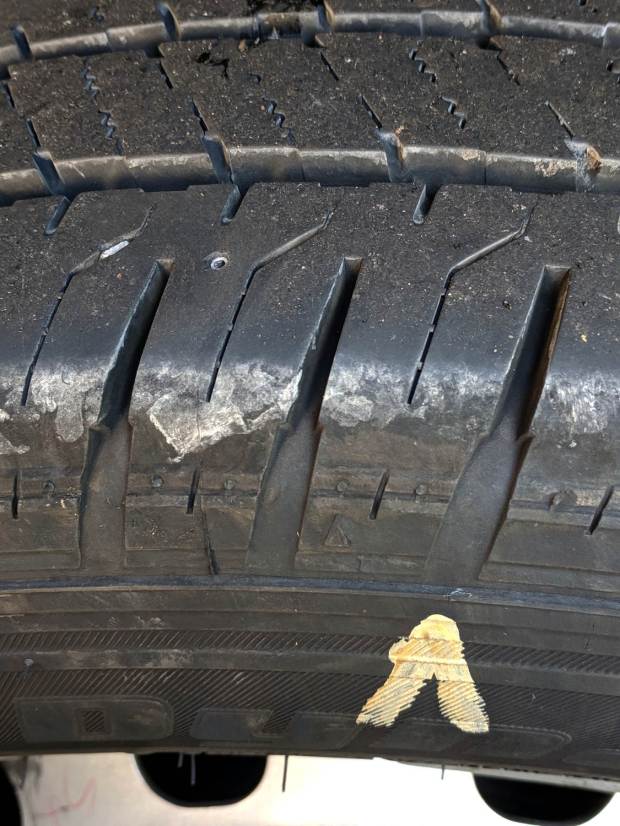
After a few days of topping off the rear tire on Mary’s bike, with no gashes or debris in the tire, I finally replaced the Michelin Protek tube and autopsied it:

While it’s possible to extract the valve and perhaps even clean / replace it, I think that’s just delaying the inevitable. The rubber shreds may be necessary to fill large punctures, but they seem to wreck the valve seal.
Her bike now has an ordinary (pronounced “cheap”) tube inside the Schwalbe Marathon Plus armored tire. We’ll see how long this lasts.
Returning from a long ride, we spotted an unusual sign at the Vassar Farm entrance (clicky for more dots):

Even more unusual was the sight of a matte black MRAP jouncing across the field:

I hadn’t noticed an uptick of the insurgency around here, but I suppose it could happen.
It looks like a Cougar HE 6×6 MRAP on loan from the DLA 1033 Program to the City of Poughkeepsie Police Department. The flat top suggests they dismounted the CROWS gun, which seems a definite step down in no-knock capability.
Some poking around showed the Poughkeepsie Police Department acquired a 107 mm Mortar Carrier some years ago:

The M106 is an impressive hunk of tracked armor, although it seems unsuited for urban warfare and would certainly scuff up the streets pretty badly. I don’t know if they scrapped the M106 in favor of the MRAP.
I’m hoping they don’t collaborate with the Dutchess County Sheriff’s Department to patrol the Rail Trail, even within the City limits.
Spotted along Robinson Lane:

A closer look at the same number of pixels:

The little one way over on the left is definitely having an adventure!
I’d read of goats climbing trees, but never turtles.
I recovered a tool from an intersection during the homeward leg of a bike ride:

The scabbard is a bit the worse for having been run over by traffic, but the knife is still in good shape.
The back of the blade has been well and truly mushroomed:

The blade edge doesn’t have nearly as much damage as you’d (well, I’d) expect from all the hammering on the back and sides:

The molded handle suggests it’s a commercial product, but it has no branding, no maker’s mark, no identification of any kind.
Google Image Search returns useless views of tail lights and rifles. Here, try it for yourself:

I have no idea what it’s used for.
Do you?
[Update: It’s a Bell System Cable-Sheath Splitting Knife, made by Klein Tools. More details in the comments … ]