The Smell of Molten Projects in the Morning

Ed Nisley's Blog: Shop notes, electronics, firmware, machinery, 3D printing, laser cuttery, and curiosities. Contents: 100% human thinking, 0% AI slop.

Category: Recumbent Bicycling

Cruisin’ the streets

  • SJCAM M20 Action Camera: Stuck Battery

    SJCAM M20 Action Camera: Stuck Battery

    The SJCAM M20 action camera has been attached to the back of my Tour Easy for the last 16 months:

    SJCAM M20 Mount - Tour Easy side view
    SJCAM M20 Mount – Tour Easy side view

    The Anker 13 A·h USB power pack on the rack provides juice for a week’s worth of rides, letting the M20’s internal battery keep its clock & settings alive between rides. I recently forgot to turn on the USB pack and discovered the camera shut down just after I cleared the end of the driveway.

    As you should expect, the battery had swollen so much its pull tab … pulled off … when I tried to extract it:

    SJCAM M20 - stuck battery
    SJCAM M20 – stuck battery

    So, we begin.

    Pry off the trim ring around the lens by jamming a small screwdriver in any of the three slots:

    SJCAM M20 - lens ring removed
    SJCAM M20 – lens ring removed

    Then pry off the entire front panel:

    SJCAM M20 - camera front panel
    SJCAM M20 – camera front panel

    Thereby exposing the battery’s rectangular protrusion and three contacts next to the optical block:

    SJCAM M20 - camera interior - battery terminals
    SJCAM M20 – camera interior – battery terminals

    Avoid shorting the brass terminals with, say, a small screwdriver, while shoving the battery out of the camera until you can grab it with your fingers and haul it out the rest of the way:

    SJCAM M20 - swollen battery case - left
    SJCAM M20 – swollen battery case – left

    Yeah, that puppy looks all swoll up:

    SJCAM M20 - swollen battery case - right
    SJCAM M20 – swollen battery case – right

    Remove the all-enclosing label to reveal the bag inside:

    SJCAM M20 - swollen battery bag
    SJCAM M20 – swollen battery bag

    Pull the bag out to reveal the protection PCB:

    SJCAM M20 - battery case interior
    SJCAM M20 – battery case interior

    Snip the wires and salvage the case against future need.

    I bought the camera with three batteries, all three of which are now similarly swollen. I also got two official SJAM batteries with an official SJAM charger; both of those batteries seem to be in fine shape. I expect the codes on the five bags would reveal two different lots, but I’m not going to sacrifice a nominally good battery to find out.

    All three swollen battery bags show the same BEP 782633PL lot code and 1704 date code. I bought everything in January 2018, so those batteries had been sitting on the shelf for the better part of a year. Maybe that’s why they offered a “deal” for two spare batteries along with the camera?

    Installing one of the unswollen batteries, reconfiguring the camera’s settings & clock, and giving it a charge from the Anker USB pack put it back in operation.

  • Traffic Signal Timing: Vassar Rd at Rt 9

    Traffic Signal Timing: Vassar Rd at Rt 9

    Our southbound bicycling routes take us through the intersection where Vassar Rd becomes NY Rt 9D at NY Rt 9. This is a large intersection:

    Rt 9 Vassar Rd SB - distances
    Rt 9 Vassar Rd SB – distances

    It’s worth noting that Rt 9D and Vassar Rd are also NYS Bicycle Rt 9., so bicycle traffic is expected, if not precisely welcomed.

    We’re traveling south on Vassar Rd, stopped in the right-hand lane (in the upper right of the picture). Eventually, the signal turns green:

    Vassar Rd at Rt 9 - Green signal - 2020-06-21
    Vassar Rd at Rt 9 – Green signal – 2020-06-21

    The traffic to our left starts moving, we start pedaling, and ten seconds later the signal turns yellow:

    Vassar Rd at Rt 9 - Yellow signal at 10 sec - 2020-06-21
    Vassar Rd at Rt 9 – Yellow signal at 10 sec – 2020-06-21

    The traffic hasn’t cleared the intersection, either, but they’re moving faster than we are. The first distance marker on the map shows we’ve traveled 85 feet at an average 5.8 mph from a standing start.
    After another five seconds, we’ve traveled 80 more feet (at 11 mph!), almost the far side of the intersection. Which is a good thing, because the signals on Rt 9 have already turned green and vehicles are accelerating toward us.

    There’s no point in reporting this to NYS DOT, because they don’t care and definitely won’t adjust the signal timing just for bicycles.

  • Schwalbe Marathon Plus vs. W5W Bulb Fragment: Standoff

    Schwalbe Marathon Plus vs. W5W Bulb Fragment: Standoff

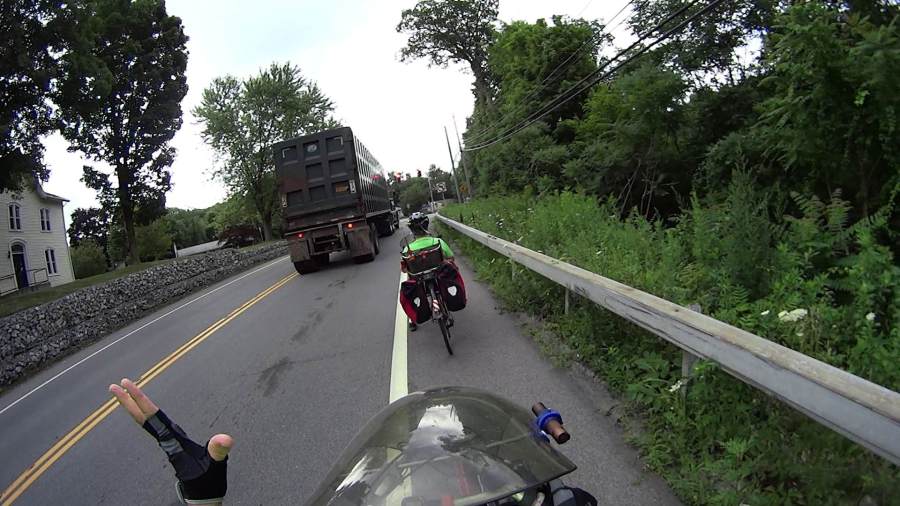
    A clicking sound from the rear of the bike suggested something was amiss as I rolled up the driveway after a recent ride. Spinning the rear tire produced this alarming sight:
    W5W fragment - on tire - side view
    W5W fragment – on tire – side view

    Pulling it out of the gash shows it’s the base of a W5W (or something similar) automotive bulb:

    W5W fragment - on tire - front
    W5W fragment – on tire – front

    Which seems perfectly designed to cripple a bike tire:

    W5W fragment - millimeter scale
    W5W fragment – millimeter scale

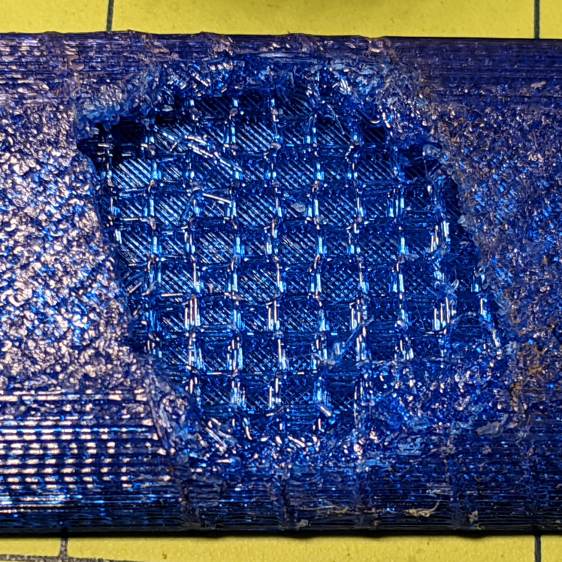
    The gash cuts all the way across the tire tread:

    W5W fragment - tire gash
    W5W fragment – tire gash

    The blue stuff is Schwalbe’s rubber / latex / plastic SmartGuard layer, all 5 mm of it hard at work separating the glass from the inner tube.

    I cleaned the wound, filled it with silicone rubber, topped it with some duct tape, and it’s still holding air after a 13 mile ride. I think the gash cut through the rubber tread and SmartGuard layer, but didn’t affect the cords in the tire carcass, so keeping further road debris out of the gash should let the tire wear out more-or-less normally.

    Putting duct tape on the tread will certainly help …

  • Traffic Signal Timing: Burnett Blvd at Rt 55

    Traffic Signal Timing: Burnett Blvd at Rt 55

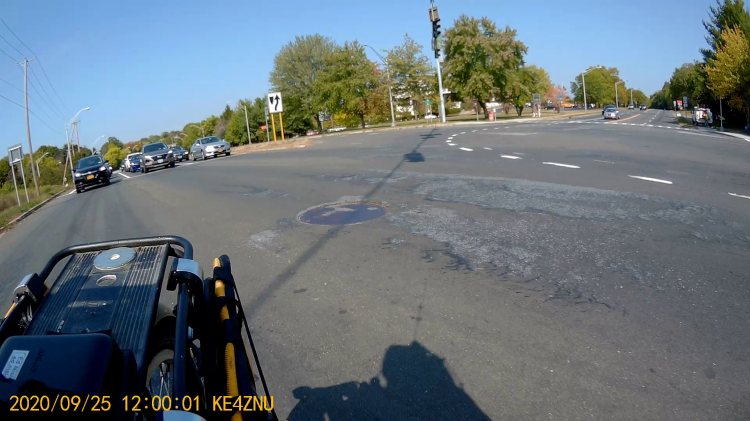
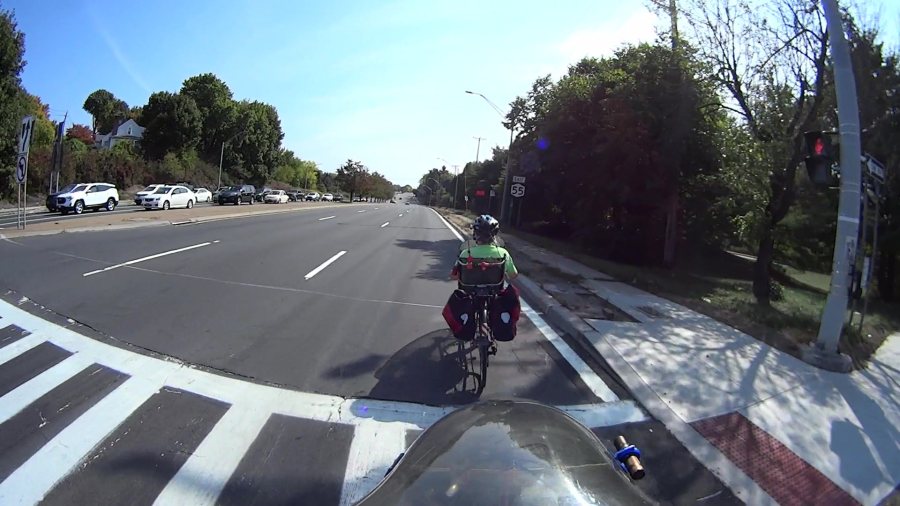
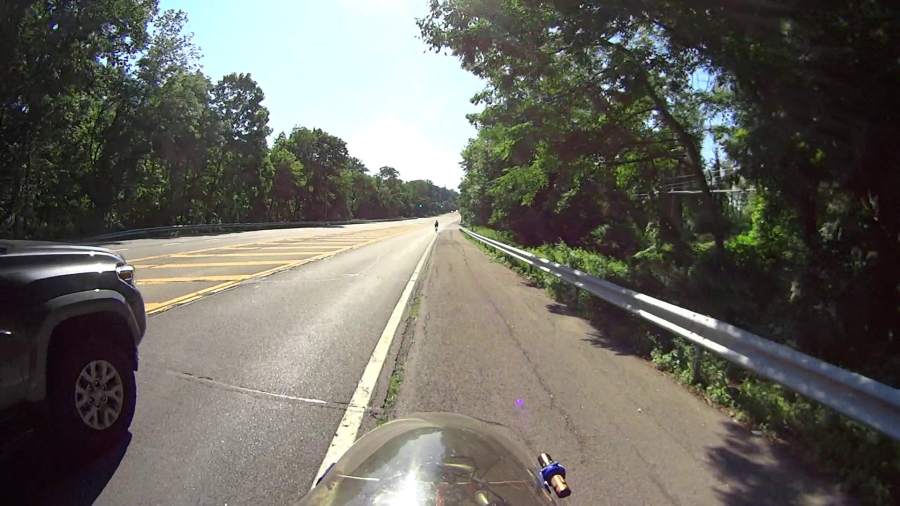
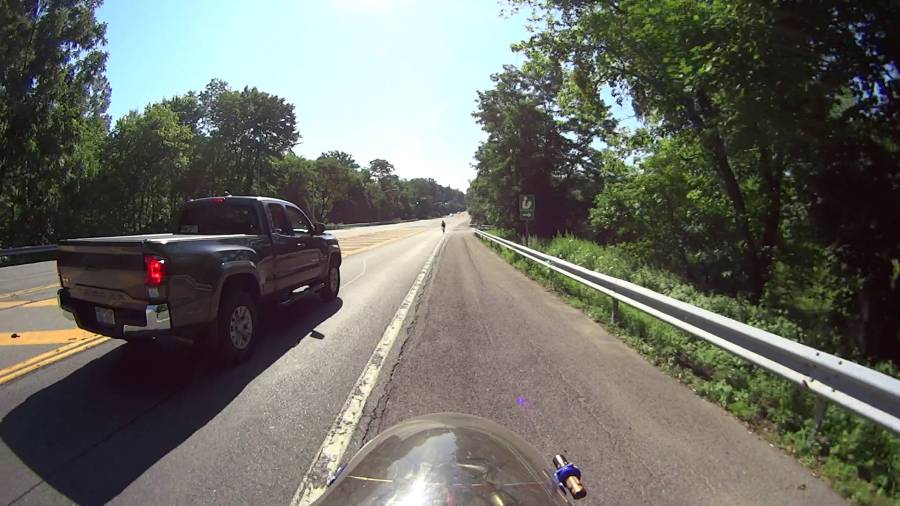
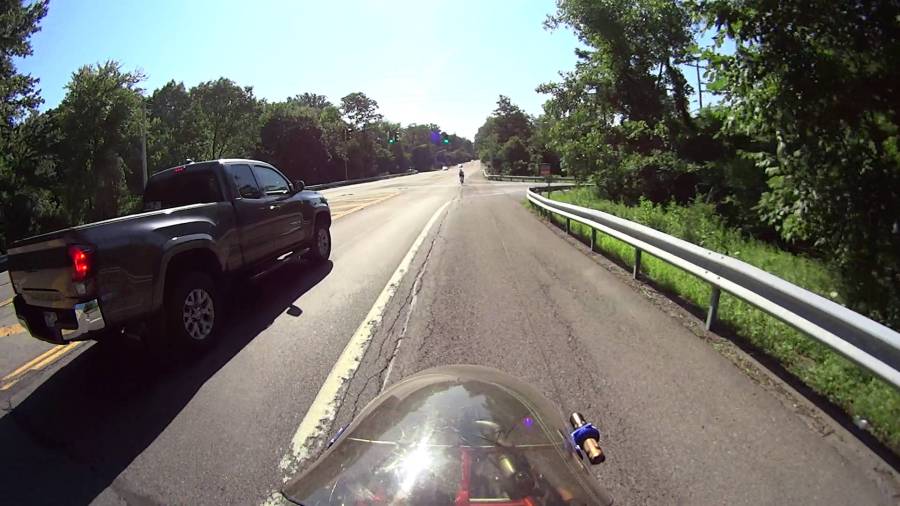
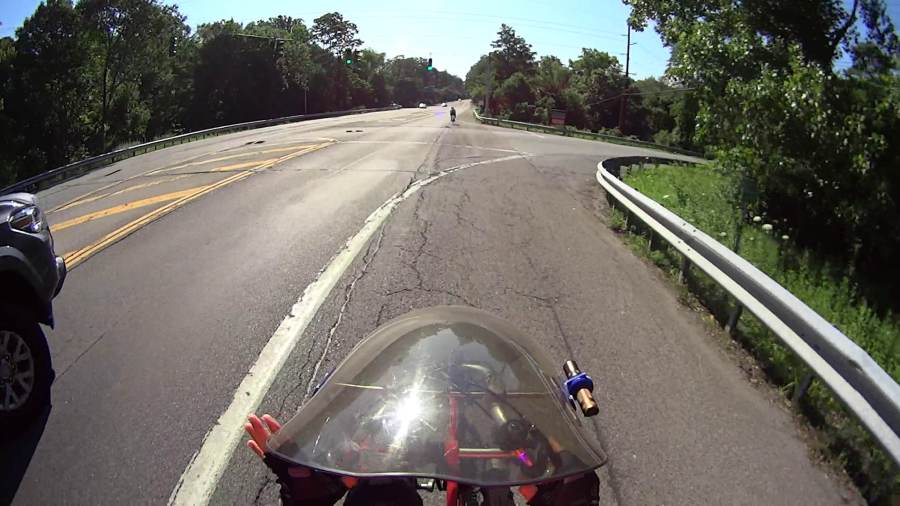
    Nothing has changed since NYS DOT added another five seconds to the green phase on Burnett Blvd in front of their Region 8 HQ building to give bicyclists a generous ten seconds to cross six lanes of traffic from a standing start.

    The Subaru WRX next to us will have no trouble clearing the intersection:

    Burnett Blvd at Rt 55 - Green signal - 2020-06-16
    Burnett Blvd at Rt 55 – Green signal – 2020-06-16

    Ten seconds later, he’s far down the road (barely visible under the median signage) and I’m just lining up with the third traffic lane:

    Burnett Blvd at Rt 55 - Yellow signal - 10 sec - 2020-06-16
    Burnett Blvd at Rt 55 – Yellow signal – 10 sec – 2020-06-16

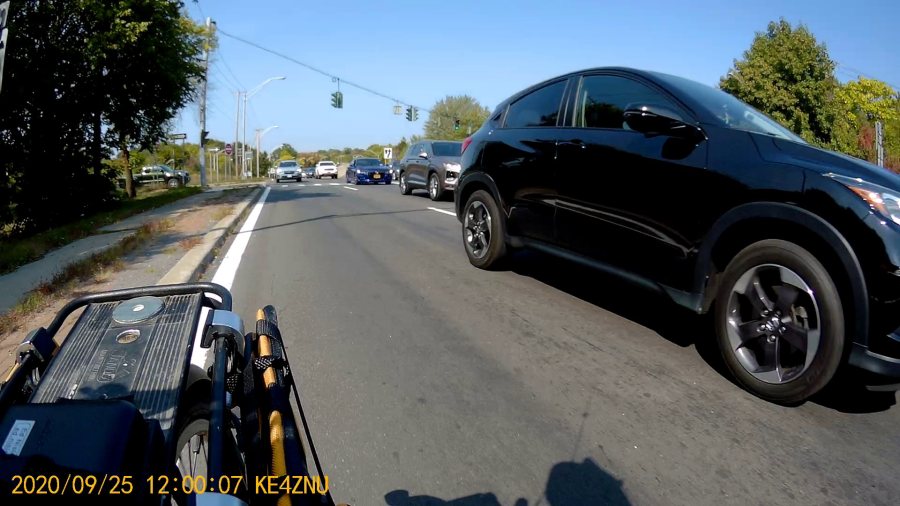
    Four seconds later, traffic on Rt 55 gets a green signal and I’m almost lined up on the far side:

    Burnett Blvd at Rt 55 - Rt 55 Green signal - 2020-06-16
    Burnett Blvd at Rt 55 – Rt 55 Green signal – 2020-06-16

    You’d think with all the emphasis on bicycling these days, NYS DOT would be receptive to change, but … there’s a reason I’m such a bitter, cynical person on that subject.

  • Monthly Image: Rt 376 Overgrowth Clearing

    Monthly Image: Rt 376 Overgrowth Clearing

    NYS DOT cleared the Japanese Knotweed from the shoulder along Rt 376 north of Maloney last year:

    The last image in that gallery is from the end of April; you can see the weeds just starting to grow under the guide rail.

    Japanese Knotweed, being basically a weed on crystal meth, becomes a lush hedge from a standing start in five weeks:

    Knowing how NYS DOT’s Region 8 Dutchess South Residency’s brush trimming has(n’t) worked in previous years, this took us by surprise:

    Rt 376 Marker 1095 - 2020-06-10
    Rt 376 Marker 1095 – 2020-06-10

    Because chopping Japanese Knotweed to the ground doesn’t actually discourage it, we hope they’re scheduled to return every couple of months …

  • No-Knead Bread

    No-Knead Bread

    Although it’s not particularly keto-friendly, I made a loaf of NY Times No-Knead Bread (fine-tuned versions):

    No-knead bread - loaf
    No-knead bread – loaf

    Wow, that tasted good and definitely added a bit more pep to my morning bike rides!

    The receipe produces a rather wet lump of dough in the mixing bowl:

    No-knead bread - mixed
    No-knead bread – mixed

    It looks much more promising after rising for 18 hours:

    No-knead bread - 18 hour rise
    No-knead bread – 18 hour rise

    The recipe calls for a large heavy pot, which produced a long-disused nickel-plated cast iron Wagner Ware No. 8 Drip-Drop Roaster from the attic:

    No-knead bread - Wagner No 8 Roaster
    No-knead bread – Wagner No 8 Roaster

    I scrubbed out the interior and used it as-found to good effect. After the cookin’ was done, a few hours of electrolytic stripping seemed in order:

    No-knead bread - electrolytic pot strip
    No-knead bread – electrolytic pot strip

    The lovely nickel plating on the outside of the pot didn’t need stripping, but the interior is once again a nice flat black surface and the next loaf should drop right out …

  • Monthly Science: USB Current Testers vs. NP-BX1 Batteries

    Monthly Science: USB Current Testers vs. NP-BX1 Batteries

    Having some interest in my Sony HDR-AS30 helmet camera’s NP-BX1 battery runtime, I’ve been measuring and plotting recharge versus runtime after each ride:

    USB Testers - Charge vs Runtime
    USB Testers – Charge vs Runtime

    The vertical axis is the total charge in mA·h, the horizontal axis is the discharge time = recorded video duration. Because 1 A = 1 coulomb/s, 1 mA·h = 3.6 C.

    The data points fall neatly on two lines corresponding to a pair of cheap USB testers:

    USB Testers
    USB Testers

    When you have one tester, you know the USB current. When you have two testers, you’re … uncertain.

    The upper tester is completely anonymous, helpfully displaying USB Tester while starting up. The lower one is labeled “Keweisi” to distinguish it from the myriad others on eBay with identical hardware; its display doesn’t provide any identifying information.

    The back sides reveal the current sense resistors:

    USB Testers - sense resistors
    USB Testers – sense resistors

    Even the 25 mΩ resistor drops enough voltage that the charger’s blue LED dims appreciably during each current pulse. The 50 mΩ resistor seems somewhat worse in that regard, but eyeballs are notoriously uncalibrated optical sensors.

    The upper line (from the anonymous tester) has a slope of 11.8 mA·h/minute of discharge time, the lower (from the Keweisi tester) works out to 8.5 mA·h/minute. There’s no way to reconcile the difference, so at some point I should measure the actual current and compare it with their displays.

    Earlier testing suggested the camera uses 2.2 W = 600 mA at 3.7 V. Each minute of runtime consumes 10 mA·h of charge:

    10 mA·h = 600 mA × 60 s / (3600 s/hour)

    Which is in pretty good agreement with neither of the testers, but at least it’s in the right ballpark. If you boldly average the two slopes, it’s dead on at 10.1 mA·h/min; numerology can produce any answer you need if you try hard enough.

    Actually, I’d believe the anonymous meter’s results are closer to the truth, because recharging a lithium battery requires 10% to 20% more energy than the battery delivered to the device, so 11.8 mA·h/min sounds about right.

    Memo to Self: Trust, but verify.