The Smell of Molten Projects in the Morning

Ed Nisley's Blog: Shop notes, electronics, firmware, machinery, 3D printing, laser cuttery, and curiosities. Contents: 100% human thinking, 0% AI slop.

Category: Photography & Images

Taking & making images.

  • Remembering Which Cells Need Charging

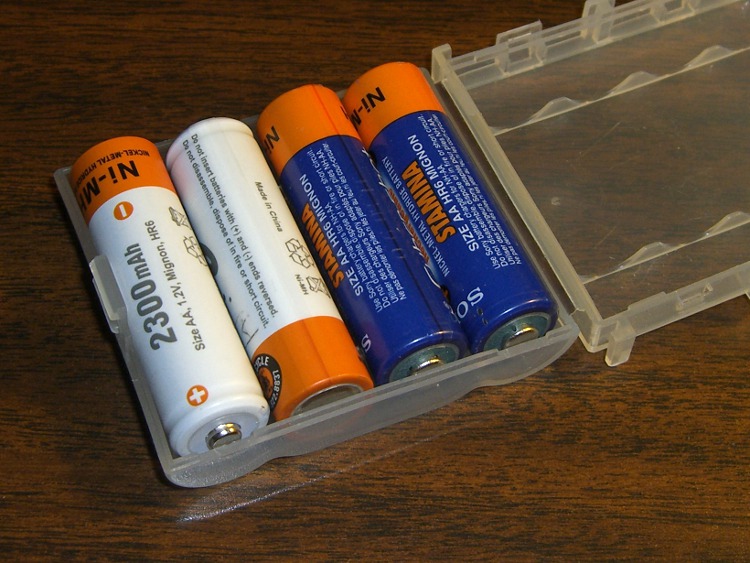
    My Sony DSC-H5 eats NiMH cells like candy, which means I must haul along a pocketful of the things. That means I often wind up with a case containing one charged pair and one uncharged pair.

    Ditto for swapping cells in the blinky lights on our bikes.

    Pop quiz: which pair is which?

    Battery Charge State Reminder
    Battery Charge State Reminder

    It’s pretty easy:

    • Nose-to-tail = as in the camera = charge ’em
    • Nose-to-nose = as in the charger = ready to use

    You could do some remote psychoanalysis based on that sort of behavior, but you’d be completely right.

  • Red Squirrel

    Red Squrrel - front
    Red Squrrel – front

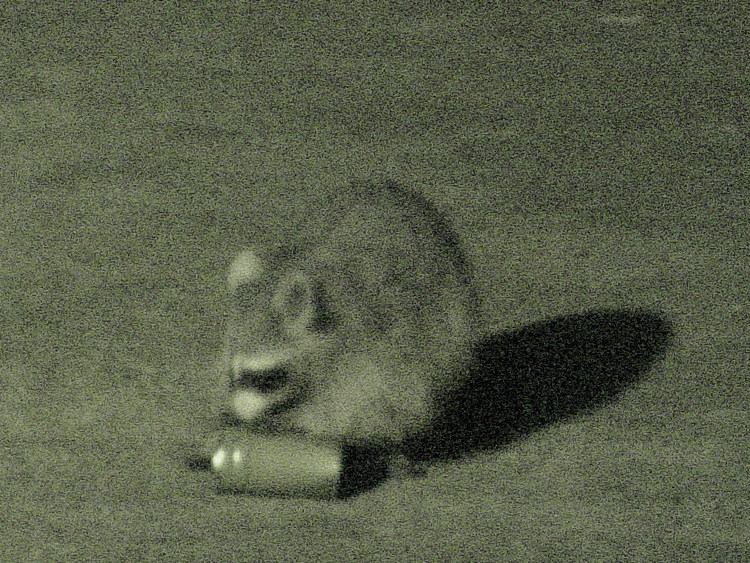
    I cleaned the compost out of the gutters yesterday and this critter came by to help with whatever missed the wheelbarrow.

    Squirrels and chipmunks show how far you can get with a snappy color scheme and a good PR agent. These things are rodents, pure and simple, but those large eyespots trip your protect-the-baby response every time.

    They’re not particularly well-behaved, either: the chipmunks and gray squirrels have had running battles with them this spring. We think the area’s chipmunks had a population explosion and are shoving into traditional red-squirrel territory. Could get ugly out there.

    Where are the hawks when you need ’em?

    Red Squirrel - side
    Red Squirrel – side
  • Generic Sony NP-FS11 Li-Ion Packs: Rebuild FTW!

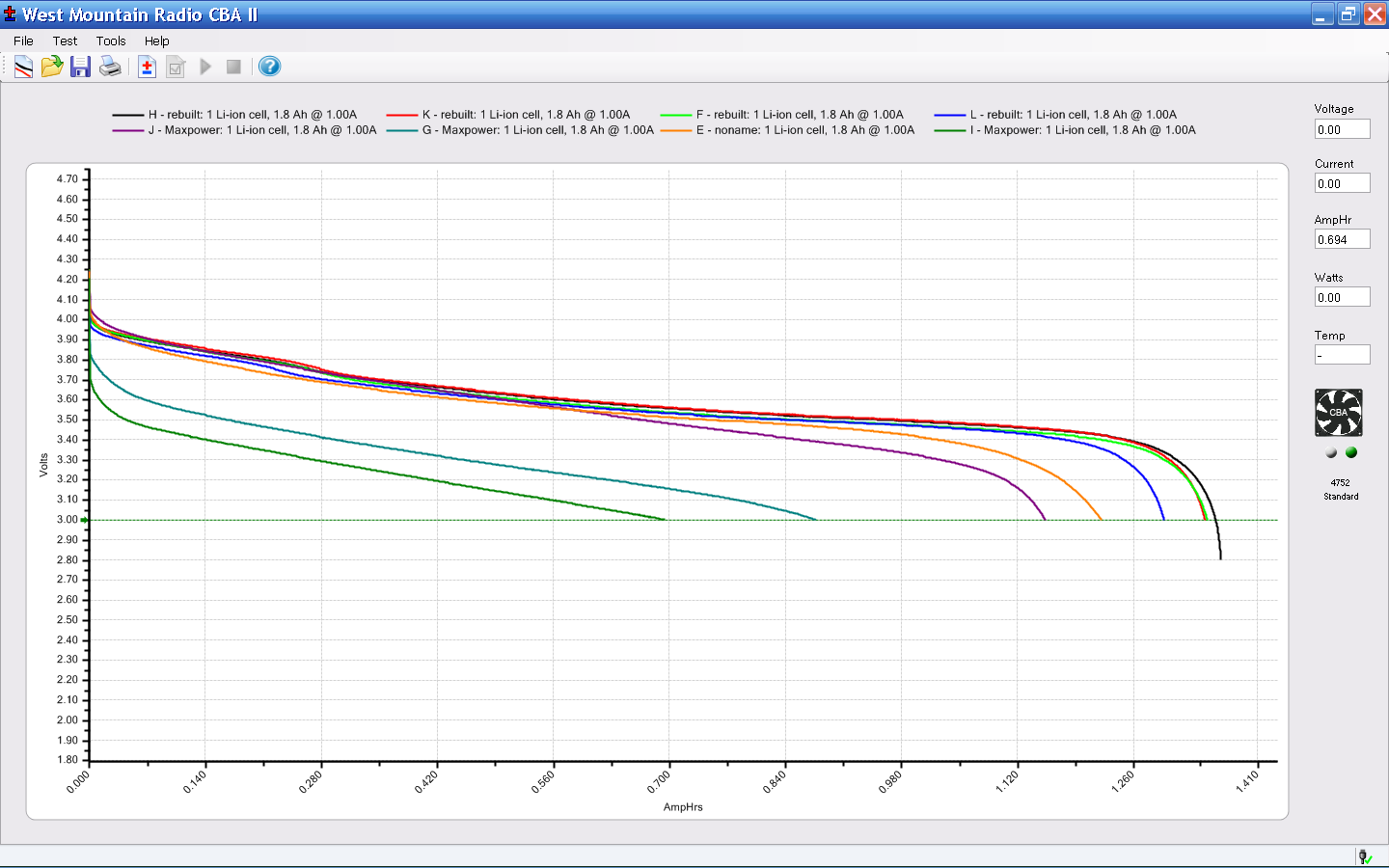
    Herewith, the discharge test results for all the generic Sony NP-FS11 battery packs I have (click for a bigger image).

    Sony NP-FS11 Status - 2010-04
    Sony NP-FS11 Status – 2010-04

    The five mostly overlapping upper traces consist of:

    • Three packs (H, K, and L) rebuilt from the eBay junkers
    • F rebuilt from a deader in my collection
    • E is an older, no-name pack that just continues to work

    The rebuilt packs now have cells from batteryspace.com that are working fine: nominal capacity 600 mAh, actual around 1200 to 1400 for a parallel pair. It’s surprising to see a cell producing its rated capacity…

    The two lowest traces (G & I), plus the purple trace (J) are from the eBay source. The first two are obvious junk, but pack J is actually pretty good. The fact that it’s the best of six packs from that vendor tells you all you need to know about their QC.

    For those of you joining us via search engines, the rest of the story:

  • Generic Sony NP-FS11 Battery Packs: Surprising Contents Thereof

    So I dismantled the three junk packs I got from halfway around the world and rebuilt them with better-quality cells. Search for NP-FS11 and you’ll find the rest of the story.

    Some observations…

    These cases are the thinnest plastic that doesn’t actually break when you pick it up: to crack the case seam, you must push firmly. Two of the three packs were already cracked and the third yielded to a slight squeeze.

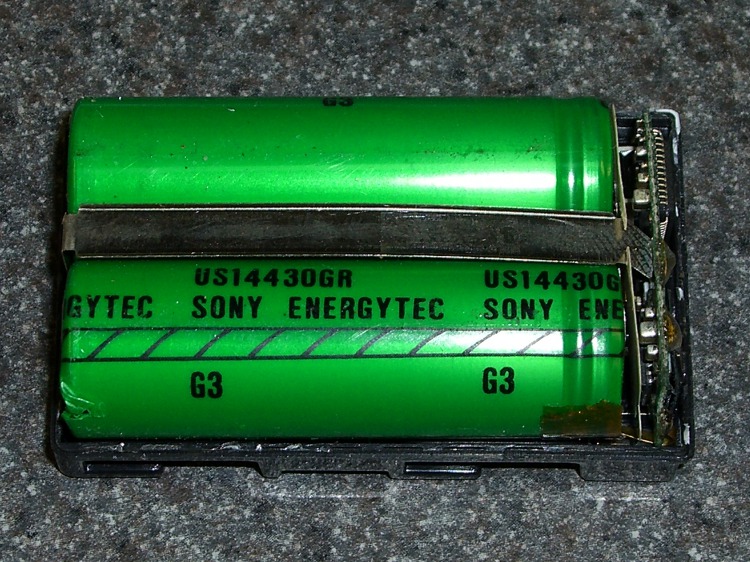
    What’s inside? Welly, welly, welly, what do we have here?

    DOA Battery Contents
    DOA Battery Contents

    The cells are labeled Sony Energytec, which ought to be a reputable brand name. Some possibilities:

    • Counterfeit cells
    • Quality test rejects

    I don’t know why you’d bother putting counterfeit cells inside a generic case; it’d be more profitable to sell a completely counterfeit battery with a fancy Sony label. So I’m guessing these came from a batch of cells that failed inspection and were miraculously saved from destruction.

    Battery Protection Circuit Board
    Battery Protection Circuit Board

    They have the usual protection circuit board on the top. What’s a bit tricky is that you must unsolder the three leads connecting to the case terminals before you can extract the cells. I unsoldered the strap from the negative terminal while I was at it; the positive lead is inaccessible beyond the black IC on the left.

    After that, it’s a straightforward rebuild.

  • LED Beam Patterns

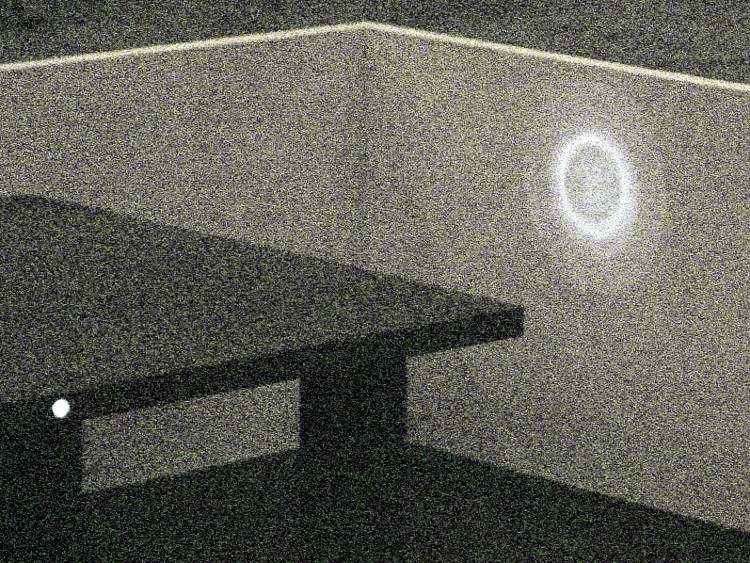
    Red LED Beam Pattern
    Red LED Beam Pattern

    For some reason, everybody thinks LEDs put out nice Gaussian beams. Unless the specs say so, it just ain’t so. Some pix from the Trinity Robotics Contest show the situation.

    This is the table used in the RobotWaiter contest. It has a visible red LED on each face to aid in locating and aligning, but you better not depend on the actual beam intensity as a function of angle!

    The same picture in pure IR shows the situation with a bit more contrast. Although it’s a visible red LED and I have a visible-cut filter on the lens, there’s enough energy for an image.

    Red LED Beam Pattern in IR
    Red LED Beam Pattern in IR

    These IR LEDs have the same general pattern.

    IR Distance Sensor Emitters
    IR Distance Sensor Emitters

    Pix with my ancient Sony DSC-F717 in NightShot mode with a Hoya R72 IR filter.

  • Replacement NP-FS11 Li-Ion Battery Pack: Plan B In Full Effect

    Rebuilt NP-FS11 battery with Kapton tape wrap
    Rebuilt NP-FS11 battery with Kapton tape wrap

    So I picked up some 4/5 AA cells from a nominally reputable supplier and popped a pair into the NP-FS11 case from the oldest pack.

    All eight cells were within 3 mV of each other, so I sorted them by voltage and picked two from the middle of the lineup. Shorting them together in parallel produced a few microamps of current, so they’re as well matched as seems reasonable.

    Rather than attempt to solvent-bond the case back together, I wrapped a layer of Kapton tape around the whole thing. The case doesn’t have quite enough meat to bond, anyway, because the width of the slitting saw turned that much plastic into dust.

    A bunch of cutouts along the bottom edge key it into the charger, so I cut out the tape over those sections. Despite what it looks like, the small metal tab between the two terminals (on the top) is not covered in tape; that’s the snazzy InfoLithium contact that tells the camera that this is a valid battery.

    The camera reported the pack had about 15 minutes of life remaining, which makes sense given that the cells spent quite a while in transit. I ran it down to empty, put it in the charger, and it seems to be perfectly happy. I’ll do a capacity test after a round or two of picture-taking.

    I doubt the tape will prove to be a permanent fix, but as far as the camera is concerned, that slick Kapton makes it go in and out like anything

  • Generic Sony NP-FS11 Lithium-Ion Packs

    Sony no longer offers the NP-FS11 Li-Ion batteries required for my DSC-F505V camera, so I’ve been using “generic” replacements for quite some time. My experience has been mixed: some batteries provide a reasonable amount of run time, others provide almost none.

    Feeding the appropriate keywords into Froogle gives you a range of battery suppliers, with offerings from, as of this writing, $3 to $103. Perhaps not surprisingly, the image for a $70 battery exactly matches the one on my desk that cost perhaps $15 a few years ago… although I’m certain that the actual battery you’d get wouldn’t match that picture.

    I just bought three NP-FS11 batteries from the usual low-buck Hong Kong eBay supplier: six bucks apiece, shipped halfway around the world. The eBay listing claimed 1800 mAh, which seemed aggressive, and the batteries sport a 3900 mAh label, which is flat-out impossible.

    Frankly, I didn’t expect much and here’s the discharge test graph to show I wasn’t disappointed. I used a 1-amp rate as a reasonable guess at the camera’s peak draw, although that might be a touch high for a continuous discharge.

    Generic Sony NP-FS11 Li-Ion Batteries
    Generic Sony NP-FS11 Li-Ion Batteries

    The top blue curve is from a two-year-old literally no-name battery (no logo, no nothing!) that still provides decent run time; it’s the one matching that $70 battery. It provides about 1100 mAh, reasonably close to its 1300 mAh rating.

    The middle curves, black and purple, are two of the new cells that provide about 900 mAh: half the as-listed-on-eBay capacity, 25% of the absurd label value. Their very low terminal voltage during most of the discharge says that these won’t provide much run time at all.

    The green curve piddling off on the bottom is the third new cell, which is obviously defective. As I said, I didn’t expect much and I certainly wasn’t surprised.

    The red curve is an old and completely defunct batteries.com offering that never provided good service.

    Here’s another plot of three successive charge-discharge cycles for just the three new batteries. The first curves (at 1.0 A) correspond to what you see above, the remaining two sets (at 0.5 A) are the next two cycles. Batteries G and I have improved, H remains a dud.

    MaxPower NP-FS11 Battery Tests
    MaxPower NP-FS11 Battery Tests

    Given the varied offerings on the Web, I believe that there is no way to ensure you’re getting a known-good battery from a reputable supplier. It’s absolutely certain that price does not correlate with quality; the ones I bought simply establish that low-end offerings are crap.

    The purchase was worth it for the amusement value alone; I don’t expect any action from the vendor, although I did send a copy of that graph with some explanatory text. The question is whether I should give them a five-star rating for prompt delivery…

    As it happens, there’s enough room to slide a standard CR123A-size cell into the battery compartment. I think a bit of Quality Shop Time applied to a dead NP-FS11 battery case (and the vital Sony “Infolithium” DRM module) will provide a baseplate with all the proper connectors. Perhaps I can conjure up a “battery” containing a single cell of known-good quality?

    Primary CR123A cells supply only 3 V, not the 3.6 V the camera really wants, so I can’t use disposable cells.