Ed Nisley's Blog: Shop notes, electronics, firmware, machinery, 3D printing, laser cuttery, and curiosities. Contents: 100% human thinking, 0% AI slop.
These are the bare cells, without the protection circuit in series, so the voltage is a bit higher than the camera will see. One is completely dead and two of them appear to have about 1 A·h of capacity, but the discharge voltage evidently drops below what the camera considers acceptable.
They’d work fine driving a less fussy load, though…
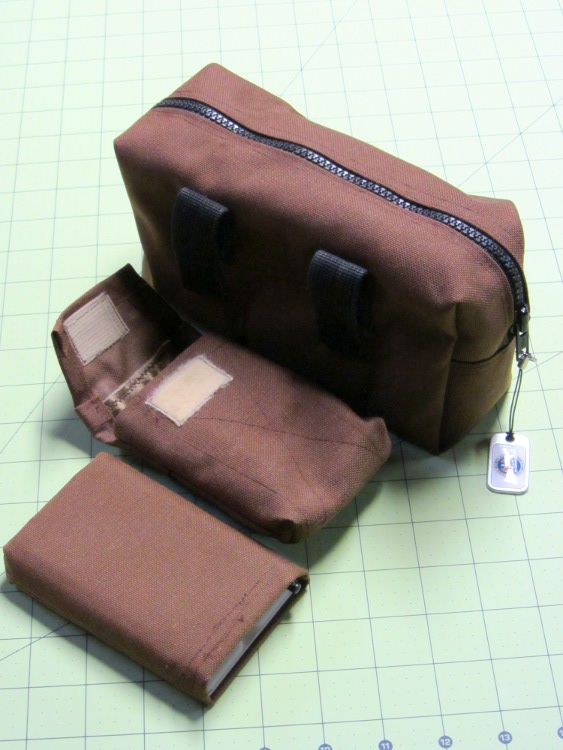
Mary made me several presents early this year: a new belt pack, a camera case for the Canon SX230HS, and a touchup for the Zire 71 case:
Belt pack – camera case – PDA case
The belt pack has an interior lining with many side pockets for the stuff I deem essential; it’s also large enough to hold both the camera and the PDA when I’m out biking around. The camera case includes a pocket nestling a battery against the camera’s front side, beside the lens cap. The Zire case, well, at some point I suppose I’ll be forced to get a phone, but, until then, this will suffice.
They’re all made from coated pack cloth, not that I expect to dunk myself in water (or that it’d do any good), but it seems to never wear out.
*hugs*
(And, yes, it probably should be “Therefor”, but …)
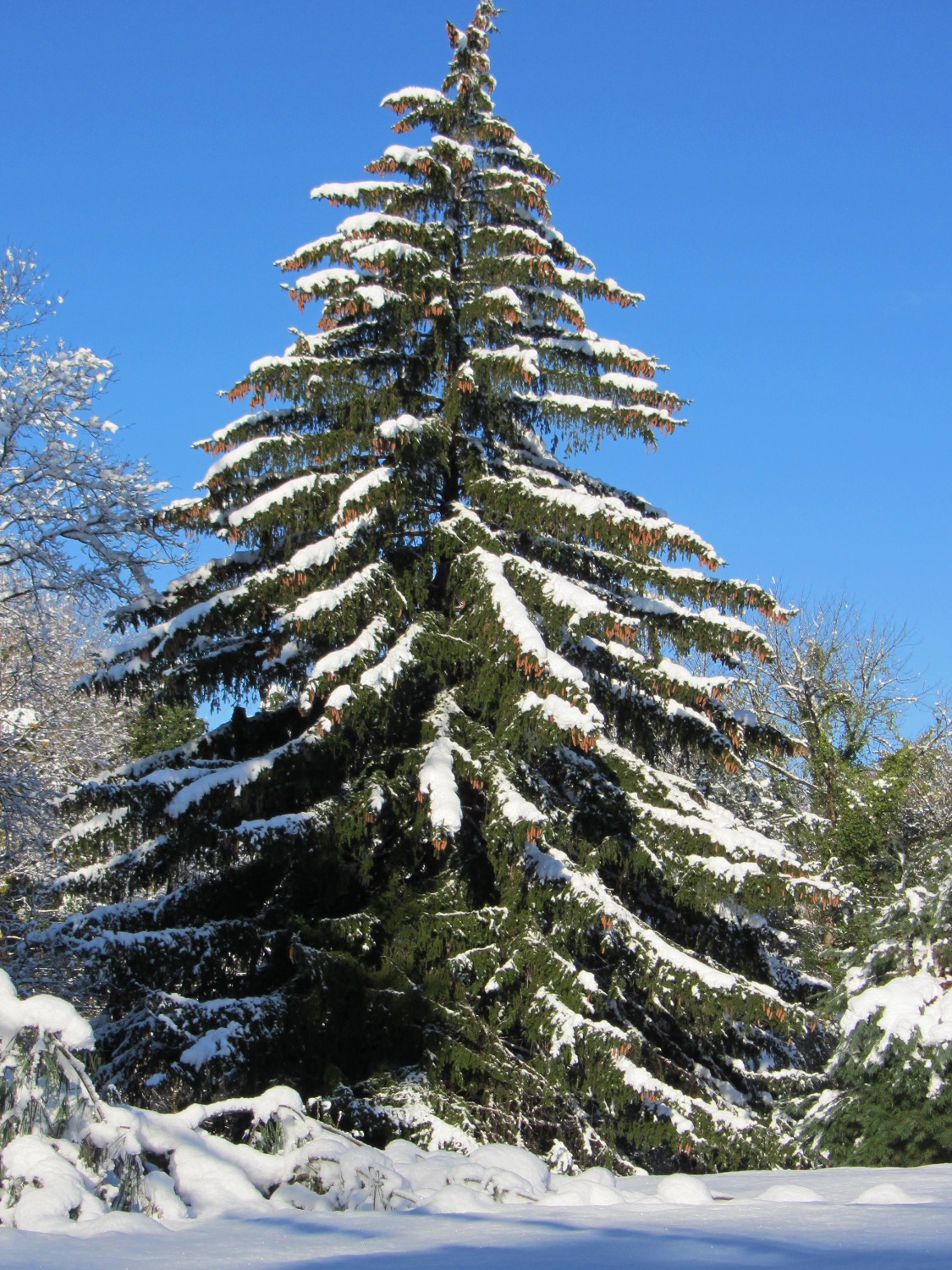
That’s the great tree in our neighbor’s front yard, taken on the crystal-clear morning following Snowtober, carefully framed and cropped to exclude all the snapped branches and downed trees surrounding it. Beauty is where you find it…
[Update: Starting in early December 2012, this post had plenty of hits based on search terms similar to “pine tree”, “pictures of snow covered trees”, and suchlike. If you arrived here by search engine: welcome! Do, please, note the Creative Commons copyright terms described there. If you want the high-resolution image, that link also has the contact form. Thanks…]
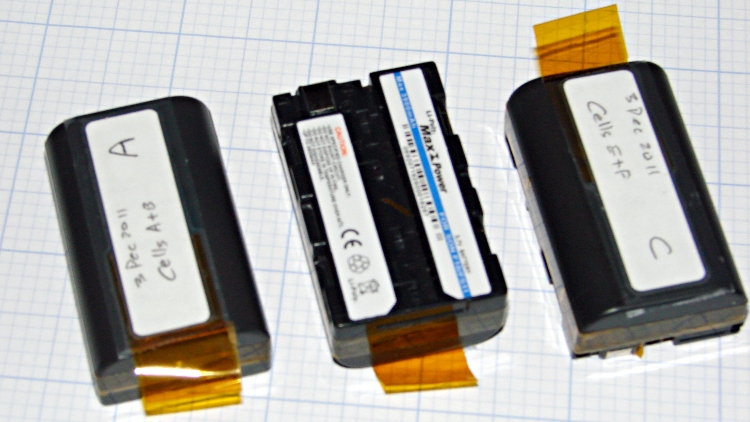
The batteries I rebuilt for our much-beloved Sony DSC-F505V camera back in early 2010 have faded away with constant use. Having already sawed the cases open, rebuilding three of them didn’t pose much of a challenge; this time I added a short tab of Kapton tape to help extract them from the camera socket.
Rebuilt NP-FS11 batteries
Three batteries seems to be about the minimax for ordinary use:
One in the camera
One in the carrying case
One in the charger
You (well, we) can’t keep track of more than three: it always seems one battery gets overused and another gets lost in the dark. We’ll see how three works in practice; there’s a set of six more raw cells lying in wait.
The new batteries produced these results on their first two charge-discharge cycles:
Sony NP-FS11 2011 Packs – First Charges
One battery didn’t come up to speed on the first charge, but after that they’re all pretty close.
The script I use to fetch screen dumps from my HP8591 spectrum analyzer works fine, but it turns out that the screen images have (at least) two sizes.
The hp2xx program converts the screen dumps from HP-GL text files to PNG bitmaps:
for f in *hgl ; do hp2xx -m png -c 1436 "$f" ; done
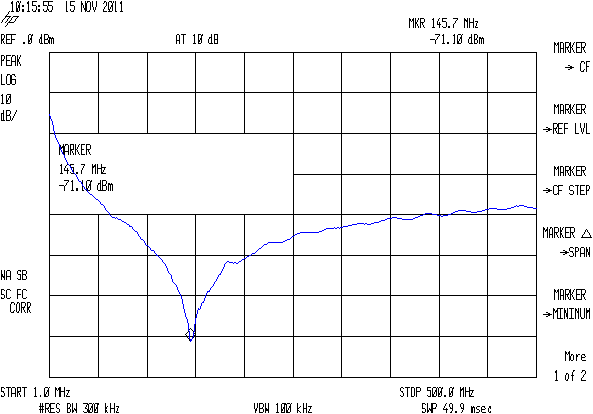
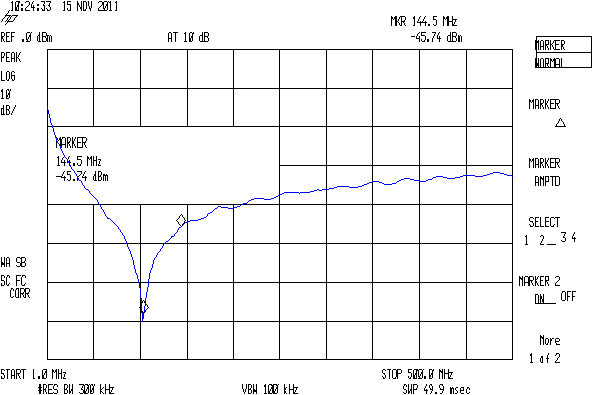
The usual size is 593x414 pixels:
SMD 470 pF – Comm Spec
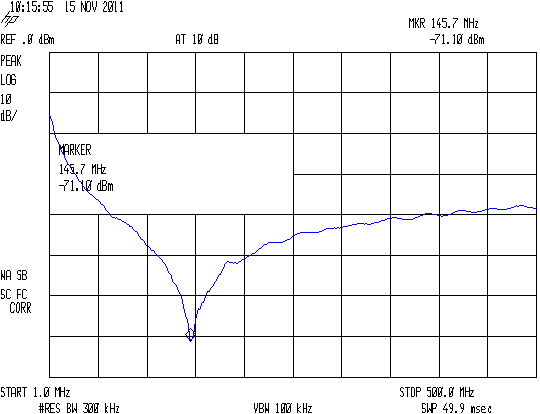
The other size is 593x395 pixels:
SMD 470 pF – Surplus
As nearly as I can tell, the spectrum analyzer mashes the Y coordinate when any of the soft keys along the right edge have reverse-video highlights, which print as outlined boxes. There may be other sizes; those are the two I’ve stumbled over so far. This doesn’t much matter unless I’m using the images in a column, in which case it’s awkward to have two sizes: a one-size-fits-all script to trim off the soft keys doesn’t produce the proper results.
Musing on how to figure this programmatically…
The file command gives the pixel dimensions, with the file name (which may contain blanks: so sue me) set off with a colon:
You need single quotes around the geometry parameter to prevent Bash (or Dash or whatever) from gnawing on the bang character (yes, that’s how you pronounce “!”).
The images are lossless PNGs because they consist entirely of single-pixel lines and characters; alas, resizing by non-integer factors close to 1.0 introduces nasty picket-fence aliasing artifacts:
Resize x 1.049
I resize the pix by a nice, even factor of two (which also adds aliasing artifacts, but in small and very regular doses) and set the dots/inch value so the images print at about the right size without further hassle along the production pipeline:
mogrify -density 300 -resize 200% whatever.png
Which looks like this:
Resize 2.00
Resizing from the smaller images to (roughly) the final size in one step doesn’t look quite so awful:







 The Smell of Molten Projects in the Morning