Ed Nisley's Blog: Shop notes, electronics, firmware, machinery, 3D printing, laser cuttery, and curiosities. Contents: 100% human thinking, 0% AI slop.
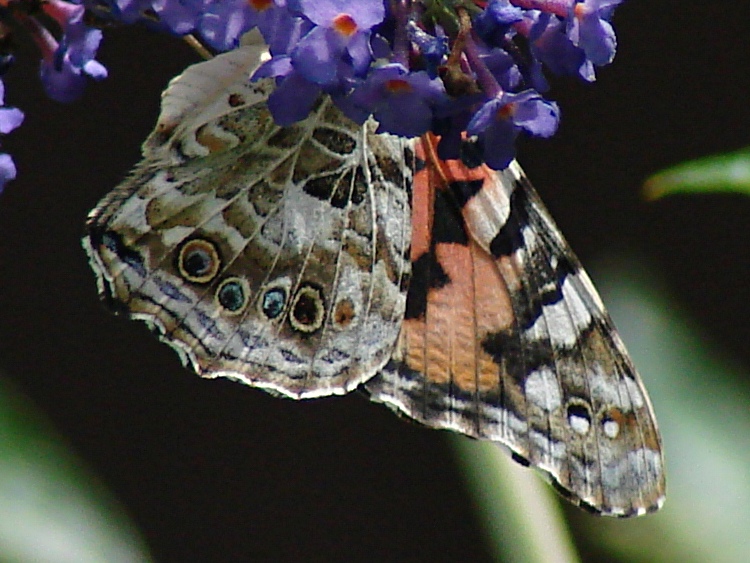
The underwing shows four eye spots as distinguishing features:
Painted Lady – underwing
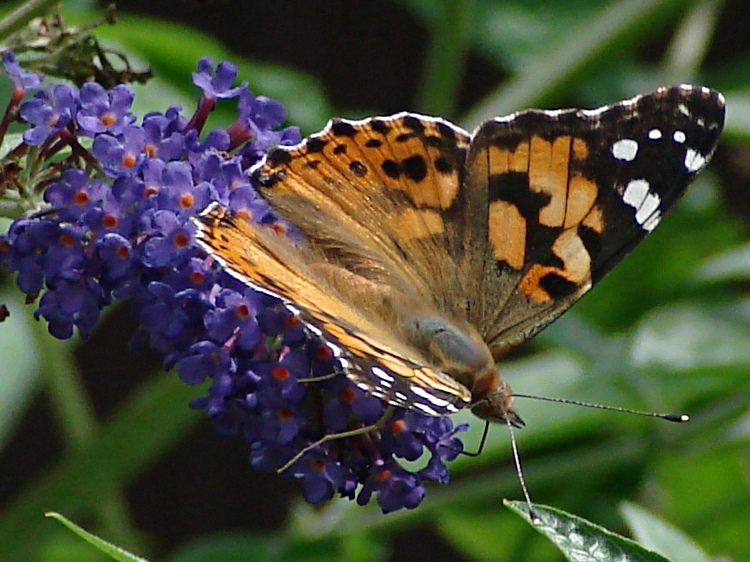
Painted Ladies have odd-looking “faces” on their front end:
Painted Lady – front
The proboscis works wonderfully well on deeper flowers than these, but they’re not passing anything up:
Painted Lady – proboscis
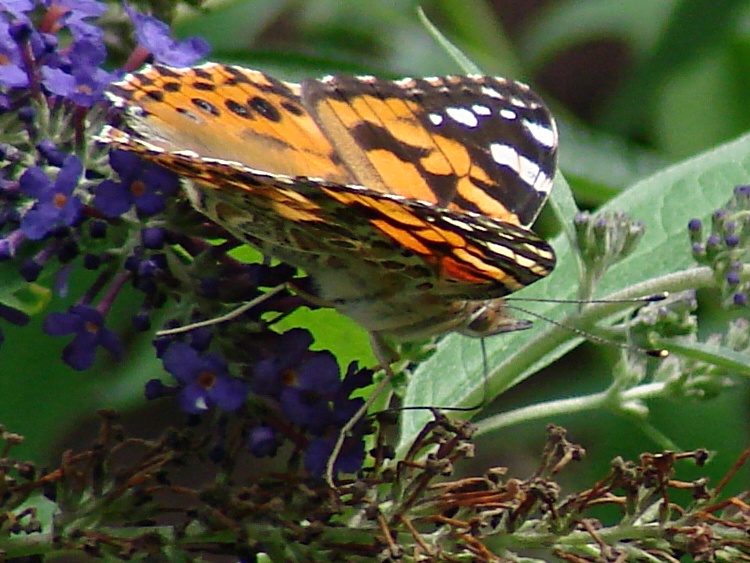
Another view:
Painted Lady – right side
The refueling tube stows neatly for flight:
Painted Lady – proboscis curled
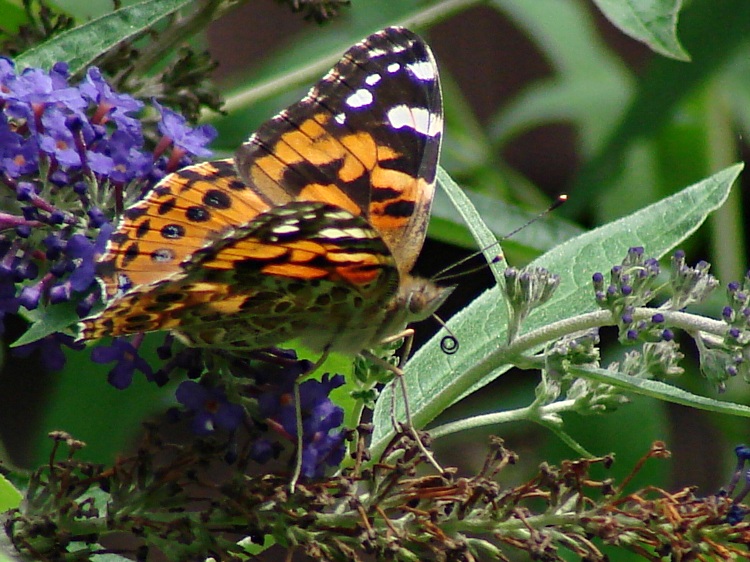
One had a few notches taken from a wing:
Painted Lady – left rear
You can’t ask for prettier colors:
Painted Lady – right front
These are all hand-held with the DSC-H5 wearing the 1.7 teleadapter, underexposed by 1 stop to keep the dark background from burning out the butterfly colors. The images are very close to dot-for-dot crops from much larger pictures, with a touch of unsharp mask, and no color fiddling at all; bright daylight and a gorgeous subject come out beautifully!
Each of the three chandeliers in the Poughkeepsie Train Station sports 36 bulbs in two rings. When the station opened in 1918 they installed those newfangled incandescent bulbs that were all the rage at the time. The color of the bulbs in this Wikipedia picture, dated October 2007, suggests that tungsten ruled for at least nine decades:
Poughkeepsie Train Station Interior
Since then, they installed chunky compact fluorescent bulbs that probably provide the same amount of light, minus the pinpoint highlights from tungsten filaments in clear bulbs. This view from below the central chandelier shows the layout and some detail of the carving & decorative sockets:
Pok RR Station Middle Chandelier – detail
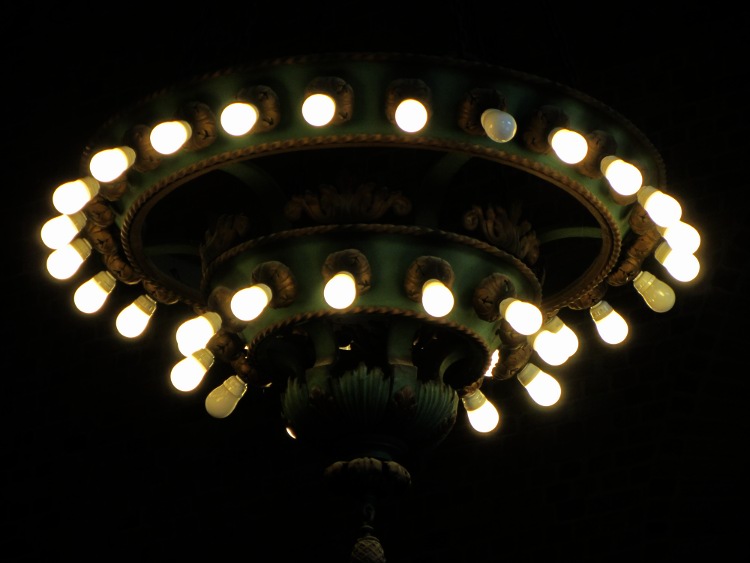
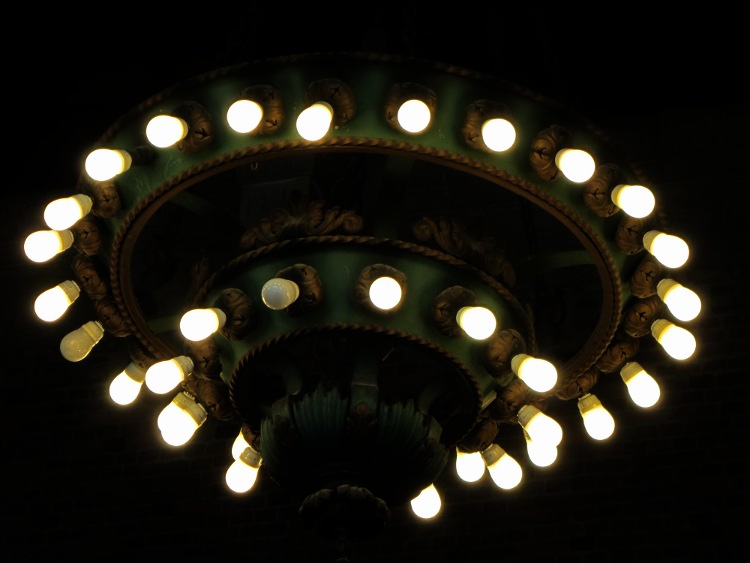
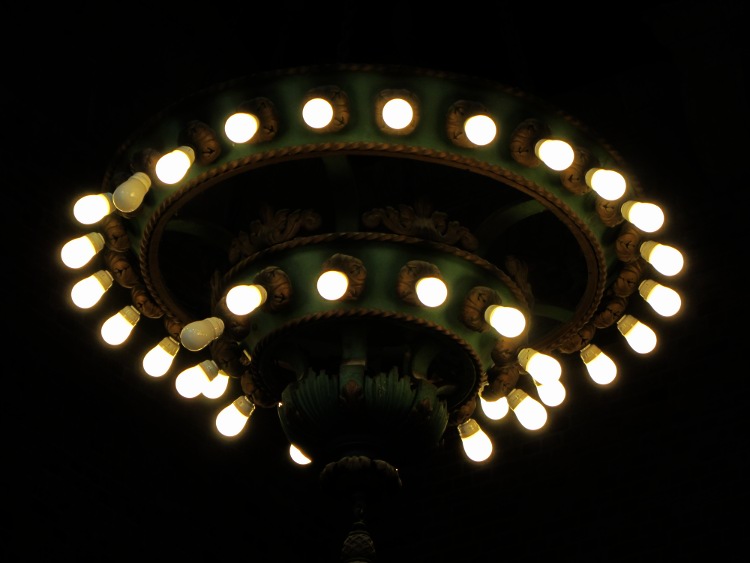
In addition to being decorative, those chandeliers also give useful data on the reliability of compact fluorescent bulbs. With the contrast stretched the other way to make the bulbs easier on the eye, count the number of deaders in …
Chandelier 1:
Pok RR Station Chandelier 1
Chandelier 2:
Pok RR Station Chandelier 2
Chandelier 3:
Pok RR Station Chandelier 3
I took each picture from a vantage point showing all the deaders; the bulbs hidden behind the central dingus work.
Let us assume all 108 bulbs were installed at the same time and, given the number of deaders, haven’t been touched since then (although they’re not covered in fuzz, which suggests that they’ve been dusted within living memory). I was there in mid-afternoon, so the bulbs probably burn 24 hours/day and aren’t subject to early failure from frequent starts.
So, in no more than five years, 108 CFL bulbs have a 4.6% failure rate, which works out to 0.9%/year, more or less, ignoring any infant mortality. If they’ve been up there for the last 2.5 years, then it’s 1.8%/year. Replacing deaders since installation, of course, makes it worse than that.
Over the course of a decade, a compounded 0.9% failure rate will kill 9.4% of the bulbs. After 20 years, 20% will be dead. A 1.8% annual failure rate kills 20% and 43%, respectively.
Now, I’ll grant you that tungsten bulbs burn far more energy over that time, but replacing a percent or two of those complex and somewhat eco-hostile CFL bulbs every year cuts away a big chunk of the rainbows-and-pink-unicorns delight involved in Saving The Planet.
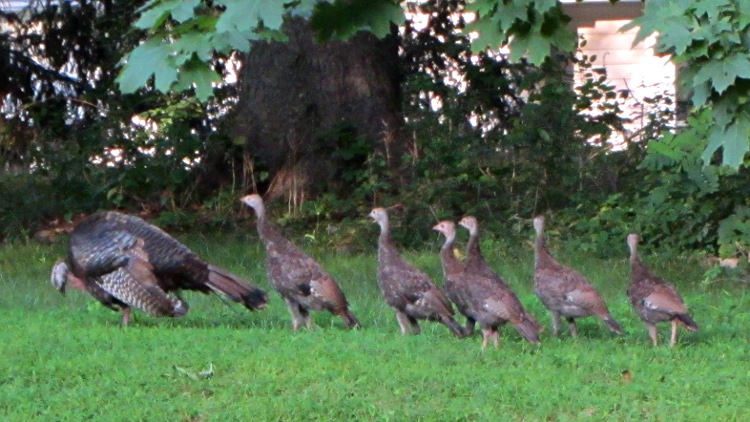
Two turkey hens have formed a creche with seven chicks; if that seems a low number compared with the five in that clutch, we may have just seen the reason.
The turkey flock came foraging across the back yard one evening while we were eating supper on the patio:
Turkey Chicks – foraging
The hens began behaving oddly and the chicks went into periscope mode while looking in all directions at once:
Turkey Chicks – high alert
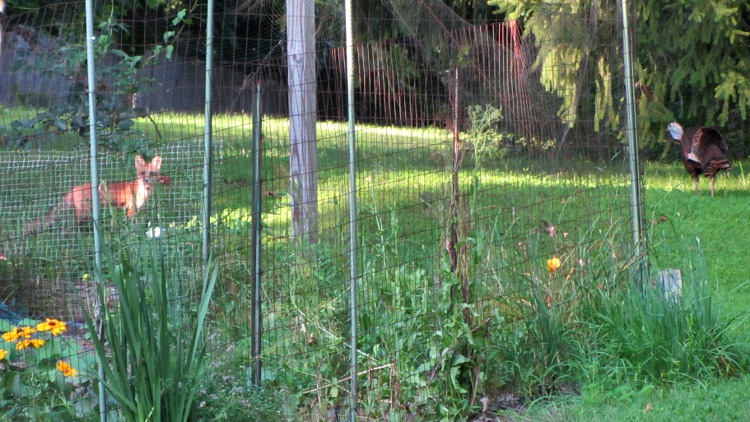
After a moment, we saw this tableau:
Red Fox and Turkey Hen
The red fox entered from the left, then made a great show of ignoring the turkeys while scratching an ear, licking its nuts, and examining the ground as the hens postured and threatened. The fox eventually trotted off to the right, through the grove in the rear, and away.
The flock required a few minutes to stand down from the alert:
Turkey Hen and Chicks – standing down
And then they moved on, searching for yummy things in the grass as usual…
The pictures are crap from the Canon SX230HS, hand-held at long telephoto, and ruthlessly cropped; the high-res originals aren’t much better than these. I’d expect better results in shaded sunlight, but for obvious reasons I couldn’t move any closer or pause to fetch a tripod. The fox tableau seems perfectly focused on the garden netting, which is what you’d expect from contrast-based autofocus; even if using manual focus would help, the bad picture you get is better than the good picture you didn’t.
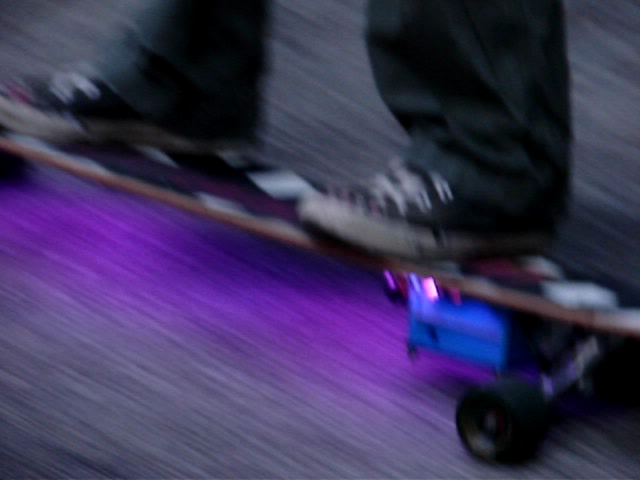
After our Larval Engineer tweaked the code to track the maximum speed for the current run, so that the color always hits pure blue at top speed and red near standstill, we can prove it happened: we have a video! It’s much less awful than the First Light video, but with plenty of cinéma-vérité camera shake, lousy focus, and bloopers:
Longboard In Action
That’s a frame extracted from one of the raw videos files using ffmpegthumbnailer:
for t in `seq 0 10 100` ; do ffmpegthumbnailer -i mov07117.mpg -o Longboard-$t.jpg -t $t% -q 10 -s 640 ; done
This view of the 3D printed case shows the power switch and the Hall effect sensor cable snaking out of the truck just below the near axle:
Longboard RGB LED Electronics – right front view
She filled the case corners that pulled up from the build platform with a thin layer of epoxy, getting a plane surface by curing it atop waxed paper on the shop’s surface plate, to keep the polycarbonate sheet flat. I didn’t have any acorn nuts to top those nylon lock nuts, alas.
The 4-cell Li-ion battery lives in the slice between the white aluminum plates, where it takes about four hours to charge from 3.0 V/cell. The Arduino Pro Mini lives behind the smoked polycarb sheet, where its red LED adds a mysterious touch. Maybe, some day, she’ll show the 1/rev pulse on the standard Arduino LED for debugging.
A view from the other side shows the hole for the charger above the circuit board, with the Hall sensor out of sight below the far axle:
Longboard RGB LED Electronics – left front view
Yes, the cable to the LEDs deserves better care. She learned that you must provide strain relief at cable-to-component junctions, which we achieved by pasting the wires to the board beside the LED strip with double-stick tape. The rest of the LED strip interconnections live atop similar tape strips. There’s nothing much protecting the LEDs or their delicate SMD resistors, butit works!
Actually, one red LED in an RGB package went toes-up and wasn’t revived by resoldering its leads. So we jumpered around the package, subjecting the remaining two red LEDs in that string to a bit more current than they’d prefer, and that’s that.
There’s a whole bunch not to like one could improve in both the mechanics and electronics, butit works! If you’ll grant it alpha prototype status, then I’d say it’s Good Enough; this is her project and she’ll learn a lot from how it works and how it fails, just like we all do.
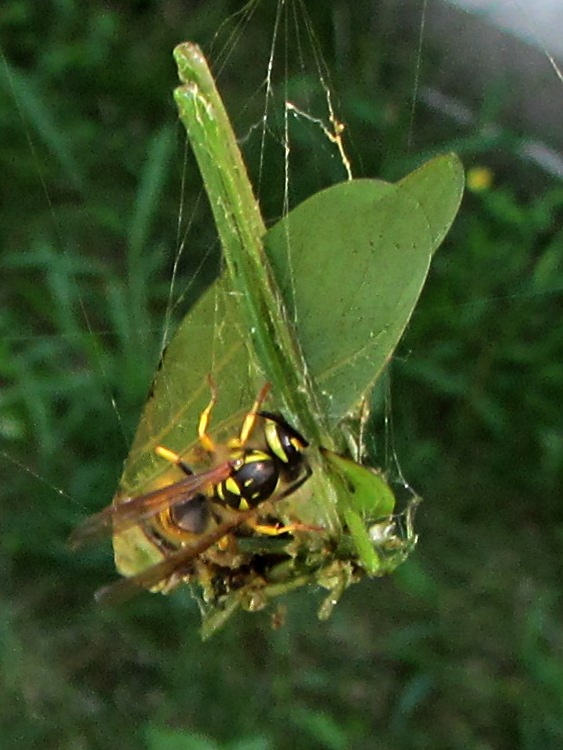
This is the season for orb-weaving spiders, one of which laid a great web between a pole and the grass in the front yard. It worked wonderfully well to capture a flying katydid, but wasps got to the victim first:
Webbed katydid with wasps
Maybe a bird took out the spider? We’ll never know, but that katydid won’t go to waste.
This is a dot-for-dot crop from a handheld shot with the Canon SX230HS, macro setting, plus a dash of unsharp mask and gentle contrast stretching to knock the background down. It’s surprisingly hard to get perfect focus on a wind-blown object; this is the least awful of the group.
We have a fine patch of milkweed in the back yard that attracts & nourishes the Monarch butterfly fleet. One of the plants also attracted a dense aphid population:
Aphids on milkweed
They’re pretty much featureless orange blobs, although the one on the edge of the leaf at the upper right does show off its legs & antennae:
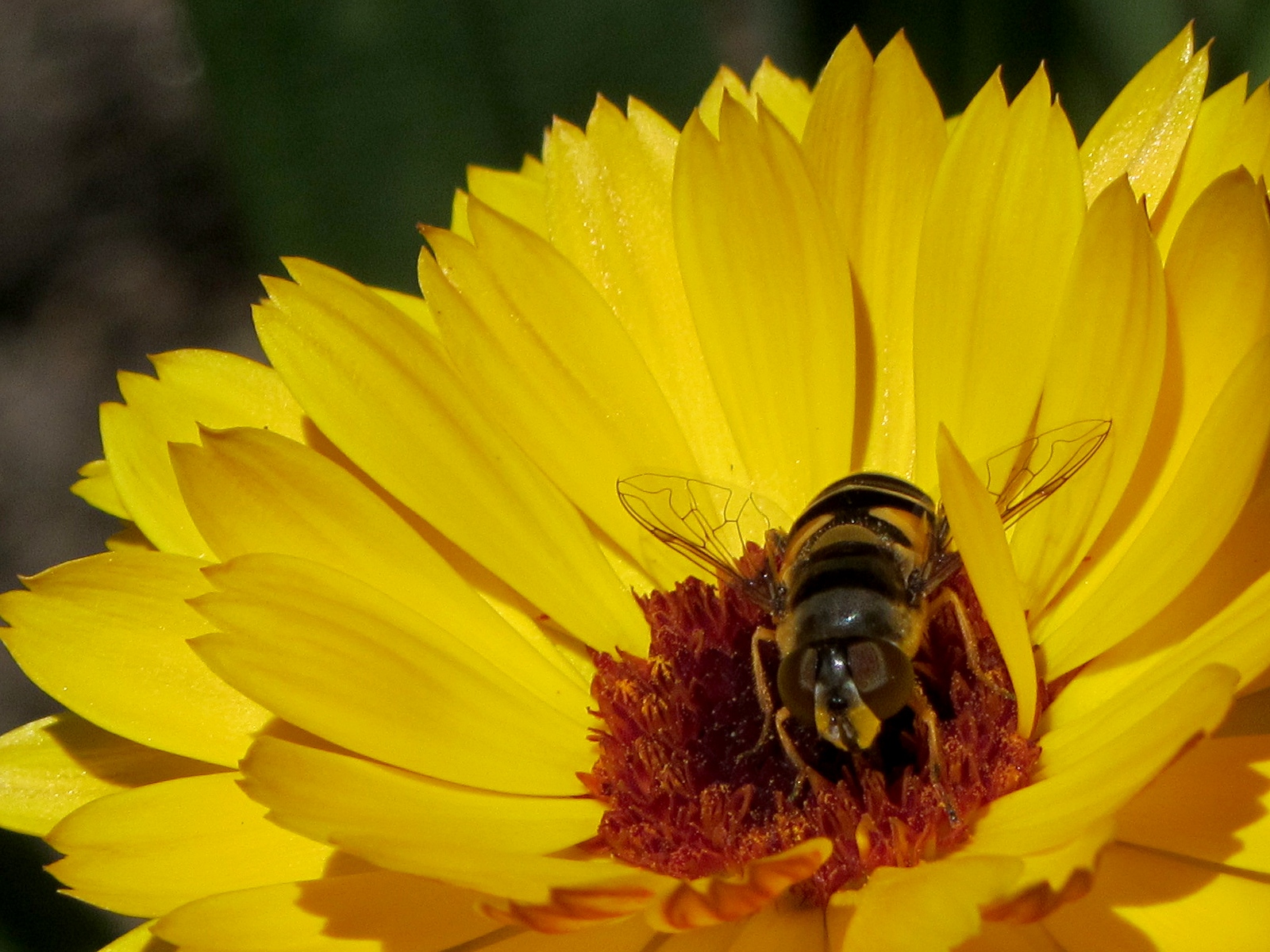
Another picture from the Quaker Hill trip, where good light made all the difference:
Hornet in Coreopsis
The flower is a Coreopsis and the insect is not a honeybee. The metallic highlights make it look artificial; if I wasn’t there in person, I’d think it was CGI, too.
It’s underexposed by about one stop to prevent those mirrored body panels from burning out and to saturate yellow petals in direct sunlight. Hand-held with the Canon SX230HS in macro mode, then cropped to 1600×1200 without any resizing at all; it’s now the background for the landscape monitor.










 The Smell of Molten Projects in the Morning