The Smell of Molten Projects in the Morning

Ed Nisley's Blog: Shop notes, electronics, firmware, machinery, 3D printing, laser cuttery, and curiosities. Contents: 100% human thinking, 0% AI slop.

Category: Photography & Images

Taking & making images.

  • Sony DSC-H5: Disassembly

    The half-pressed shutter switch position on my Sony DSC-H5 recently stopped working, which seems to be one of two common failures. The other, a broken switch shaft, happened to Tee’s camera, as described there, and I figured I should preemptively fix that while I was inside my camera.

    This being a common failure, several folks have described how to dismantle the camera; I followed that guide’s English version.

    The DSC-H5 differs slightly from that description. After I got the thing apart, it became obvious that there’s no need to remove the LCD panel, the main control board, and most of the ribbon cables if you have a Philips #0 or #00 screwdriver with a very thin shaft. There’s no way to describe this operation, so take it apart his way, then you’ll see what I mean: the guts can come out as one big lump.

    In any event, all the camera controls eventually emerge from the body:

    DSC-H5 Control Assembly
    DSC-H5 Control Assembly

    Looking back into the camera body reveals the bottom of the shutter button, captured by a static discharge contact and the gray plastic frame of the Focus / Break button caps:

    DSC-H5 Shutter Button - interior view
    DSC-H5 Shutter Button – interior view

    Removing the pushbutton frame and pushing the left button bezel latch with a small flat-blade screwdriver extracts the shutter button; it falls out of the inverted body. This is one of the few intact DSC-H[1-9] shutter buttons you’ll ever see:

    DSC-H5 Shutter Button - bottom view
    DSC-H5 Shutter Button – bottom view

    Those rectangular protrusions lock into the slots in the black plastic cap that appears almost silver in this front view that shows the dimple in the switch membrane:

    DSC-H5 Shutter Button Switch - depressed surface
    DSC-H5 Shutter Button Switch – depressed surface

    You must remove the cap to release the flex PCB with the shutter switches. Two heat-staked pins retain the cap; a scalpel neatly slices off the melted plastic:

    DSC-H5 Shutter Switch - cover removed
    DSC-H5 Shutter Switch – cover removed

    Nota bene: the DSC-H1 button bezel I repaired earlier does not have features that lock into the cap over the switch assembly, which means you can remove and replace it without disassembling the camera. You cannot remove or install the DSC-H5 button without taking the camera apart. I suppose this counts as a continuous product improvement, but …

    The shutter switch has two parts:

    • The full-press switch that takes the picture (the white dot on the blue flex, shown above)
    • The half-press switch that triggers the focus & exposure is in a black plastic tray (seen edge-on above the white dot)

    The bottom of the half-press tray has a small nub that activates the full-press switch, so the force required to activate the half-press switch must be considerably less than the force that activates the full-press switch. This turns out to be a critical part of the repair…

    A closeup of the half-press switch with the protective cover sheet (the “damn confetti” of the disassembly instruction) and the dimple that held the contacts together with the button released:

    DSC-H5 Shutter Switch - dimpled protector
    DSC-H5 Shutter Switch – dimpled protector

    A closeup of the switch through a snippet of PET plastic shows the switch membrane itself is in fine shape:

    DSC-H5 Shutter Switch - cover removed
    DSC-H5 Shutter Switch – cover removed

    However, the new plastic shield did not work out well, for reasons having to do with the new button plunger. That’s the next step: rebuild the plunger…
  • Boott Cotton Mills Museum: Along the Line

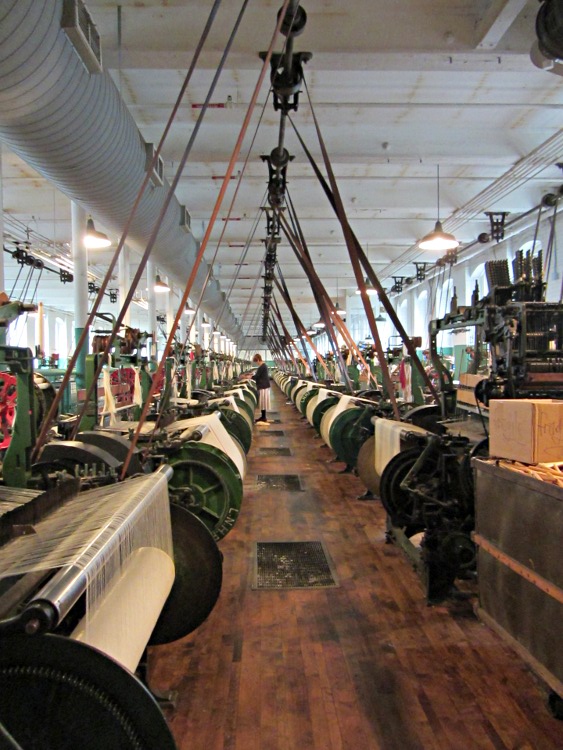
    We stopped at Lowell MA to visit the New England Quilt Museum (photography prohibited) and the Boott Cotton Mills Museum (photography encouraged). The NPS, among others, managed to salvage the buildings and restore some of the machinery, to the extent that one room on one floor of one building has some running cotton mills:

    Boott Cotton Mill Museum
    Boott Cotton Mill Museum

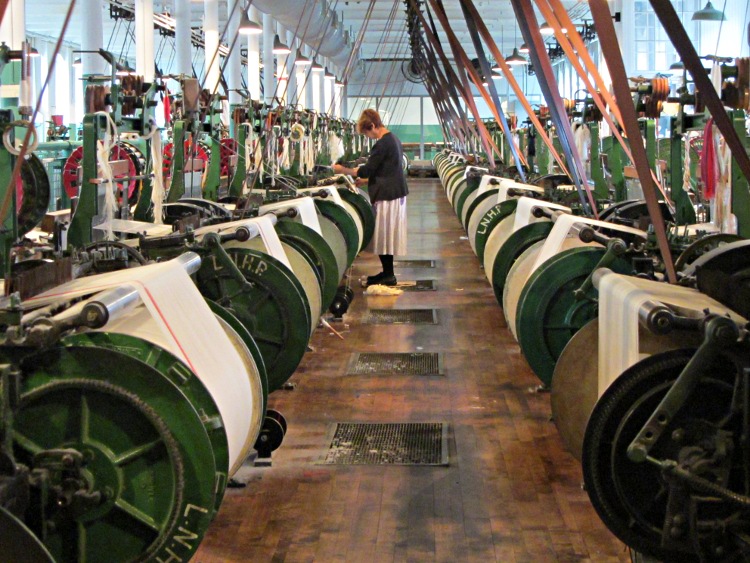
    A bit more detail:

    Boott Cotton Mill Museum - line detail
    Boott Cotton Mill Museum – line detail

    The original mills used water power, as did much of New England’s industry, but moments after Watt worked the bugs out of that newfangled steam engine, water power was history. The museum uses a huge old electric motor, mounted on the ceiling, to drive the line shafts above the mills; the vibration shakes the entire building and they hand out ear plugs at the door, despite having only half a dozen mills operating at any time. The working environment, horrific though it was, attracted employees (largely young women) from across the region; it was a better deal than they had on the family farm.

    Employees were, of course, prohibited from using cotton to plug their ears…

    They sell the cloth in the museum shop and we’ll eventually have some kitchen towels.

  • Monthly Picture: Laboratory Study of the Grasshopper

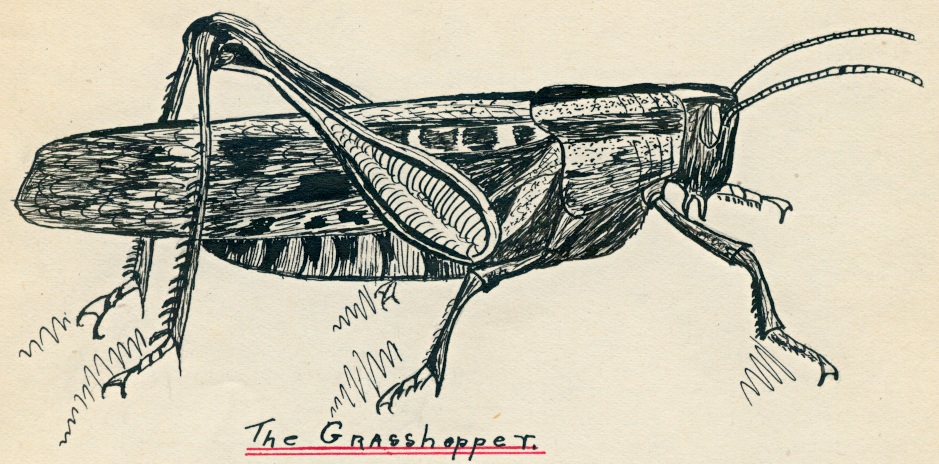
    My father drew this in his Sophomore Biology Laboratory Notebook:

    Laboratory Study of the Grasshopper
    Laboratory Study of the Grasshopper

    Can you imagine the attention span required to draw that with no obvious errors? The next four pages contain a hand-written discussion of the grasshopper, with two corrections; he filled the entire notebook using a pen and four colors of fluid ink.

    Here’s a closer look at the grasshopper (clicky for more dots):

    The Grasshopper
    The Grasshopper

    I cannot imagine assigning that task to present-day students…

    Things were different in 1927, when he was 17 years old. They were about to get really different; 15 years later he was in the South Pacific.

  • Dismantling a Gas Tank

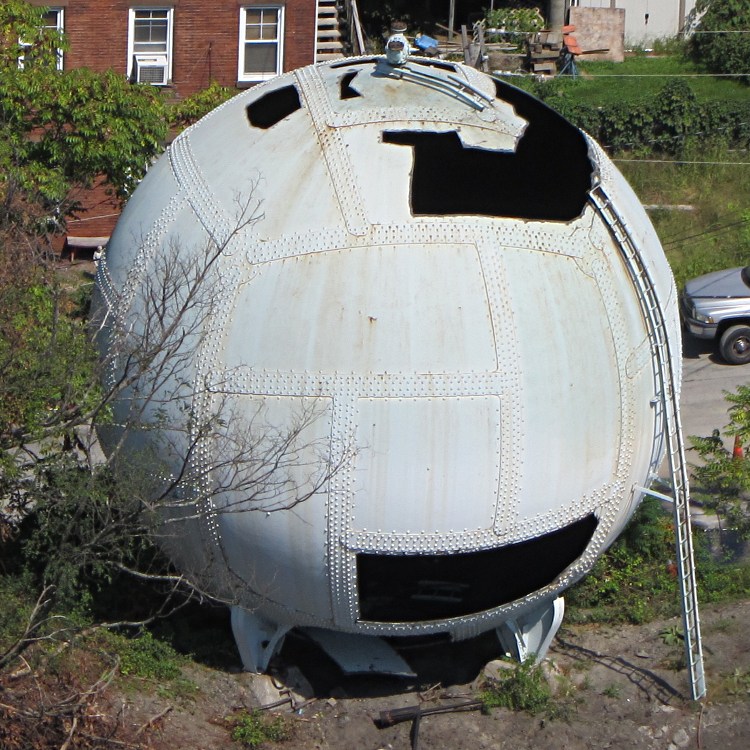
    That gas tank has evidently reached the end of its life:

    Cutting up spherical CHGE gas tank
    Cutting up spherical CHGE gas tank

    Many of the nearby gas pipelines end in open stubs and a concrete crusher worked over one of the pads for a long-vanished cylindrical tank, so it looks like they’re scrapping the whole installation. I think the project to install an elevator for the Walkway lands nearby, which may explain everything.

    I took the picture from the Walkway, aligning the SX230HS lens through the chain-link fence. Occasionally a small lens wins over more glass!

  • Orb-Weaving Spiders

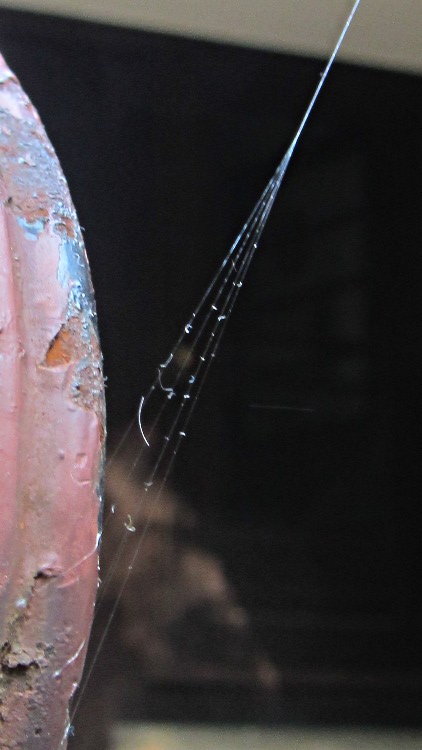
    August was the month for giant orb weaving spiders; a pair of thumb-sized monsters took up residence under the gutter over the patio. One started by anchoring its web to the handrail by the steps:

    Web anchor on handrail
    Web anchor on handrail

    While we like and encourage spiders, that anchorage didn’t last long and, yes, I must strip and repaint that railing…

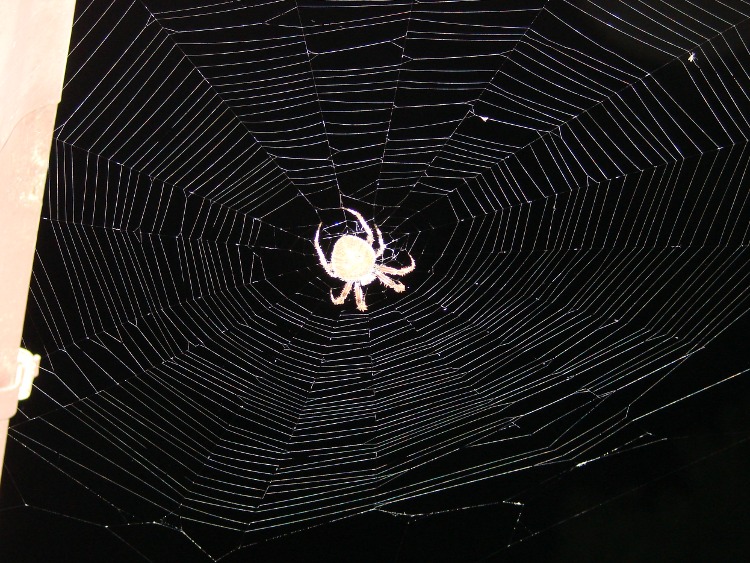
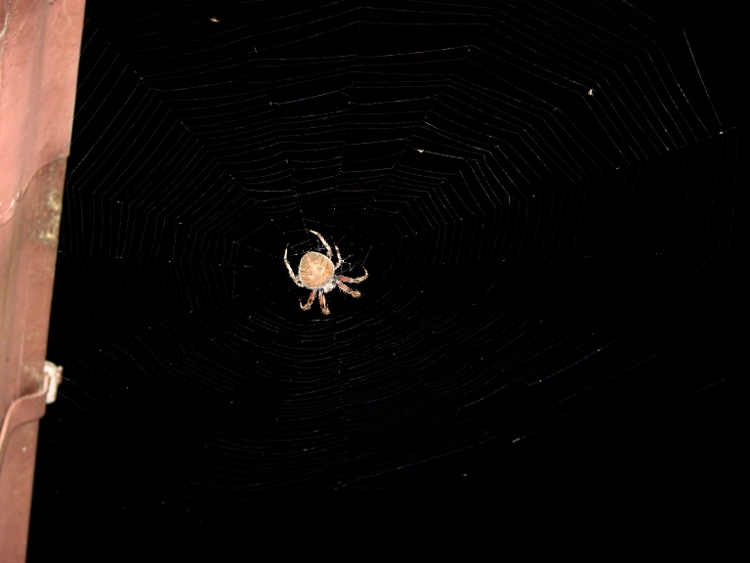
    There’s a horizontal web at the corner of the gutter over the back door:

    Orb spider at gutter - light
    Orb spider at gutter – light

    Changing the exposure to favor the spider loses the web strands:

    Orb spider at gutter - dark
    Orb spider at gutter – dark

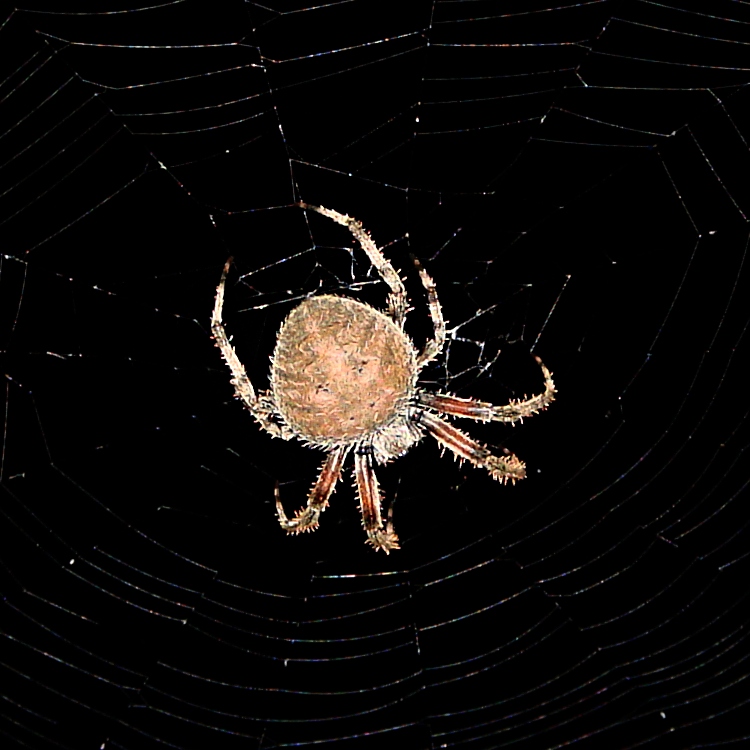
    Cropping that one down around the spider shows they really are the stuff of nightmare:

    Orb spider - detail
    Orb spider – detail

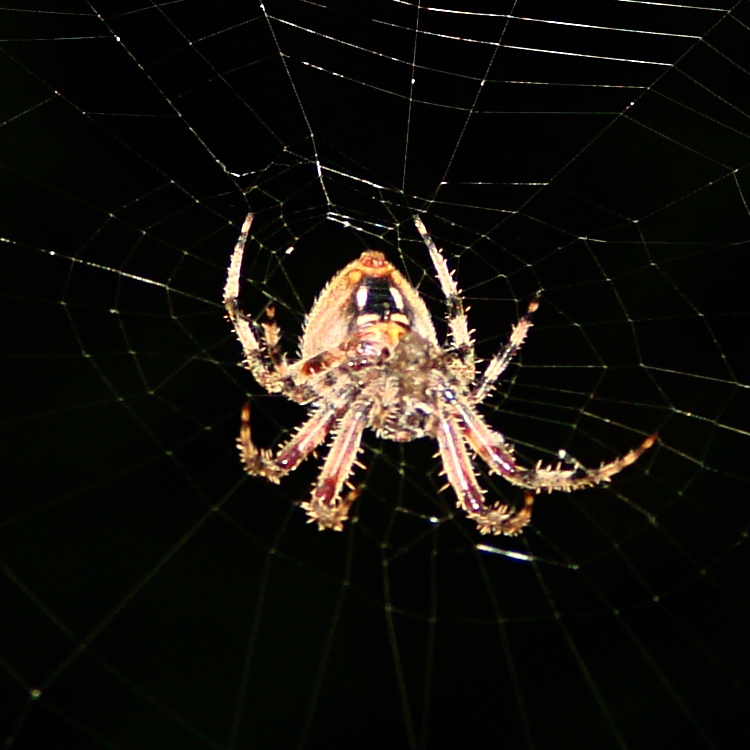
    The other spider prefers a vertical web attached along the gutter and anchored to a patio chair, which means I can get between the house and the web to see the spider’s tummy:

    Orb spider - ventral
    Orb spider – ventral

    We leave the lights on in the evening for their benefit…

  • Monthly Picture: Paper Wasp Nest

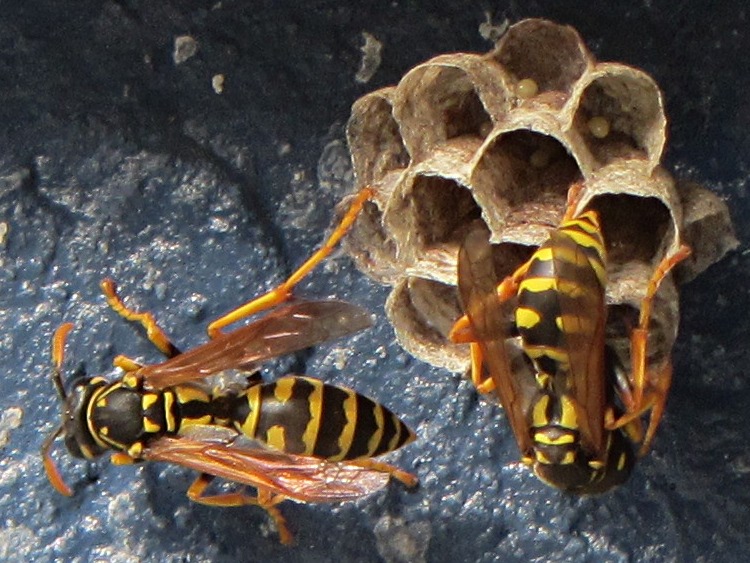
    Found these paper wasps building their nest on a painted brick post:

    Paper wasp nest with eggs
    Paper wasp nest with eggs

    That’s a new nest with eggs a-cooking!

    They were minding their own business, but they’re in a very public area and won’t last long…

    This is a dot-for-dot crop from a larger image, with just a touch of unsharp mask to bring out their hazard warning stripes.

  • Hummingbird Moth!

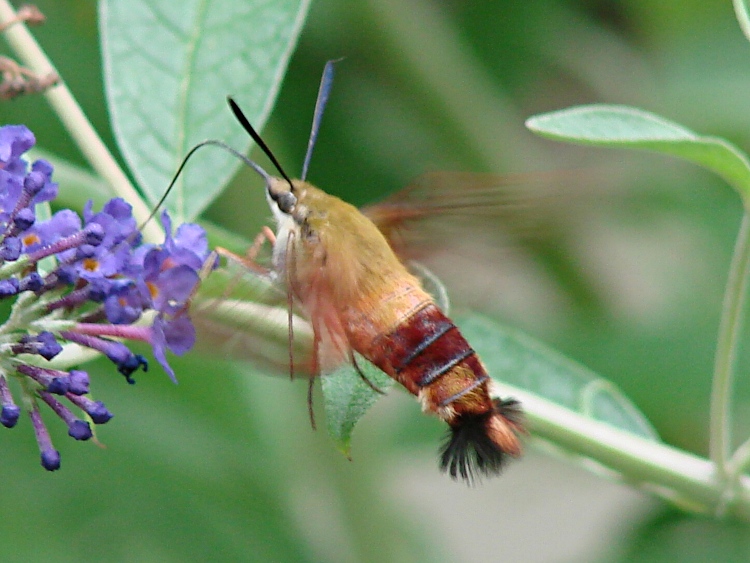
    A Hummingbird Moth recently visited the Butterfly Bush:

    Hummingbird Moth - left side
    Hummingbird Moth – left side

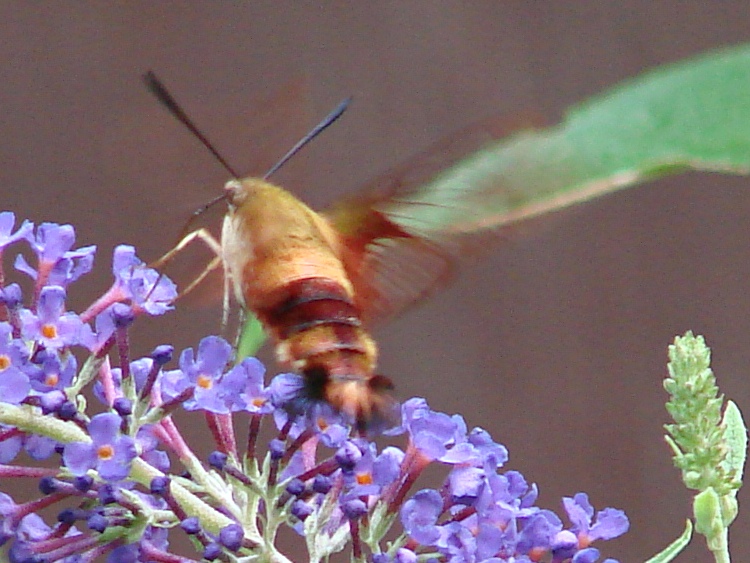
    They’re heavy-bodied moths and, unlike those butterflies, never alight on the flowers to dine. Their wings are clear and never stop moving:

    Hummingbird Moth - wing
    Hummingbird Moth – wing

    It’s impossible to not see a face looking back at you, even though that’s a proboscis down the middle:

    Hummingbird Moth - front
    Hummingbird Moth – front

    They don’t stay very long and are extremely flighty, so the picture are catch-as-catch-can: hand-held with the DSC-H5, roughly dot-for-dot crops, and only the last one got any color correction. I didn’t have time to set the usual one-stop underexposure, so the colors washed out a bit. I really like the first picture; almost all my mistakes canceled out.