Ed Nisley's Blog: Shop notes, electronics, firmware, machinery, 3D printing, laser cuttery, and curiosities. Contents: 100% human thinking, 0% AI slop.
We biked to Saugerties for the Hudson Valley Garlic Festival and spotted this monster looming in the morning mist during the ride home:
Excavator on CSX gondola car – side
The end view shows it’s not an optical illusion:
Excavator on CSX gondola car – end
Some Google Maps fiddling reveals the plant, with the excavator atop the first car on the siding, down in the lower-left corner of the image:
Google Maps – Kings Highway at Tissal Rd
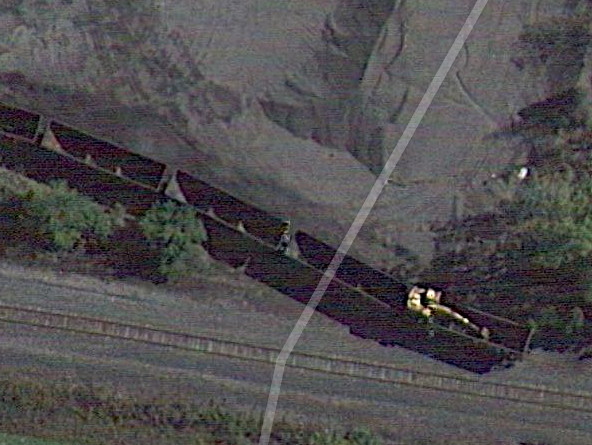
A zoomed view, rotated a quarter-turn CCW so it’s not quite so vertiginous:
Google Maps – Kings Highway at Tissal Rd – detail
My search-fu isn’t strong enough to uncover the plant’s name. They’ve obviously been doing something involving gravel and either asphalt or concrete for many years, so it’s not a prank…
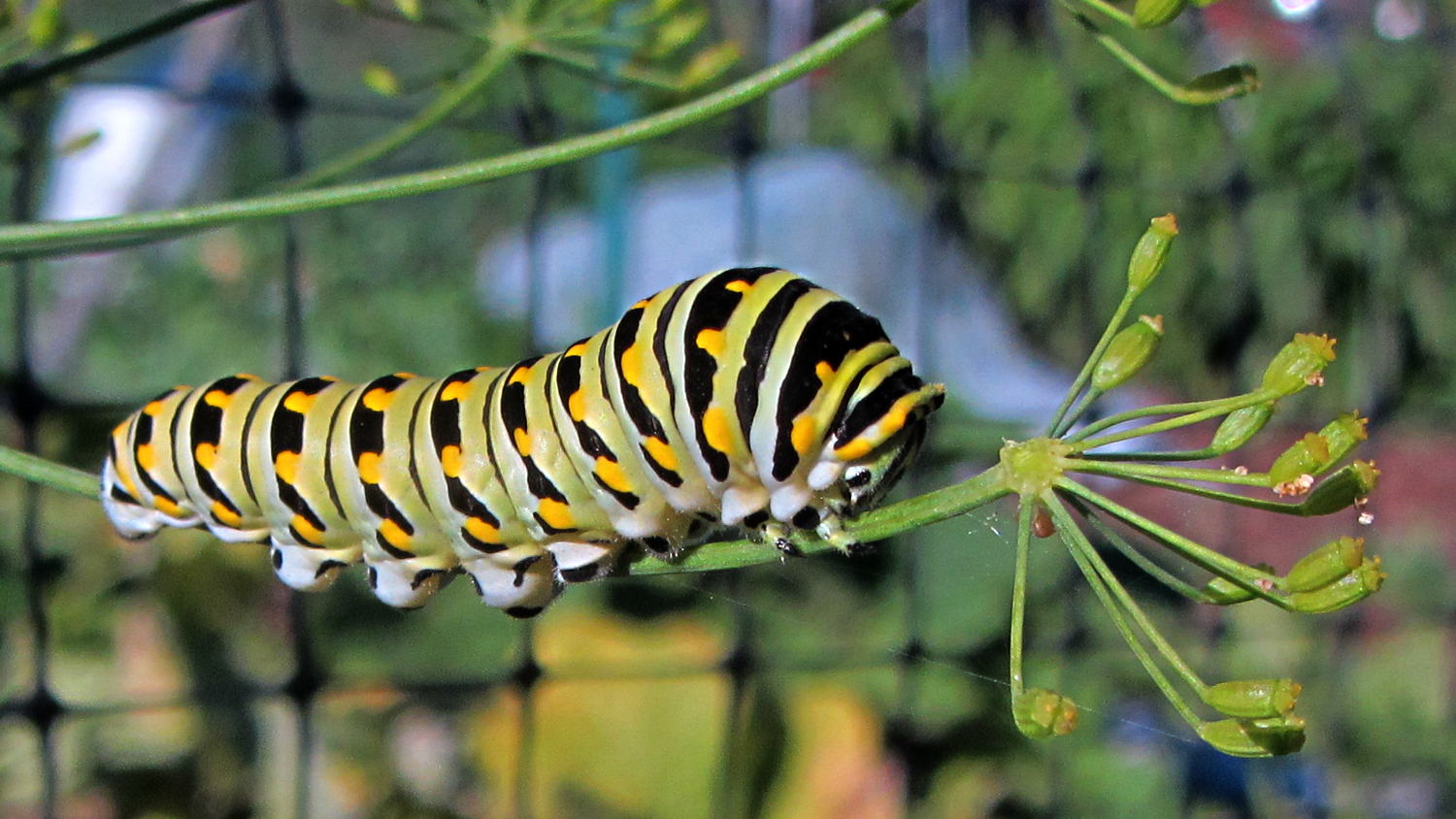
Four of these ferocious Parsley Worms were chowing down on a volunteer dill plant along the garden fence:
Parsley Worm Caterpillar on Dill
Amazingly, they turn into Black Swallowtail butterflies that sometimes visit the Butterfly Bush outside our living room window. Well, maybe not this one, but certainly some of its relatives.
We don’t hassle them; they have a fearsome threat display that apparently works wonders on their natural predators.
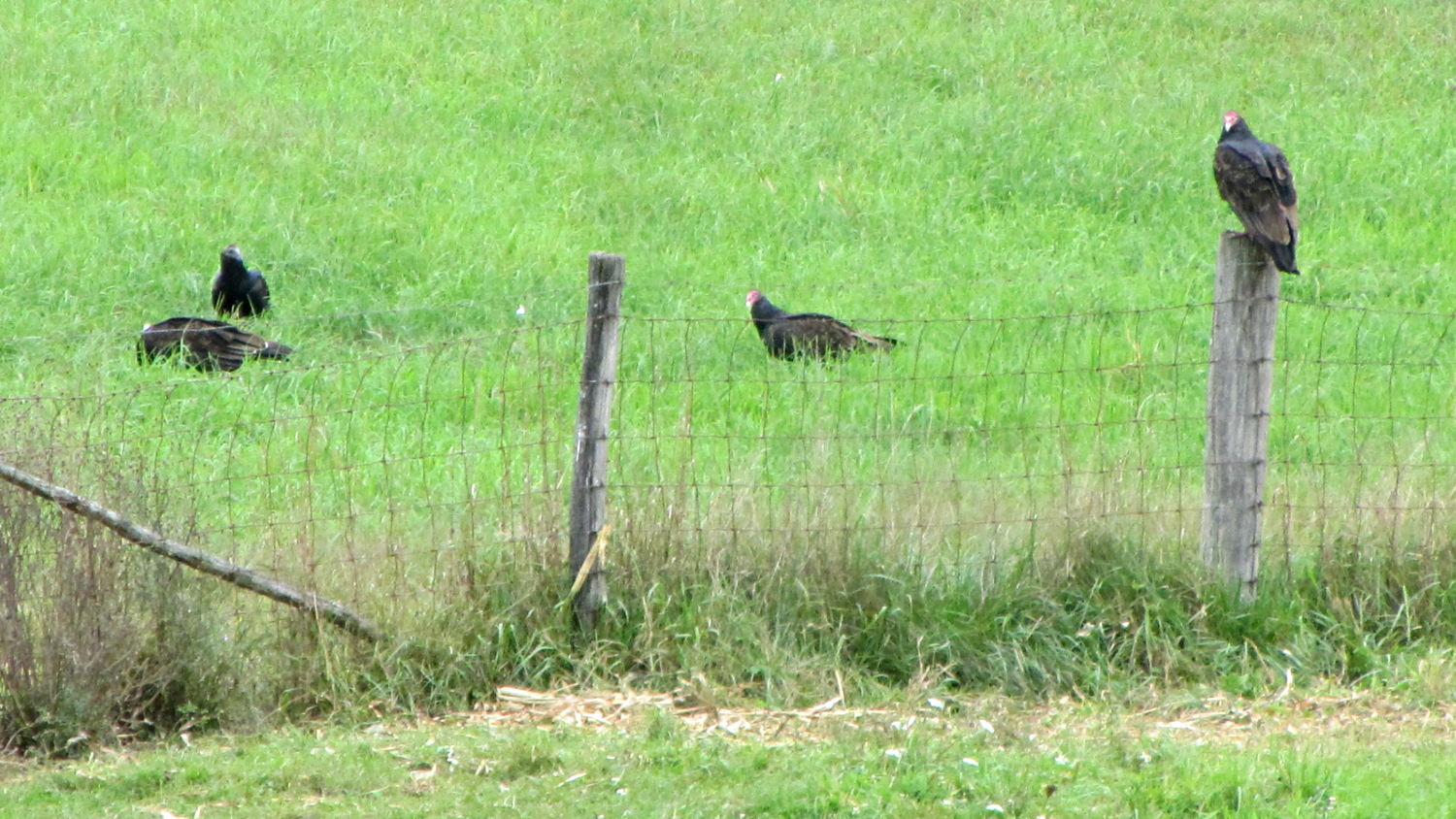
We don’t often see Turkey Vultures on the ground, so this gathering was unusual:
Turkey vultures on the ground
The depression in the grass suggests something keeled over right there; perhaps they’re rummaging around for leftovers. Although they’re totally graceless on foot, it works well enough for them.
There were two vultures on posts when I stopped, but one joined the ground party before I could deploy the camera. The other bird kept a close eye on me throughout the proceedings:
Turkey vulture on fence post
Look alive!
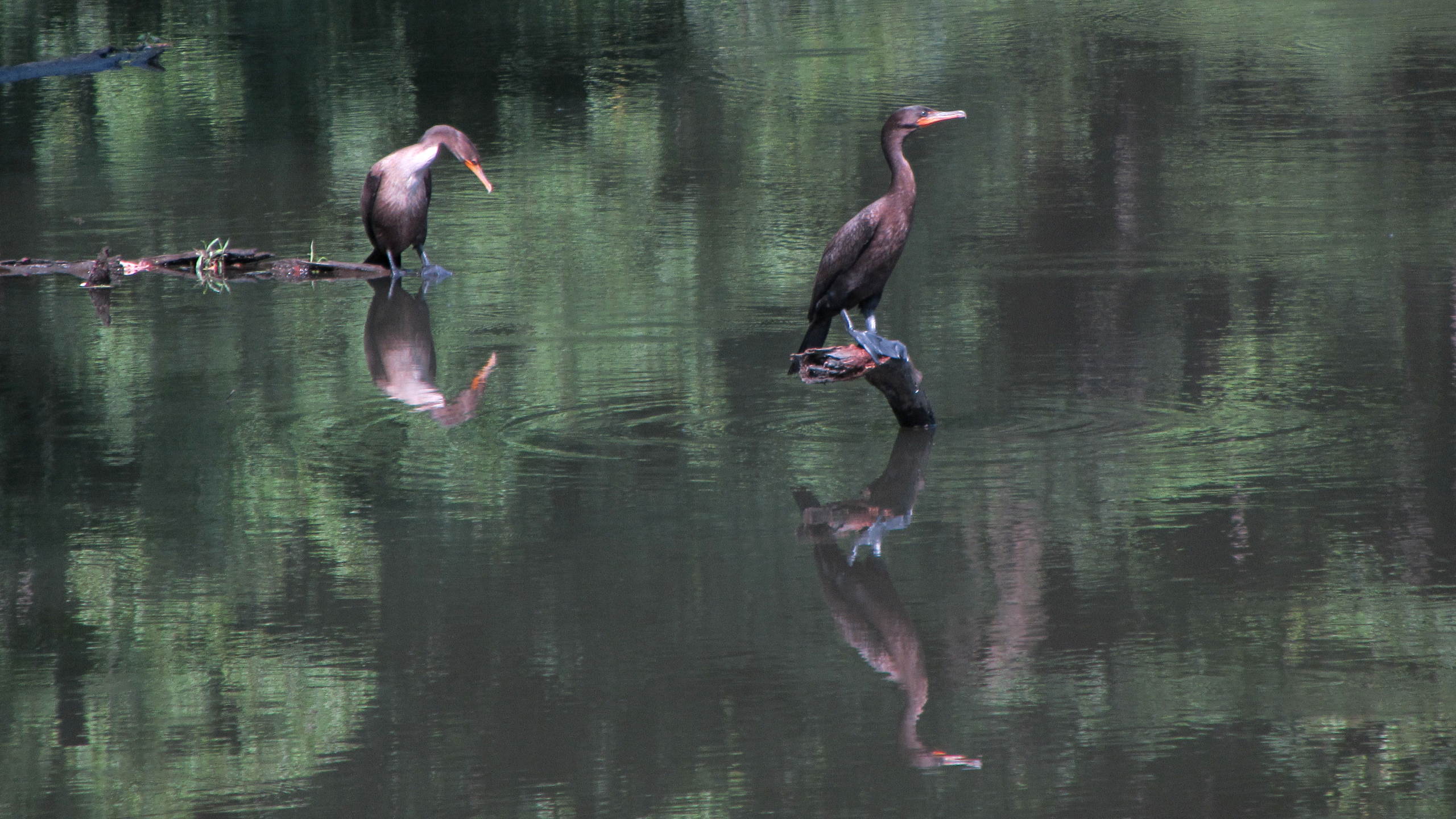
Pix from the Canon SX230HS, zoomed to its optical limit, and certainly not prizewinners…
I carry the Canon SX230HS in my pocket, so as to have a decent camera ready when it’s needed; yes, it’s in a cloth case. Unfortunately, in recent weeks a tiny hair made its way into the lens stack, where it shows up as a slight blurring just left of center in high f/stop images:
Cheap cartridge heater insulation
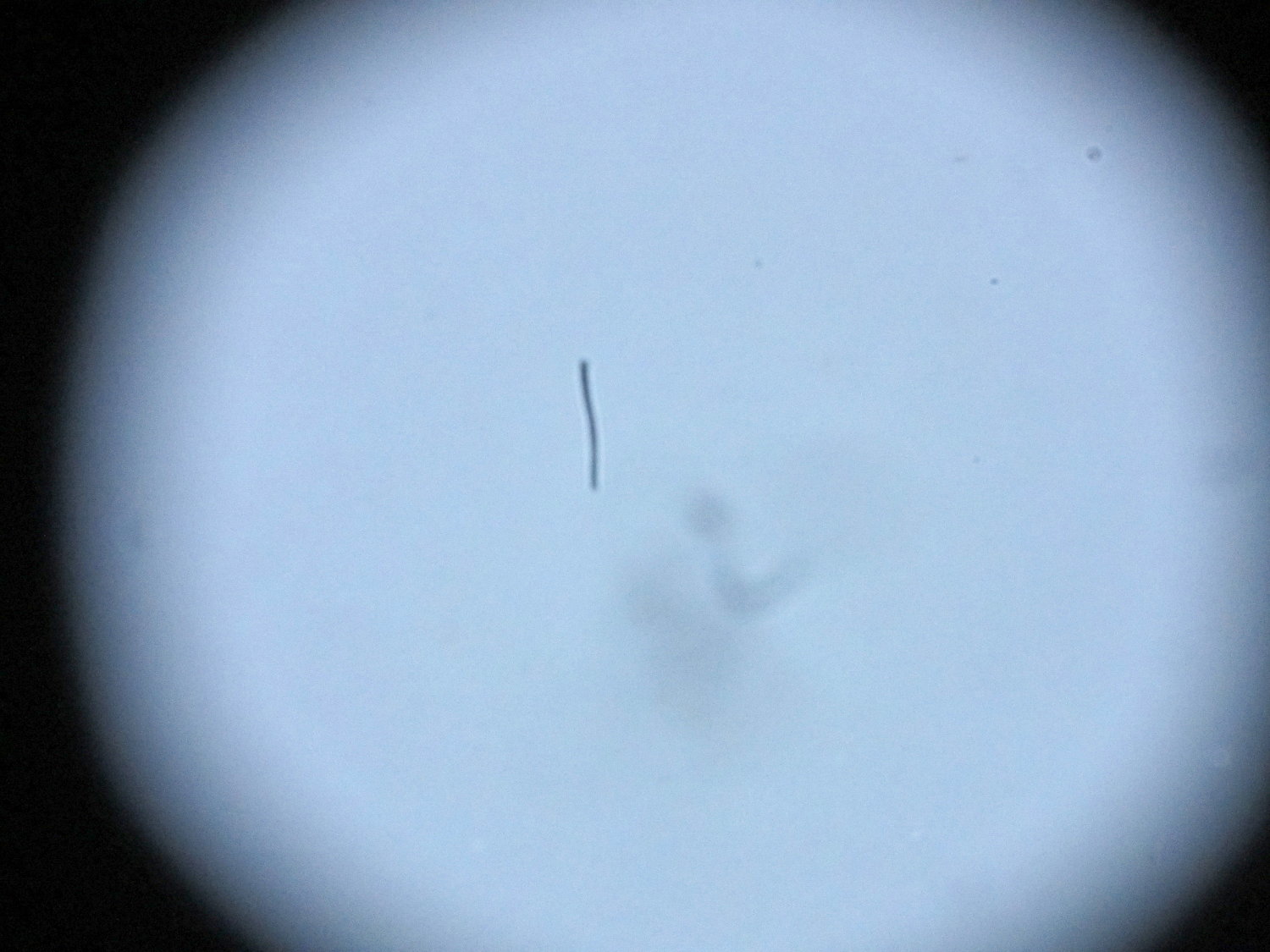
With the camera attached to the stereo zoom microscope, the hair becomes painfully obvious:
Hair on SX230HX Sensor
Of course it’s in the middle of the image. [sigh]
A bit of searching turns up a bootleg technique to remove the front lens from the turret (basically, just twist and pull), but neither of the internal lens surfaces thus revealed lie near a focal plane and, in any event, were surprisingly clean. The hair is probably lodged just in front of the image sensor, most likely stuck to the back of the final lens where it casts a shadow on the sensor. If it wandered around you’d call it a floater.
Dismantling the entire camera and opening the lens stack seems fraught with peril, particularly as the camera pretty much still works fine for normal picture-taking. More pondering is in order…
Late August is, as always, the season for giant orb-weaving spiders, one of which spun a web between two tall cactus plants on the patio and greeted us with this sight one morning:
Spider vs. Dragonfly – overview
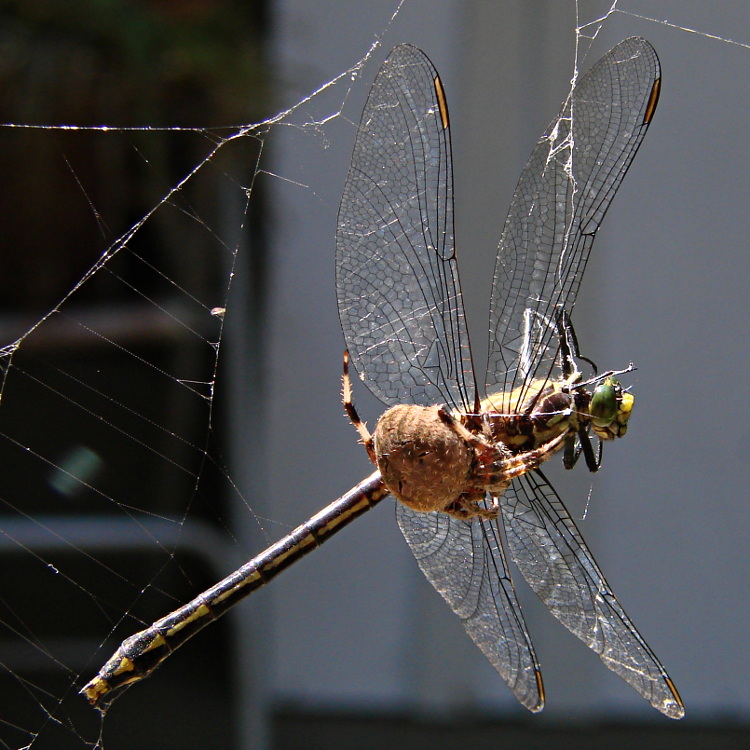
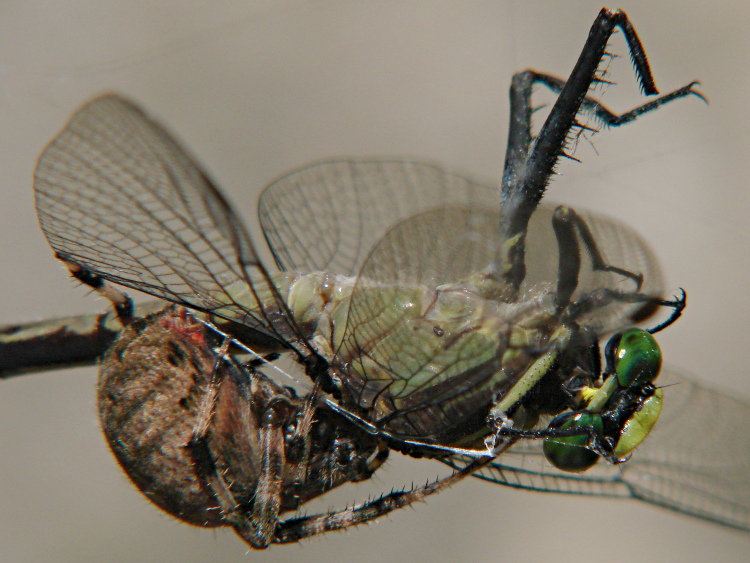
We’re big fans of both spiders and dragonflies, but it was obvious who came out on top in this contest:
Spider vs. Dragonfly – front
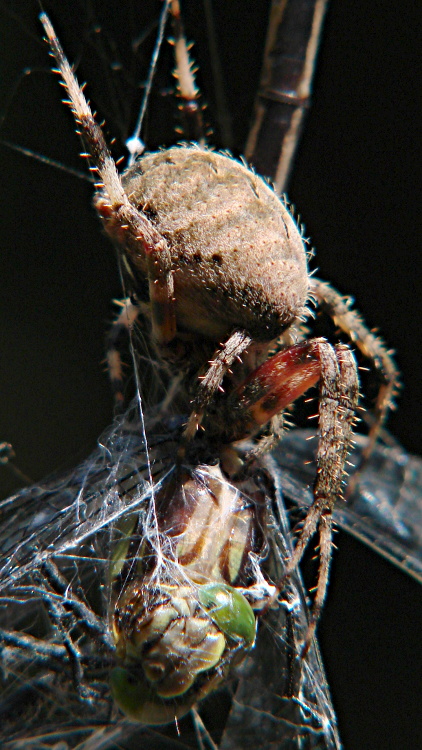
These things are unimaginably weird:
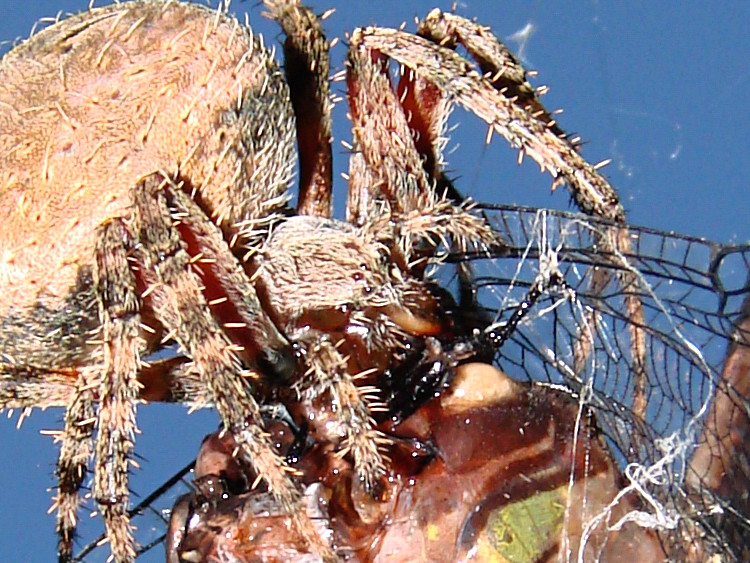
Spider vs. Dragonfly – bottom detail
Even with the spider busy at lunch, she has four eyes to spare. They reflect the flash and appear as white-centered dark dots near the middle of the image:
Spider vs. Dragonfly – many eyes
I’m sure the red spinnerets are diagnostic:
Spider vs. Dragonfly – side detail
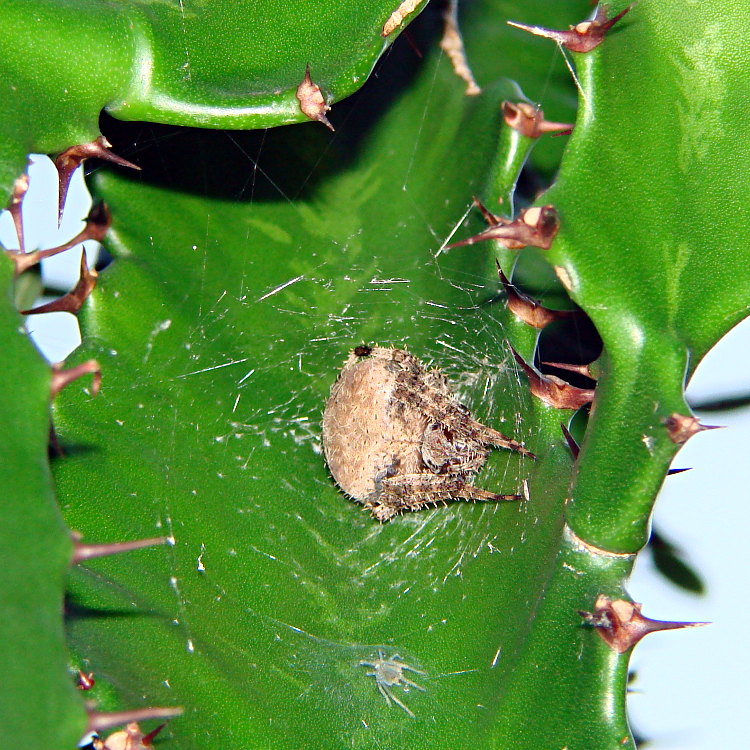
The spider tossed the empty husk over the side, then spent the next two nights and days parked in her lair, presumably digesting that big meal, and didn’t bother repairing the web:
Spider vs. Dragonfly – spider at home
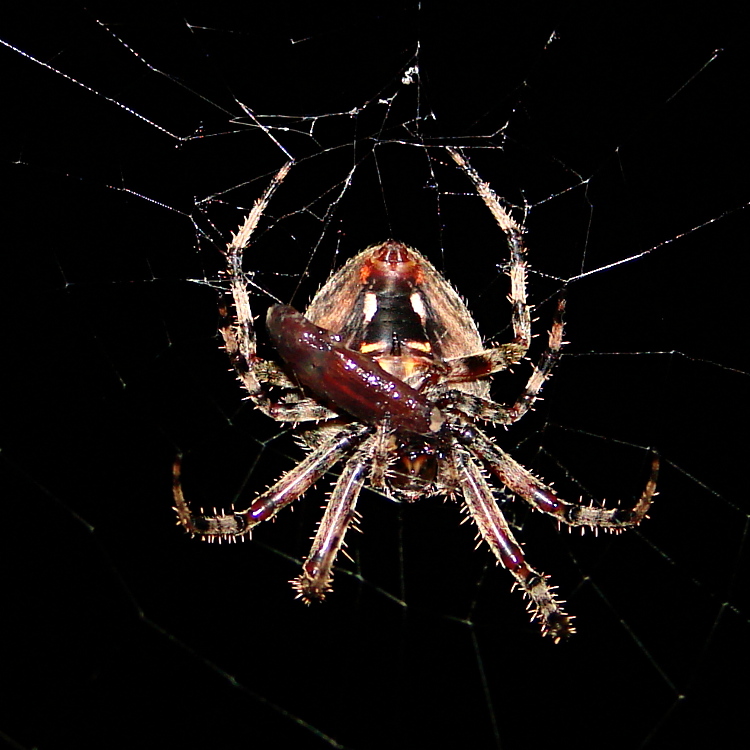
She spun a fresh web on the third night and caught a more manageable insect:
Spider with smaller prey
All hand-held with the Sony DSC-H5, some with a 2x close-up lens. All the pix are tight crops, crushed to fit my arbitrary 750 pixel maximum and 200 kB size limit. If you need high-res original images for anything, drop me a note; I took far too many pictures of this encounter…