Ed Nisley's Blog: Shop notes, electronics, firmware, machinery, 3D printing, laser cuttery, and curiosities. Contents: 100% human thinking, 0% AI slop.
Rolling through the back of the Vassar Campus, watching a murder of crows on the lawn, when all of a sudden:
Fast Squirrel – 0258
That squirrel passed about three feet in front of Mary’s bike, running flat out and, at 60 frame/s, touched the ground every 200 ms:
This slideshow requires JavaScript.
Figuring a squirrel body+tail is 1.5 ft long and it covers 3 of those units with every leap, it’s moving at 22 ft/s = 15 mph. That’s about as fast as we travel…
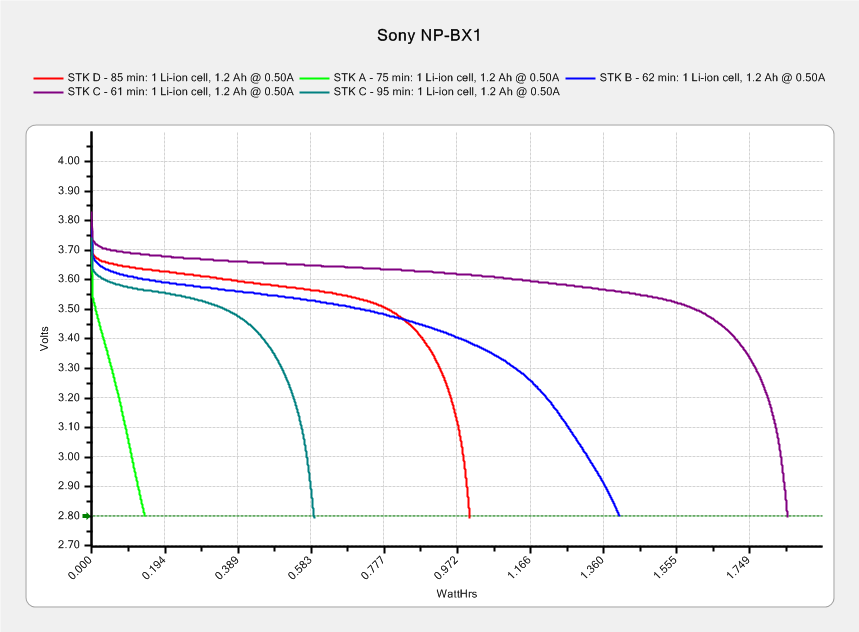
After 95 minutes on a pleasant ride with temperature around 55 °F, the STK C battery had 0.59 W·h remaining (dark green trace):
Sony NP-BX1 – STK used – Wh scale – 2015-12-12
The last time around, it had 1.85 W·h after 61 minutes. Subtracting the two (and ignoring that it may have started with slightly different charges and behave differently at different temperatures) says the camera used 1.26 W·h = 76 W·min in 34 minutes, which averages out to 2.2 W.
That’s close enough to the “a bit over 2 W” figured from those partial-to-empty measurements for me.
The best STK battery (D) holds just under 4.2 A·h, so its absolute longest run time could be 110-ish minutes. That graph shows the A cell was just about done after 75 minutes, so changing the battery after an hour still makes sense; you never know what will happen during the last few minutes of a ride…
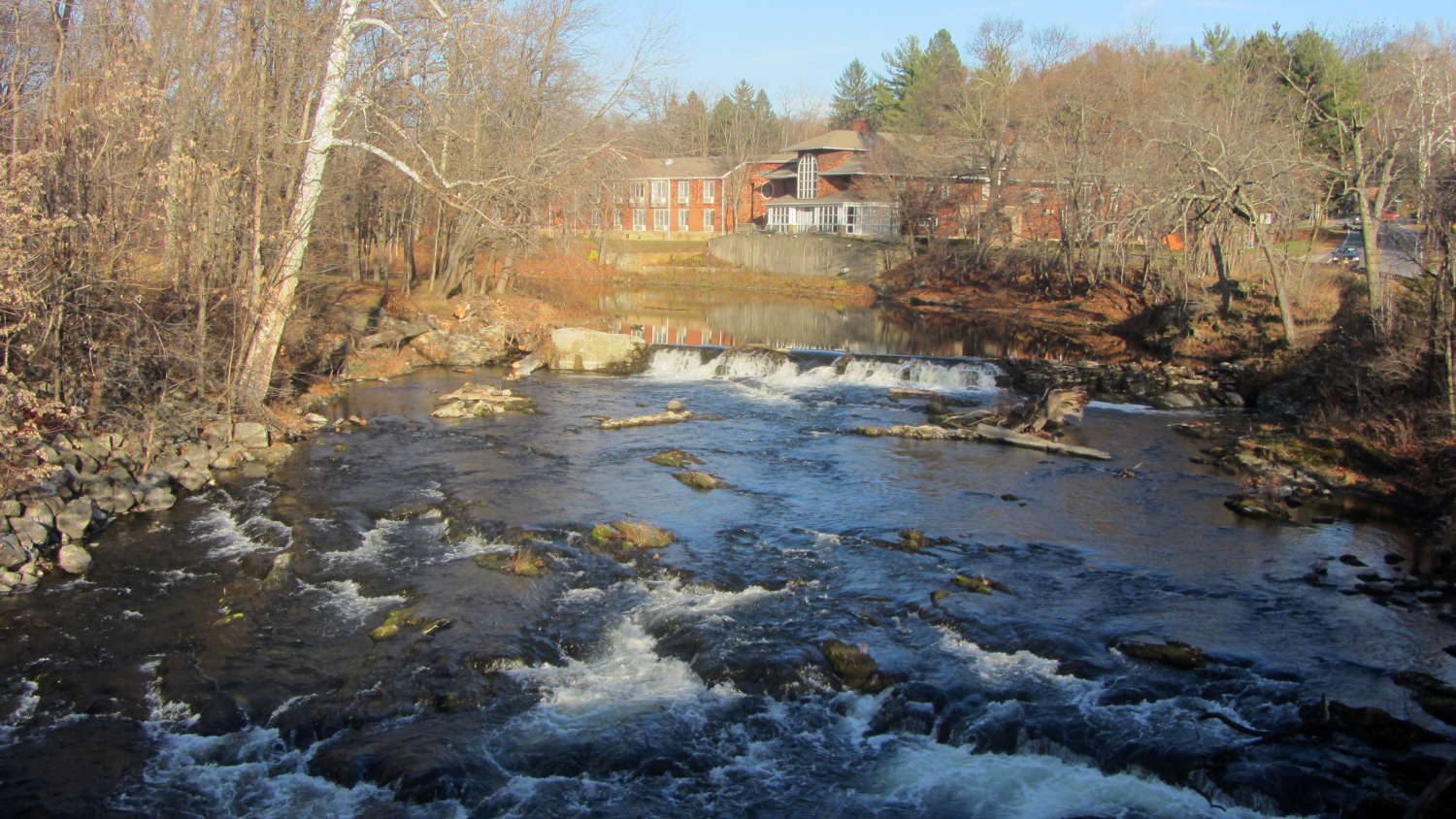
We walked past the Red Oaks Mill dam on a mild and dead-calm afternoon, with the headwater like a mirror:
Red Oaks Mill Dam – still water
I liked the smooth curves formed where the surface drops through the rubble:
Red Oaks Mill Dam – water curvature at breast
We wonder how far upstream the dam affects the water level, because, after it completely disintegrates and washes away, the creek level will definitely fall. The flow rate surely makes the calculation more difficult than just tracing contour lines from the dam breast upstream until they meet the bottom of the channel…
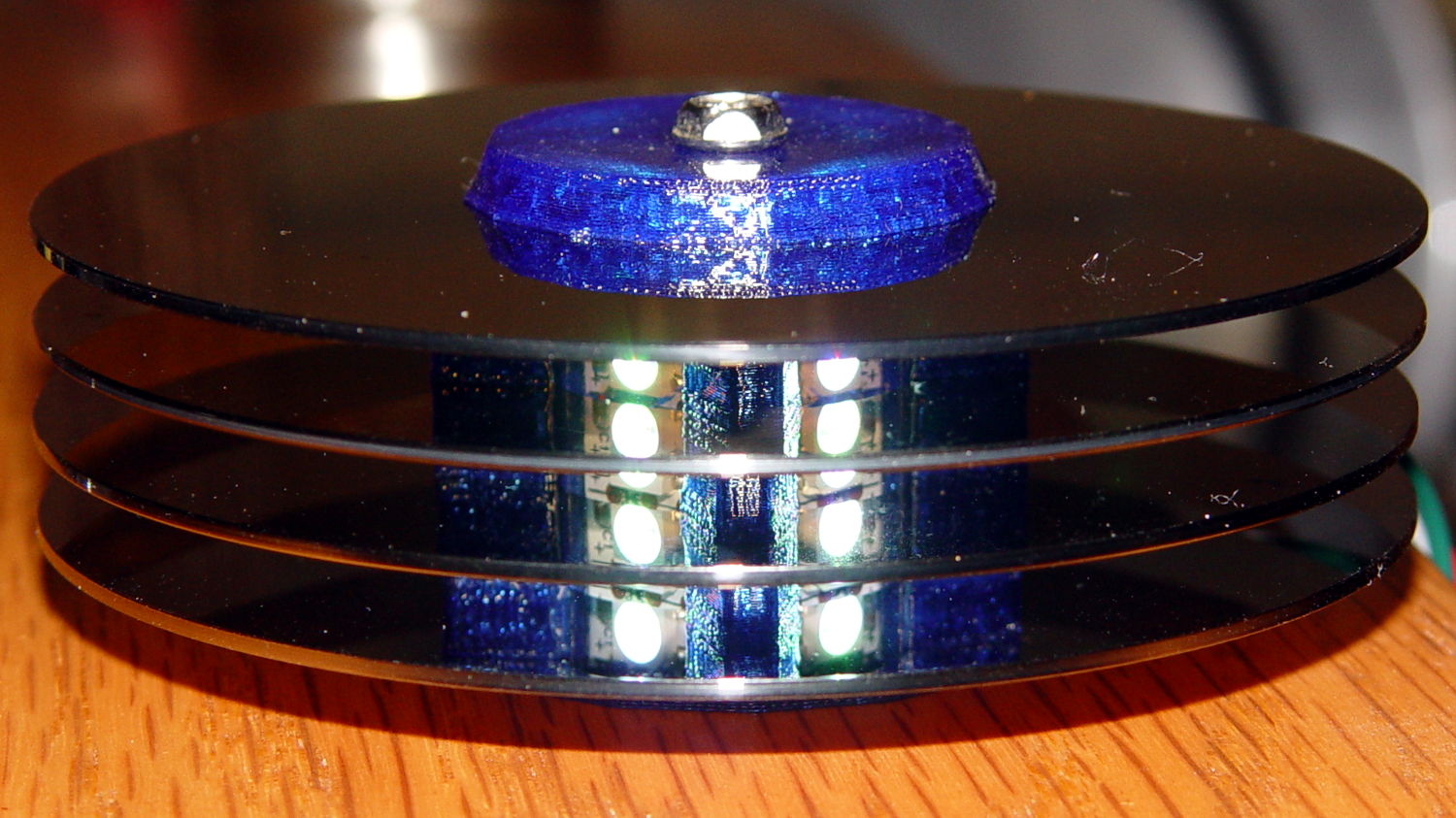
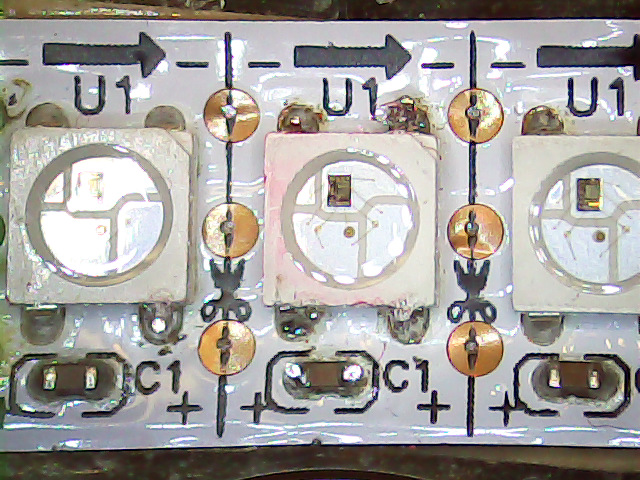
About a week after First Light, one of the knockoff Neopixels (not a Genuine Adafruit Product) suffered an intermittent failure: it worked fine after being off for an hour or two, but eventually stalled at a fixed color, with all downstream pixels equally dead. Of course, it was the middle package in the string of three, buried in the hub (this is before the failure):
Hard Drive Mood Light – low angle
Spraying circuit cooler on the package brought it back to life for a few minutes, confirming the diagnosis. Reducing the maximum intensity to PWM 32 reduced the average power dissipation enough to let it run for as long as I was willing to let it, although it might not survive a hot summer day.
Not having glued the spacers onto the hub simplified extracting the strip, although warranty repair is always a nuisance. I daubed red Sharpie on the failing LED to avoid losing track of it, then resoldered the LED and capacitor connections to no avail:
Knockoff Neopixel Failure – overview
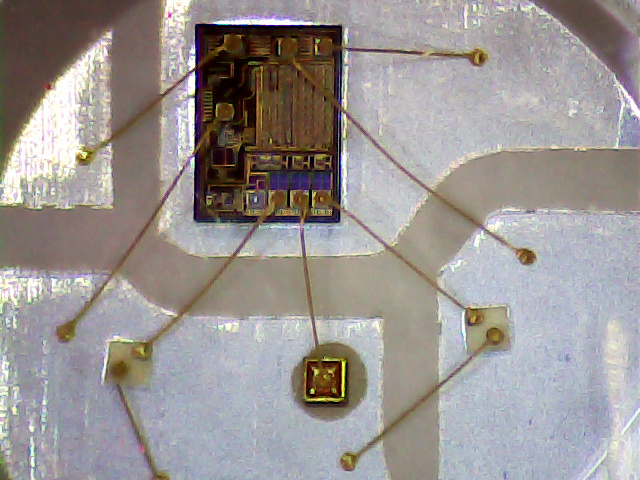
There’s nothing obviously wrong inside:
Knockoff Neopixel Failure – detail
The fine details of the WS2812B controller produce a horrible Moiré blur with the camera’s low-res image, but you get the general idea.
Most likely, one of those flying wires isn’t quite bonded, but we’ll never know…
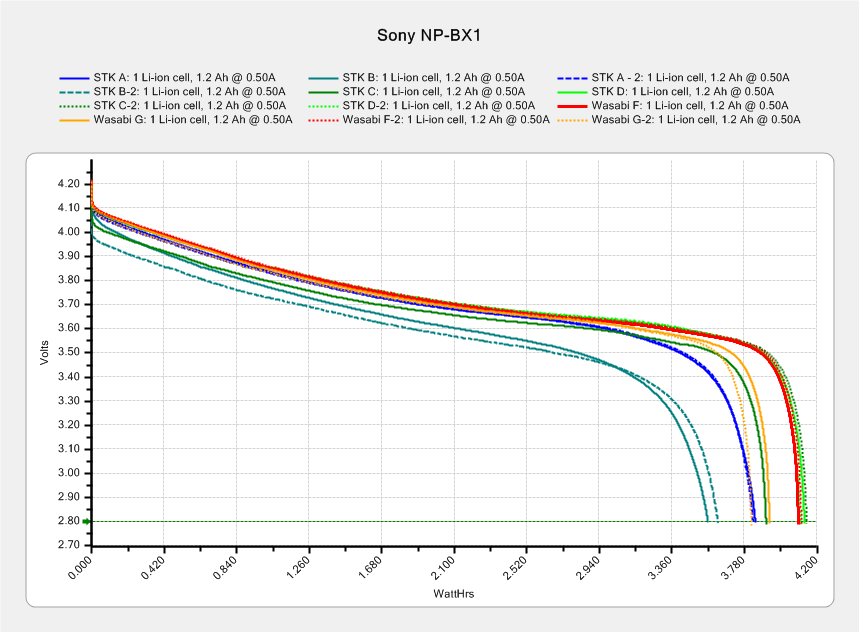
This sheaf of tests shows three of the four STK NP-BX1 batteries deliver about 4 W·h during a constant 500 mA discharge, with battery B trailing behind:
After the three most recent bike rides, I popped the partially discharged battery into the tester and used the same test current:
Sony NP-BX1 – STK ABD – charged vs used – Wh scale – 2015-11-22
The longer curves come from the top chart (with different colors), the shorter ones from the partially discharged batteries. In an ideal world, the shorter curves should give the energy left in the battery after the ride, so subtracting that from the before-ride capacity gives the energy used during the ride.
The results for battery A may not be typical, as the camera turned off before I rolled into the garage. The camera may run with a battery voltage below the 2.8 V cutoff in those tests, so it can extract more energy than the tests. The slope of the curve toward the end suggests it won’t get much, but that will still bias the results.
In round numbers, the bike rides required:
A: 3.8 – 0.1 = 3.7 W·h
B: 3.6 – 1.4 = 2.2 W·h
D: 4.2 – 1.0 = 3.2 W·h
I generally turn the camera off during the mid-ride pause (Protip: never wear a helmet camera into a Port-a-Loo), so at least two of the rides have discontinuous usage. I figured the total run time from the video file sizes at the rate of 22.75 min/4.0 GB, blithely ignoring issues like the battery recovering during the pauses, the effect of ambient temperature vs. camera heating on battery temperature, and so forth and so on.
In an ideal world, dividing the total energy by the run time (converted from minutes to hours and not venturing into pirate·ninja territory) should produce a nearly constant value equal to the camera’s power dissipation:
A: 3.7 W·h / 1.25 h = 2.96 W
B: 2.2 W·h / 1.0 h = 2.1 W
D: 3.2 W·h / 1.4 h = 2.25
Ignoring the suspiciously high result for battery A, it looks like the HDR-AS30V really does dissipate a bit over 2 W while recording 1920×1080@60fps video. That’s with GPS, WiFi, and NFC turned off, of course.
Which turns out to be pretty close to the test conditions: 3.7 V x 500 mA = 1.85 W. I could goose the test current to 600 mA = 2.2 W/3.7 V for the next tests, but maybe long-term consistency is a virtue.
The two dim LEDs to the left are actually very faintly lit, so I think the dark one has failed nearly open.
When I installed those nine central LEDs, I didn’t notice that the bag (from the usual eBay source, IIRC) contained two different types of white LEDs. The difference shows up clearly under UV that lights up the yellow phosphor:
Ring Light Mount – failed LEDs in UV
By random chance, each of the three groups has one non-fluorescing LED. If I can extricate them from their epoxy tomb, maybe I can figure out which one failed.
Rather than replace those, I’ll try a new-fangled chip-on-board light source, even though that might require a current limiter and maybe a heatsink. Obviously, this is getting out of hand, but maybe the same folks who can’t make a white LED can make a functional COB assembly for a buck… [sigh]