The Smell of Molten Projects in the Morning

Ed Nisley's Blog: Shop notes, electronics, firmware, machinery, 3D printing, laser cuttery, and curiosities. Contents: 100% human thinking, 0% AI slop.

Category: Photography & Images

Taking & making images.

  • Monthly Image: Groundhog Burrow

    Our new back-yard groundhog made extensive renovations and improved the landscaping before moving into the unoccupied burrow against the garage wall:

    Groundhog at garage burrow - cobbles
    Groundhog at garage burrow – cobbles

    It seems the same architect designed this project:

    Cobbled walk - 37 Fairmont Ave
    Cobbled walk – 37 Fairmont Ave

    I cannot explain the post in the middle of the walk; perhaps they’ll remove it when everything’s finished.

    The top photo is through three layers of 1950s glass. I cropped the bottom one from a helmet camera image.

  • Groundhog on High Alert

    Looks like I’m getting the stinkeye:

    Groundhog being suspicious
    Groundhog being suspicious

    The extensive garden armor remains effective, although we know groundhogs can run straight up a chain-link fence when given sufficient motivation. They generally give up after encountering the galvanized chickenwire around the buried concrete blocks; the garden is just to the left of the picture.

    The front-yard groundhog suffered a fatal automobile accident shortly after it finished excavating its burrow against the front foundation. This critter may have moved into the abandoned summer home near the garage at the back of the house.

  • Monthly Image: Transit of Mercury

    The 2016 Transit of Mercury, as seen from Red Oaks Mill:

    Mercury transit - 2016-05-09
    Mercury transit – 2016-05-09

    Hint: Mercury is (almost certainly) the tiny speck below and left of the crosshair.

    The larger speck is (almost certainly) Sunspot 12529, one of the few in this part of a historically weak Solar Cycle. Its shape would be obvious though a real telescope.

    If you know what you’re doing, you can measure the size of the sun and scale the entire solar system from observations like that. Takes more science than I’ll ever accomplish, that’s for sure!

    I realized the show was on just before Greatest Transit (roughly what you see above), so I duct-taped a 1 inch spotter / finder scope to a camera tripod, taped a sun shield on the scope, bent some card stock for a screen, then assembled everything on the patio:

    Mercury transit - 2016-05-09 - spotting scope setup
    Mercury transit – 2016-05-09 – spotting scope setup

    Astronomy mostly happens at night; this was an unexpected delight!

  • Traffic Signal Timing: Burnett Blvd at Rt 55 Detour

    Word from the BPAC meeting says that NYSDOT re-timed the signals on both ends of Burnett Blvd, because of the increased traffic from the closed bridges on Degarmo Rd. Here’s what that looks like from a bicyclist’s perspective; you may want to compare this with other measurements in the recent past.

    T=0.00 – I’m approaching the light and obviously won’t get through on the current cycle. However, the car in the left lane is just clearing the sensor loop, so we know the sensor has been triggered:

    Burnett Blvd at Rt 55 2016-04-27 - detour timing - 0073
    Burnett Blvd at Rt 55 2016-04-27 – detour timing – 0073

    T=4.133 – Signals turn yellow:

    Burnett Blvd at Rt 55 2016-04-27 - detour timing - 0321
    Burnett Blvd at Rt 55 2016-04-27 – detour timing – 0321

    T=8.433 – The left signal turns red (the right signal will go on 4/60 s later), with the white car accelerating hard across the stop line:

    Burnett Blvd at Rt 55 2016-04-27 - detour timing - 0579
    Burnett Blvd at Rt 55 2016-04-27 – detour timing – 0579

    As nearly as I can tell, the green-to-yellow change has decreased from about 7 s to maybe 4 s; that may be influenced by the car position / speed across the loop. NYSDOT definitely hasn’t increased the minimum delay to provide additional time for bicyclists.

    The yellow-to-red transition may have decreased from 5 s to 4 s; it definitely hasn’t increased.

    T=10.433 – The white car deliberately blew through the yellow and red signals:

    Burnett Blvd at Rt 55 2016-04-27 - detour timing - 0699
    Burnett Blvd at Rt 55 2016-04-27 – detour timing – 0699

    T=12.000 – The white car has almost cleared the intersection, 3.567 s after blowing through the red light, and cross traffic in Rt 55 has started to move:

    Burnett Blvd at Rt 55 2016-04-27 - detour timing - 0793
    Burnett Blvd at Rt 55 2016-04-27 – detour timing – 0793

    It’s impossible to tell from my position when the Rt 55 traffic saw their green signals, but they started moving 3.5 s from the time the signal in our direction turned red. I’d previously measured that at 1.333 s, so NYSDOT seems to have lengthen the all-red overlap.

    T=14.433 – Cross traffic on Rt 55 fills the intersection:

    Burnett Blvd at Rt 55 2016-04-27 - detour timing - 0939
    Burnett Blvd at Rt 55 2016-04-27 – detour timing – 0939

    That’s 10.3 s from the Burnett signal turning yellow, which usually happens when we’re just barely into the intersection; we need at least 15 s to reach the far side of all six lanes. Obviously, cross traffic on Rt 55 must notice that we haven’t cleared the intersection when their signals turn green and avoid running over us; that’s legally required, but it’s obvious NYSDOT (still) isn’t helping bicyclists get across the intersection.

    The NYSDOT regional office behind my right shoulder has a bike rack. We’ve never seen any bikes in it, so it’s equally obvious NYSDOT doesn’t practice dogfooding. I’ve never been able to invite / persuade / shame anyone from NYSDOT to ride along with us, so they can show me why their design really does “mak[e] our highway systems safe and functional for all users“.

  • Moth Flyby

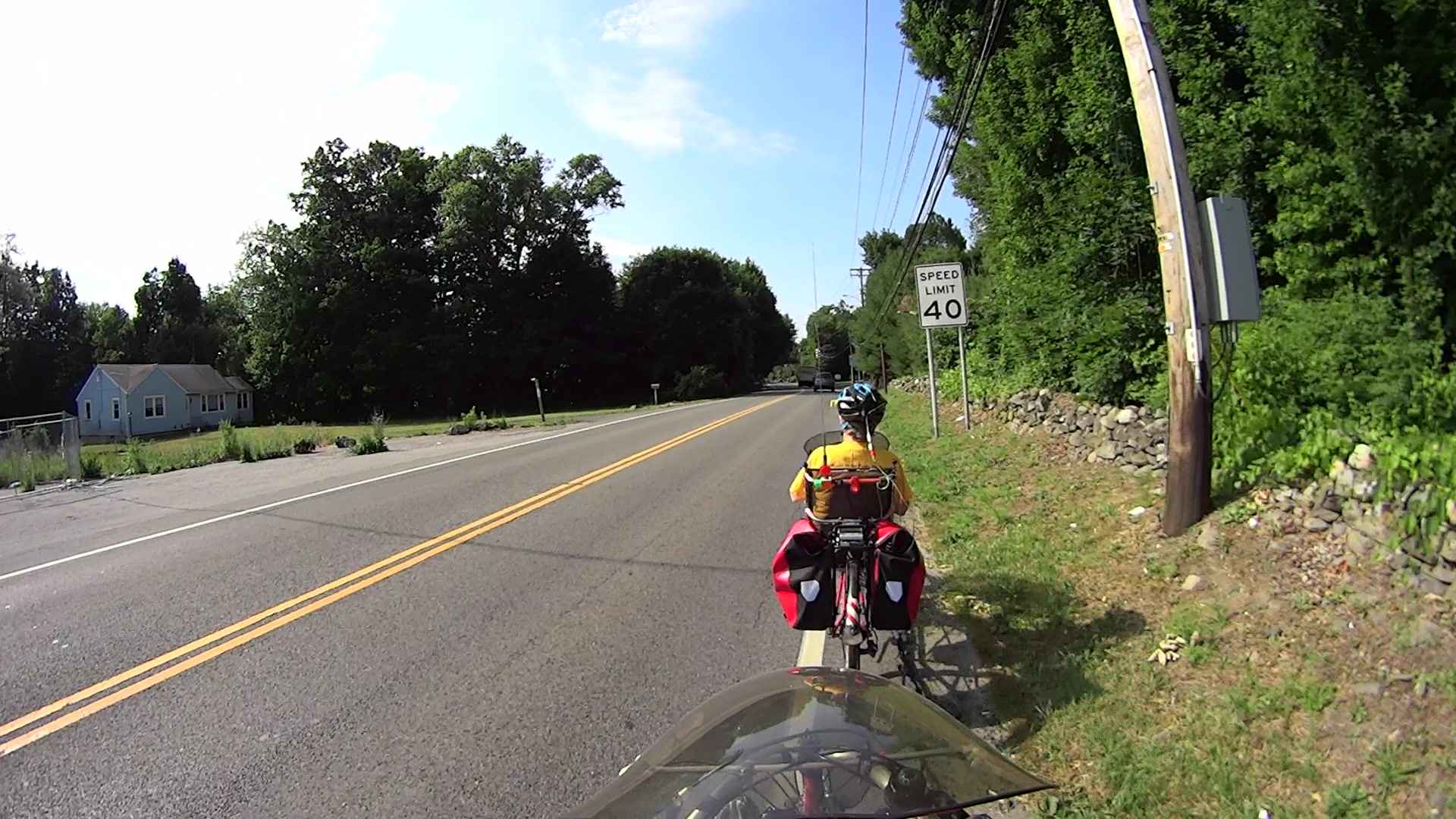
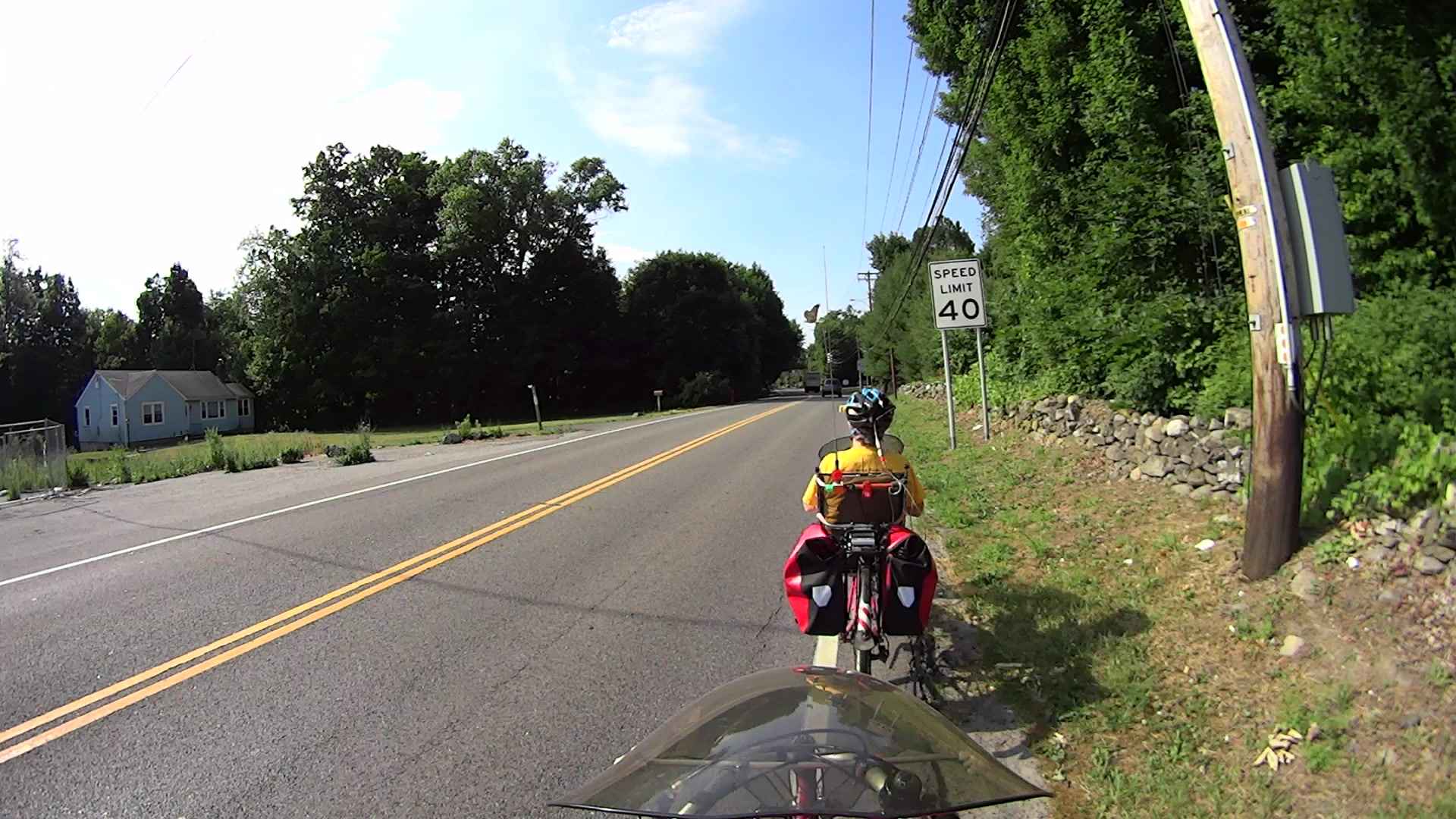
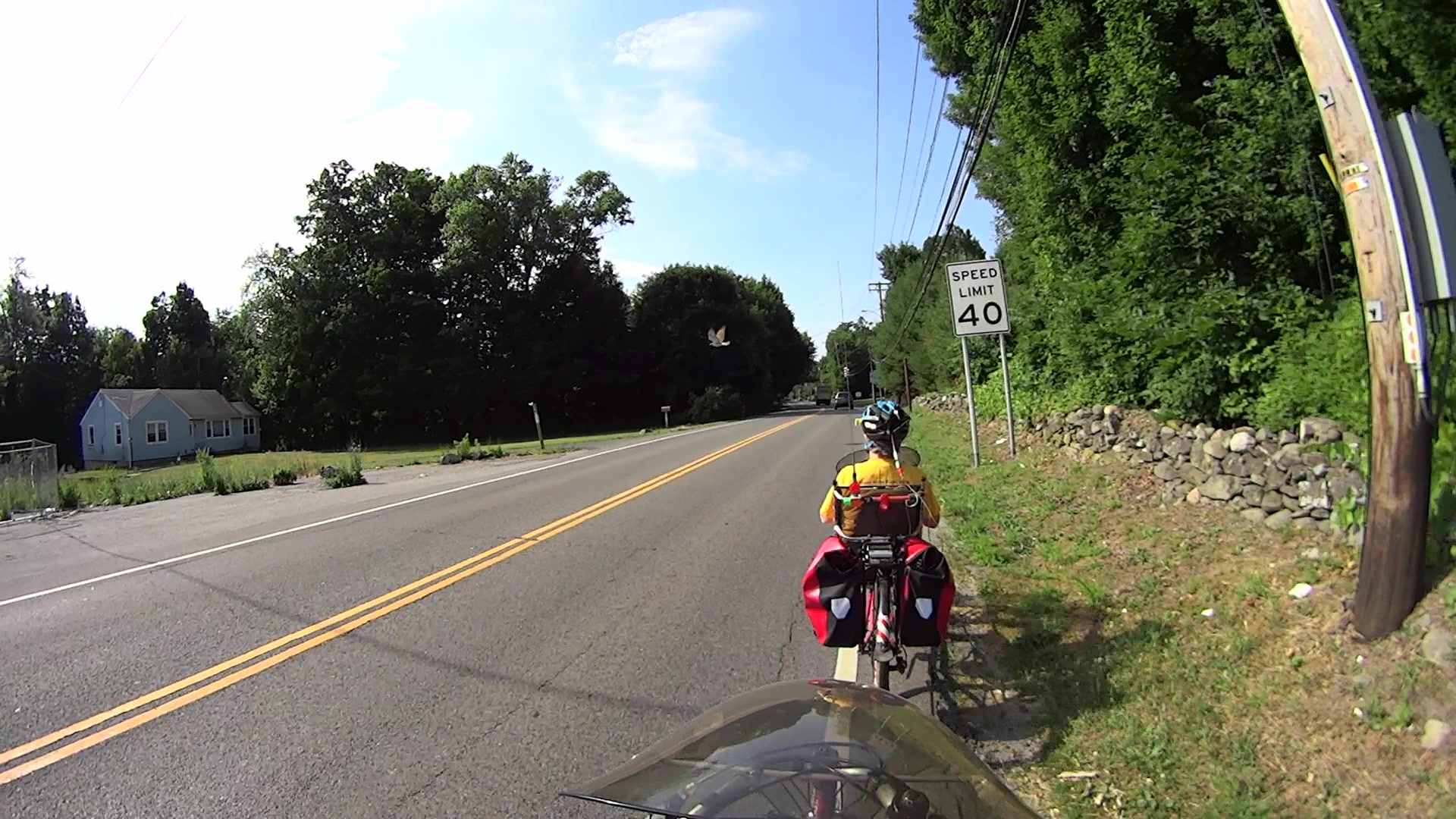
    A moth came within arm’s reach during a ride along the Dutchess County Rail Trail:

    This slideshow requires JavaScript.

    Squinting at some earlier frames that show only a tiny moving dot, the moth disappears every five frames: one wingbeat requires either 5/60 or 10/60 s = 12 or 6 strokes/second.

    We continued our respective missions without incident…

    The moth came much closer to the camera than it looks. I should calibrate the images with known objects at known distances, but that seems like a lot of work.

  • Macrophotography Exposure Calculator

    Back in high school, I designed and built a slide rule exposure calculator to improve my macro photographs:

    Macrophotography Exposure Calculator - front
    Macrophotography Exposure Calculator – front

    The base consists of three layers of thin cardboard glued together with Elmer’s Glue. The three slides have three layers of thinner white cardboard glued together, with offsets forming tongue-and-groove interlocks, topped with yellow paper for that true slide rule look:

    Macrophotography Exposure Calculator - slide detail
    Macrophotography Exposure Calculator – slide detail

    Judging from the seams, I covered the hand-drawn scales with “invisible” matte-surface Scotch Tape. Worked well, if you ask me, and still looks pretty good:

    Macrophotography Exposure Calculator - front - detail
    Macrophotography Exposure Calculator – front – detail

    The reverse side carries instructions under a layer of packing tape (which hasn’t survived the test of time nearly as well), for anyone needing help:

    Macrophotography Exposure Calculator - rear
    Macrophotography Exposure Calculator – rear

    A closer look at the instructions:

    Macrophotography Exposure Calculator - instructions
    Macrophotography Exposure Calculator – instructions

    The slides still move, albeit stiffly, and it might be usable.

    I vaguely recall extension tubes on an early SLR, but memory fades after that. Getting the exposure settings close to the right value evidently posed something of a challenge and, given the cost of 35 mm film + development, it made sense to be careful.

    Fortunately, even today’s low-end cameras make macro photography, at least for my simple needs, easy enough, with the camera handling the exposure calculations all by itself:

    SX230HS - macro lens - 15 x 20 mA ring light
    SX230HS – macro lens – 15 x 20 mA ring light

    I’m definitely not on the level of a professional insect photographer!

    Randy’s observation to Amy in Neal Stephenson’s Cryptonomicon comes to mind:

    “… One of the most frightening things about your true nerd, for many people, is not that he’s socially inept — everybody’s been there — but rather his complete lack of embarrassment about it.”

    “Which is kind of pathetic.”

    “It was pathetic when they were in high school,” Randy says. “Now it’s something else. Something very different from pathetic.”

    “What, then?”

    “I don’t know. There is no word for it. You’ll see.”

  • Candidate Caravan

    For obscure reasons, the Silly Season brought Sanders, Trump, and Clinton fille to the City of Poughkeepsie within the span of eight days. We know enough to stay far away from such events, but one of the contestants came to us!

    A siren heralded flashing lights off to the left, coming up the hill from the bridge over the Mighty Wappingers Creek:

    Candidate Motorcade - 0463
    Candidate Motorcade – 0463

    The police car jammed to a stop in the middle of the Red Oaks Mill intersection, directly in front of the cars (and bikes) that had just begun moving after the light turned green:

    Candidate Motorcade - 0700
    Candidate Motorcade – 0700

    During the next minute, the officer managed to clear most of the traffic from the left-turn storage lanes perpendicular to us, after which two motorcycle officers led the procession:

    Candidate Motorcade - 5015
    Candidate Motorcade – 5015

    Two ordinary SUVs with flashing light bars followed:

    Candidate Motorcade - 5211
    Candidate Motorcade – 5211

    Two stretched SUVs with side window and marker flashers:

    Candidate Motorcade - 5403
    Candidate Motorcade – 5403

    One blatantly inconspicuous black sedan running dark:

    Candidate Motorcade - 5467
    Candidate Motorcade – 5467

    Two black patrol cars and a white patrol car, all with flashing lights:

    Candidate Motorcade - 5792
    Candidate Motorcade – 5792

    The officer jumped into his car and rejoined the procession at the end:

    Candidate Motorcade - 5992
    Candidate Motorcade – 5992

    According to my back-of-the-envelope, the motorcade moved through the intersection at a steady 20 mph.

    Given where all the folks who merit such an escort were supposed to be at the time, I don’t know why they brought The Personage through the Red Oaks Mill intersection in that direction; the City of Poughkeepsie is to our rear, due north of Red Oaks Mill. Perhaps they’re following a randomly chosen route to confuse the unprepared, even though it’s longer and requires more traffic control?

    Rumors from a Reliable Source indicate that not all trains travel on steel rails.

    I suppose you eventually get used to having a couple of quiet people standing in every room with you.

    One benefit of the inevitable news coverage: a few more people now know how to pronounce “Poughkeepsie”.