The Smell of Molten Projects in the Morning

Ed Nisley's Blog: Shop notes, electronics, firmware, machinery, 3D printing, laser cuttery, and curiosities. Contents: 100% human thinking, 0% AI slop.

Category: Oddities

Who’d’a thunk it?

  • Cabin Fever Tchotchke: Engraved Dog Tag

    Once again I’m planning to attend the Cabin Fever Expo in York; my shop assistant says this year she won’t barf in the kitchen sink Thursday evening just before bedtime…

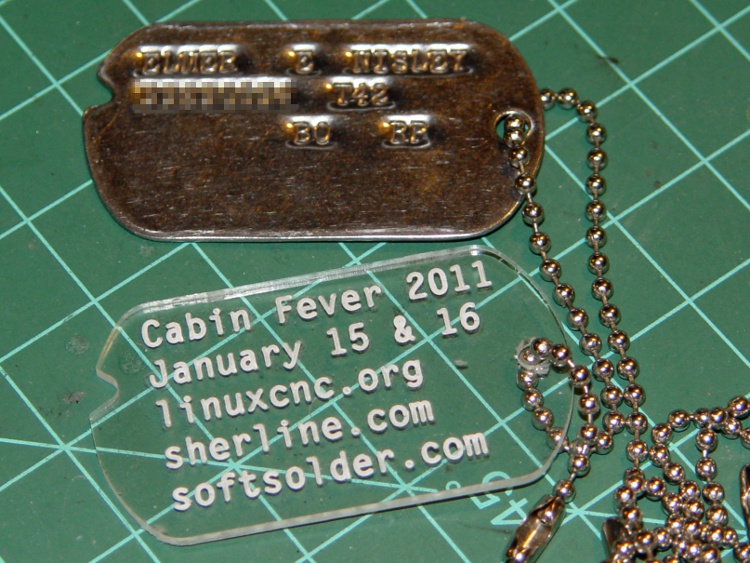
    If I’m going to haul a Sherline CNC setup that far and spend all day talking machining, I must have some tchotchkes / swag to talk about. We figured a small plastic dog tag with relevant URLs would be appropriate.

    Cabin Fever Dog Tag
    Cabin Fever Dog Tag

    I modeled the tag after my father’s WWII tag, including the mysterious notch. The rounded ends actually have three curves: two small fairing arcs blend the sides into the end cap.

    The G-Code routine figures out all the coordinates and suchlike from some basic physical measurements & guesstimates, so tweaking the geometery is pretty straightforward. There was a blizzard going on while I wrote it: a fine day to spend indoors hacking code.

    My assistant fired up Inkscape, laid out the text, figured out how to coerce G-Code out of Inkscape using the cnc-club.ru extension, then aligned it properly with the center of the chain hole as the origin on the right side. My routine calls the text G-Code file as a subroutine.

    The extension’s header and footer files wrap EMC2’s SUB / ENDSUB syntactic sugar around the main file. The default files include an M2 that kills off the program; took a while to track that one down.

    The header file:

    O<dogtagtext> SUB
    

    And the matching footer file:

    O<dogtagtext> ENDSUB
    

    The Inkscape-to-gcode instructions come out with absolute coordinates relative to the origin you define when you create the layout. The nested loops in my wrapper slap a G55 coordinate offset atop each label in turn, then call the subroutine.

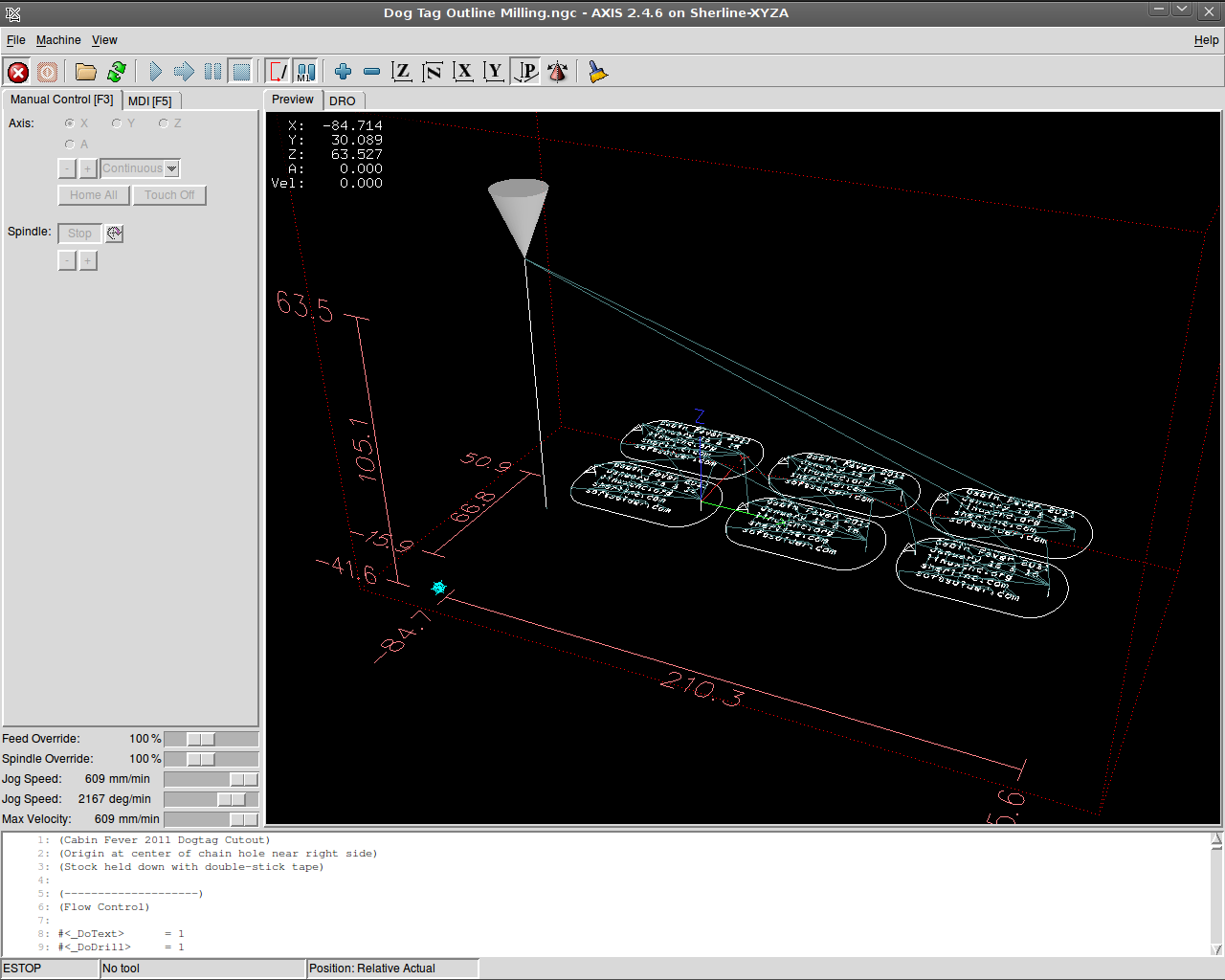
    The result is pretty slick:

    Screenshot: AXIS Dog Tags
    Screenshot: AXIS Dog Tags

    I carved out that proof-of-concept label atop double-sided adhesive tape, but peeling off the goo is a real pain; a 2×3 array will be much worse. I’d rather do that than figure out how to clamp the fool things to the sacrificial plate, though.

    The engraving is 0.2 mm deep with a Dremel 30 degree tool. My shop assistant describes it as “disturbing” the acrylic, not actually engraving a channel. This isn’t entirely a Bad Thing, as the font isn’t quite a stick font and the outline of each character mushes together. We must fiddle with the font a bit more; she favors a boldified OCR-A look.

    Some lessons:

    • The Kate G-Code syntax highlighter isn’t down with EMC2’s dialect
    • Be very sure you touch off the workpiece origin in G54, not G55
    • Xylene doesn’t bother acrylic and works fine on tape adhesive
    • Symlinks aimed across an NFS link work fine in ~/emc2/nc_files/
    • That 2×3 array may be too big for the Sherline’s tooling plate
    • Tool length probing FTW!

    The G-Code:

    (Cabin Fever 2011 Dogtag)
    (Ed Nisley - KE4ZNU - December 2010)
    (Origin at center of chain hole near right side)
    (Stock held down with double-stick tape)
    
    (--------------------)
    (Flow Control)
    
    #<_DoText>      = 1
    #<_DoDrill>     = 1
    #<_DoMill>      = 1
    
    ( Sizes and Shapes)
    
    (-- Tag array layout)
    
    #<_NumTagsX>    = 3                         (number of tags along X axis)
    #<_NumTagsY>    = 2                         ( ... Y axis)
    
    #<_TagSpaceX>   = 60                        (center-to-center along X axis)
    #<_TagSpaceY>   = 35                        ( ... Y axis)
    
    (-- Tag Dimensions)
    
    #<_TagSizeX>    = 50.8                      (2.0 inches in WWII!)
    #<_TagSizeY>    = 28.6                      (1-1/8 inches)
    #<_TagSizeZ>    = 2.0
    
    #<_HoleOffsetX> = 4.0                       (hole center to right-side tag edge)
    
    #<_NotchSizeX>      = 3.5                   (locating notch depth from far left edge)
    #<_NotchCtrY>       = 5.0                   (locating notch from Y=0)
    
    #<_NotchAngleBot>   = 30                    (lower angle in notch)
    #<_NotchAngleTop>   = 45                    (upper angle in notch)
    
    (-- Fairing Curve Dimensions as offsets from end arc center)
    
    #<_EndFairR>    = [0.68 * #<_TagSizeY>]
    #<_CornerFairR> = [0.25 * #<_TagSizeY>]
    
    #<_PCRadius>    = [#<_EndFairR> - #<_CornerFairR>]
    #<_PCY>         = [[#<_TagSizeY> / 2] - #<_CornerFairR>]
    #<_PCTheta>     = ASIN [#<_PCY> / #<_PCRadius>]
    #<_PCX>         = [#<_PCRadius> * COS [#<_PCTheta>]]
    
    #<_P1Y>         = [#<_TagSizeY> / 2]                    (top / bottom endpoint)
    #<_P1X>         = #<_PCX>
    
    #<_P2X>         = [#<_EndFairR> * COS [#<_PCTheta>]]
    #<_P2Y>         = [#<_EndFairR> * SIN [#<_PCTheta>]]
    
    (-- Tooling)
    
    #<_TraverseZ>   = 1.0                       (safe clearance above workpiece)
    
    #<_DrillDia>    = 3.2                       (drill for hole and notch)
    #<_DrillNum>    = 1                         ( ... tool number)
    #<_DrillRadius> = [#<_DrillDia> / 2]
    #<_DrillFeed>   = 200                       (drill feed for holes)
    #<_DrillRPM>    = 3000
    
    #<_MillDia>     = 3.2                       (mill for outline)
    #<_MillNum>     = 1                         ( ... tool number)
    #<_MillRadius> = [#<_MillDia> / 2]
    #<_MillFeed>    = 150                       (tool feed for outlines)
    #<_MillRPM>     = 5000
    
    #<_TextDia>     = 0.1                       (engraving tool)
    #<_TextNum>     = 1
    #<_TextFeed>    = 600                       (tool feed for engraving)
    #<_TextRPM>     = 10000
    
    (-- Useful calculated values)
    
    #<_TagRightX>   = #<_HoleOffsetX>           (extreme limits of tag in X)
    #<_TagLeftX>    = [#<_TagRightX> - #<_TagSizeX>]
    
    #<_EndFairRtX>  = [#<_TagRightX> - #<_EndFairR>]
    #<_EndFairLfX>  = [#<_TagLeftX> + #<_EndFairR>]
    
    #<_NotchCtrX>   = [#<_TagLeftX> + #<_NotchSizeX> - #<_DrillRadius>]
    
    (--------------------)
    (--------------------)
    ( Initialize first tool length at probe switch)
    (    Assumes G59.3 is still in machine units, returns in G54)
    ( ** Must set these constants to match G20 / G21 condition!)
    
    #<_Probe_Speed>     = 400            (set for something sensible in mm or inch)
    #<_Probe_Retract>   =   1            (ditto)
    
    O<Probe_Tool> SUB
    
    G49                     (clear tool length compensation)
    G30                     (move above probe switch)
    G59.3                   (coord system 9)
    
    G38.2 Z0 F#<_Probe_Speed>           (trip switch on the way down)
    
    G0 Z[#5063 + #<_Probe_Retract>]     (back off the switch)
    
    G38.2 Z0 F[#<_Probe_Speed> / 10]    (trip switch slowly)
    
    #<_ToolZ> = #5063                    (save new tool length)
    
    G43.1 Z[#<_ToolZ> - #<_ToolRefZ>]    (set new length)
    
    G54                     (coord system 0)
    G30                     (return to safe level)
    
    O<Probe_Tool> ENDSUB
    
    (-------------------)
    (-- Initialize first tool length at probe switch)
    
    O<Probe_Init> SUB
    
    #<_ToolRefZ> = 0.0      (set up for first call)
    
    O<Probe_Tool> CALL
    
    #<_ToolRefZ> = #5063    (save trip point)
    
    G43.1 Z0                (tool entered at Z=0, so set it there)
    
    O<Probe_Init> ENDSUB
    
    (--------------------)
    (Start machining)
    
    G40 G49 G54 G80 G90 G94 G97 G98     (reset many things)
    
    G21                                 (metric!)
    
    (msg,Verify G30.1 position in G54 above tool change switch)
    M0
    (msg,Verify XYZ=0 touched off at left front tag hole center on surface)
    M0
    
    O<Probe_Init> CALL
    T0 M6                           (clear the probe tool)
    
    (-- Engrave Text)
    
    O<DoText> IF [#<_DoText>]
    
    (msg,Insert engraving tool)
    T#<_TextNum> M6         (load engraving tool)
    O<Probe_Tool> CALL
    
    F#<_TextFeed>
    S#<_TextRPM>
    
    (debug,Set spindle to #<_TextRPM>)
    M0
    
    G0 X0 Y0                (get safely to first tag)
    G0 Z#<_TraverseZ>       (to working level)
    
    G10 L20 P2 X0 Y0 Z#<_TraverseZ>         (set G55 origin to 0,0 at this point)
    G55                                     (activate G55 coordinates)
    
    O3000 REPEAT [#<_NumTagsX>]
    
    O3100 REPEAT [#<_NumTagsY>]
    
    O<dogtagtext> CALL
    
    G0 X0 Y0
    G10 L20 P2 Y[0 - #<_TagSpaceY>]         (set Y orgin relative to next tag in +Y direction)
    
    O3100 ENDREPEAT
    
    G10 L20 P2 X[0 - #<_TagSpaceX>] Y[[#<_NumTagsY> - 1] * #<_TagSpaceY>] (next to +X, Y to front)
    
    O3000 ENDREPEAT
    
    G54                                     (bail out of G55 coordinates)
    
    (-- Drill holes)
    
    O<DoDrill> IF [#<_DoDrill>]
    
    T0 M6
    (msg,Insert drill)
    T#<_DrillNum> M6
    O<Probe_Tool> CALL
    
    F#<_DrillFeed>
    S#<_DrillRPM>
    
    #<_DrillZ> = [0 - #<_TagSizeZ> - #<_DrillRadius>]
    
    (debug,Set spindle to #<_DrillRPM>)
    M0
    
    G0 X0 Y0                (get safely to first tag)
    G0 Z#<_TraverseZ>       (to working level)
    
    #<IndexX> = 0
    O1000 DO
    
    #<IndexY> = 0
    O1100 DO
    
    #<TagOriginX> = [#<IndexX> * #<_TagSpaceX>]
    #<TagOriginY> = [#<IndexY> * #<_TagSpaceY>]
    
    G81 X#<TagOriginX> Y#<TagOriginY> Z#<_DrillZ> R#<_TraverseZ>
    G81 X[#<TagOriginX> + #<_NotchCtrX>] Y[#<TagOriginY> + #<_NotchCtrY>] Z#<_DrillZ> R#<_TraverseZ>
    
    #<IndexY> = [#<IndexY> + 1]
    O1100 WHILE [#<IndexY> LT #<_NumTagsY>]
    
    #<IndexX> = [#<IndexX> + 1]
    O1000 WHILE [#<IndexX> LT #<_NumTagsX>]
    
    G30     (go home)
    
    O<DoDrill> ENDIF
    
    (-- Machine outlines)
    
    O<DoMill> IF [#<_DoMill>]
    
    T0 M6                   (eject drill)
    (msg,Insert end mill)
    T#<_MillNum> M6         (load mill)
    O<Probe_Tool> CALL
    
    F#<_MillFeed>
    S#<_MillRPM>
    
    (debug,Set spindle to #<_MillRPM>)
    M0
    
    G0 X0 Y0                (get safely to first tag)
    G0 Z#<_TraverseZ>       (to working level)
    
    G10 L20 P2 X0 Y0 Z#<_TraverseZ>         (set G55 origin to 0,0 at this point)
    G55                                     (activate G55 coordinates)
    
    O2000 REPEAT [#<_NumTagsX>]
    
    O2100 REPEAT [#<_NumTagsY>]
    
    G0 X[#<_NotchCtrX>] Y[#<_NotchCtrY>]     (get to center of notch hole)
    G0 Z[0 - #<_TagSizeZ>]                      (down to cutting level)
    
    G91                                         (relative coordinate for notch cutting)
    G1 X[0 - #<_NotchSizeX>] Y[0 -  #<_NotchSizeX> * TAN [#<_NotchAngleBot>]]
    G1 X[0 + #<_NotchSizeX>] Y[0 +  #<_NotchSizeX> * TAN [#<_NotchAngleBot>]]
    G1 X[0 - #<_NotchSizeX>] Y[0 +  #<_NotchSizeX> * TAN [#<_NotchAngleTop>]]
    G90                                         (back to abs coords)
    
    G42.1 D#<_MillDia>                          (cutter comp to right)
    G1 X[#<_TagLeftX>] Y0                       (comp entry move to tip of left endcap)
    
    G3 X[#<_EndFairLfX> - #<_P2X>] Y[0 - #<_P2Y>] I[#<_EndFairR>] J0    (left endcap front half)
    
    G3 X[#<_EndFairLfX> - #<_P1X>] Y[0 - #<_P1Y>] I[#<_P2X> - #<_PCX>] J[#<_P2Y> - #<_PCY>]
    
    G1 X[#<_EndFairRtX> + #<_P1X>]                                      (front edge)
    
    G3 X[#<_EndFairRtX> + #<_P2X>] Y[0 - #<_P2Y>] I0 J[#<_CornerFairR>]
    
    G3 X[#<_EndFairRtX> + #<_P2X>] Y[#<_P2Y>] I[0 - #<_P2X>] J[#<_P2Y>]    (right endcap)
    
    G3 X[#<_EndFairRtX> + #<_P1X>] Y[#<_P1Y>] I[#<_PCX> - #<_P2X>] J[#<_PCY> - #<_P2Y>]
    
    G1 X[#<_EndFairLfX> - #<_P1X>]                                      (rear edge)
    
    G3 X[#<_EndFairLfX> - #<_P2X>] Y[#<_P2Y>] I0 J[0 - #<_CornerFairR>]
    
    G3 X[#<_EndFairLfX> - #<_P2X>] Y[0 - #<_P2Y>] I[#<_P2X>] J[0 - #<_P2Y>]    (left endcap complete)
    
    G0 Z#<_TraverseZ>
    
    G40
    
    G0 X0 Y0
    G10 L20 P2 Y[0 - #<_TagSpaceY>]         (set Y orgin relative to next tag in +Y direction)
    
    O2100 ENDREPEAT
    
    G10 L20 P2 X[0 - #<_TagSpaceX>] Y[[#<_NumTagsY> - 1] * #<_TagSpaceY>] (next to +X, Y to front)
    
    O2000 ENDREPEAT
    
    G54                                     (bail out of G55 coordinates)
    
    G30         (go home)
    
    O<DoMill> ENDIF
    
    M2


    The doodles leading to the equations:

    Dog Tag Geometry Doodles
    Dog Tag Geometry Doodles

    We’ll see you there!

  • Bugged ATX Supply

    I intend to use an ATX power supply as a cheap source of bulk +12 V and +5 V power for the resistors on those heatsinks. I have a 250 W box on the shelf (harvested from a dead donor PC) that seemed ideal; they run more efficiently with higher loads and I only need 150-ish W.

    Being that type of guy, I opened it up to see what’s inside…

    Damaged ATX Supply
    Damaged ATX Supply

    Huh. Looks like some small creature of the night immolated itself down there in the lower left corner, tucked against the transformer. There’s nothing more than black goo and charred filaments left over, with green-blue corrosion creeping up the resistor lead.

    Or maybe it’s actually toxic snot from the manufacturing line. Hard to say at this point.

    The power supply tester says the juice comes out fine & dandy, so I might use the thing after trying to get the gunk out.

  • Buckle Up For Safety

    Windshield head strikes
    Windshield head strikes

    Y’know how some folks say they don’t wear a seat belt because they want to be thrown free in a crash? Here’s how that works in actual practice.

    The air bag fires as the front bumper begins to deform and your body rises off the seat. Because you’re not belted in, the bag boosts your upper torso against the roof liner, bounces your head off the sunshade and bezel, then feeds you directly into the windshield glass.

    Laminated glass doesn’t disintegrate, so your skull probably won’t completely penetrate the windshield. You’ll lose some scalp, though, as you slide down the crumbling glass and wedge above the dashboard.

    Even if you survive a broken neck, the ensuing brain trauma means you won’t be the same person ever again.

    News flash: massive brain trauma does not make you a better person.

    Before laminated windshield glass became mandatory, your head would completely penetrate the windshield. Here’s what happened in 1937, from the incomparably grisly — And Sudden Death by J. C. Furnas:

    Safety Glass Windshields
    Safety Glass Windshields

    I read one of the many Reader’s Digest editions of that article during my formative years. Probably the one in October 1967, if a bit of Google-fu serves me right. You can’t get reprints of it from RD any longer, it seems.

    However, unbelievably, while I was composing this post, I checked eBay and found a typewritten copy of the article, signed by Furnas, with 38 minutes remaining in the auction. I was the only bidder: for nine bucks (delivered) it’s mine.

    Most likely it’s a publicity / fundraising copy, because the handwritten notation on the first page reads:

    With best
    regards to
    [name]
    J. C. Furnas
    Oct 20, 1947

    Those SUVs reside in the junkyard along the Dutchess Rail Trail near Creek Road, where I might get a new seat to rebuild my comfy office chair this spring.

  • Cold Solder Joint

    Found this inside a friend’s dead USB memory stick:

    Cold solder joint in USB memory
    Cold solder joint in USB memory

    The leads come from a teeny 12 MHz crystal. The solder blob on the other side looked just fine, but you simply can’t tell by looking.

    As it turned out, the stick was dead for some other reason: the Flash memory controller chip got hot when the stick was drawing power. Resoldering all the joints had no effect, which wasn’t surprising.

    I suspect a killer static discharge or some such calamity.

  • Scraped Into Gibberish

    Every now and again I search for a few obvious keywords to discover where my posts have wandered off to; there’s a straightforward Creative Commons license (on the About page) that scrapers seem unable to comprehend. In a surprising number of cases, a simple note to the plagiarist webmaster suffices to eliminate the problem.

    Lately, though, the scrapers collect a page of text, run it bodily through a thesaurus, then post the ensuing gibberish. I think this gives the page some overall search-engine-friendly English syntax while concealing the deed from the original author.

    For example, my original deathless prose:

    Loose plugs, it turns out, vibrate the HT’s jacks right off the circuit board in short order and those jacks are a major pain to replace.

    A trip through the shredder produces this gem (I won’t reward them with a link):

    Loose plugs, it turns out of the closet, quiver the HT’s jacks all there potty the lap conquer rooms in butt in fail ask for and those jacks are a foremost ass effort to be a sensation.

    Doesn’t that give you the impression of someone locked in a room with a foreign-language dictionary, desperately trying to force an important message through a noisy channel?

    For the record, note that I did not refer to anyone’s posterior anatomy. It seems their phrase-o-matic converter fills in some obvious (to them, anyway) empty spots. All those, um, keywords appeared, as if by magic, in the “translation”.

    Sometimes, though, they get it right. My summary:

    Memo to Self: It’s always the connectors.

    emerged with just one change:

    Memo to Self: It’s everlastingly the connectors.

    Isn’t that cute?

    I collect some of the more amusing spam efforts there.

  • Steel Stair Stringer: Just Make It Fit

    Stair stringer cut out for bolt
    Stair stringer cut out for bolt

    Saw this in the Syracuse Sheraton: every stringer in the stairwell had a torch-cut opening so they could bolt the flight to the landing.

    I don’t know if the flights came pre-assembled (minus the concrete, I assume), but the cutouts definitely have that “WTF do we do now?” aspect about them, don’t they?

    Ah, well. I’ve been there & done that, too.

    Haven’t you?

  • Bed Bugs: Dying on Planet Sticky

    Even half an inch of masking tape forms an impenetrable barrier for small creatures; you could splurge on 2-inch tape to get more surface area if you’re squeamish. I did see a spider stepping daintily along a barrier, but, for the most part, all these specimens became mired within a few millimeters of an edge. That made it easy to decide which direction they were traveling: incoming insects stuck near the floor and a (very few) outbound insects stuck at the top, just after leaving the non-sticky surface.

    This is, we think, a well-fed first- or second-instar bed bug caught on a tape barrier; it’s not quite the right shape for the book louse seen below. A powder trap caught the only other bed bug in our collection.

    Bed bug on tape
    Bed bug on tape

    In addition to that sole bed bug, the tape barriers captured a steady stream of critters that were not bed bugs. The trick is sorting through all the false positives…

    Given the number of books in the house, we caught many book lice. These have a disturbing resemblance to bed bugs, but are basically harmless to humans. You don’t really need books to have book lice, although we captured most of them adjacent to our bookshelves.

    Book louse with 0.5 mm scale
    Book louse with 0.5 mm scale

    This scary critter is a carpet beetle larva. They survive on any fabric surface and can infest upholstery as well as carpets.

    Carpet beetle larva with 0.5 mm scale
    Carpet beetle larva with 0.5 mm scale

    Dust mites, at least for their first few instars, are transparent little bags of bug stuff. The first instar may have six legs, just like a first instar bed bug, but successive instars have eight.

    Dust mite first instar
    Dust mite first instar

    Here’s a close up view, showing it has eight legs:

    Dust mite
    Dust mite

    We have no idea what this cute little thing might be. It’s about 0.5 mm in diameter and, to the naked eye, looks like nothing so much as bed bug crap. But it’s alive!

    Spherical insect - dorsal
    Spherical insect – dorsal

    This terrifying apparition sprinted across the (non-isolated) kitchen table, whereupon I mashed it with a magazine. It’s most likely not a bed bug; we’re guessing a spider of some sort. That stylet in its proboscis doesn’t look spider-ish, though.

    Red insect with stylet
    Red insect with stylet

    It might be related to this eight-legged critter; the lancet on the front end is similarly scary. The legs aren’t the same, though.

    Mystery bug
    Mystery bug

    All in all, we found a bewildering variety of insects, bugs, and spiders wandering around in our house. None of them are particularly harmful, although I now have a (most likely pyschosomatic) allergy to dust mites.

    We’re not entomologists: if you know what the mystery critters are, I’d like to hear from you!

    Up next: a Hot Box that might forestall all this excitement.