Ed Nisley's Blog: Shop notes, electronics, firmware, machinery, 3D printing, laser cuttery, and curiosities. Contents: 100% human thinking, 0% AI slop.
The Huion tablet on my desk has its USB cable sticking straight out of the left side, whereupon it must loop around to burrow under the shelf under my monitor on its way to the port on the back of the PC case. The loop snagged on all the clutter atop the desk and I finally got around to Fixing That Problem:
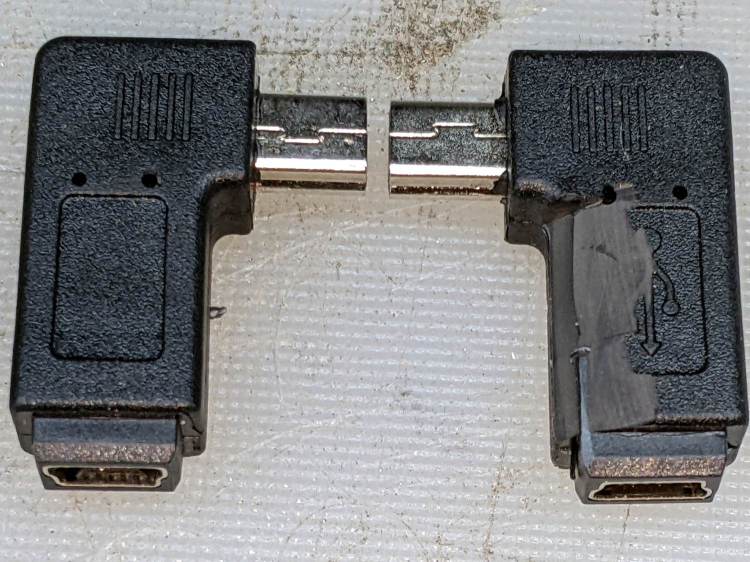
Which is a “left angle” adapter and which is a “right angle” adapter depends on which supplier you ask and how much you trust their descriptions / product photos, so you should get a set containing both: it’s the only way to be sure.
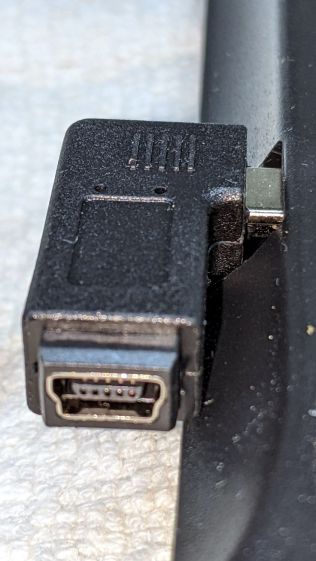
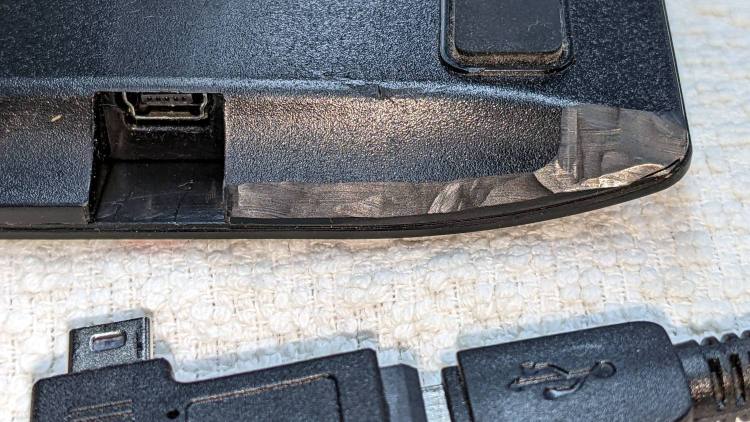
The one on the right (a “right angle”) shows a bit of carving, which came after the completely unsurprising discovery that the stylin’ curves on the side of the tablet collided with the rectangular adapter:
Huion tablet – misfit adapter
Some diligent X-Acto knife work carved away enough of both the adapter and the tablet case to snugly join them:
Huion tablet – plastic surgery
The hackery over on the far right fits around the USB cable’s molded connector. I simply cut away any parts that touched until the adapter seated firmly in the USB socket and the cable exited parallel to the edge.
Part of this involved not carving deeply enough into the adapter or cable connector to expose the internal wiring. I assumed the tablet didn’t have anything vital immediately inside that fancy curve, so that’s where I dug deepest.
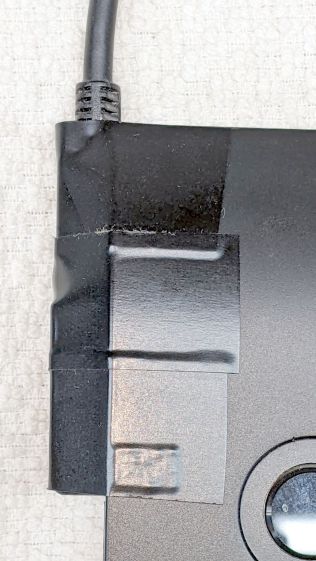
Stick adapter + cable to the tablet with good-quality electrical tape and now the cable points directly to where it should go.
A crude test setup to measure the duct fan’s air flow against resistance from plausible lengths of 6 inch duct and fittings:
Duct fan test setup
The orange stripe (upper left corner) marks the blast gate mounted on the steel plate closing off the fireplace: when the stripe is visible, the gate is open. It’s hot-melt glued into a plywood square reducing the 8 inch hole in the plate.
I won’t be using five feet of steel duct, but [handwaving] it’s what I have on hand and should produce results similar to a shorter length of flexible duct [/handwaving].
A useful conversion factor from the anemometer’s air flow in meter/sec to the corresponding volume flow in ft³/min (colloquially CFM), based on a 6 inch diameter opening with uniform airflow:
The air flow up the chimney depends strongly on basement temperature, outdoor temperature, and wind speed. On a midwinter’s calm-but-freezing evening it ran around 1.5 m/s → 57 CFM and the next day I measured 0.7 m/s → 27 CFM with wind gusts pooting old-fireplace smell into my face.
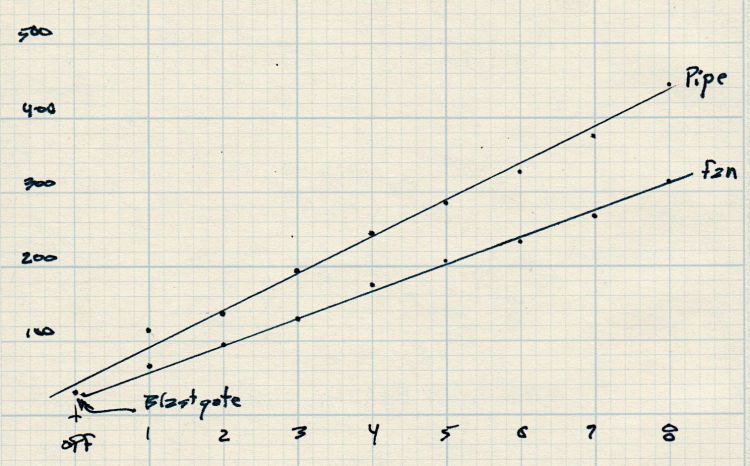
One might reasonably conclude something has gone horribly wrong, as the ductwork seems to contribute negative resistance and increased airflow. I think it’s a combination of the natural flow up the chimney, combined with a bit of flow straightening through the pipe directing air into the fan’s blades and measuring the (mostly uniform) inlet stream instead of the (somewhat segmented) outlet stream.
Anyhow, the controller has eight speeds with surprisingly linear output. I doubt the upper line’s slope of 50 CFM/click means anything, but the consistency of both suggests a 4:1 flow range, from which I can pick the lowest speed that provides enough fume extraction.
The basement has enough air leaking in (and out) that opening the exterior door had no discernible effect on the flow through the fan and up the chimney. At top speed the fan will produce two air changes per hour, chilling the basement something awful in the winter and introducing too much warm+moist air in the summer. This may call for a separate duct for outdoor makeup air, but that’s a problem for another season.
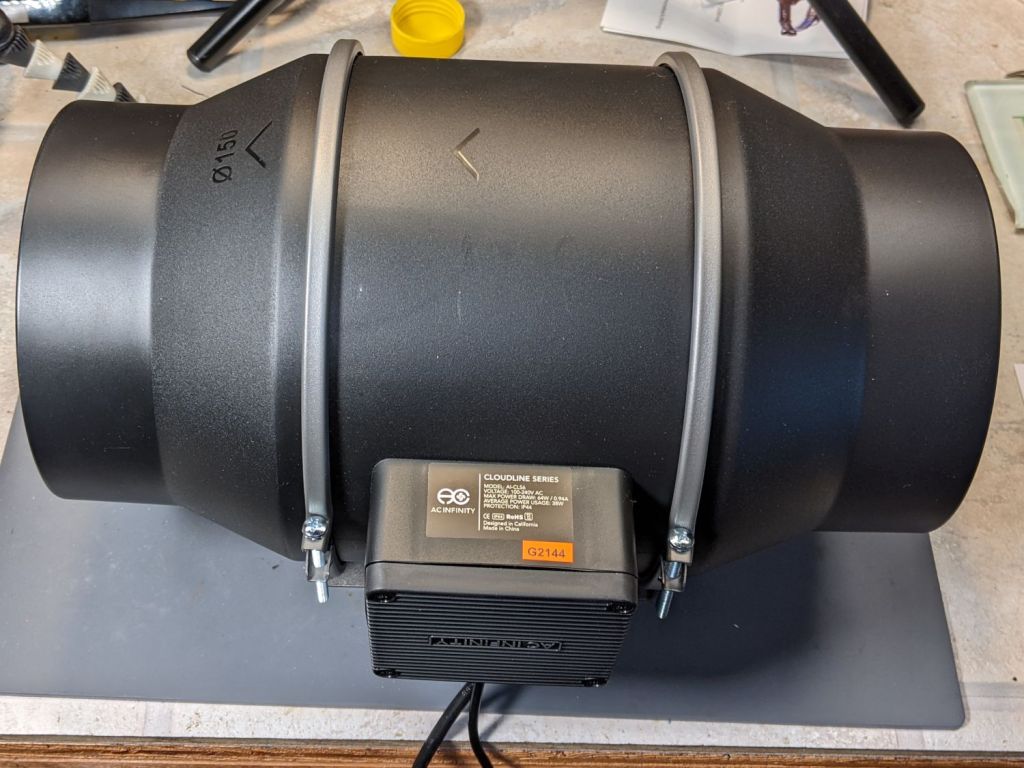
Being that type of guy, I had to measure the airflow through the inline duct fan intended for the soon-to-arrive laser cutter:
CloudlIne Duct Fan – overview
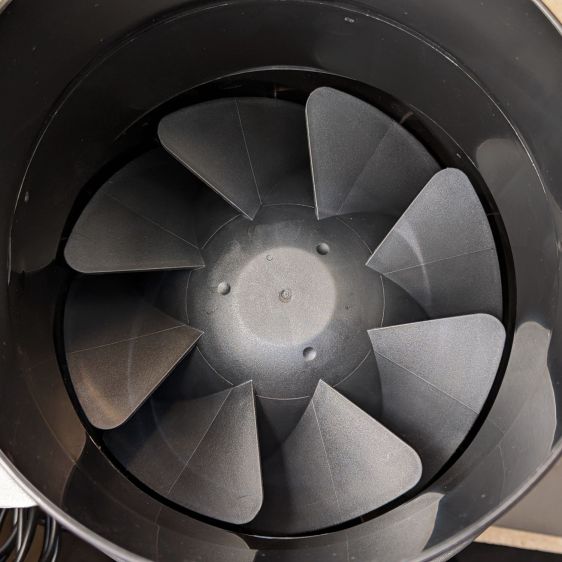
The fan is on the inlet side:
CloudlIne Duct Fan – inlet
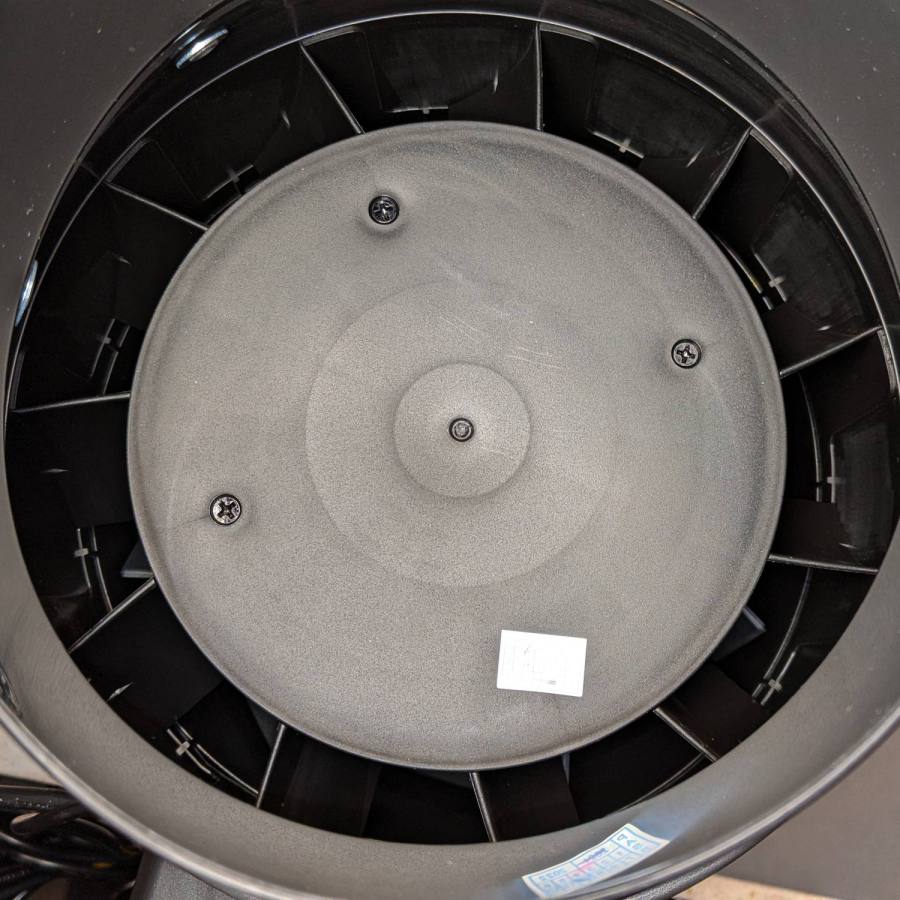
The outlet side consists of flow straightening blades around the backside of the motor mount:
CloudlIne Duct Fan – outlet stator
The duct ports on each end are (nominal) 6 inch, with the larger central body about 7 inch ID around the blank-faced 5 inch OD motor mount.
I measured the air speed (in m/s) at the rim of the outlet port and at the center, with the rim speed about twice the center speed. The anemometer is an inch in diameter, so I assumed the annular flow was about 1.5 inch thick.
Subtracting the dead zone in the middle from the total area of the fan body gives the area of the annulus carrying most of the moving air:
Dia inch
Area in^2
Area ft^2
Pipe
6
28
0.20
Center
3
7
0.05
Annulus
21
0.15
Remember, the central dead zone isn’t quite dead: it has an air speed maybe half of the annulus.
More spreadsheet action finds the flow for each of the fan speed settings:
Speed
Outer m/s
Outer ft/m
Uniform CFM
Annulus CFM
Inner ft/min
Inner CFM
Total CFM
Rated
1
1.8
354
70
52
177
9
61
44
2
2.9
571
112
84
286
14
98
88
3
3.8
748
147
110
374
18
129
132
4
4.9
965
189
142
482
24
166
176
5
6.0
1182
232
174
591
29
203
220
6
6.9
1359
267
200
679
33
233
264
7
7.8
1536
302
226
768
38
264
308
8
9.3
1831
360
270
916
45
315
351
The Uniform CFM column assumes a uniform air flow through the whole pipe, which is obviously incorrect. The Total CFM equal to the sum of the Annulus and the Inner zone, which comes out pretty close to the Rated values in the last column, taken from a comment by the seller.
Hard to believe I did the figuring before finding the “right” answers.
This is, admittedly, in free air without ducts or elbows, so the results will be lower when everything gets hooked up.
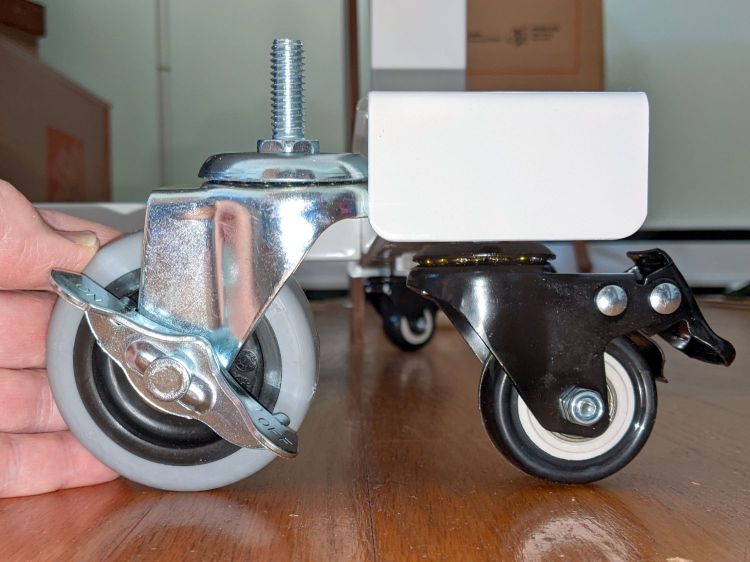
Cranked down as far as it would go, a new adjustable height workbench in Mary’s sewing room turned out to be just slightly higher than the other work surfaces adjoining it, so I replaced its 3 inch casters with 2 inch versions:
Sewing bench – 2 vs 3 inch casters
The bench arrived as a kit and included the 17 mm flat wrench required to snug the hex head on the 3/8-16 threaded stem atop the 3 inch caster against the bottom of the bench foot. The 2 inch caster also has a threaded stem, but of course it has a 14 mm hex head.
I traced around a 14 mm open-end wrench on a scrap of aluminum and introduced the outline to Tiny Bandsaw:
Improvised 14 mm caster wrench – rough cut
A little belt sander action cleaned up the outside, some hand filing matched the wrench to the hex, and it came out OK, even before I scrubbed the dirt off its white-ish pebble-finish coating:
Improvised 14 mm caster wrench – finished
The bare steel wrench arrived with the bench and has 13 and 17 mm openings. I briefly considered embiggening the 13 mm end, but came to my senses.
Aluminum isn’t a particularly good metal for wrench duty, but this one had to apply maybe 1/3 of a turn to each of four stems, stopping when snug, and it performed just fine. It’s now sleeping in the wrench drawer, dreaming of another job that may never arrive.
The smaller casters lowered the bench by about an inch, whereupon cranking the surface up a bit less than half an inch aligned it perfectly.
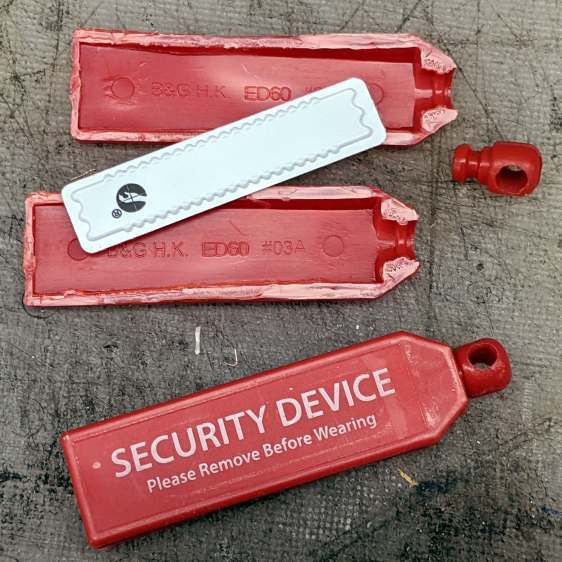
Having worn my work glove collection to exhaustion, the fanciest two pairs in a new selection came with elaborate security tags:
Elaborate Security Tag dissection
Finding a standard tag inside inside the fancy shell shouldn’t come as any surprise, but I’m surprised the retail loss ratio for a pair of $20 gloves can support that much hardware.
I went through the self-checkout area and didn’t do anything special, so either those lanes don’t have tag scanners or the tags are security theater.
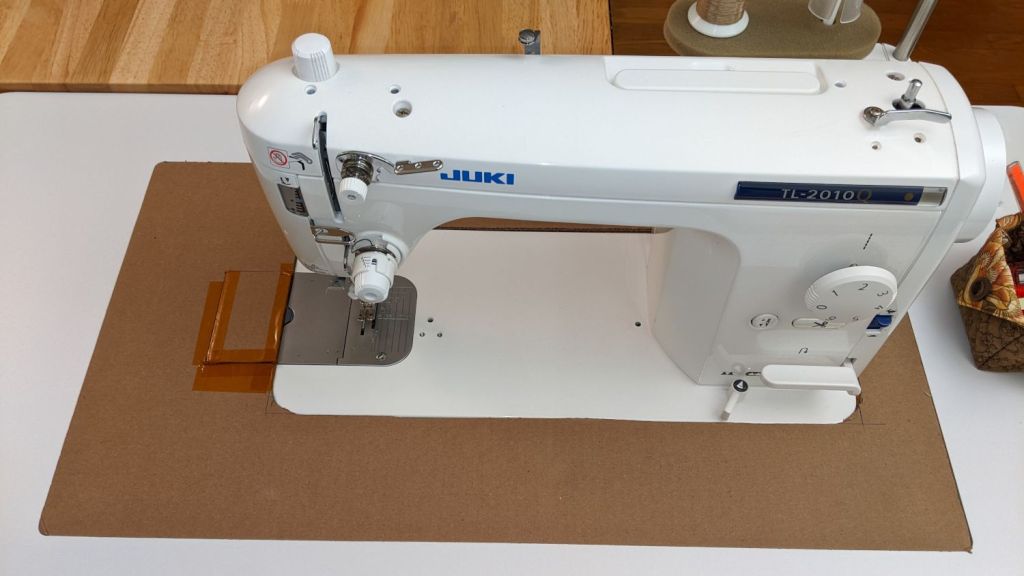
Mary’s new sewing table just arrived, but the laser-cut acrylic insert fitting around her Juki sewing machine is still a month or two away. Until then, a simple cardboard replacement must suffice to fill the gap:
Juki temporary table insert
The rectangle just to the left of the needle is a hatch for bobbin changes. Sheer faith and an interference fit between layers of Kapton tape holds it in place with surprising force.
I wanted to tape the cardboard edges to the machine and the table to smooth out the transitions, but her Supreme Slider slippery sheet may solve the problem without adhesives:
Juki temporary table insert – Super Slider
The “insert” is a 1/4 inch thick double-layer corrugated cardboard sheet, utility-knifed from a huge box. She layers cardboard under the wood chips in her Vassar Farms garden paths to discourage the weeds; this seemed like a perfectly reasonable diversion.










 The Smell of Molten Projects in the Morning