Ed Nisley's Blog: Shop notes, electronics, firmware, machinery, 3D printing, laser cuttery, and curiosities. Contents: 100% human thinking, 0% AI slop.
With those doodles in mind, I applied an abrasive cutoff wheel to the shaft of an inspection mirror (from the usual eBay supplier) about 15 mm behind the second joint. That puts a short section of the third tube inside the yet-to-be-built helmet mirror mount.
The two copper-colored springs center the smaller tube inside the larger one and provide enough friction to make the whole thing work. The tubes seem to be chrome-plated brass and the springs might be phosphor bronze. I suppose they’re Matryoshka-sized from one end to the other.
I’d never taken one of those shafts apart before; now we both know.
Having had many bike helmet mirrors disintegrate over the miles and years, I’ve had a background project bubbling along to build something more durable. Whether that’s feasible or not remains to be seen, but here’s another go at it.
A full-up ball joint seems to be more trouble than it’s worth and, in any event, requires far too much precision to be easily duplicated. That renders those doodles, mmm, inoperative.
These doodles aren’t workable, either, but they convert the ball joint into two orthogonal rotating joints that could be 3D printed with some attention to detail.
The general idea:
An ordinary inspection mirror has most of the tricky bits
An azimuth-elevation mount aligns the shaft relative to the helmet
The mirror shaft extends to put the mirror forward of your eye
The existing mirror ball joint aligns the mirror relative to your eye
What’s not to like:
Exposed screw heads
Off-center, hard-to-grip adjustments
Probably not printable without support due to all the bearing surfaces and cutouts and suchlike
Mirror Mount – Doodles
A few more days of doodling produced something that seems better. The az-el joint axes and the mirror shaft axis now meet at a common point, so the mirror shaft moves as the radius of a sphere. The elevation screw hides behind the azimuth mount, out of the way, which makes it awkward to adjust the tension.
The helmet mount plate must be concave to more-or-less match the helmet curvature. I’ve been securing mirrors using double-sided foam tape to good effect, but it requires a fairly large pad to provide enough adhesive force.
Two glue joints make everything buildable and should have basically the same strength as the parts themselves. The helmet plate builds concave face up. The az and el mounts build with the bearings upward, as do the mating surfaces on the other parts. Maybe the screws need actual nuts embedded in the mating parts, in which case there may be problems.
The setscrew holding the mirror shaft can crush the tube; I think they’re thin brass, at best. Putting a stud screw on the end will hold the shaft in place, leaving the setscrew to prevent rotation. Perhaps the stud can reinforce the tube.
As the scrawled notation says: printed at 50 mm/s with 100 mm/s moves. The only cleanup: remove the scaffolding and slice off the Reversal zittage.
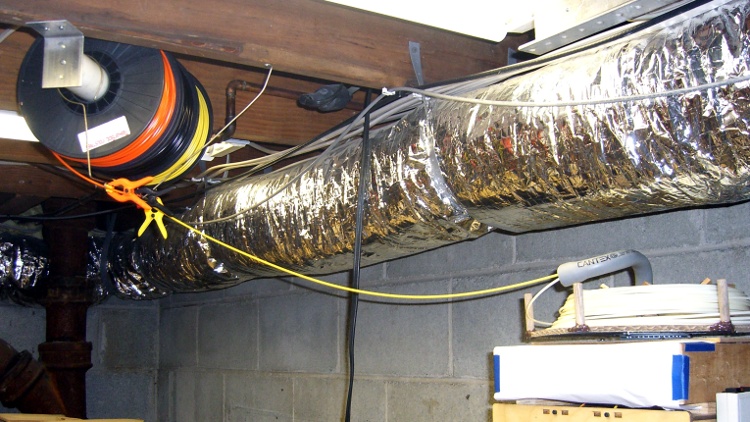
If the truth be known, that was actually the third knot. The first suffered a spectacular failure: one corner of the filament spool snagged on the wall behind the printer and jammed the filament:
Large Knot – failed
The filament drive pulled all the slack out of the bundle, broke off three of the six internal guide posts (admittedly, they’re just hot-melt glued in place), and dragged a nasty kink halfway down the feeder tube. Obviously the stepper was shedding steps during that whole process, but it came rather close to doing the Ouroboros thing.
While that went down, I was puttering around in the far reaches of the Basement Laboratory, attempting to clean up a bit of the clutter, and checking in on the printer every now and again. Seemed like a good idea at the time, is all I can say.
Perhaps the Lords of Cosmic Jest simply decided this was an appropriate object to mess with. The vertices of the hexagonal filament spool stick out perhaps 10 mm from the printer’s backside and every one has cleared the wall on countless previous rotations. I moved the entire affair a bit further from the wall and maybe it’ll be all good from now on.
Eks loaned me a Tek AM503 Current Probe Amplifier, one of those gorgeous instruments that Just Works: a clamp-on DC to 50 MHz Hall Effect current meter. Because it’s electrically isolated from all the hideous electrical hash that surrounds any stepper motor driver circuit, it doesn’t see much of the garbage that pollutes any current sensor depending on a series resistance and a differential amplifier.
The initial ramp occupying the first third of each step comes from the motor’s L/R time constant coupled with the 9 V supply I was using. Back of the envelope: 2 mH / 2 Ω = 1 ms. With 8 V (9 V less MOSFET drops &c) applied, the initial slope = 8 V / 2 mH = 2500 A/s, so in 75 ms it rises 187 mA: close enough.
The small ripples show the A4988 chopping the current to maintain the proper value for each microstep.
Looks just like the pretty pictures in the datasheet, doesn’t it?
What’s more fun than one Stanford Bunny? A few litters!
These at 50 mm/s feed came out a bit jittery. The ear overhangs were particularly messy:
Small bunnies – ragged edges – 50-100
Another litter at 20 mms/s had better ear overhangs and much smoother coats with less overall jitter:
Small bunnies – ragged ears – 20-100
The obvious shear line across their tummies came from my messing around with the HBP cabling, jerking the X stage while preventing the cables from snagging on the Y stage. Moral of the story: don’t mess around with anything inside the box while it’s printing!
They have little droopy tails:
Small bunnies – droopy tails – 20-100
I think 25 or 30 mm/s would be better all around, as it’d move the extruder away from the Z stage’s mechanical resonance at 1.10 rpm.
The Judges at the Trinity College Home Firefighting Robot contest use butane grill igniters to light the candles in the arenas, but the gadgets seem to have terrible reliability problems: very often, they simply don’t work. I brought a few deaders back to the Basement Laboratory this April and finally got around to tearing them apart.
It seems they don’t ignite because the trigger’s safety interlock mechanism shears the plastic gas hose against the fuel tank’s brass outlet tube:
Grill igniter with sheared gas tube
I tried putting a small brass tube around the (shortened and re-seated) hose, but it turns out the trigger interlock slides into that space and depends on the hose bending out of the way:
Grill igniter with brass tubing
So there’s no easy way to fix these things.
It seems to me that a device using flammable gas should not abrade its gas hose, but what do I know?
Those cute little Pololu stepper driver boards using the Allegro A4988 chip have one conspicuous problem: there’s no good way to heatsink the chip. The doc recommends heatsinking for currents around 1 A and some informal testing shows it will trip out on thermal protect around 800 mA, so heatsinking really isn’t optional.
A thermal pad from the chip bonds to vias that conduct heat through the PCB to the bottom surface copper layer: putting a heatsink on the top doesn’t help as much as one on the bottom. What I’m doing here is a first pass at a bulk heatsink that would work with several of the driver chips lined up in a row; this one is ugly and doesn’t work well, but it should let me do some further electrical tests.
The general idea is to clamp the heatsink around the board, with the chip as the top-side pressure point. The catch: no room for an actual heatsink underneath, because that’s where the connector pins live. You could mount the board upside-down, but then there’s no good way to tweak the stepper current trimpot. That may not be a problem after you get things set up, although I’d hate to unplug and replug the board for each adjustment.
So I think a reasonable solution involves a metal strip to conduct the heat out the ends and up to the heatsink. What I’ve done here does not accomplish that; I’m just feeling around the parameter space.
You can’t get too enthusiastic with the clamping force, lest you crush the chip, so moderate pressure is the rule of the day. However, the chip sits low on the board, surrounded by taller components, so I put a drop of epoxy on top and flipped it over to produce a short thermally conductive column that’s higher than everything else:
Pololu stepper board – epoxy curing
The blue sheet comes from a trimmed-down TO-220 transistor heatsink pad; it’s thermally conductive silicone, provides a bit of compliance against the PCB, and insulates the REF trimpot test point from the heatsink.
The result looks OK, but it would be better to embed a small metal block between thinner epoxy layers to get better thermal conductivity:
Pololu stepper board – epoxy blob on driver chip
Although most of the heat goes out the bottom, you still need something on the top to take the spring pressure. I trimmed down the TO-220 heatsink that came with that silicone pad; it must mount off-center to permit access to the trimpot but, alas, blocks the voltage monitoring pad and both sense resistors. A length of 45-mil music wire bent into a flat M provides the spring:
Pololu stepper board – heatsink top view
The side view show how the kludge fits together:
Pololu stepper board – crude heatsink
The final result is truly ugly. The epoxy column didn’t turn out nearly as parallel to the PCB as I’d like, so some filing and finishing will be in order.
Now, to find out if it’ll allow the chip to run above 1 A for at least a while.