Ed Nisley's Blog: Shop notes, electronics, firmware, machinery, 3D printing, laser cuttery, and curiosities. Contents: 100% human thinking, 0% AI slop.
Pure almond butter comes with the somewhat stilted admonition “Must stir product. Oil separation occurs naturally.” I’d just opened a new jar and was busily (and laboriously) stirring when I realized we have the technology:
Lathe-turned Almond Butter
I installed the chuck’s outside jaws to grab the jar lid.
About three hours at 50 rpm, the lathe’s slowest speed, did the trick. We now have the smoothest, creamiest, best-mixed almond butter ever.
In a month or so, I’ll chuck up an unopened jar to see how well it works without any manual intervention.
I recently bought a pair of pork belly packages, one labeled “Local” at an additional buck a pound. They were packaged skin side downward, so the USDA inspection stamps came as a surprise:
Pork Belly Skin – USDA Stamps
Turns out the digits give the “establishment number”, which you can look up online. These came from a processor in Pine Plains.
We presume they keep track of their pigs …
The meat is curing even as I type. Next week: smoking.
The previous times we slow-roasted a pork shoulder, the smoke alarm went off well before the skin crisped. We’d drained the drippings from the pan before crisping the skin, but the residue still smoked up a storm; this time we we left the pool in place to see if it kept the surface cooler and reduced the smoke.
Well, no, it didn’t. This happened in the five minutes between one rotation and the next:
Roast Pork Shoulder – Smoked Kitchen
Knowing things would get at least a little smoky, I’d closed the pocket door (on the left) and hung a beach towel across the opening into the laundry room (to the right), which kept most of the smoke out of the rest of the house. The smoke detector in the laundry room didn’t go off until I walked through the towel, so my precautions worked pretty well.
Wow, was that skin crispy:
Roast Pork Shoulder – Crispy Skin
Plenty of smoke and no fire; the roasting pan has narrow slits for that very reason. Took a couple of hours to vent the house, during which the yard smelled downright yummy.
Next time, we’ll plunk the roast on a lined cookie sheet (with a rim!) and see what happens.
You don’t get my patter, but perhaps you’ll get the gist from the pix.
Hearphone – Detail
Summary: I like ’em a lot, despite the awkward form factor and too-low battery capacity. If you’re more sensitive to appearances than I, wait for V 2.0.
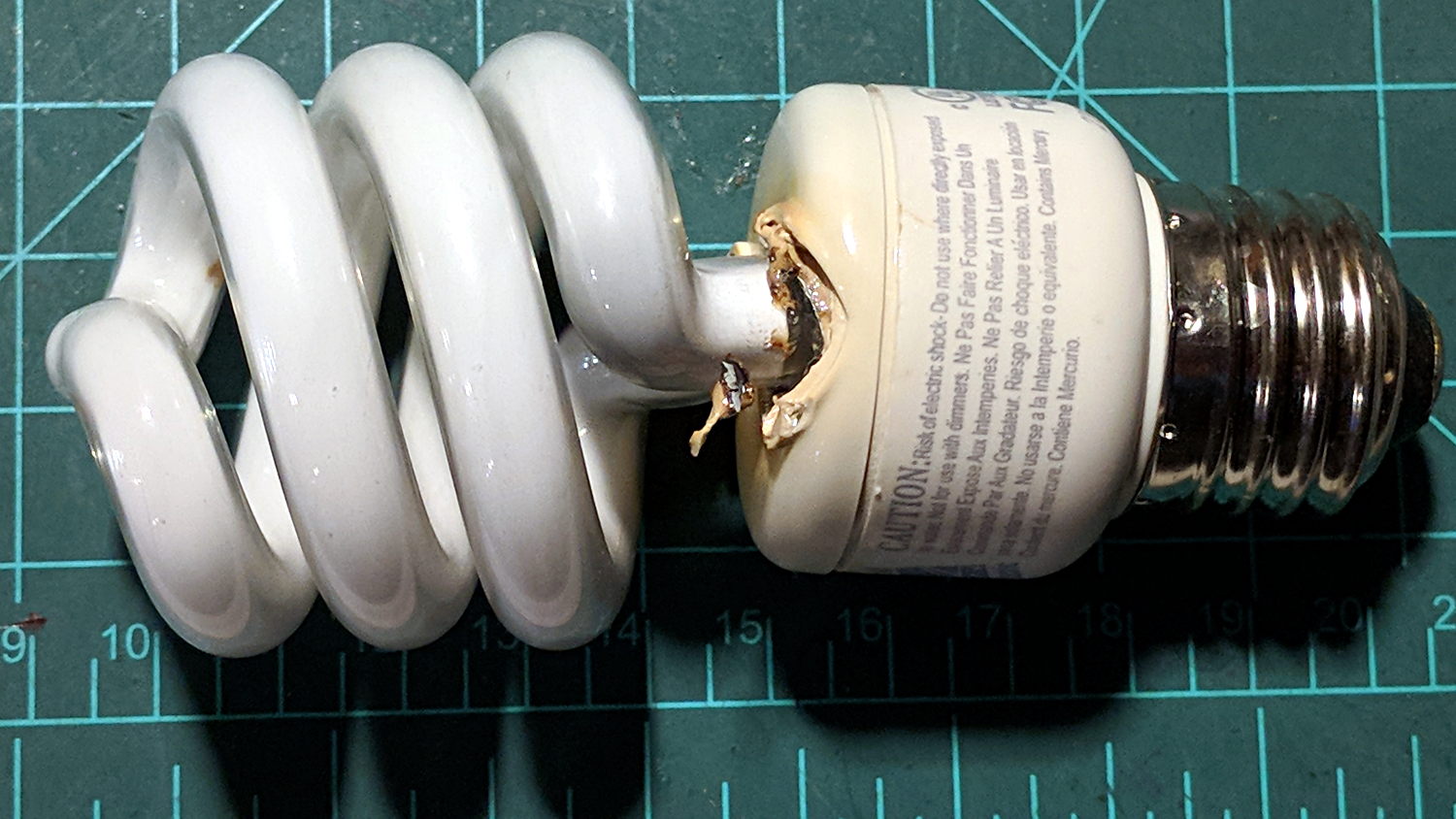
Unlike the last CFL failure, this time I noticed the faint smell of electrical death near the Electronics Workbench, but I couldn’t track it down until the can light over the the Bench didn’t start:
Another Hot-Failed CFL Bulb
The date code suggests it’s been in the fixture for over a decade, so I can’t complain. Having two unrelated bulbs fail within a week, after years of service, is surely coincidence. If another fails within a week or two, however, it will definitely be Enemy Action.
An overhead light in the Basement Laboratory went dark:
Failed CFL bulb
One end of the twisty tube got really really hot as it failed!
The Lab didn’t smell of electrical death, so the bulb must have failed while I was elsewhere. Metal enclosures with actual UL ratings suddenly seem like a Good Idea …




 The Smell of Molten Projects in the Morning