Ed Nisley's Blog: Shop notes, electronics, firmware, machinery, 3D printing, laser cuttery, and curiosities. Contents: 100% human thinking, 0% AI slop.
Whoever composed this wall of text knew the next person in line would update the placeholder:
HelloFresh Intro Offer Card – missed directions
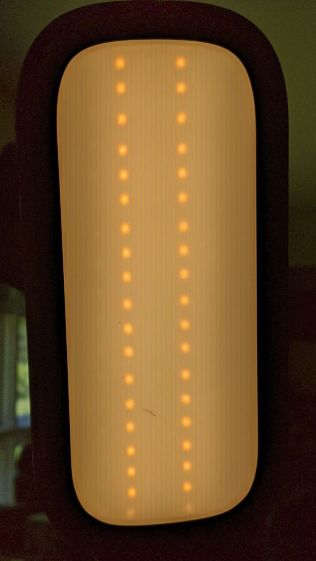
As you can tell from the prices, this dates back to late last year. Since then, the two red LED panels on each side had at least one pinball panic and were replaced with much dimmer units:
Mobil gas price puzzle
And a friend pointed me at this bit of innocently twisted signage from a Twitter thread:
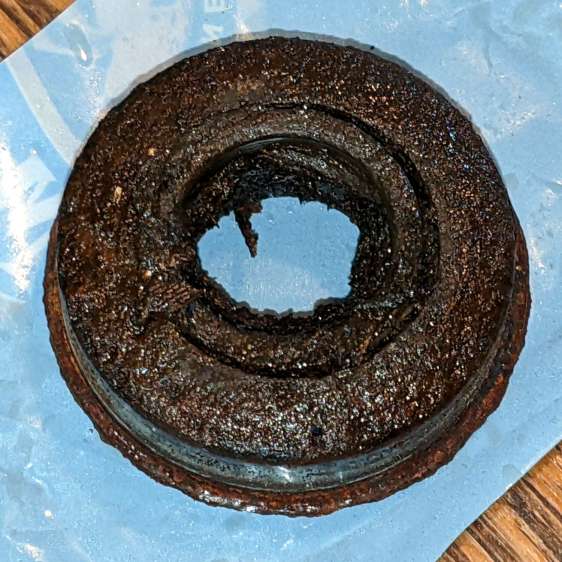
Radial slits around the middle let it bend upward over the folded aluminum joint around the pillar:
Angel Food Cake Pan liner – detail
Ours claims to be a 10×4-½ inch pan, roughly the diameter at the top and the overall height. Your pan will surely be different: this one is, as the saying goes, old enough to know better.
Mary’s new sewing table just arrived, but the laser-cut acrylic insert fitting around her Juki sewing machine is still a month or two away. Until then, a simple cardboard replacement must suffice to fill the gap:
Juki temporary table insert
The rectangle just to the left of the needle is a hatch for bobbin changes. Sheer faith and an interference fit between layers of Kapton tape holds it in place with surprising force.
I wanted to tape the cardboard edges to the machine and the table to smooth out the transitions, but her Supreme Slider slippery sheet may solve the problem without adhesives:
Juki temporary table insert – Super Slider
The “insert” is a 1/4 inch thick double-layer corrugated cardboard sheet, utility-knifed from a huge box. She layers cardboard under the wood chips in her Vassar Farms garden paths to discourage the weeds; this seemed like a perfectly reasonable diversion.
It’s one of the few Underwriter’s Knots I’ve ever seen in the wild. Many recent (i.e., built in the last half-century) lamps pass the cords through a plastic clamp or depend on simple bushings, with some just ignoring the problem.
This anonymous lamp sports the usual Made in China sticker, but also features a genuine-looking UL sticker complete with elaborate holograms, so it may well have been sold by a reputable company. IIRC, it came from a trash can in a Vassar College hallway, back when in-person meetings were a thing; perhaps Vassar required known-good electrical hardware.
Just before the turn of the millennium, I bought what turned out to be a never-sufficiently-to-be-damned HP 2000C inkjet printer that served as my introduction to refilling inkjet cartridges. A few years later, a Canon S630 printer joined the stable and worked fine for perhaps five years before succumbing to a printhead death. An Epson R380 that might have cost fifteen bucks after rebate took over, drank maybe a gallon of knockoff ink through a continuous ink supply system during the next thirteen years, and finally suffered progressive printhead failure during the last year.
Something recently changed in the inkjet market: Epson (among others) now touts their “Ecotank” printers featuring large internal reservoirs refilled by 70 ml bottles of color ink priced at perhaps 20¢/ml, obtained direct from Epson via Amazon. They proudly note you can save 90% off the cost of cartridges (“Kiss Expensive Cartridges Goodbye”), without mentioning how their previous extortionate cartridge business made that possible. Of course, Ecotank printers cost far more than cartridge-based printers, but that seems reasonable to me.
Because the ink bottles fit neatly into the printer through a push-to-flow valve interlock, I can finally retire this relic:
Inkjet refilling towel
That’s maybe fifteen years of accumulated splotches.