The Smell of Molten Projects in the Morning

Ed Nisley's Blog: Shop notes, electronics, firmware, machinery, 3D printing, laser cuttery, and curiosities. Contents: 100% human thinking, 0% AI slop.

Category: Home Ec

Things around the home & hearth

  • Antique Desk Chair Woodwork

    Antique Desk Chair Woodwork

    A wood desk chair that I’ve known since I was a pup finally got some much-needed attention, although not a restoration. By and large, I’m finally sorting out that corner of the basement and needed to put the chair’s parts back together so I can work on something else.

    The wood seat consists of several slabs glued along keyed joints, one of which had fractured into a rough mess. Amazingly, the two sides fit perfectly together, albeit with the bottom no longer a planar surface, and glued up just like they should:

    Wood desk chair - seat clamping
    Wood desk chair – seat clamping

    The chair isn’t up to contemporary office standards, but it has a seat elevation screw, a backrest with adjustable angle & elevation, and even a backrest tension setting:

    Wood desk chair - ironwork
    Wood desk chair – ironwork

    It was the cutting edge of desk chair technology:

    Wood desk chair - patented
    Wood desk chair – patented

    I vaguely recall it rolled on long-vanished steel-wheeled casters. Somewhat less long ago, one of the legs broke enough to lose its caster socket (about which, more later), so I set about yanking the three remaining sockets:

    Wood desk chair - caster socket removal
    Wood desk chair – caster socket removal

    During that struggle, another leg revealed a neat woodwork joint:

    Wood desk chair - leg joint
    Wood desk chair – leg joint

    It’s easy to remove a caster socket when you can bash it from the top!

    Gluing that piece back in place required Too Many Clamps™ aligning it with the leg:

    Wood desk chair - leg clamping
    Wood desk chair – leg clamping

    But the end result looks pretty good:

    Wood desk chair - leg glued
    Wood desk chair – leg glued

    They did a nice job of matching the wood grain; I hadn’t noticed that joint while attacking the socket.

    Pending restoring the broken leg’s socket, the soon-to-arrive new casters will clash horribly with the chair’s woodwork. At least it’ll roll again and its new plastic wheels won’t scar the floors.

  • Folding Wood Chair Arm Repair

    Folding Wood Chair Arm Repair

    One of the folding wood chairs that Came With The House™ had a loose arm that turned out to be due to a missing chunk of wood:

    Wood chair arm - as found
    Wood chair arm – as found

    The obvious lay of the grain shows why it failed like that, surely hastened by the crack below the screw.

    So I cut a snippet of brass tubing that, mirabile dictu, fit both the hole and the M6 screw, mixed up some wood epoxy and buttered it up:

    Wood chair arm - brass tube epoxy fill
    Wood chair arm – brass tube epoxy fill

    The crack extended entirely through the arm and was more extensive that seemed reasonable to expect the epoxy to handle on its own:

    Wood chair arm - splits
    Wood chair arm – splits

    So I slobbered soaked saturated the cracks with wood hardener and clamped them shut:

    Wood chair arm - clamping
    Wood chair arm – clamping

    The hardener is intended to solidify rotted wood, but it makes a reasonable adhesive and, being much more liquid than ordinary wood glues, seemed like it would penetrate further into the cracks than anything else on hand. We shall see how this works out.

    Rummaging in the Drawer o’ M6 Screws produced a better match to the brass tube than the original flat head screw:

    Wood chair arm - repaired
    Wood chair arm – repaired

    It screws into a fancy tee nut in the upright chair rail, where a dot of thread locker should hold it forevermore.

    I hit the exposed end with some sandpaper to smooth off the last of those smears and, after a few years, it’ll probably look like it grew there.

  • Dish Drainer Drain Board Draining Improvement

    Dish Drainer Drain Board Draining Improvement

    It seems all the drain boards under dish drainers are now intended for contemporary under-counter sinks without a rim, which is not the Old School drop-in sink we have in the kitchen. After considerable faffing about, I hacked a fix to make the drain board & drainer fit the sink:

    Dish Drainer - sink lip cutout
    Dish Drainer – sink lip cutout

    The crude notch not only lowers the front edge by a few millimeters, it also encourages the lip to stay over the sink, rather than sliding back over the counter and slobbering water everywhere.

    The drain board has stiffening ribs under the center section, cleverly arranged so they do not actually touch the counter. I measured the shape of the board near the ribs:

    Dish Drainer - measuring center ribs
    Dish Drainer – measuring center ribs

    And then cut shapes to both support the board and rest on the counter:

    Dish Drainer - center support
    Dish Drainer – center support

    The board has a swale in the middle, directly over those ribs, requiring more tilt for proper drainage:

    Dish Drainer - rear support
    Dish Drainer – rear support

    Getting all of that flying in formation required several iterations and we’re still not entirely satisfied, but at least the water flows into the sink and does not puddle in the drain board or on the counter.

    Stipulated: wood is the wrong material for the job, hot melt glue is breathtakingly ugly, and you want no part of this.

    You can buy fancier drain boards, some with cute spouts leading into the sink, but the fine print suggests most expect to work with rimless under-counter sinks.

  • Balans Chair Re-footing

    Balans Chair Re-footing

    I’ve been using what’s now called a Multi balans chair since shortly after it came out in the 80s, during which time the plastic feet have worn flat:

    Balans chair foot - foot wear
    Balans chair foot – foot wear

    By now, the wood bases ride on the floor, which is a Bad Thing I should have fixed long ago:

    Balans chair foot - wood wear
    Balans chair foot – wood wear

    The newer Multi chairs have rolling endcaps, but AFAICT that’s not a retrofittable thing.

    The feet have no obvious way to get them out, but after I saw how thin the plastic had become on one foot, some experimental carving solved the problem:

    Balans chair foot - OEM foot removal
    Balans chair foot – OEM foot removal

    A large bolt threaded into the crude hole provided enough griptivity to yank the feet out:

    Balans chair foot - removed feet
    Balans chair foot – removed feet

    With measurements in hand, I picked up a quartet of furniture leveling feet with M10 stems and tee nuts that exactly fit into the recesses:

    Balans chair foot - tee nut fit
    Balans chair foot – tee nut fit

    I generally buy from sellers who include measurements in their descriptions, although I no longer believe any unit-measurement prices. Most of the time the sizes come out close enough to reality for my simple needs.

    The stems were, of course, too long, but that’s easy to fix:

    Balans chair foot - cutting stem
    Balans chair foot – cutting stem

    The saw does yank the stem down at the last moment, but cutting slow & steady thins the steel and reduces the drama to manageable proportions. Fitting a scrap of wood exactly under the screw would be a much better technique; be it so moved.

    With the chair set to the mid-angle position I normally use, the feet meet the floor almost perfectly:

    Balans chair foot - straight foot contact
    Balans chair foot – straight foot contact

    At the steepest angle, things get skewed:

    Balans chair foot - angled foot contact
    Balans chair foot – angled foot contact

    Applying my nearly perfect hindsight, I got a set of swiveling feet and found an appropriate scrap of wood:

    Balans chair foot - swivel foot cutting
    Balans chair foot – swivel foot cutting

    Zero drama!

    Which looks exactly like it should with the chair at the steepest angle:

    Balans chair foot - swivel foot contact
    Balans chair foot – swivel foot contact

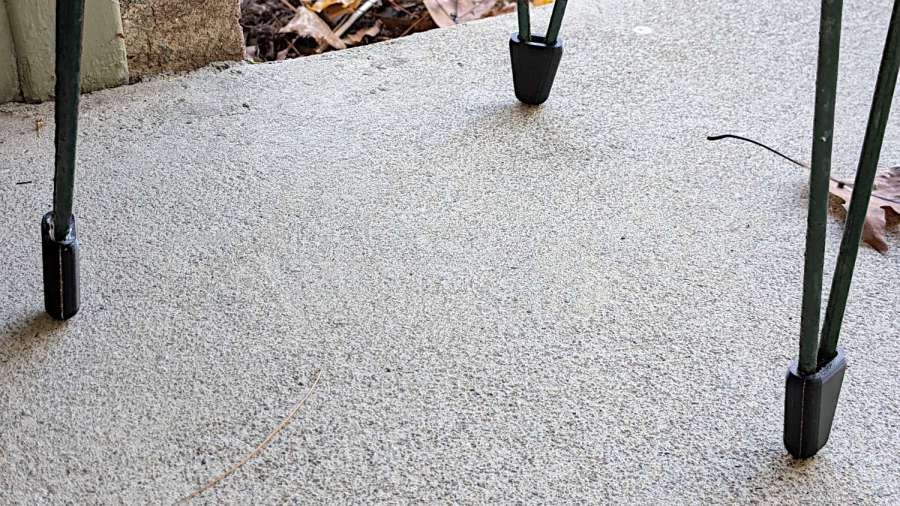
    The chair now sports two pairs of feet:

    • Straight feet on the rear
    • Swivel feet on the front

    Now, to see how they survive on a chair, rather than motionless furniture.

    If you have any idea why the WordPress AI image generator would come up with this, let me know:

    Balans chair foot - WP AI image
    Balans chair foot – WP AI image

    That’s not hallucination, it’s just plain irrelevant.

    For the record, we also have a couple of equally ancient Variable balans chairs.

  • Improvised Table Leg Latch

    Improvised Table Leg Latch

    While setting up the small table I conjured from scrap, I discovered one of the folding legs no longer had a latch to keep it from folding. Whether it never had one or the latch got lost along the way, there’s no time like the present:

    Table leg latch - installed
    Table leg latch – installed

    The bolt I put there in place of the joint rivet precludes a smaller latch along the lines of the simple steel loop on the other leg, so I figured I may as well go large and, with that much surface area, plywood will work just as well as steel for my simple needs.

    It’s a topless, bottomless box from the infinite supply at boxes.py, here seen with its halves being glued at right angles on an aluminum bracket:

    Table leg latch - gluing
    Table leg latch – gluing

    When those set, I glued & clamped them together in situ, then wrapped the whole mess with what’s basically high-strength friction tape to encourage it to not come too far apart under the inevitable stress when the leg tries to fold with a pile of stuff on the table.

    We’ll see how long this survives; if past experience is any guide, it’ll be a while.

    The WordPress AI image generator has a shaky grasp of both human anatomy and the blog topic:

    Woodwork design by Escher. What is that interesting tool? So many arms, all with nightmare fuel anatomy!

  • Sillcock Faucet Alignment Wedge: Getting the Angle Right

    Sillcock Faucet Alignment Wedge: Getting the Angle Right

    A pair of frost-free sillcock faucets arrived to replace the house’s leaky and un-repairable hose bibs. The faucet must be mounted at a 5° angle to let the water drain out when it’s closed:

    Everbilt Frost-Free Sillcock faucet - installation
    Everbilt Frost-Free Sillcock faucet – installation

    One might expect the Alignment Wedge included with the faucet to have a 5° angle. Because I can both measure and math, it has a 1° angle.

    Well, I can fix that.

    Start by scanning the bottom (widest side) of the wedge and apply GIMP’s Select by color tool:

    Sillcock faucet alignment wedge - GIMP color selection
    Sillcock faucet alignment wedge – GIMP color selection

    After a little manual cleanup in Quick Mask mode, apply a 1 mm inset to ensure it snaps around the pipe, convert the selection to a path, export it as an SVG image, and import it into OpenSCAD to cut the angle:

    // Sillcock faucet alignment wedge
    // Ed Nisley KE4ZNU - May 2024
    
    MaxThick = 5.0;
    Tilt = -5.0;
    
    PlateOA = [60,40,MaxThick];   // XY = original angle plate size
    
    difference() {
      linear_extrude(height=MaxThick,convexity=5)
        offset(r=-1.0)
          import("/mnt/bulkdata/Cameras/2024/Shop Projects/Sillcock Faucets/Sillcock faucet angle washer - outline.svg",
                 center=true);
       translate([-PlateOA.x/2,-PlateOA.y/2,MaxThick])
         rotate([Tilt,0,0])
            cube(PlateOA,center=false);
    }
    

    The solid model goes into PrusaSlicer for duplication & slicing:

    Sillcock faucet alignment wedge - PrusaSlicer layout
    Sillcock faucet alignment wedge – PrusaSlicer layout

    And comes off the printer looking just about like you’d expect:

    Sillcock faucet alignment wedge - OEM vs printed
    Sillcock faucet alignment wedge – OEM vs printed

    The far side of both wedges are 5 mm tall, but you can see the difference four more degrees makes in the front.

    It’s even more obvious from the edge:

    Sillcock faucet alignment wedge - on pipe
    Sillcock faucet alignment wedge – on pipe

    The wood siding where these will fit is perfectly vertical, so getting the wedge angle right isn’t really optional.

    I must drill the existing hole in the sill plate out to 1-1/8 inch to clear the pipe fittings, plus the wood around the screws holding the current bibs to the wall will surely need some buttressing, but all that’s in the nature of fine tuning.

    FWIW, this was the first 3D print after the move and I’m happy to say the M2 had no any need of adjustments.

    The WordPress AI image generator apparently ignored the post text and produced a stylin’ picture of an arched bathroom faucet over a rimless sink, which I shall leave to your imagination.

  • C-Power KK-800A Calculator Dress Panel Re-gluing

    C-Power KK-800A Calculator Dress Panel Re-gluing

    Long ago, I got Mary a cheap “desk calculator” with a vital function: it beeps cheerfully with each keypress. Nothing lasts forever and the aluminum dress panel around the keys has been gradually working its way loose.

    So, we begin …

    Gingerly remove the panel, un-bend and flatten it, lay it on the scanner, and cover with black paper:

    C-Power calculator keyboard cover
    C-Power calculator keyboard cover

    Blow out the contrast, threshold the image, do a little touchup, and get a binary mask:

    C-Power calculator keyboard cover - mask
    C-Power calculator keyboard cover – mask

    Import into LightBurn, trace and discard the image, do some shape optimization, add 0.2 mm to the height & width of one key, propagate those dimensions to other keys (Make same width and Make same height FTW), cut a paper prototype to verify the fit, iterate until it drops neatly into place, cut an adhesive sheet, then peel & stick:

    C-Power KK-800A keyboard - adhesive placed
    C-Power KK-800A keyboard – adhesive placed

    The dress panel was held in place by what was once a quick-setting gooey glue that had long since fossilized. Although it gave up on the aluminum, it was not going to come off the calculator body without more struggle than seemed warranted.

    So I stuck the new glue atop the old glue and hoped for the best. You can see traces of the old glue bead through the sheet:

    C-Power KK-800A keyboard - adhesive ready
    C-Power KK-800A keyboard – adhesive ready

    Lay the dress panel in place, burnish between the rows & columns, and it looks about as good as it ever did:

    C-Power KK-800A keyboard - restored
    C-Power KK-800A keyboard – restored

    If the adhesive sheet also gives up on the aluminum, I’ll try some fancy 3M 300LSE adhesive.

    The WordPress AI image generator heard I like keys, so it spat out some keys for my keyboards:

    Calculator keyboard - WP AI image
    Calculator keyboard – WP AI image

    The piano keys seem familiar, the thing in the middle looks eerily like a PDP-11 front panel, and … could that be a folding keyboard in the distance next to an 8-track player from a car dashboard?