Ed Nisley's Blog: Shop notes, electronics, firmware, machinery, 3D printing, laser cuttery, and curiosities. Contents: 100% human thinking, 0% AI slop.
This herd, a family unit that’s been traveling around the neighborhood in recent weeks, paused for morning brunch in our neighbor’s yard. They generally cross the road at a dead run, but haven’t gotten themselves or anyone else killed. Yet.
They and their ilk are why our vegetable gardens must have ten-foot fences with robust supports. There are no understory plants left in the wooded areas and precious few young trees; the deer population is literally eating everything in sight.
Vassar College recently culled 60-odd deer on their preserve in about ten hours, much to the dismay of the local animal huggers. It wasn’t a hunt; professional sharpshooters took ’em out.
We have a proposal: if you like deer so much, adopt ’em, haul ’em home, and take care of the things. Let them eat your shrubbery, crap all over your lawn, and infect your children, but keep them off the streets and out of your neighbor’s yards. Fair enough?
And let’s not get started about deer ticks. Dutchess County is the epicenter of Lyme Disease infections, for well and good reason.
Got the replacement X10 controller from the usual eBay source and it works fine, except it has a red LED that’s on unless it’s sending an X10 command.
That’d be OK, except that I’ve spent the last few months associating a red LED at that spot on the dresser with a jammed X10 controller.
Not to mention that red LEDs are sooo 20th Century…
Four screws hold the baseplate in place; it takes a bit of prying to release the stiffening collars around the front screws and remove the baseplate. One more screw holds the circuit board in place.
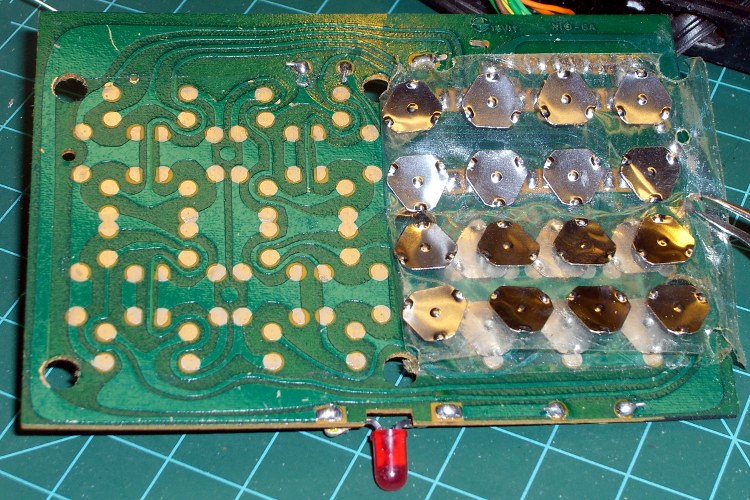
Surprisingly, they used the same metal-dome switch plates!
Anyhow, with the board out, it’s easy to unsolder the red LED and replace it with a green one from my bag o’ mixed LEDs. It’s not quite the same shape and doesn’t have a big shoulder to keep it in place, but it’s good enough for me.
New green LED
The heat of soldering melted the thermoplastic glue that held the original LED in place. The new one isn’t quite as firmly bonded, but I don’t intend to jam a paperclip into the hole after shoving the LED out of the way.
After 30-some-odd years, the X10 controller we’ve been using to turn off all the lights at bedtime finally stopped working. For the last few months it had been occasionally jamming ON, even when nobody pushed any keys, and the only way to reset it was pulling the plug.
The big silver can on the white cable is an ultrasonic mic, so perhaps the circuitry around that was getting cranky: the ultrasonic cleaner in the bathroom (which we use for eyeglasses) would reliably jam it. I think the controller was responding to the third harmonic of the 40-ish kHz cleaner power, delivered through the power line.
As you’d expect, all the electrolytic caps were shot; ESR for the big one was “open”, the smaller ones around 5 Ω. The capacitance values were entirely within spec, of course. I replaced all three.
X10 Controller keyboard
While I had the hood up, I cleaned the switch contacts, even though that probably had nothing to do with the problem. Back in the day, they used actual metal deformable domes, stuck under an adhesive layer that did a fine job of keeping the crud and dust out.
Put everything back together, fired it up, and it misbehaved the same way. I’d say we got our money’s worth out of it, though.
A replacement is on the order of $15 from the usual eBay suppliers, so it’s not the end of the world.
The new one probably doesn’t have the ultrasonic receiver, so it shouldn’t respond to the ultrasonic cleaner with the same enthusiasm.
I attempted to assemble the Totally Featureless Clock’s case using Liquid Nails Clear Seal, figuring that it’d be easier to fixture than runny epoxy. I hoped that the joints would have enough surface area to allow curing, but was dead wrong.
Hope is not a strategy and proper fixturing is your friend.
Anyhow, I was left with eight surfaces on four dislocated panels covered with more-or-less cured sealant. I left ’em sit for a few days, then had to choose between:
Remove enough of the sealant to make the joints fit or
Machine new panels
Turns out that xylene (from my can of Goof-Off) removes cured Liquid Nails Clear Seal just fine, without affecting the surface of the acrylic panel. Soak the corner of a rag, rub vigorously, and the gunk comes right off.
Note, however, that Goof-Off comes in many different formulations. The one I have is mostly xylene, but the California “VOC Compliant” version is mostly acetone… which, I think, eats acrylic plastic for lunch.
All of that stuff eats your liver for lunch, too.
Don’t do like I did and use your bare finger in the rag. Alas, any solvent that actually works also eats any protective glove in my inventory for lunch.
So I signed into the credit union’s online banking site, did the multi-factor authentication dance, and was confronted with this dialog box…
HVFCU Mystery DLL Download
No, as a matter of fact, I did not choose to open ibank.dll, thank you very much for asking.
Well, what would you do?
Got this response from the credit union’s email help desk:
Upon speaking to out Information Technology department, I have been advised that this is a known problem for FireFox, Mac, and Linux users.
Hmmm, well now, Internet Explorer is conspicuous by its absence on that list, isn’t it?
A bit more prodding produced this response:
HVFCU uses a third party vendor to provide the Internet Banking software used on our servers. On November 22 we installed the equivalent of their year end release (which is mandatory due to regulatory changes contained in the release). Subsequent to that upgrade we discovered that errors had been introduced for Mac and/or Linux users of Safari and FireFox (and also for a small subset of Windows Internet Explorer users). These same errors do not occur on Safari nor FireFox running on Windows. We reported these problems to our vendor within 24 hours of the installation.
My guess is that the “small subset of Windows Internet Explorer users” corresponds to the few who actually armored-up their IE security settings enough that it doesn’t automatically download and execute anything offered to it from any website.
The rest, well, those PCs are most likely part of a zombie botnet.
He assured me:
The “ibank.dll” program cannot run on a Mac nor a PC. It is solely a server side application which generates HTML pages.
Just guessing here, but if the “misconfiguration” had extended to actually serving the file, well, it probably would have run just fine (or, at least, attempted to run) on any Windows PC. They are, after all, using DLLs on the server, so it’s not like they’re a Unix-based shop.
And it’s pretty obvious that their vendor’s testing extended only far enough to verify that the code worked with security settings dialed to “Root me!” Maybe they didn’t actually do any testing at all; this was, after all, just an end-of-year update. What could possibly go wrong?
If you’re wondering why your Windows-based PC has been behaving oddly, maybe you’ve gotten a drive-by download from a trustworthy site with all the appropriate icons on their home page.
Makes you really trust the banking system, doesn’t it?
Or maybe it’s just another reason to stop using Windows…
The drain in our black bathroom(*) stopped working: the pop-up drain seal didn’t pop up.
I finally wedged myself under the sink, with my feet in the shower stall, and removed the operating rod. Turns out that we replaced the countertop and sink (nine years ago; nothing lasts) and the drain used plastic pipe.
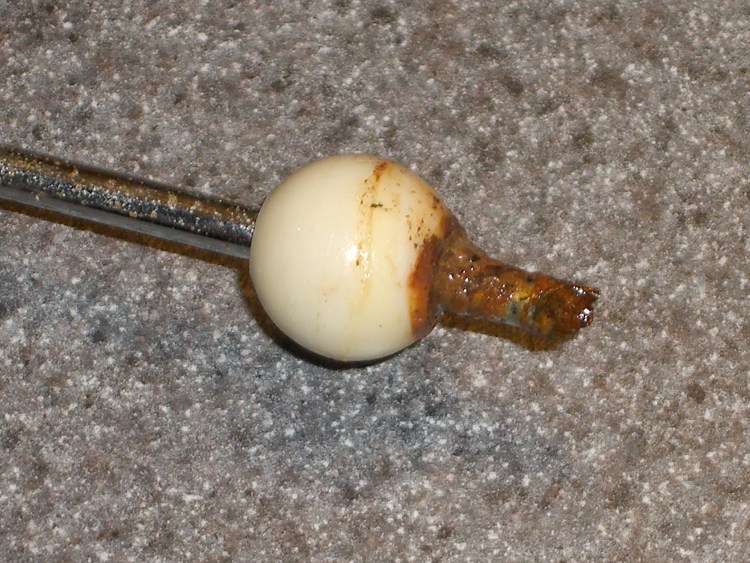
Except, of course, for the operating rod that sticks out into the drain. That’s chrome-plated steel, evidently with a few plating imperfections, and the end had simply rotted away. I suppose there’s a small chunk of steel decomposing in the trap.
How much would it have cost to use stainless steel in this corrosion-prone application? Or good old brass (“contains an ingredient known to the State of California to cause cancer or birth defects”)?
After a brief moment of consideration, with my feet still in the shower, I pushed the rod through the bearing ball so the other end stuck out by about the right amount and replaced it in the drain.
Swapped Rod
Yeah, there’s an icky rusted end hanging out there in mid-air, but the next person under that sink will understand exactly what’s going on…
(*) It’s the size of a large closet with wraparound black ceramic tile, a white tile shower stall, and a wall-sized mirror over the sink. We painted the walls and ceiling white, installed an ersatz gray granite counter top (it’s laminate, not anything spendy) with a shiny white sink, and it’s all good. The original half-century-old grout is in fine shape: some things really do last!
As part of the Great Kitchen Cleaning, I was charged with replacing a missing foot on the banana gallows we received as a gift many years ago. I found a tiny hole in the bottom that we’d never noticed before, most likely because we mistook it for an ink dot or an imperfection in the wood.
The spot seemed to have something inside and a pass under the microscope showed the remains of a pupal case. I pried it out, destroying it in the process. The insect was, of course, long gone.
Those are millimeter ticks on the scale along the top edge, so the hole is the better part of 1.5 mm in diameter. Perfectly round, of course, as only an insect programmed to drill holes can produce.
The hole was 8 mm deep (likely deeper before the wood was planed), so the bug was qualified for gun drilling!
The stand is marked “Made in Thailand”, but who knows where the wood came from or where it’s been? We’ve had the stand for many years now, but I’m pretty sure the critter was in there when we got it.





 The Smell of Molten Projects in the Morning