Ed Nisley's Blog: Shop notes, electronics, firmware, machinery, 3D printing, laser cuttery, and curiosities. Contents: 100% human thinking, 0% AI slop.
Thou shalt not eat siphon feeders, bottom feeders, things without eyes, or bugs
Someone famous once observed that being a gourmet consists almost entirely of being able to make approving noises and say “That was very good!” after eating a morsel that would cause ordinary folks to throw up.
The lab tech who coined that aphorism, obviously a man with an earthy sense of humor, also experimentally determined that the women he dated couldn’t tell the difference between fancy wine in ornate bottles and cheap wine in screw-top gallon jugs. So he kept a couple of ornate bottles around which he refilled as needed from the jugs. He simply pushed the corks back in and did a credible job of re-sealing the top with paper and wax.
We worked together on the IBM Video Disk project, then served time together in the East Fishkill Factory. Lost touch over the years and I think I just saw his obituary go by… sic transit, etc.
Most office desk chairs are crap. Spend a couple of hours in a typical office chair and you wonder if it had been designed by aliens who, perhaps, read the specs for human beings, but never actually met a person in the flesh.
Conversely, you can drive for a couple of hours and get out of the car feeling at least OK. (Well, if you buy a decent car, that is. Last rental car I drove had terrible seats.)
So, a couple of decades ago, I went to a junkyard and picked up a nice seat from a fancy wreck for about $50, built a plywood base with six casters from Home Depot, put a 1-foot-diameter Lazy Susan bearing between the two, and bolted everything together. The seat even had power adjustments, so (just for fun) I tucked a battery underneath.
After a while, I stripped off the seat belt doodads… and, of course, you really don’t need power adjustments after the first week.
Worked like a champ for about a decade, but even a high-end seat cushion eventually goes flat. So I swapped in a front seat salvaged from one of our cars (a Toyota Camry wagon, from back before minivans ruled the road) and that lasted another decade. It finally went flat and I swapped in the other front seat.
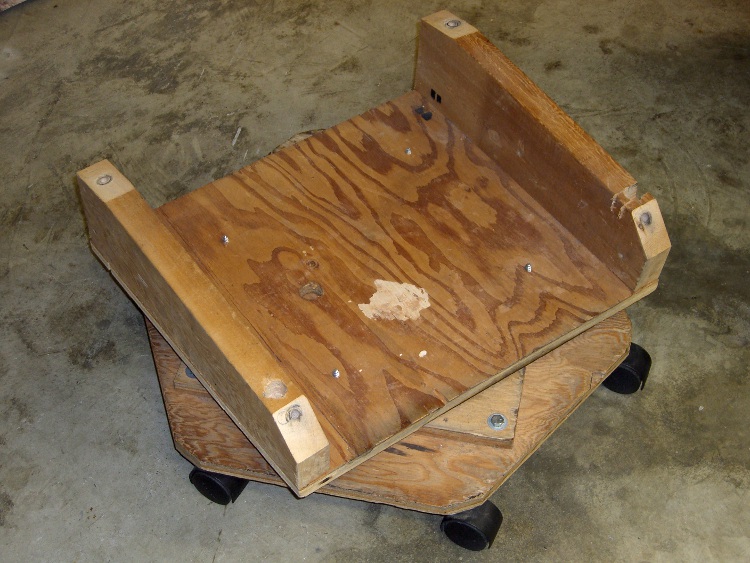
The 2×6-inch upright boards have slopes and cutouts that match the peculiar shape of the seat frame, with holes drilled in the wood for the metric machine bolts, and that’s a good enough anchorage for an office environment.
Chair base
The Lazy Susan bearing is between the top plywood layer and the square corner sticking out to the front. That layer bolts to the bottom sheet, providing enough clearance for the various heads and whatnot.
You really need six casters on a fairly large base, because the chair is immensely heavy (it was, after all, designed to not fall apart during a full-on collision) and rather top-and-back-heavy without you in place.
Considerations:
Get the seat close to the right height, as the adjustment range isn’t all that wide
Put your center of gravity in the middle of the base. Fortunately, the seat has plenty of forward-aft adjustment
Get the seat base pretty much horizontal
A closer look at the front:
Front detail
The back isn’t a lot different:
Back detail
Maybe I just have a weird butt or don’t spend enough money on office chairs.
The continuous ink system I have on the Epson R380 occasionally stops the yellow ink flow. I think it’s related to back pressure: the lines drain down quickly after the printer stops and the yellow line is on top.
The label on the front of the continuous ink supply reservoir minces no words:
Do not raise the external ink reservoir higher because of curiosity or insufficient ink-supply …
Well, maybe a little bit won’t hurt?
As it turns out, the original ink tanks inside the printer are pretty high up, with the bottom of the print heads maybe 60 mm off the table. That chunk of foam packing material is 40 mm tall: the bottom of the ink supply remains well below the heads.
The ink supply tubes drain back a few cm when the printer has been idle, which means the elevated reservoir isn’t applying positive pressure to the heads. And, after a few weeks of this treatment, the yellow ink flow hasn’t stopped!
I’ll call it a win.
Here’s the overall view, with a few ink splotches visible from previous blunders. If the table wasn’t a raw slab of half-inch plywood bolted to a surplus printer (?) stand in the basement, I’d care a lot more…
Elevated continuous ink reservoir
The amount of ink in the waste ink tank beside the printer is breathtaking: about 50% more than noted there.
When I replaced the kitchen counter & installed a new sink, I added a soap dispenser, mostly because the stainless steel sink had three holes that needed filling. After nigh onto a decade, the dispenser pump is now getting sticky: difficult to push down and reluctant to pop up.
Soap dispenser pump
The problem seemed to be that the O-ring wasn’t sliding nicely along the internal bore.
The catch is that both ends have ball check valves, so you can’t just squirt lube into the bore. I tried prying the thing apart, but the snap-together cap has a really aggressive closure.
So I shoved the exit valve ball (on the left of the picture) out of the way with a pin punch, wedged it into the end of the spring, and squirted the least amount of silicone lube I could manage into the pump. A bit of fiddling un-wedged the ball and got it back in position.
The pump works fine now, but I have my doubts as to how long the lube will last with continuous exposure to soap and constant sliding.
The thing probably needs a new O-ring and I’m certain of two facts:
I bought a pair of stainless-steel water bottles on sale from the usual Amazon sub-supplier at a small fraction of “regular price”: roughly 11 bucks delivered. My ladies use water bottles pretty heavily and these looked like good, durable bottles.
Of course, you wash new water bottles before putting them into service. It’s a darn good thing I got the first look inside; these were filthy!
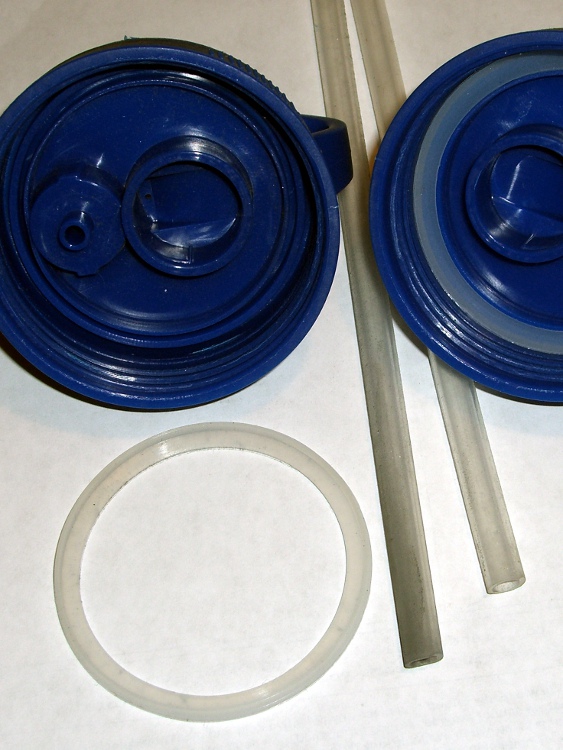
The caps have nice flexible silicone-rubber “straws” extending down into the bottles. The straw on the left was literally black with a coating of fine, powdery dust. The one on the right was merely gray.
The interior of the bottle with the dirtiest straw was, as you might expect, coated with black dust. The other bottle was comparatively clean, although I suspect the straw collected much of the free-floating dust.
I’m guessing the dust was part of the final polishing for the stainless bottles, although I can’t imagine how it got past final QC. Oh, yeah, they’re made in China, as is everything else these days.
All the parts cleaned up nicely after an attack with the bottle and tubing brushes, then two passes through the dishwasher.
My shop assistant came home with a five-dollar tag sale find: either a genuine antique car horn or a reasonable facsimile lashed together by an underemployed Pakistani shipbreaker. The original rubber bulb had long since rotted away, but the brass reed worked fine and the horn gave off a mighty honk! when given sufficient wind.
She bought a replacement bulb with hardware definitely made by the shipbreakers, knowing full well that the internal thread on the end of the new bulb’s brass stem couldn’t possibly match up with the external thread on the old horn. We sketched out some possibilities and decided to make a bushing over the horn’s stem with an internal thread: easier than a very short, perilously thin, double-threaded adapter ring.
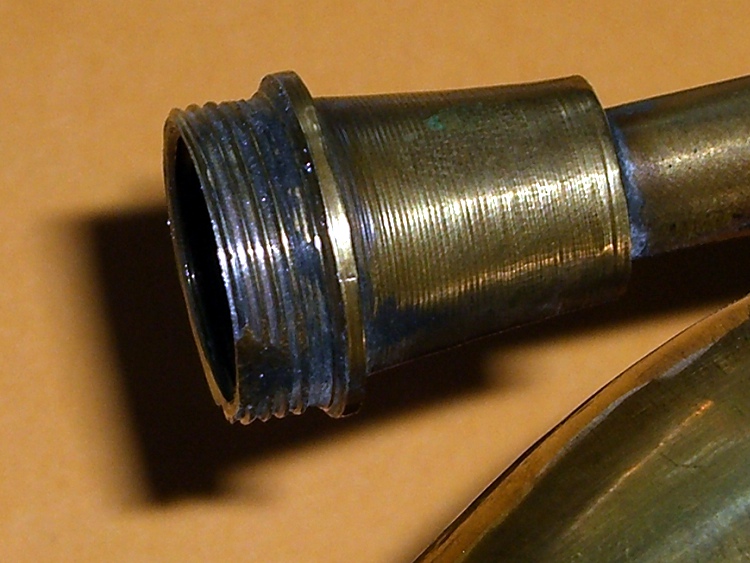
She measured various dimensions of both pieces and we consulted Machinery’s Handbook. The horn has a really crusty 32-tpi thread somewhere between 1/2 and 9/16 inch, which is not standard at all. Heck, it’s not even metric. (#include standard-metric-goodness-rant)
Horn fitting
The fitting also has an internal pipe thread (!) for the brass reed assembly. We eventually filed a few bits off the reed’s mounting dingus in order to clear the final bushing ID.
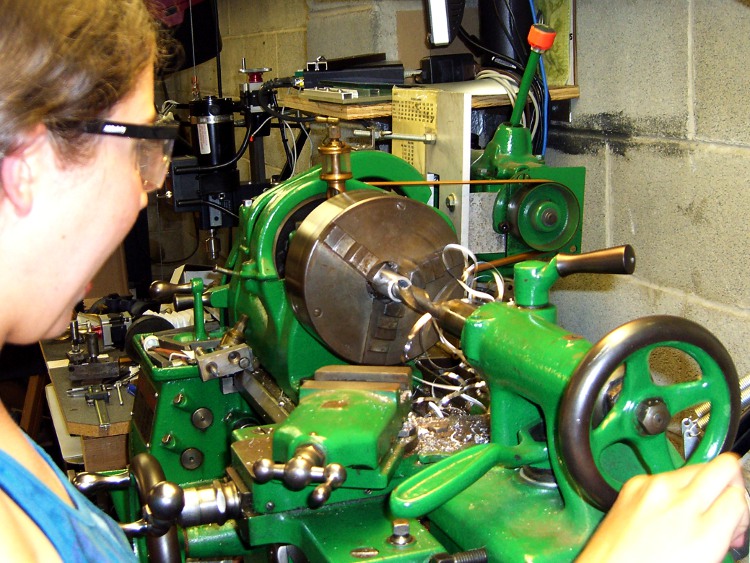
Some poking forced the scrap pile to disgorge an aluminum cylinder of exactly the right size for the bushing, with a nice half-inch hole right down the middle. Using a half-inch bolt with a center-drilled end as a mandrel, we brass-hammered it to line up pretty true, and she cleaned off the OD while learning about the quick-change gearbox; a round-nose bit at 104 tpi puts a nice zeepy (her term) finish on aluminum.
We left it stout, rather than trying to turn it down to a thin and elegant shell, because that was the easiest way to get things done. She’ll epoxy it to the horn stem and apply some Loctite to the horn bushing.
A lot of rummaging in the tool cabinet’s recesses produced a taper-shank drill slightly larger than the bulb stem. She drilled out most of the cylinder’s guts, leaving just enough for the threads at the far end, counting 1/10-inch turns on the tailstock all the way.
Shop Assistant Making Swarf
That pile of razor-edged swarf is now prized possession…
She bored out the narrow end to what seemed like the right minor diameter, given that we really didn’t have anything more than a guesstimate of the thread dimensions. I figured we could just continue threading, eating away at the ID, until it fit.
I don’t do a lot of internal threading, but we found a suitable threading tool, lined things up, and she learned about single-point threading by cutting a thread to match that horn. No measurements worth mentioning; this wasn’t the sort of job requiring a Go-NoGo gage.
I stayed away while she completed the threading, apart from consoling her when she discovered why you shouldn’t hand-rotate the chuck with the quick-change gearbox disconnected. We picked up the thread again and she completed the mission.
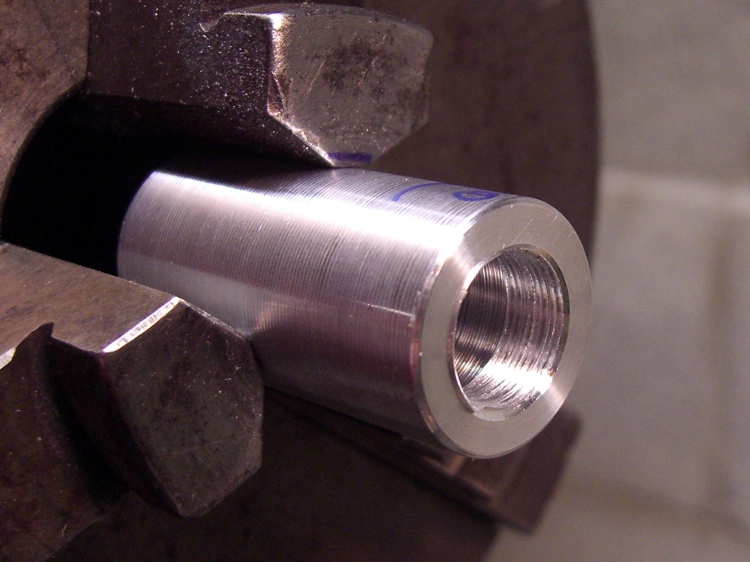
Here’s the raw thread before beveling the entrance.
Horn Bushing
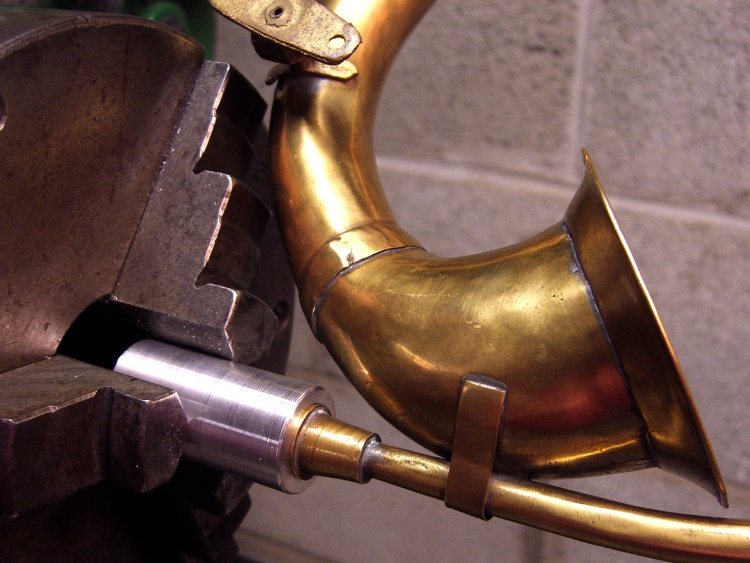
And then it fit! Verily, the horn itself was the Go-NoGo gage.
Horn in bushing
This was the second part she’s turned on the lathe; I’d say she’s doing just fine.
Our ancient Sears Kenmore electric clothes dryer (which is not matched to the never-sufficiently-to-be-damned HE3 washer) started squeaking again. The last time it did that, I tore it apart and determined that the rear seal between the drum and the back panel needed replacing; I ordered the seal, buttoned up the dryer, and, amazingly, the squeak Went Away.
The box with the new seal arrived a few days later and has been perched atop the dryer for the last few months. Never borrow trouble, sez I.
Unlike the HE3 washer, tearing the dryer down isn’t a big deal. Two screws secure the lint trap enclosure to the top panel; be careful about not dropping them down the chute.
Screws holding lint trap to top
Then push the top forward and pry it off the clips holding it in place. You do not need to remove what looks like clips holding the top to the back panel; they’re sort of hinges that let you tilt the top back. With any luck, you can let the top hang; I rested it on the nearby laundry sink.
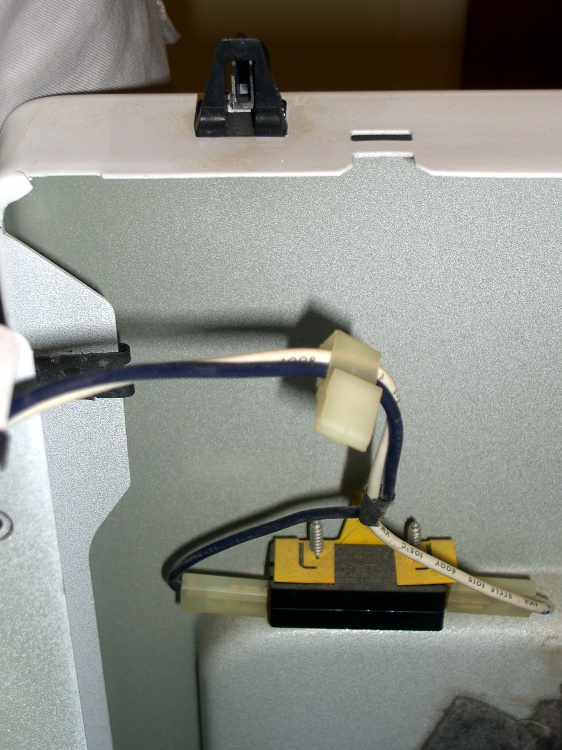
Door switch
Two screws hold the entire front door panel in place. Before you remove those, disconnect wires from the door latch switch so you can remove the front panel. The alert reader will note I didn’t do that…
The drum has two sliding seals that bear on the front and rear panels. There is nothing else holding the drum in place, so when you remove the front panel, the drum falls out. It’s helpful to have an assistant holding the drum in place, perhaps with a hand through the open door, while you jockey the front panel out of the way.
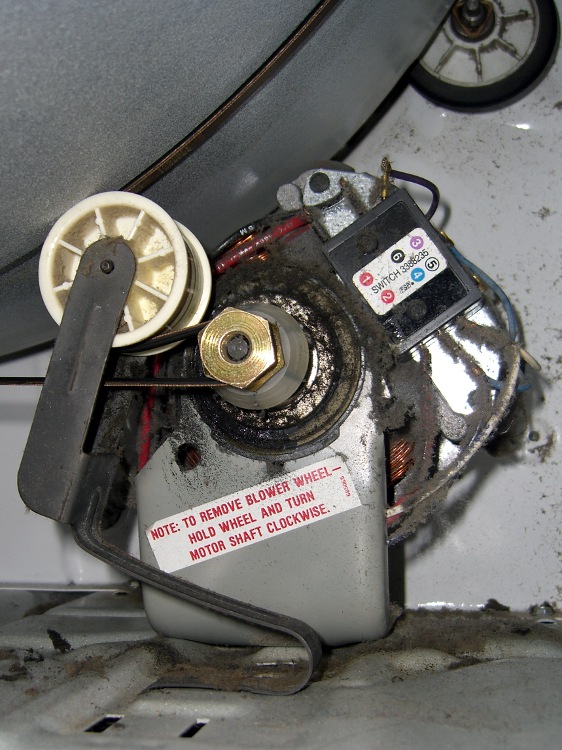
Drum belt path through tensioner
Have your assistant continue to hold the drum while you memorize the path of the drive belt around the tensioner and motor pulleys. This is not obvious: you don’t have to take the tensioner pulley off the shaft to remove or install the belt.
There are two sets of slots in the dryer base plate that could hold the tensioner. Only one set will work. Pay attention to the situation in your dryer.
Hint: the drum rotates counterclockwise as you view the front of the dryer. The motor pulls the belt off the drum and the tensioner acts on the slack side of the belt. If you try rotating the drum clockwise, the tensioner and motor make graunching noises that will convince you something has gone terribly wrong. It hasn’t, you’re just turning the drum the wrong way.
With the drum out, this is what the old seal looked like:
Worn seal
I cut the threads at the seam holding the ends of the old seal together and peeled it off the drum. That reveals the dried adhesive all around the drum.
Removing old seal
I applied xylene to soften the adhesive, then used a razor knife and a vast quantity of rags to remove the goo. The key is to get enough xylene on the adhesive to get its attention without slobbering solvent all over the drum; it will soften the paint, which is a Bad Thing. Do this in the garage or outdoors to enhance Family Harmony.
I did a trial fit of the new seal, which showed it’s a snug fit and requires careful alignment. A dozen small clamps held successive parts in place while I got it settled. The trick is to position the center part of the T-shaped seal against the rim of the drum without wrinkles. You probably can’t get it right without a dozen clamps.
To apply the adhesive, I removed two clamps, eased that section of the seal off the rim, and ran two beads of adhesive: one along the rim where the previous adhesive had been and a smaller bead just below the folded metal edge. That pretty well smeared out as I eased the section back in place.
Then remove the next clamp, ease that section off the rim, apply adhesive, and iterate all the way around.
Clamping new seal to drum
I dug a patched bicycle tube out of the drawer and eased it under the clamps around the drum, then pulled it mildly taut all the way around to apply uniform pressure to the seal. Two larger clamps held the slack ends in place.
After supper, we declared the adhesive (which looks & smells a lot like plain old contact cement) to be cured. Off came the clamps and tube and, lo and behold, it’s all good.
Reassembly is in the obvious reverse order. The instructions packed with the seal remind you to ease the loose end of the seal outside the drum where it can ride on the back panel. Make it so.
While your assistant holds the drum in place, reinstall the tensioner and route the belt around it. The belt in our dryer has two possible positions on the pulley (it has ridges), so I made sure it was tracking in the same position as before.
Attach the front panel, rotate the drum a few times to be sure everything is in place and tracking correctly, then slam the top, screw it down, and you’re done!






 The Smell of Molten Projects in the Morning