Ed Nisley's Blog: Shop notes, electronics, firmware, machinery, 3D printing, laser cuttery, and curiosities. Contents: 100% human thinking, 0% AI slop.
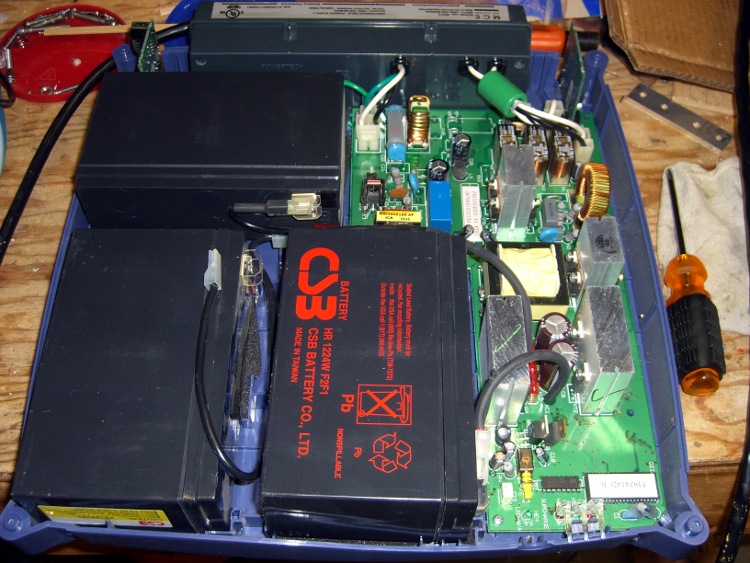
The SLA batteries in the MGE Ellipse 1200 UPS finally gave out. This picture shows how they’re arranged inside the box:
MGE Ellipse 1200 UPS – battery arrangement
They’re 12 V 5 Ah batteries that are about 12 mm thinner than the garden variety 7 Ah batteries you can get everywhere; they’re not the same size as the generic 5 Ah batteries you might think would work. Of course, there’s not enough room inside the stylin’ case for the larger ones, either. I’m thinking of using fatter batteries anyway and putting a belly band around the gap. Maybe an external battery box with a chunky cable burrowing through a hole in the UPS case?
For what it’s worth, APC absorbed MGE a while ago (so the MGE website redirects to APC), got Borged by Schneider, then spat out MGE’s consumer grade UPS units to Eaton. You won’t find any of that documented anywhere, but here’s the response from APC after I didn’t find this UPS on their list:
I do apologize; when APC was acquired by Schneider Electric, the single phase UPS line that MGE once offered was sold to Eaton. Eaton now provides support for the MGE single-phase products. We do not sell batteries for these models. You will actually need to contact Eaton for further assistance regarding the MGE Ellipse units. You may click on the link below to go to Eaton’s website:
The Eaton website does have a battery replacement for this one, but sporting the dreaded “Contact us for price” notation. Given that I got the UPS cheap-after-rebate, I’m thinking maybe this isn’t worth the effort.
OK, this resembles dynamiting fish, but I can’t help myself. A cute little Lenovo Q150 with a D525 dual-core Atom and nVidia ION graphics just arrived, which, perforce, has Windows 7 preinstalled. The first step is to get Windows activated, updated, and settled down… the second step being, of course, to shrink that partition to a nub and install Linux for actual use.
After a bit of huffing & puffing, reading (*) & clicking of many EULAs, and the first round of updates:
Windows 7 – You must restart your computer
Every time I see that, I think of the old dialog box joke:
Mouse motion detected. Windows NT must reboot to apply this change. [OK]
Then it had to update .NET, which produced this unbelievable body count of changes:
Windows 7 – Applying update operation
And then another few rounds of updates, the last of which evidently crashed & burned. The Get help with this error link was, mmm, unhelpful; it simply reported they hadn’t the foggiest idea what went wrong. Rebooting and retrying the automated updates presumably worked:
Windows 7 – Some updates were not installed
Doing all of that while puttering around with other stuff occupied the better part of a day, after which one owns a PC with an operating system installed. Yeah, you do get a UI that exposes IE 9, but if you want to do something with the PC, well, that requires installing applications.
I loves me my default Windows desktop background, from a long-ago crash inside a VM:
BSOD – fatal app exception
(*) Yes, I do read them, mostly for comic relief. The general practice of forcing you to scroll through a sheaf of typewriter-formatted pages in a 2×3 inch peephole centered in a huge monitor suggests that they really don’t want you to know what’s going on. Anyone who suggests buying commercial software because it has a reputable company standing behind it has obviously never gone to the trouble of reading the relevant EULA.
It turns out that an ordinary carbide glass drill works just fine on glazed clay pots. Use a low RPM and very slow feed, flood the scene with water, and drill from the other side after the point breaks through.
Glass drill for plant pot hole
The glaze inside the pot already had a flaw that let the water into the clay, from whence it seeped out through the unglazed lower rim. I suppose saturating the clay can’t possibly be good, but I’ve done this to many glazed pots over the years and none of them have ever complained, so it’s all good.
Strictly speaking, I do not have a beard: I simply do not shave (*). There being no money in selling Trimmers for the Non-shaving, a while back I bought a battery operated Beard Trimmer. The NiCd cells lasted for the predictable few years and recently gave up the ghost entirely: an overnight charged produced a weak buzz with no cutting action to speak of.
The case uses one-time snap-together latches, which makes dismantling it a challenge. Start by removing all the gimcrackery on the business end, then pry out the two latches holding the it-was-white-once cutting length adjustment ring. With that out of the way, undo the two latches inside the top and work your way down, prying the case halves apart in the way the overlap flange doesn’t like, so as to force the latches loose.
This picture shows the six latches, three on each side. The ones just to the right of the blue impeller require the most cursing:
Beard trimmer case and innards
The circuit board snaps out, with the two PCB contact areas clamped down by springy contacts leading to the motor.
Beard trimmer – battery charger PCB
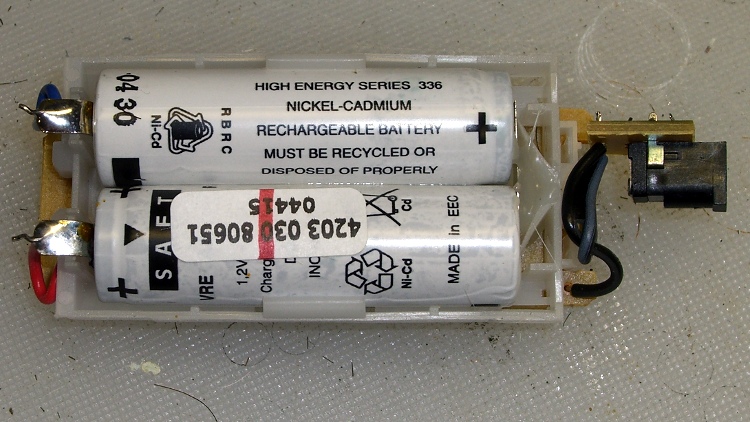
The two NiCd cells boast of their High Energy, but they’re only 600 mAh. That’s actually too much for this high-drain, short-run application, as they don’t completely discharge. They’re held in place on the right end with a blob of hot melt glue:
Beard trimmer – NiCd cells
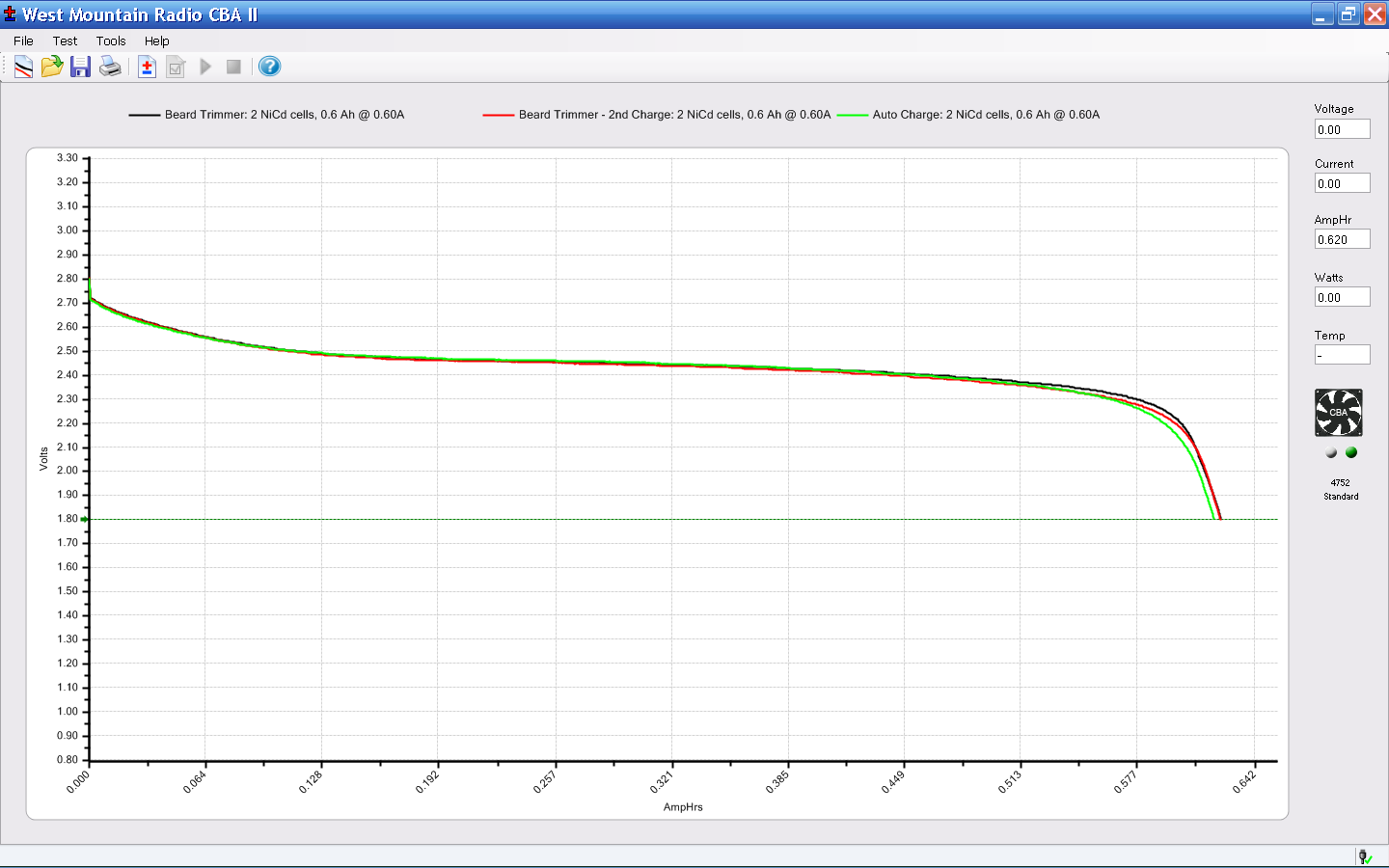
I unsoldered the cells and gave ’em a brute-force overnight charge at C/10 = 60 mA, then ran a discharge test (clicky for more dots):
Beard Trimmer – NiCd Discharge Test
Lookee that! The cells still deliver their rated capacity, even though they no longer worked with the stock charger. I repeated the slow-charge and discharge trick, which produced a perfectly overlapping trace.
Flushed with success, I unleashed the built-in charger overnight, then produced a third overlapping trace.
So they suffered from voltage depression, most likely due to never being completely discharged and then being overcharged far too often. That’s cured by a complete discharge and recharge, which worked perfectly.
I hack back the overgrowth when it gets bushy and recharge the trimmer when it seems to be getting weak, which used to take a week or two. That’s a bad way to maintain a NiCd battery, particularly as the PCB applies a very low load to keep its computronium running, but I have better things to do than babysit a beard trimmer. Honest.
Anyhow, assembly is in the reverse order and it’s perfectly happy again.
I probably won’t change my evil ways, so the next time I’m sure the battery will be really and truly dead.
(*) Not shaving adds about ten minutes a day to my life, which I regard as a fair tradeoff over the course of several decades. It also added a decade to my apparent age, Back In The Day when that mattered. Now it seems to knock off a decade, which isn’t entirely a Bad Thing.
Our Craftsman lawn mower has both a deadman grip for the motor (the Operator Presence Control Bar) and a Drive Control Lever that engages the rear wheel drive. The latter requires a death grip to keep the belt engaged, which means you (well, I) spend about two hours clenching the grip.
Lawn mower – compound leverage handle
I’ve long since flipped the control to the left side and added thick foam padding, but there’s no adjustment that reduces the death-grip requirement: you can change the engagement distance, not the spring constant.
Evidently the Sears engineers have much stronger hands than anyone in our family.
The doodad hose-clamped to the upright part of the mower handle is a basically a hinge that applies force to the tip of the red handle. The hinge axis lies far enough from the handle’s pivot so that holding the hinge against the handle requires very little force; at least it’s no longer a death grip.
Lawn mower – compound leverage handle engaged
It’s not an ideal solution, but it engages and (more importantly) disengages easily. I still don’t like mowing the lawn, but at least I don’t return with a crippled-up hand.
The hinge is actually a lock hasp, so it has a slot that slides neatly over the Drive Control Lever’s tab. I beat both sides into a more-or-less cylindrical form over a piece of pipe, while miraculously not bending the hinge pin.
Evidently the Sears engineers never actually used the damn mower for two hours at a time.









 The Smell of Molten Projects in the Morning