Ed Nisley's Blog: Shop notes, electronics, firmware, machinery, 3D printing, laser cuttery, and curiosities. Contents: 100% human thinking, 0% AI slop.
This look at the ingredients found in various commercial vanilla extracts (plus their prices) finally pushed me over the edge into brewing up that DIY vanilla extract.
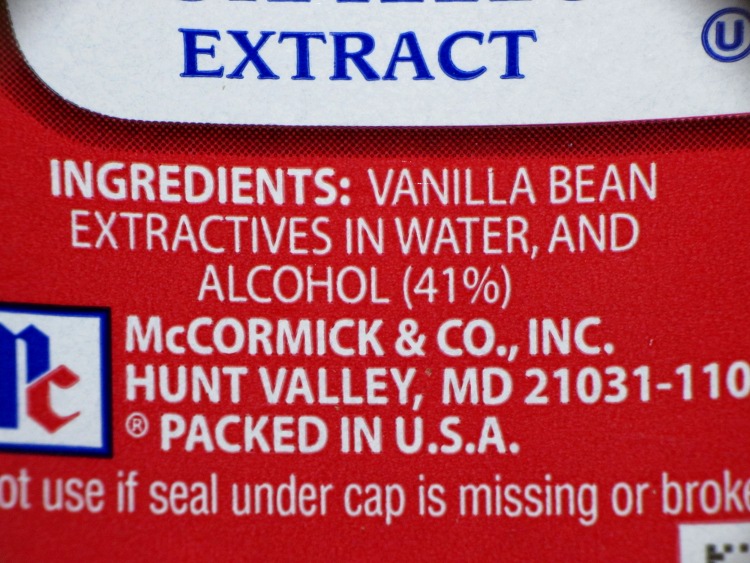
We’ve been using McCormick vanilla forever, mostly because it has the simplest and shortest list of ingredients:
McCormick Vanilla
Nielson-Massey vanilla seemed about the same, although it’s not clear why it needs more sugar than those “vanilla bean extractives”:
Nielsen-Massey Vanilla
Wal-Mart vanilla doesn’t smell like vanilla, even though it has more “extractive” than corn syrup:
Wal-Mart Vanilla
All three extracts have “Pure” on the label, which (according to Wikipedia, anyway) means that they have at least 13.35 ounce of vanilla bean per gallon of extract. I didn’t weigh the three beans in my 8 ounces of hooch, but I suspect they weighed far less than the regulation 0.834 ounce. Next time, for sure, I’ll go for triple strength extract!
Despite that, my DIY hooch has turned brown and smells pretty good…
These full-frame pix used my new close-up lens gizmo; even with some vignetting the results seem perfectly usable. Normally I crop pix down to the central section, so this will be as bad as it gets.
The discussion about drying my silica gel stash prompted me to toss a Hobo datalogger into the safe along with the desiccant bag. We now have enough data to spot a trend:
Basement Safe Humidity – Oct-Nov 2011
Verily, one measurement trumps a thousand opinions: I was totally wrong about the door seal. Either that or the safe’s contents started out a lot wetter than I thought.
The basement humidity runs about 55% RH, pumped down by a dehumidifier in the summer and ambient air in the winter, which (I think) sets the upper limit. Modulo having hygroscopic stuff like paper in the safe, I suppose.
I’ll toss a fresh bag in there, tape over the door crack, and see what happens during the next month.
FWIW, the Onset HOBOware program doesn’t run under Wine and Wine doesn’t support USB hardware anyway, which is one of the few reasons I have a Token Windows Laptop. I’ve set it up to automagically export the data into CSV files, from which this went into OpenOffice 3.2 for a quick look. Surprisingly, HOBOware is a Java program, but evidently written specifically to avoid portability; they have Windows and Mac versions and that’s all. Worse, there’s no way to extract data from the loggers without using that program, because Onset doesn’t document the interface protocol. Enough said.
Having bought some low-budget Walmart vanilla extract that smells nothing at all like vanilla, I figured it’s time to get serious about this stuff. Recipes for DIY vanilla extract abound on the Internet, but as nearly as I can tell, the basic idea is to put vanilla beans in contact with ethanol, shake occasionally for a couple of months, then enjoy. Uh, by the teaspoonful, that is.
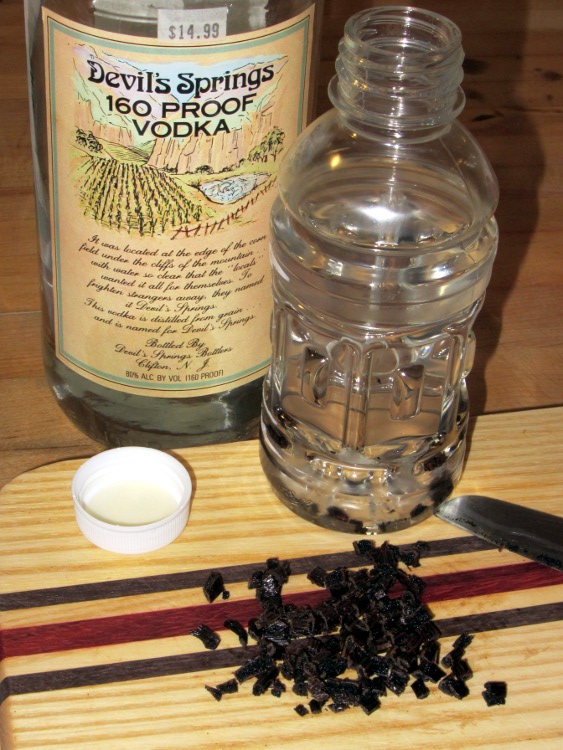
Quite some years ago I discovered that NYS prohibits the sale of grain alcohol, so you must buy stiff vodka to get high-test ethanol. That glass bottle contains the cheapest 160 proof vodka I could find in the waning years of the last millennium; I figured it was likely to have fewer additives around its 80% ethyl alcohol than anything else in the liquor store. After more than a decade on the Basement Laboratory’s Solvents Shelf (I don’t use a lot of ethanol), a dollop in a saucer burns with an ethereal blue flame: it’s in fine shape.
The plastic bottle originally held some weird alien fruity liquid (which, IIRC, I picked up while doing amateur radio duty at a charity event) and has the desirable attribute of a tight sealing lid. It’d be better to use glass and I suppose amber beats clear, but this stuff will spend its entire life in a dark cupboard with all the other spices. Although some recipes call for sterilizing the bottle in boiling water, I figure any bug that can survive 80% ethanol will shrug off hot water… and the vanilla beans probably aren’t all that sterile, anyway.
A cup of neat vodka, three slit-and-chopped vanilla beans, and away we go. It should be ready for the Christmas baking season.
If this works, I’ll get a substantial quantity of vanilla beans from the usual eBay supplier and make some really stiff extract. Two bucks a bean at the local grocery store: ouch.
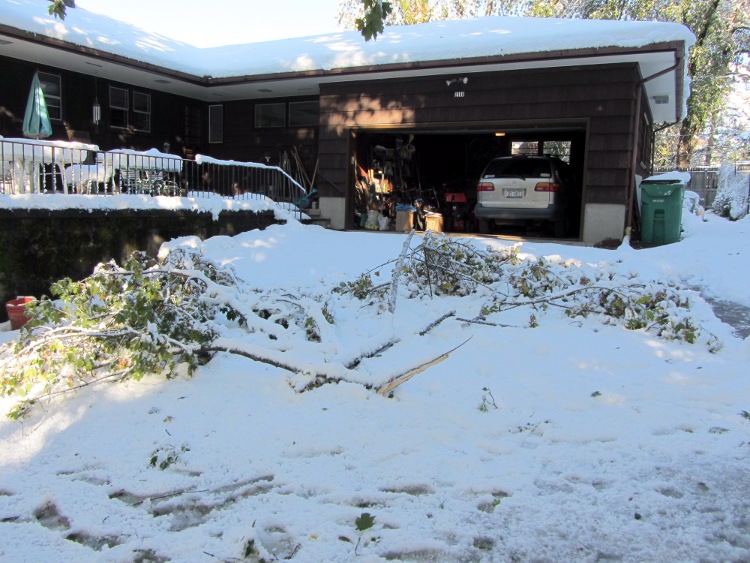
Our yard accumulated about 14 inches of heavy wet snow that made a mess of the maple trees. Before I could get the snowblower out of the garage, I had to cut up a stack of branches:
Branches at garage
Yes, there really is that much of a slope leading up to the garage; clearing the driveway immediately after every snowstorm is not optional.
Many of the branches in the back yard broke off and simply leaned against the ones still arched over the driveway:
Branches in back yard
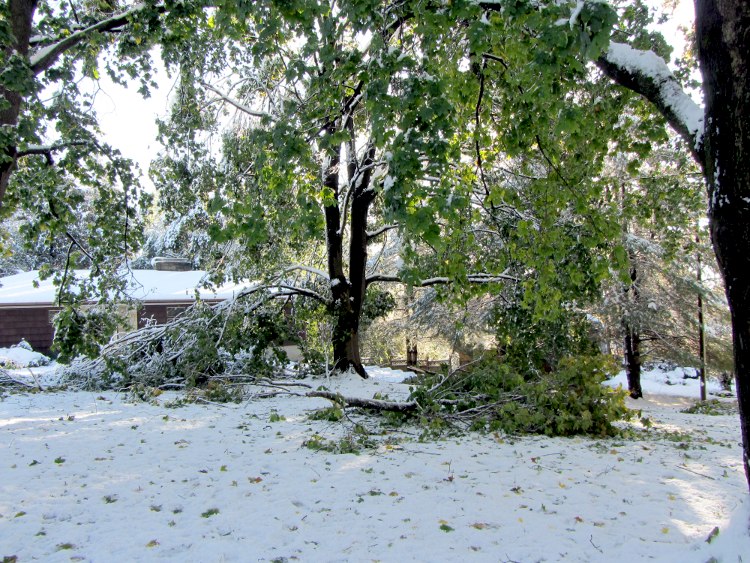
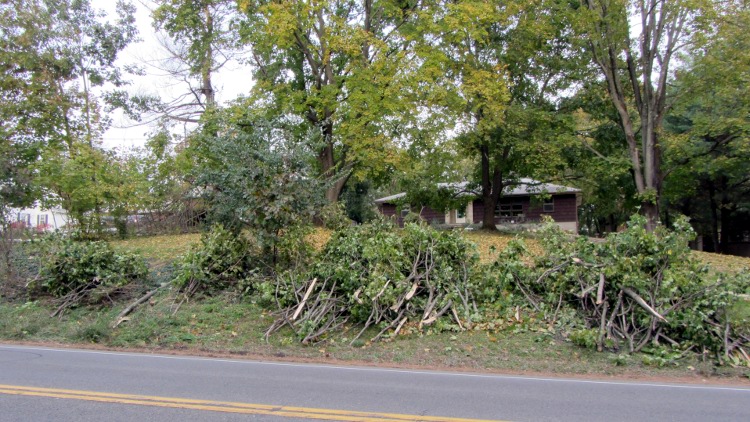
The front yard was a mess:
Branches in front yard
In addition to all that, we had branches down beside the house, in the garden, around the beehive, and, in general, everywhere. Obviously, we have too many maples, but they’re what the previous owners planted (or at least didn’t uproot while that was possible).
The generator bridged 25 hours without power to save the refrigerator & freezer contents and keep the house between 55-60 °F. We survived five days with no phone (shrug) or Internet (eeek!); the cell phone was, as usual, useless because the house sits on a local maximum in a shallow valley below line-of-sight from all the surrounding towers.
The last break in the phone & Internet cables occurred just north of us:
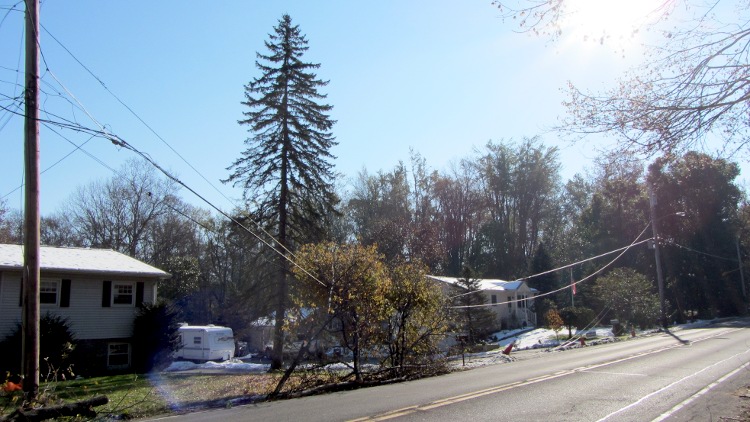
Branches on wires
Those branches came from a tree across the road that put down roots on a slab of rock that just didn’t provide enough griptivity:
Tree down on Rt 376
After three days of diligent bow-saw work and mule-mode dragging, we cleared the yards. The back yard clutter went over the cliff toward our bottomlands adjoining the Wappingers Creek and the front yard timber now sits ready for what we hope will be the town’s pickup:
Branches ready for pickup
Our experience was a nuisance, rather than a disaster, unlike that of many folks in the area.
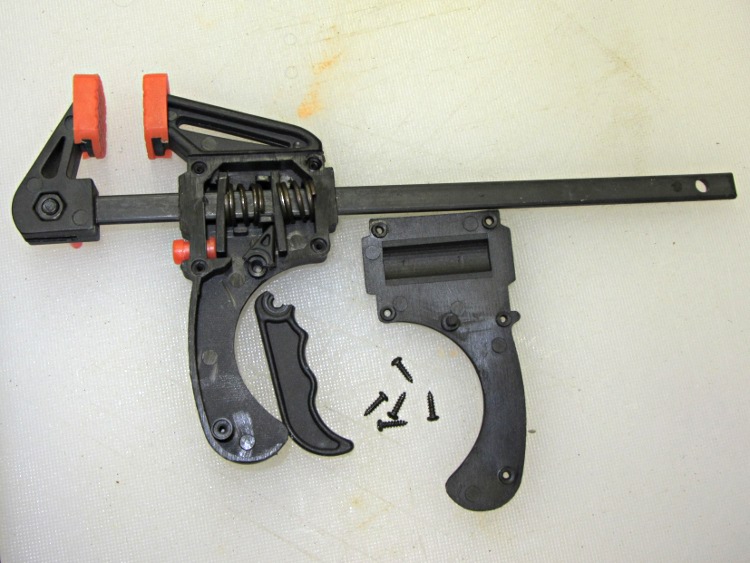
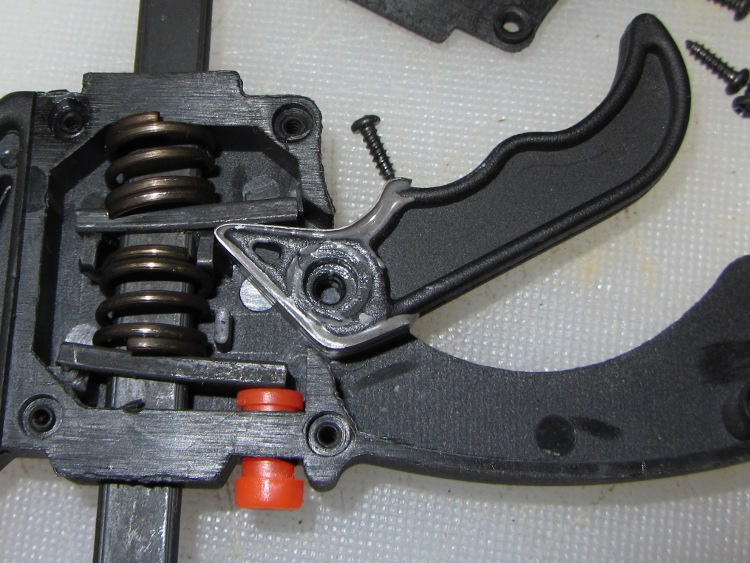
The squeeze handle that tightens the bar clamp cracked exactly where you’d expect: directly across the pivot hole where the miracle engineering plastic thins down to a precarious ridge. The end of the handle is still inside the clamp:
Bar clamp with broken handle
Nothing bonds that plastic, so, in the nature of a quick fix, I cut a steel strap to wrap around the perimeter of the broken section and epoxied the whole mess together:
Reinforced bar clamp handle
That lasted for exactly 2.5 squeezes and then pulled apart; the epoxy doesn’t really have anything to grab.
ABS isn’t a good substitute for engineering plastic, so this will require a bit of CNC work on the Sherline. I’ll probably carve the first one from polycarbonate, just because I have a sheet of the right thickness, but it really cries out for aluminum, doesn’t it?
Why CNC? Well, I’m going to make a handful of handles and get proactive on the other clamps.
My other bar clamps have much heavier sections in that area, so perhaps the folks supplying Harbor Freight could take a hint? Yeah, but the clamp was cheap, which always conflicts with good. On the other paw, I’ve seen exactly this same clamp priced at not cheap elsewhere.
We frequently host touring bicyclists who need a campsite in the Mid-Hudson Valley. The most recent couple has been riding for two years, starting eastward from Paris shortly after their wedding. Yeah, it’s a honeymoon trip.
After riding through Western and Eastern Europe, the Middle East, and several of the ‘Stans, JeanMarc’s handlebar mirror broke in Kazakhstan. Marie toted the carcass out of the ‘Stans, across India, through China, and then from Montreal to here. They’re biking to Houston, where they’ll fly to Peru, ride south and across the Andes, and work their way across the Atlantic on a cargo ship that eventually docks in Germany. Then, a year from now, they’ll just bike back to Paris.
Makes you feel like sludge, too, doesn’t it?
With that as prologue, JeanMarc wondered if I could fix the mirror mount. It started as a 10 mm plastic ball on a molded plastic fitting with an integral worm screw and strap; of course, the ball stem snapped off during a hard landing or some such event that comes naturally during long-distance riding. We kicked around some ideas, rummaged through the heap, and came up with a workable, albeit hideous solution.
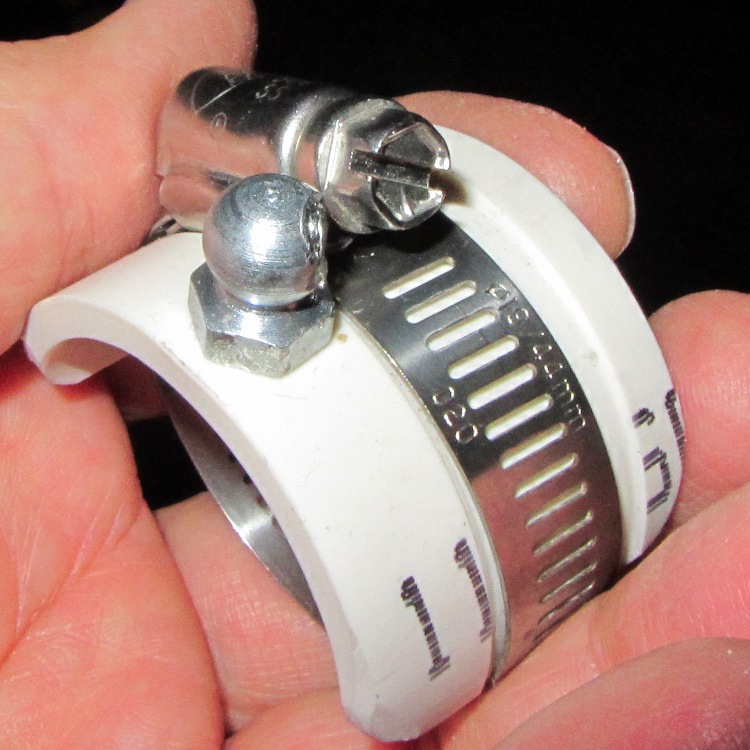
I applied a Dremel slitting wheel to a pair of Zerk grease fittings, sliced off the inlet valve, extracted the valve spring, and cleaned up the residue to leave a somewhat misshapen 9.3 mm (really a scant 3/8 inch) ball-like end. A bit of lathe work converted a chunk of PVC pipe into a sleeve grooved for a metal hose clamp. I drilled two #3 holes, tapped them 1/4-28 (which, believe it or not, is the correct thread for a Zerk), bandsawed the pipe in half, introduced the pieces to Mr Belt Sander to round the edges, screwed Zerks into holes, and wound up with a pair of these:
Handlebar Mirror Mount – detail
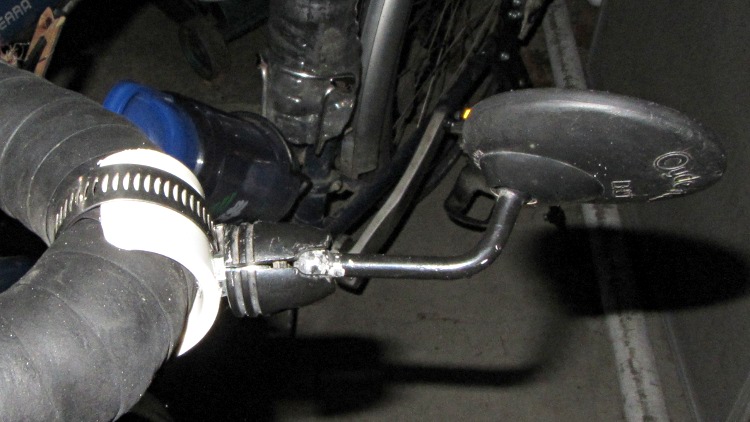
Which looks awful on the handlebars, but we’re pretty sure it won’t break and he has a spare if the mirror on Marie’s bike snaps off:
Handlebar Mirror Mount – fixed
The Zerk fitting could unscrew, but the threads aren’t exactly in pristine condition after all that fussing and seem to be jammed firmly in place. If we had more time, I’d have heated the PVC and molded it around the handlebars, but we decided that wasn’t really necessary.
They rode off into the distance this morning… may you have smooth roads and a tailwind, JeanMarc and Marie!
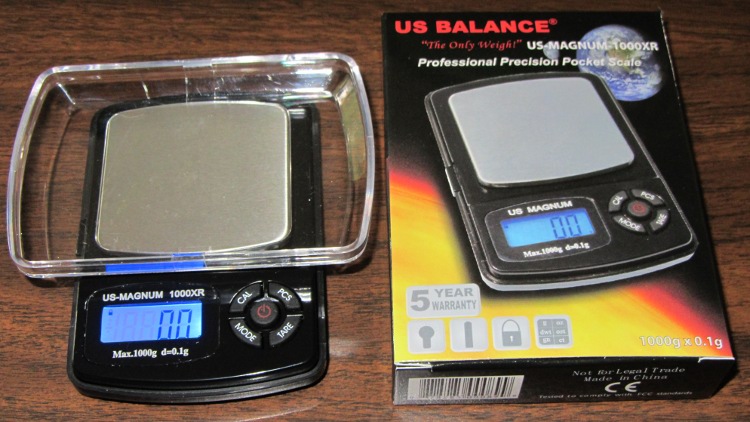
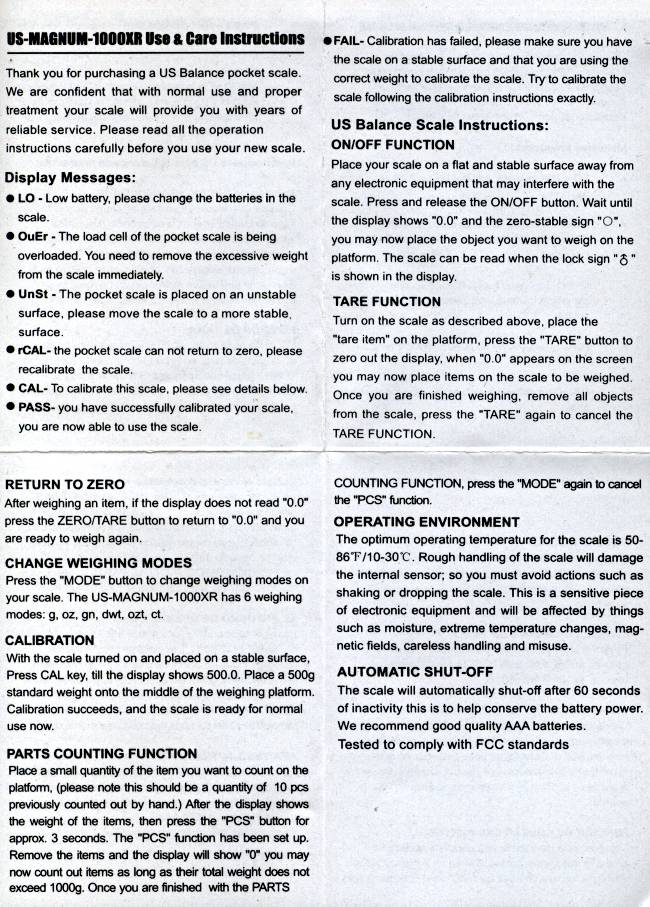
So I picked up a cheap digital scale at Harbor Freight because it can count parts based on weight. After all the dust settled, it was on sale for about $8, which tells you just about all you need to know, and the “5 Year Warranty” looked generous on the box:
Harbor Freight 1 kg Scale
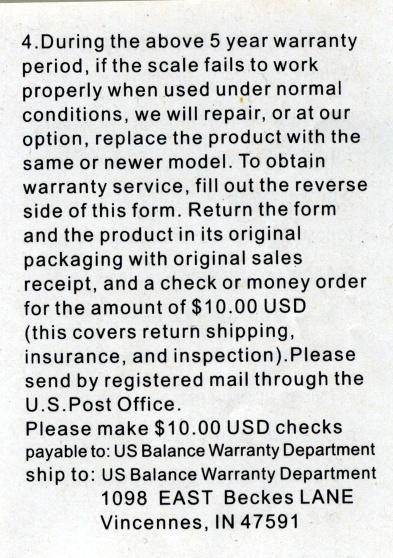
Alas, the fine print taketh away (clicky for more dots):
Warranty
Ah, well, all this stuff is disposable anyway, right? Nobody’d ever try to fix it…
The instructions for the Count function omit a step. In order to invoke the Count function, do this dance:
Turn it on
Count exactly 10 pieces on the scale, wait for stabilization
Press-and-hold PCS until the display shows 10
Release PCS
Press PCS briefly; the pcs annunciator turns on (they omitted that)
The display will still show 10, which is the number of pieces
Now you can weigh stuff and read off their counts
The scale resolution is 0.1 gram, so SMD resistors just aren’t going to count properly at all. It’s best if you add the entire group at one time, rather than trickle parts into the pan.






 The Smell of Molten Projects in the Morning