Ed Nisley's Blog: Shop notes, electronics, firmware, machinery, 3D printing, laser cuttery, and curiosities. Contents: 100% human thinking, 0% AI slop.
That tag should ensure any TSA agent will sideline me for an enhanced inspection sufficient to reset breakfast to last Tuesday. Or I get to ride in the cockpit. Maybe both.
Aitch is one of the very few people in the world who can use a business trip to the Atacama Desert as a cover story for his real activities, about which I know absolutely nothing because I’m Still Alive™. The fact that he returns with a camera full of gorgeous pix merely demonstrates the cover team’s finesse. The NSA schwag came from another trip. So he says, anyway.
Oh, that tag originally hung from the drawstring of a very nice black velveteen pouch containing an NSA-logo sippy cup along with the matching coaster. All made in China, of course: if irony were energy, we could saw off the entire Middle East and be done with it…
As part of sawing a kitchen countertop apart to fit it into the bathroom, this happened:
Sawed-off sawhorse
I’d very carefully checked the clearance for the first two cuts, but …
The sawhorse is polyethylene, which cannot be glued, so I drilled holes in the internal bulkheads, slobbered JB Industro-Weld epoxy through them, and filled the gaps with wood blocks:
Wood-epoxy PE repair
The goal being to not have metallic fasteners where the saw blade can find them.
This should work for a while:
Sawhorse cap repaired
If that’s never happened to you, I’d say you aren’t doing enough circular saw work…
I finally got around to replacing the sink in the front bathroom, which required a surprising number of tools:
Bathroom tool midden heap
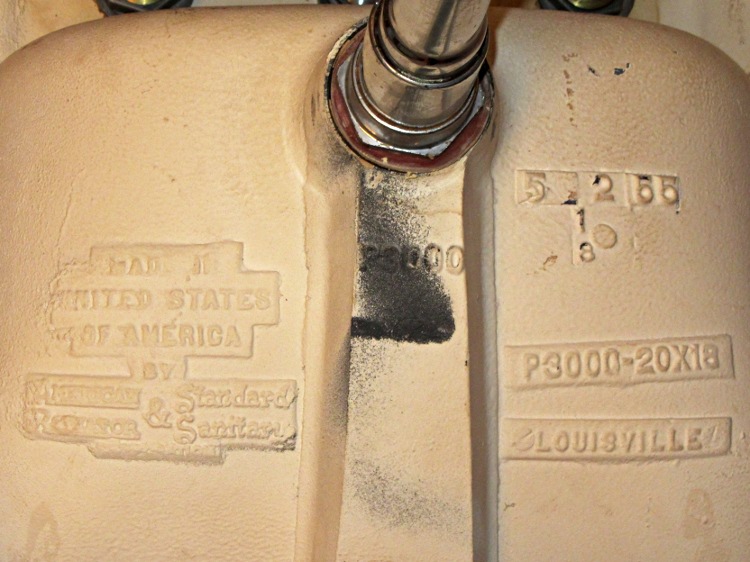
As with the three other sinks I’ve replaced over the years, this one was a beautiful cast-iron monster made by the American Regulator & Standard Sanitary company, back before the name mushed into American Standard. This casting shows the original typography:
Bathroom sink by American Regulator and Standard Sanitary
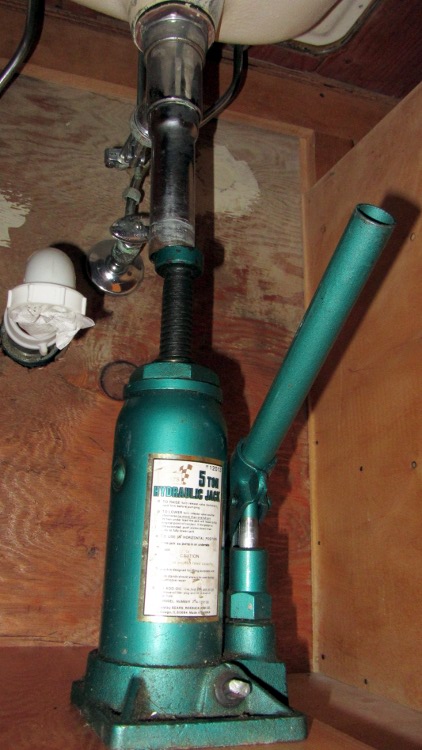
A thin stainless steel trim ring and 16 (!) clamps held the sink in place on the countertop. Harsh experience taught me to support the sink while removing the clamps, because without the clamps there is nothing holding the sink up and I no longer enjoy stopping the tailpiece of a cast-iron sink with my chest…
Supporting the old sink
As it turned out, the sink required two pumps on the jack to break it free from the gunk gluing it in place; I was pleased to be wrong. I toted it to the end of the driveway, put a FREE sign on it, wherefrom it vanished within two hours. We’ll never know if it became someone’s precious antique or just a source of heavy brass fittings at the scrap metal recycler.
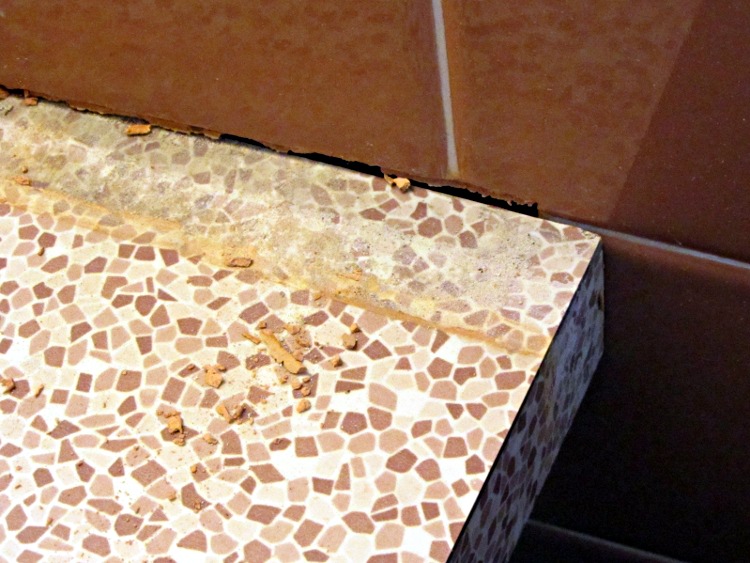
The original vanitory countertop had been recessed into the corner walls before the tiles went up, so I sawed out a chunk of the front edge and bent the plywood enough to tap it out without destroying anything. The countertop rotated around the left-front corner and the right-rear corner looked like this when the dust settled:
Extracted vanitory countertop
Half a century ago, the tile installers did a lovely mud job; the tiles adjoin and the grout is barely 1/16 inch wide. The vanitory case top was dead level, but the tiles weren’t quite aligned and my carefully applied and very neat 5 mm stripe of new caulk looks downright amateurish.
For what it’s worth, the new countertop started life as a stock kitchen countertop. I sawed off the backsplash, trimmed the length, cut a pair of notches to match the recesses, sawed a hole for the sink, rotated it into place, and screwed it down. You can go the custom-top route, but given that you only see about two square feet when you’re done, dropping $400 for 6 ft2 of fancy material with a gaping sink hole or over a kilobuck for a countertop with built-in recessed sink didn’t make enough sense to us.
And, no, vanitory is not a misspelling; I learned a new word during this project:
Vanitory job label
After we sell the house, the new owners will rip all this out without a second thought. After all, Dusky Rose went out of style a long time ago, a perfect hand-set array of 3/4 x 1-5/8 inch floor tiles isn’t attractive, and nobody cares about mud jobs. We’d rather keep that nice work around (even if we’re willing to put up with a simple countertop), but that’s just us; we’re the type of people who think keeping the original spring-loaded turned-wood dowel in the toilet paper holder is charming.
They’ll junk that space heater recessed into the wall, too: it has a long coily 120 V heating element strung inside, easily within the reach of questing little fingers. I added a GFI to that circuit, but I can’t imagine anybody else tolerating it. Times change.
I’ve carried all my stuff in a belt pack since long before such things were fashionable and, quite some years ago, a friend made me a custom-sized one that’s been in constant use ever since. Of late, one of the zippers got cranky and finally failed completely.
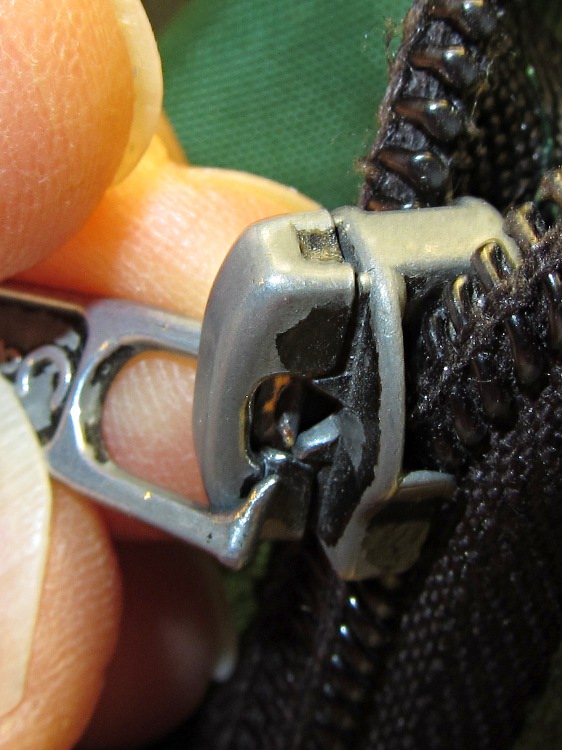
An autopsy showed the middle of the cross bar on the tab had worn completely through, the stubs had bent outward, and the remains no longer engage the zipper tooth lock.
Worn-through zipper tab
I replaced the tab with a short length of chain and a jump ring, but I fear the pack fabric is also reaching end of life.
The keyboard on my trusty HP 48GX calculator finally deteriorated to the point of unusability, so I tore the thing apart following the useful instructions there. The warning about applying force to the rivets that hold the case halves together gives you not the faintest concept of how much force is actually required to pry the mumble thing apart at the battery compartment; I finally invoked force majeure with a chisel scraper…
HP-48GX case rivets
I expected the calculator would not survive this operation and I wasn’t disappointed.
An HP 50g is now in hand. Here in late 2011 I’d expect HP’s top-of-the-line RPN calculator to sport a crisp high-resolution display, but noooo the low-contrast 131×80 LCD seems teleported directly from the latter part of the last millennium. The manuals are PDFs, which is OK, but their content is far inferior to the HP 48GX manuals. In particular, the editing / proofreading is terrible. I infer that the HP calculator division can barely fog a mirror and is on advanced life support; HP’s diverting all their money to, uh, executive buyouts or some other non-productive purpose.
The fact that HP sells new-manufacture HP 15C calculators doesn’t crank my tractor, even though I lived and died by one for many years. A one-line 7-segment display doesn’t cut it any more, even if the new machinery inside allegedly runs like a bat out of hell.
My HP 16C, now, that one you’ll pry out of my cold, dead hands. At one point in the dim past, I’d programmed the Mandelbrot iteration into it to provide bit-for-bit verification of the 8051 firmware for the Mandelbrot Engine array processor I did for Circuit Cellar: slow, but perfect. That calculator has a low duty cycle these days, but when I need it, I need it bad.
Our neighbor’s back yard features an unkempt apple tree about 3 feet from the fence that must be 40 feet high by now. It grows Macintosh-style fruit and drops half of them into our yard. Most land in the garden, some land in the yard, a few bounce off his plastic storage shed with resounding bonks, and every critter out there loves them. Mary makes applesauce from the best of the harvest and tosses the rest far away to keep the wasps out of her veggies.
The chipmunks and groundhogs have a belly-busting good time:
Chipmunk with apple
The deer, of course, eat ’em like candy, another reason for clearing the garden.
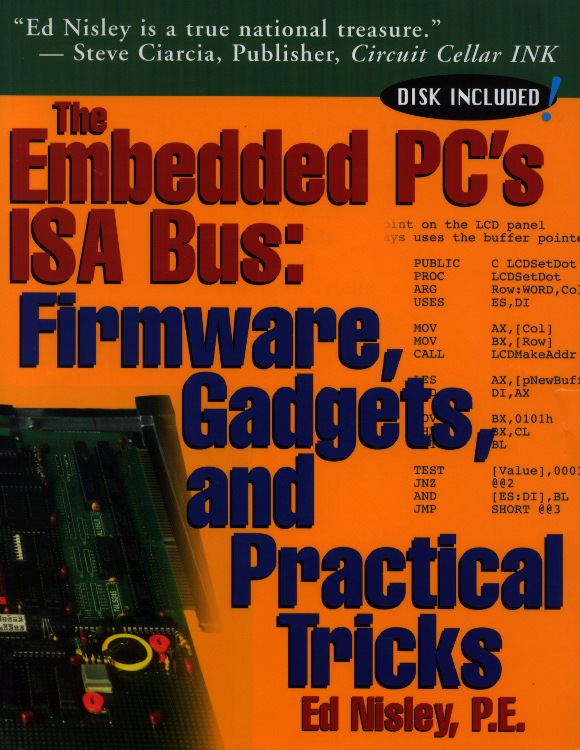
A long time ago, in a universe far away, I wrote a book that (barely) catapulted me into the ranks of the thousandaires. Time passes, companies get sold / fail / merge / get bought, and eventually the final owners decided to remainder the book; the last royalty check I recall was for $2.88.
Anyhow, now that it’s discontinued and just as dead as the ISA bus, I own the copyright again and can do this:
They’re both ZIP files, disguised as ODT files so WordPress will handle them. Just rename them to get rid of the ODT extension, unzip, and you’re good to go. Note, however, that I do retain the copyright, so if you (intend to) make money off them, be sure to tell me how that works for you.
The big ZIP has the original pages laid out for printing, crop marks and all, so this is not as wonderful a deal as it might first appear. The little ZIP has the files from the diskette, which was unreadable right from the start.
Words cannot begin to describe how ugly that front cover really is, but Steve’s encomium still makes me smile.
The text and layout is firmly locked inside Adobe Framemaker files, where it may sleep soundly forever. The only way I can imagine to get it back into editable form would be to install Windows 98 in a VM, install Framemaker, load up the original files, and export them into some non-proprietary format. Yeah, like that would work, even if I had the motivation.
If you prefer a dead-tree version, they’re dirt cheap from the usual used-book sources. Search for ISBN 1-57398-017-X (yes, X) and you’ll get pretty close.
Or, seeing as how I just touched the carton of books I’ve been toting all these years, send me $25 (I’m easy to find; if all else fails, look up my amateur callsign in the FCC database) and get an autographed copy direct from the source. Who knows? It might be worth something some day…







 The Smell of Molten Projects in the Morning