The Smell of Molten Projects in the Morning

Ed Nisley's Blog: Shop notes, electronics, firmware, machinery, 3D printing, laser cuttery, and curiosities. Contents: 100% human thinking, 0% AI slop.

Category: Home Ec

Things around the home & hearth

  • Credit Card Services: Loquacity In Full Effect

    The friendly, albeit almost unintelligibly accented rep from Credit Card Services had a ten minute conversation with me: 10:35 is a call duration record!

    The minimum balance has bounced back to $3500 and they’re touting a 6.9% rate. She was unwilling to discuss exactly how this works before I “qualified” myself, but I was unwilling to reveal my financial details before knowing more about Credit Card Services.

    So we went a few rounds…

    Somewhat surprisingly, she gave me plenty of contact information:

    • Credit Card Services (“We work with [list of big name credit card companies]”)
    • Orlando FL
    • Callback 888-311-2249 (don’t call it, it’s not a real number)
    • Anna Stakovic
    • Extension 292
    • ID 435

    All of it bogus, of course.

    Perhaps Anna married into her name, because she has a thick Indian subcontinent accent that wasn’t helped by boiler-room background noise and VOIP dropouts. Correspondingly, I was hampered by a soft voice that often required me to repeat myself, despite speaking slowly and, if I do say so myself, rather clearly.

    Anyhow, poor Anna became increasingly frustrated, accusing me of wasting her time and repeatedly telling me that if I was not interested in Lowering My Interest Rates I should just hang up. So I asked her if she worked for the same Credit Card Services that had called me several (dozen? hundred?) times previously; to my surprise, she said it was.

    She said that she would “do her best” to remove my number, but that, because she didn’t actually do the dialing, it might not have any effect. That agrees with what I’ve been told before: CCS is actually a demon-dialing front end for other scammers.

    She dodged my question about why CCS doesn’t obey the FTC No-Call Registry rules, claiming that she was just qualifying me for a credit reduction, not actually selling me anything. She was unwilling to discuss the relation between CCS and my various card issuers, which might have provided the “prior business relationship” required to work around the rules.

    Somewhat surprisingly, she simply wouldn’t hang up before I agreed that I had no interest whatsoever in Lowering My Interest Rates. I eventually agreed, she wished me a good rest of the day, and I suppose we parted as friends…

  • Basement Safe Humidity: The Trend Continues

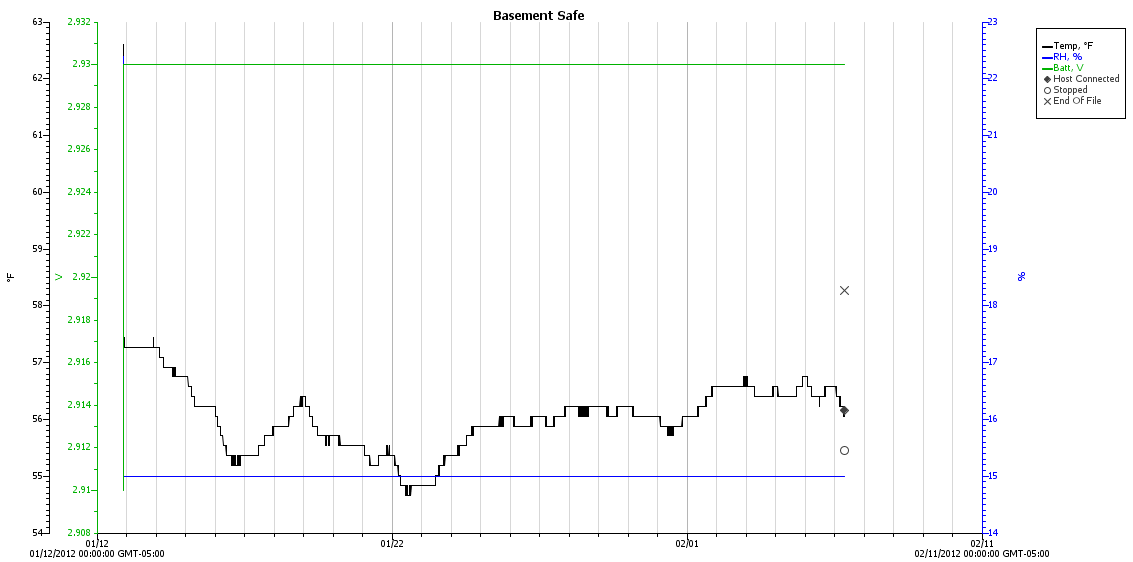
    The desiccant in the basement safe:

    Desiccant in safe
    Desiccant in safe

    Continues to work just fine, much better than the first attempt:

    Basement Safe Humidity - 2012-02-06
    Basement Safe Humidity – 2012-02-06

    The paper scrap gives the weight of tray+desiccant, so when the humidity finally starts going up I’ll have some idea of the average leak rate. Most likely, opening the door for the more-or-less monthly logger readout introduces most of the water vapor…

  • Tweezer Tip Alignment & Shaping

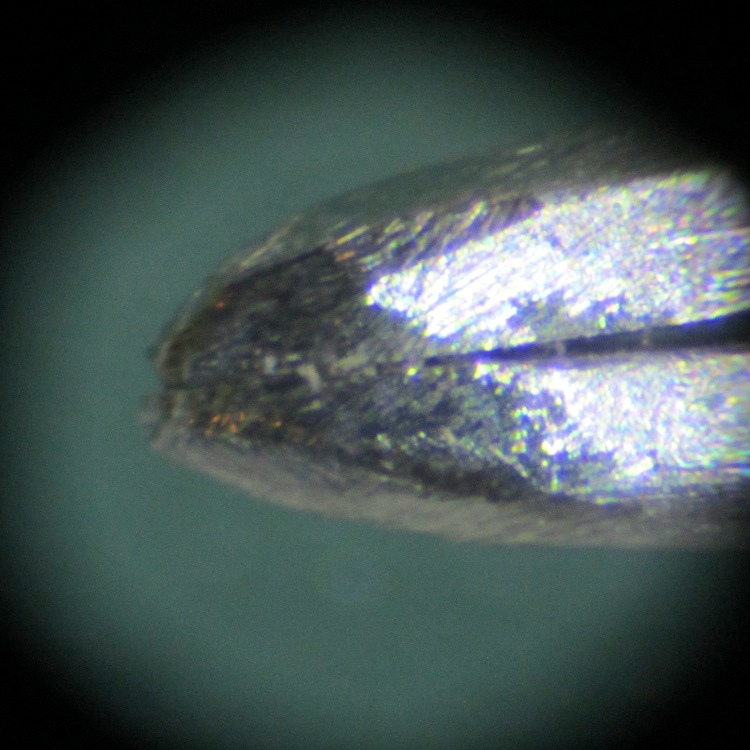
    During a recent rainstorm I grabbed the fiberglass marker pole at the end of the drain pipe to clear a wad of leaves out of the driveway gutters. Unfortunately, that left me with a finger full of glass fibers; it seems the top of the pole has deteriorated. The first tweezer I plucked from the stash around the pencil-oid tool holder hadn’t had its jaws aligned, so after I plucked (most of) the glass using those tweezers, I did a bit of filing and sandpapering:

    Tweezer tips
    Tweezer tips

    That’s a millimeter scale in the background: these really are needle-tip tweezers.

    A closer view:

    Aligned and shaped tweezer tip
    Aligned and shaped tweezer tip

    It still has a bit of overbite, but it grabs hairs from the bench with no hassle. Given that you can’t get all the glass fibers on the first pass, it’ll come in handy…

  • DIY Vanilla Extract: Batch 2

    So I picked up half a pound of Grade B Madagascar Vanilla Beans from the usual eBay supplier, a 1.75 liter slug of the next-to-the-cheapest 80 proof vodka (“carefully distilled, then filtered through selected charcoal”) from the neighborhood liquor store, and scavenged some bottles from the basement stash:

    Vanilla extract bottles
    Vanilla extract bottles

    The proper mix seems to be around 2 ounces of beans per 16 liquid ounces of 80-ish proof vodka, which nearly fill the two round half-liter (16.9 fluid ounce) bottles. The flat bottle on the right has the rest of that Devil’s Spring 160 proof rotgut, cut down to 90 proof, with enough beans to make the answer come out right for that volume. The leftmost round bottle has the remainder of the beans in the appropriate volume, which is why it’s half full. The little bottle is that one, minus doses for my hot chocolate & pancakes.

    One motivation for using 80 proof vodka is that a teaspoon of 160 proof hooch brings a cup of hot chocolate right up around 3 proof. That earlier batch really didn’t have enough vanilla to be effective, but increasing the total dosage would put a dent in my already meager afternoon productivity…

    Although the recipes recommend daily shaking for a month before the brew reaches equilibrium, I’m sure this is one of those exponential diffusion deals that’s mostly done after a day or three. These two bottles show the concentration on the next morning, after and before shaking:

    Vanilla extract - shaken and unshaken
    Vanilla extract – shaken and unshaken

    Chopping half a pound of vanilla beans on the kitchen cutting board produces an interesting side effect: everything you cut for the next day or so smells strongly of vanilla, as does the entire kitchen end of the house, as do your fingers. Mostly, that’s OK, but we decided vanilla-scented onions were just plain weird and there really isn’t any justification for vanilla-flavored green tea.

  • Kitchen Hazard: Exploding Potato!

    It was such a small potato that it didn’t need a nail and, somehow, didn’t get punctured before going into the oven. When it came out, the first touch of the fork detonated the thing:

    Exploded Potato
    Exploded Potato

    Memo to self: always puncture potatoes before baking!

  • KitchenAid Mixer Pivot Shaft Tweak

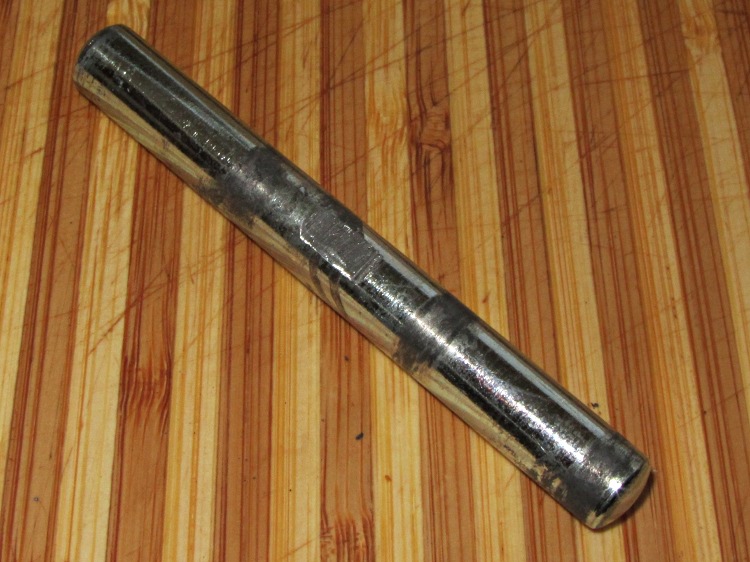
    The shaft that tilts the mixer head has started walking sideways out of its hole, which is not to be tolerated. Looking up inside the base column shows a locking screw that’s worked loose:

    KitchenAid mixer - pivot shaft and locking screw
    KitchenAid mixer – pivot shaft and locking screw

    I took the thing apart and filed a flat on the shaft:

    KitchenAid mixer pivot shaft - added flat
    KitchenAid mixer pivot shaft – added flat

    And then a dab of Loctite on the screw will prevent that from happening again:

    KitchenAid mixer pivot locking screw
    KitchenAid mixer pivot locking screw

    It’s still piddling oil on the countertop. If you have one of these things, always store it with the head tilted upward. That makes the oil run down the column onto the counter, rather than through the planetary gears into the mixing bowl…


  • Watts 9D-M3 Backflow Preventer Valve: Failure & Aggravation

    This Watts 9D-M3 Backflow Preventer Valve feeds water into our furnace, provides an overpressure relief, and prevents heating loop water from re-entering the potable water supply.

    Watts 9D-M3 Backflow Preventer Valve
    Watts 9D-M3 Backflow Preventer Valve

    The vertical pipe leads downward near the floor, underneath which sits the small plastic bucket I provided to catch the occasional drip. Recently we had an all-hands scramble to soak up a pool of water spreading across the floor from the overflowing bucket, across the aisle, and below the shafts-and-rods-and-tubes-and-pipes storage rack. Evidently the occasional drip became a steady drip while we weren’t watching; not a catastrophic flood, but far more water than we want on the floor.

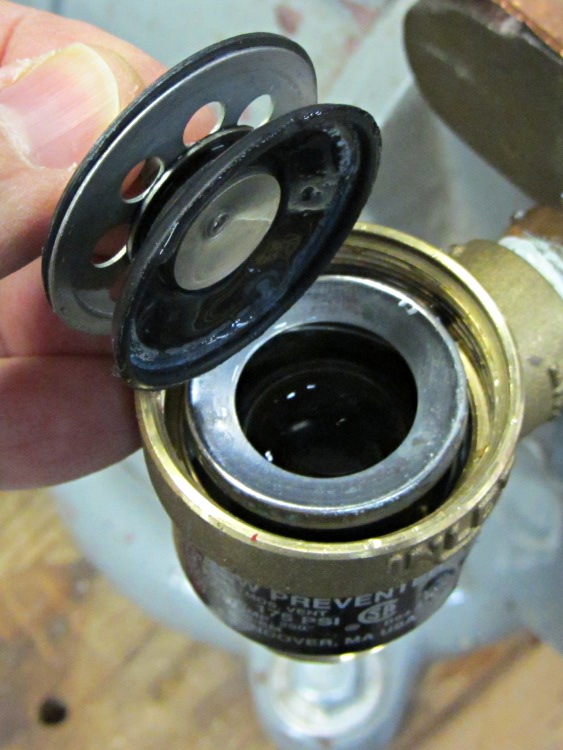
    This is the inlet valve, which is basically a flapper. You can’t see the fine cracks around the central mount, but they’re all over the inner half of the ring.

    Watts 9D-M3 - Inlet valve
    Watts 9D-M3 – Inlet valve

    And this is the outlet valve, which has pretty much disintegrated. Note the outer rim peeled back under my thumb:

    Watts 9D-M3 - Outlet valve
    Watts 9D-M3 – Outlet valve

    A complete new valve is $40, in stock and ready for pickup at Lowe’s, but all I really needed was the failed rubber flapper valves, which they don’t carry. A few minutes of searching reveals the Watts 0886011 Repair Kit, which has all of the interior parts.

    Pop Quiz: How much does the repair kit cost?

    Answer: Starts at $38 plus shipping and goes up from there. Cheap aftermarket kits run $20 and up, but they’re all out of stock.

    Now that, party people, is the sort of thing that ticks me right off.

    Perhaps the local HVAC / plumbing supply stores have such kits in stock? To quote: “They may exist, but we don’t have them.”

    I don’t see any way to homebrew new flapper valves, so it’s off to Lowe’s we go…

    It would seem to me that these things shouldn’t fail after a mere decade of service. I thought that about the CdS flame sensor that crapped out in the middle of a sub-zero January cold snap while I was at Cabin Fever some years ago, too.