Ed Nisley's Blog: Shop notes, electronics, firmware, machinery, 3D printing, laser cuttery, and curiosities. Contents: 100% human thinking, 0% AI slop.
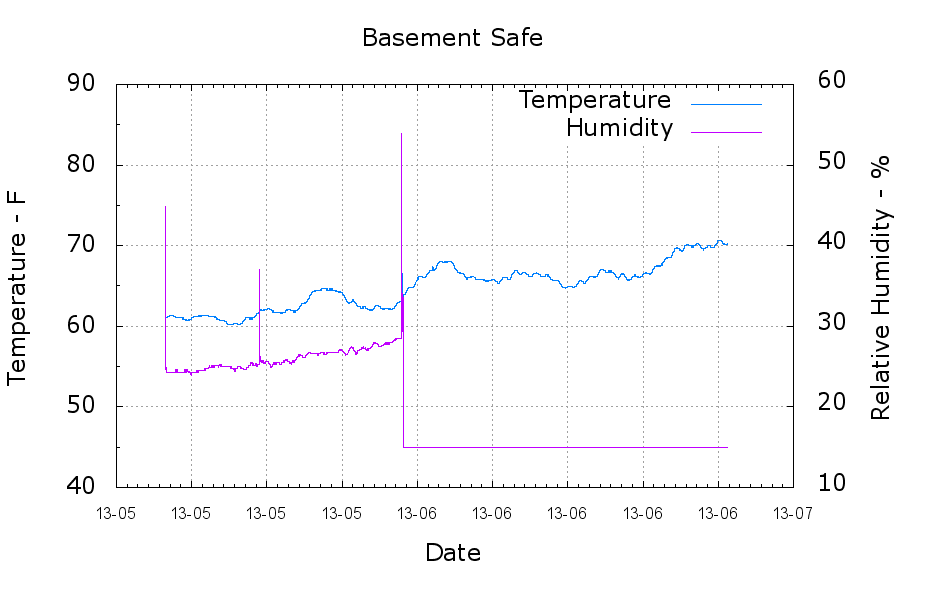
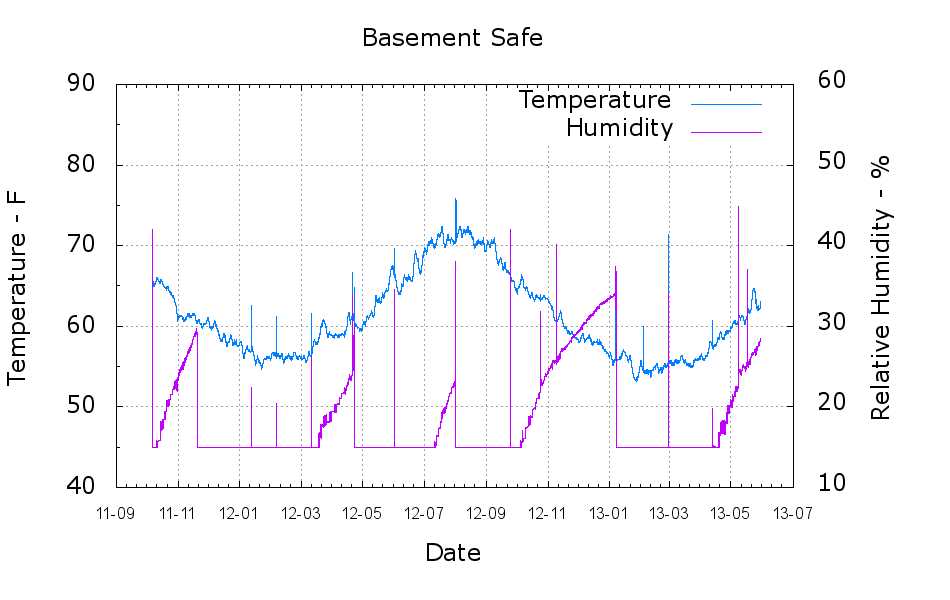
The last two months of temperature and humidity data from inside the basement safe indicate that Spring is becoming Summer down there:
Basement Safe – Temp Humid – 2013-06-30
The new bag of new silica gel beads once again dropped the humidity below the Hobo datalogger’s 15% threshold, so I don’t know the actual humidity. The indicator cards packed inside the silica gel buckets report they’re below 10%; that’s dry enough for me.
However, the bag now weighs 539 g, so it’s pulled 31 g of water out of the air over the last month. The old gel accumulated 63 g over five winter months, so there’s much more water in the air these days! The safe still has a tape seal around the door gap; perhaps a better gasket is in order.
The glitch at the end of May shows the datalogger coming upstairs on a hot, humid day, going back into the safe with the old silica gel tray, then, after a short pause for some Quality Shop Time, snuggling up next to the new bag. The mid-month glitch shows a peek inside the safe…
This plug for a portable air conditioner’s window vent may be un-buildable with my current state of 3D printer-fu. The top view shows the recess for a disk of insulating foam:
Portable AC Vent Plug – solid model – top
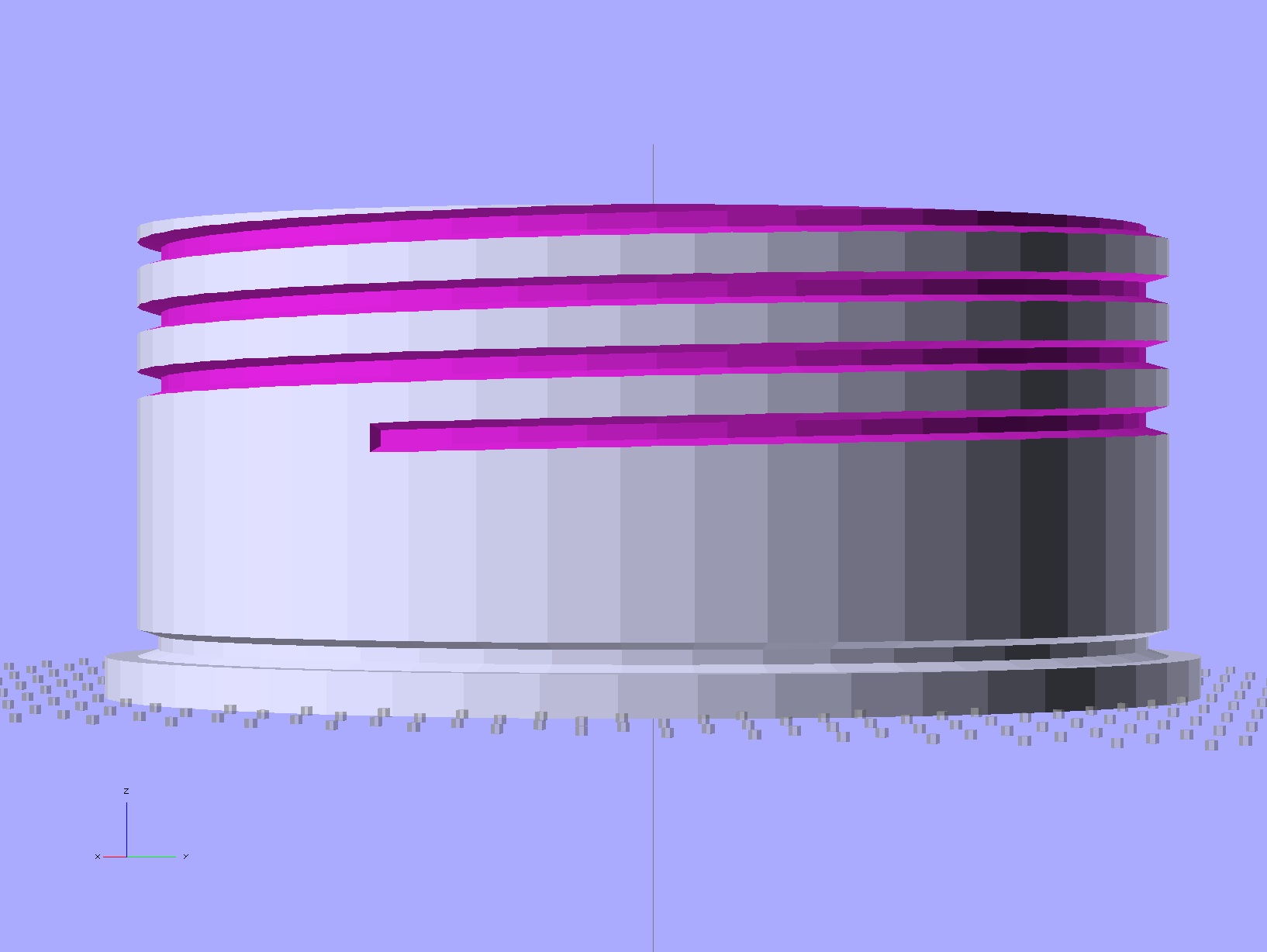
The side view shows the thread profile and the groove for the O-ring seal:
Portable AC Vent Plug – solid model – side
The bottom view shows the hemispheric finger grip recess:
Portable AC Vent Plug – solid model – bottom
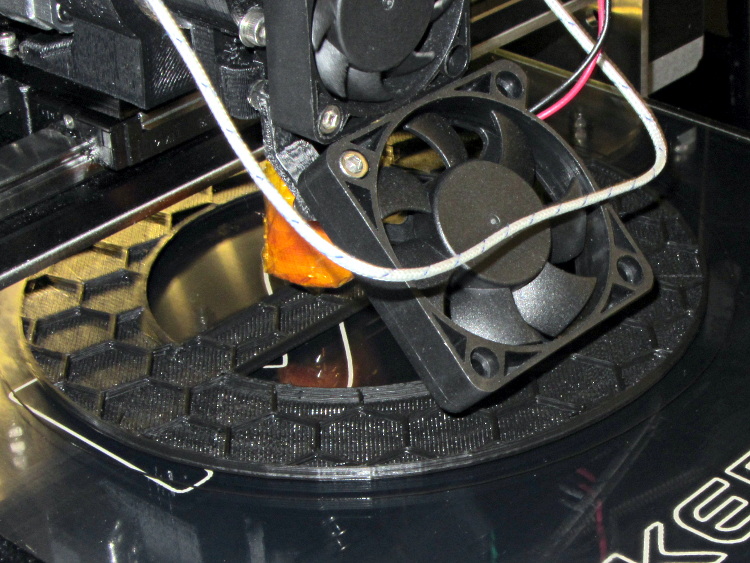
Basically, that design requires extensive support material no matter how it’s laid out. I tried the obvious way without any support, but that huge flat surface popped off the glass:
AC Vent Plug – flat build
The thread and groove overhangs in that orientation would require support and then extensive cleanout. Slic3r doesn’t do a good job of supporting internal layers, so the bottom of the recesses tend to flop into the hexagonal infill. I’m not sure building internal support all the way up the inside of the threads would be a Good Thing, though.
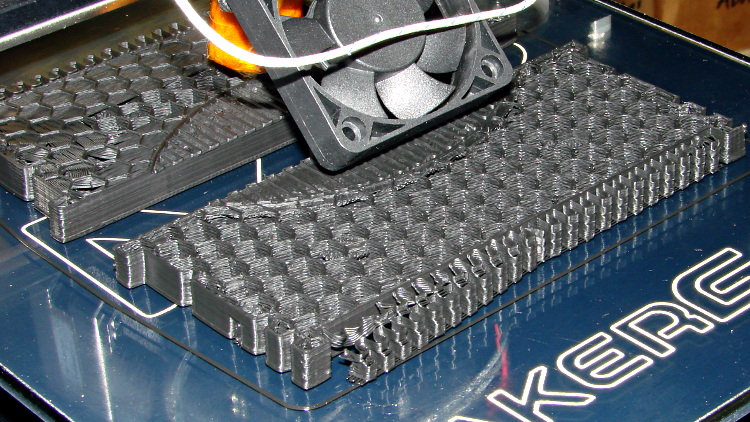
Rotating by 90 degrees and cutting it in half failed because the automagic support structure popped off the platform:
AC Vent Plug – split build
Admittedly, that was before I started using hairspray (on the platform!), but both orientations require far too much support. In fact, the rotated version might weigh half a kilo…
I’m also generating the thread elements incorrectly; the joints don’t meet smoothly at the junctions. I think tapering each element so the smaller end nests inside the larger end will work better. Perhaps using a scaled hexagonal element would be better / faster than the current extruded 2D shape?
I think the correct way to proceed will be a 3D print of the finger grip and flange section, oriented so the hemisphere points upward, with the threaded section made from a length of PVC pipe with lathe-turned threads and O-ring groove, butted against the flange around the grip section.
Problem: that’s an 8 mm pitch thread and my inch-size lathe doesn’t do metric:
Need: 8 mm = 0.315 in → 3.175 TPI
Closest: 3-1/4 TPI → 0.308 in = 7.82 mm
Worse: 3 TPI → 0.333 in = 8.47 mm
The plug needs about three turns, which means the 3-1/4 TPI = 7.82 mm pitch thread would be off by 0.54 mm, roughly a third of the thread form’s crest. That might actually work, as the “thread” on the inside of the pipe this thing fits into is actually a thin ridge, rather than an actual thread shape, and the plug is supposed to jam against the flange anyway.
Maybe a four-axis setup in the Sherline, with the rotary table holding the PVC pipe (or whatever) aligned with the X axis? It would just barely fit under the spindle with the end mill in a collet.
The pipe rack doesn’t hold any suitable plastic pipe.
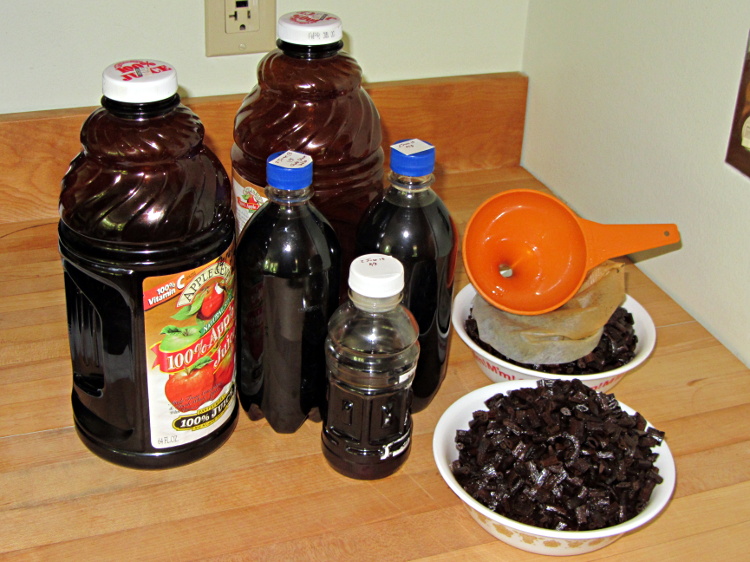
It seems we go through maybe 1.5 l of vanilla extract in a bit over a year , so a month ago I picked up a pound of Grade B Madagascar Vanilla Beans from the usual eBay supplier, two bottles of low-end vodka (Popov and Crystal Palace), and combined them in a pair of apple juice bottles. Fast forward through a month of daily shaking and we have a still life with chopped vanilla beans:
DIY Vanilla Extract 2013
Having established that running the extracted and drained bean chunks through a blender doesn’t produce anything useful, I dumped the chunks into a pair of plastic tubs with loose-fitting lids and put them in the basement. That ought to improve the ambiance down there something fine!
The net yield looks to be a bit over 1.5 liter of extract from each 1.9 liter apple juice jar filled with vodka + chopped beans. The rule of thumb is a quart (= 1 liter) of hooch for each 1/4 pound of beans, but I figure this isn’t an exact science and those jars came from the stockpile.
To my untrained nose, the Crystal Palace vanilla extract smells better than the Popov brew, but I’d be surprised if that makes any difference in the pancakes.
A while back I bought a lifetime supply of silica gel beads from Sorbent Systems, with the intent of gradually replacing all of the miscellaneous desiccant packs floating around here. The catch is figuring out how to package 2 mm spherical beads, because the whole point of a desiccant pack is getting moist air in contact with the beads. I’m sure there’s a commercial solution for this out there, but …
Anyhow, here’s what 500 g of beads looks like, captured inside a 12×12 inch square of landscaping cloth folded in half:
Silica gel in landscape cloth bag
It really should be sewn along the three joined edges, but this is a quick-and-dirty prototype to see how it works; I simply folded the edges over twice and stapled through all six layers.
For the record, 500 g of beads occupies 700 ml in the measuring cup I used to weigh and pour them into the end of the bag. The bag + beads + staples weighs 508 g. The can holding the bulk beads has a humidity indicator card that shows the humidity is below 10%, so I’ll assume they’re pretty well dehydrated.
It’s now in the basement safe, presumably soaking up moist air at a frantic pace. I’ll check it in a week or two and see what’s actually happening.
For the record, those old desiccant granules (and their tray) weighed 853 g when they went into the safe and emerged at 916 g, having soaked up 63 g = 2 oz of water over the last five months.
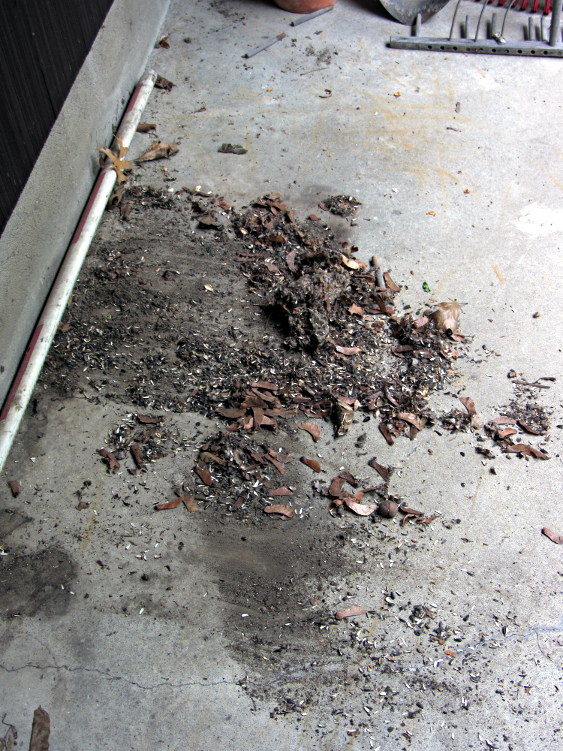
Before washing the bedroom windows, I moved the garden tool rack and a bunch of clutter away… only to find a remarkable amount of litter below the plastic base:
Litter under garden tool rack
One of those lumps consisted of tightly packed fluff, much like the mouse nest inside the barbie a few years ago, so this was surely a winter home.
But it seems at least one mouse didn’t make it through the winter:
Dessicated mouse under tool rack
Given its dessicated nature, I think the poor critter probably expired during the depths of the winter freeze.
A plot of the temperature and humidity inside the basement safe over the last year-and-a-half:
Basement Safe
The tray of silica gel (or whatever those granules might be) holds the humidity firmly at 14 to 15 %, at least with a simple masking tape seal around the door opening that dates back to early 2012. Less water vapor gets through the door during the winter, due to the lower basement humidity when it’s cold outside, but it looks like four regenerations per year with just under a kilogram of desiccant in the tray.
Ordinarily, it’d be time for those granules to endure another oven session, but I just picked up a bunch of real silica gel beads and must conjure up some porous bags.
The Bash / Gnuplot script that cleaned the CSV files and produced the plot:
#!/bin/sh
#-- overhead
export GDFONTPATH="/usr/share/fonts/truetype/"
base="${1%.*}"
echo Base name: ${base}
ofile=${base}.png
tfile=$(tempfile)
echo Input file: $1
echo Temporary file: ${tfile}
echo Output file: ${ofile}
#-- prepare csv Hobo logger file
sed 's/^\"/#&/' "$1" | sed 's/^.*Logged/#&/' | sed 's/ ,/,/' | sed 's/\/\([0-9][0-9]\) /\/20\1 /' > ${tfile}
#-- do it
gnuplot << EOF
#set term x11
set term png font "arialbd.ttf" 18 size 950,600
set output "${ofile}"
set title "${base}"
set key noautotitles
unset mouse
set bmargin 4
set grid xtics ytics
set timefmt "%m/%d/%Y %H:%M:%S"
set xdata time
set xlabel "Date"
set format x "%y-%m"
#set xrange [1.8:2.2]
set xtics font "arial,12"
#set mxtics 2
#set logscale y
set ytics nomirror autofreq
set ylabel "Temperature - F"
set format y "%3.0f"
set yrange [40:90]
set mytics 2
set y2label "Relative Humidity - %"
set y2tics nomirror autofreq
set format y2 "%3.0f"
set y2range [10:60]
#set y2tics 32
#set rmargin 9
set datafile separator ","
#set label 1 "label text" at 2.100,110 right font "arialbd,18"
#set arrow from 2.100,110 to 2.105,103 lt 1 lw 2 lc 0
plot    \
    "${tfile}" using 2:3 axes x1y1 with lines lt 3 title "Temperature",\
    "${tfile}" using 2:4 axes x1y2 with lines lt 4 title "Humidity"
EOF
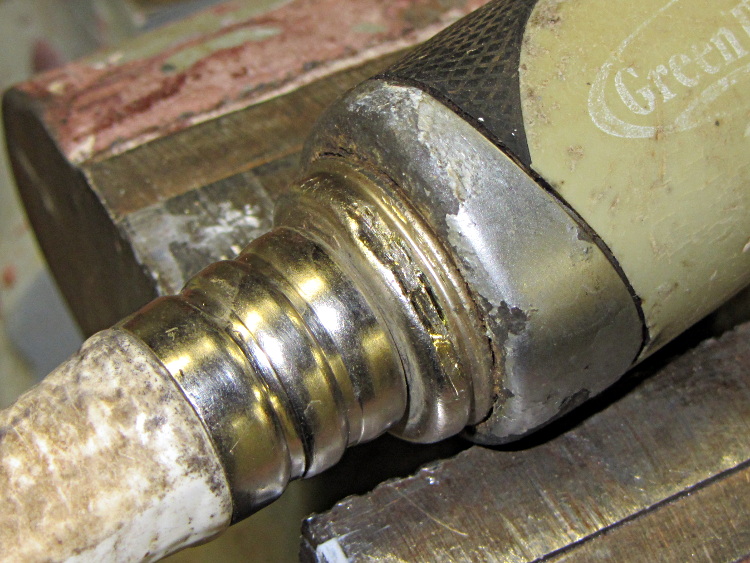
The hose attached to this garden sprayer had failed last season, but the hose fitting had become one with the sprayer. Soaking it with penetrating oil for far longer than seemed necessary didn’t help, so I tried brute force:
Garden sprayer hose fitting
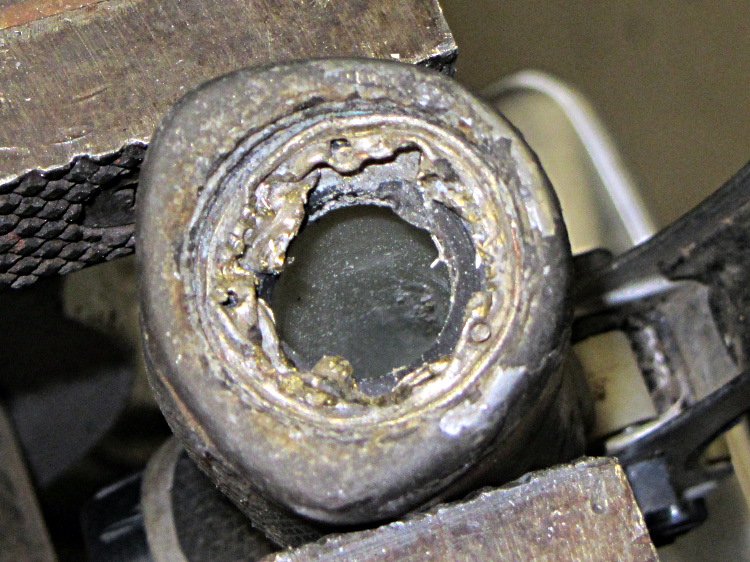
After convincing myself that wasn’t going to work, I cut the fitting off and tried the old standby of collapsing the threaded shell inward with a small punch:
Garden sprayer – rolled-in fitting
That didn’t work, either: the shell really had become one with the sprayer.
As it turned out, the plastic sprayer body had begun to crack in several high-stress locations and would shortly become Yet Another Project. I cut my losses and tossed the hose and the sprayer.




 The Smell of Molten Projects in the Morning