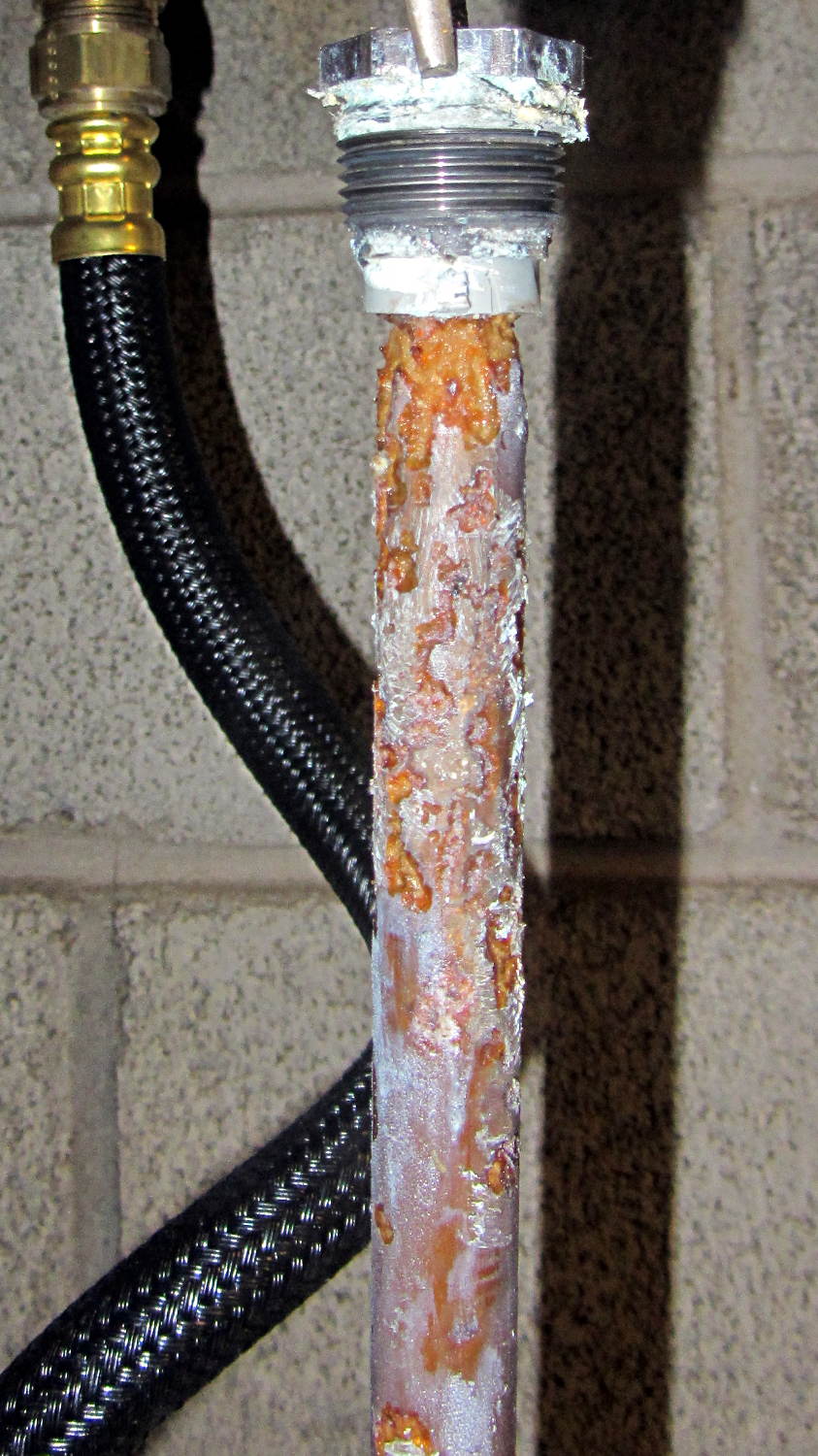
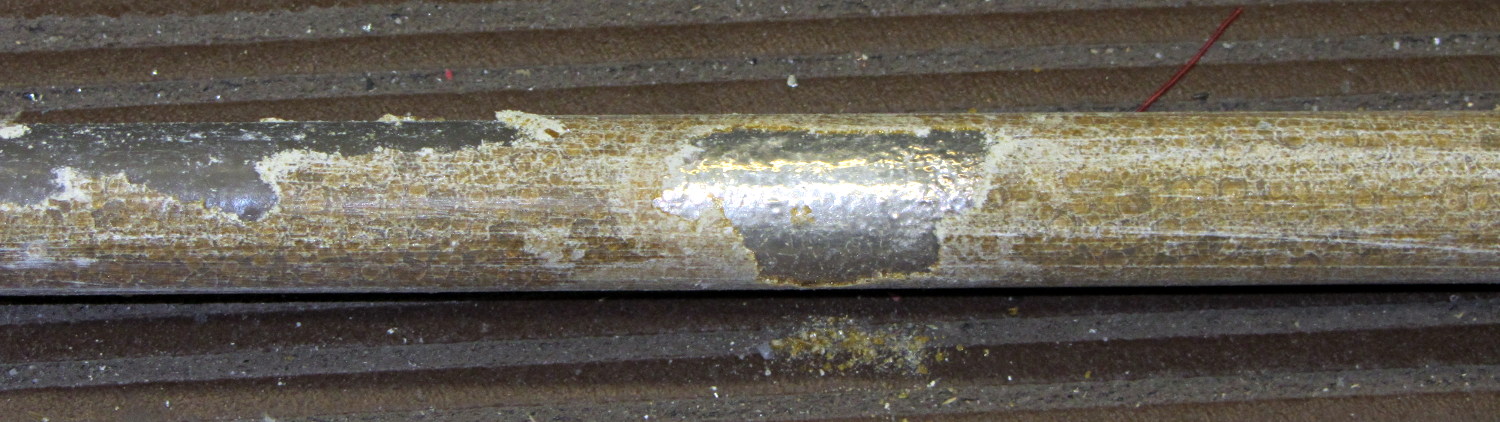
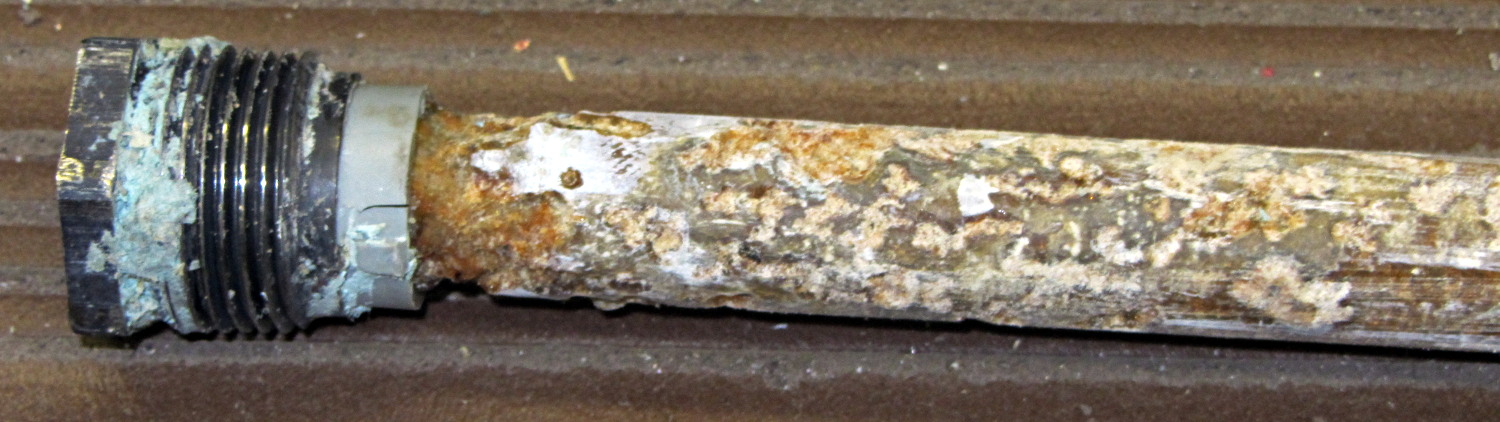
A one-year-old magnesium rod looks pretty good, all things considered:

The previous one was still working after seven years, although I had to wreck it to get it out…
The Smell of Molten Projects in the Morning
Ed Nisley's Blog: Shop notes, electronics, firmware, machinery, 3D printing, laser cuttery, and curiosities. Contents: 100% human thinking, 0% AI slop.
Things around the home & hearth
A one-year-old magnesium rod looks pretty good, all things considered:

The previous one was still working after seven years, although I had to wreck it to get it out…
Those simple floor brush strips for the Samsung vacuum cleaner worked moderately well, but the urethane adhesive didn’t have enough grip on the plastic strips. Having just run out of that batch, I made up another set with slightly undercut holes:

That’s half a thread width on each side, just enough to give the adhesive something to grab. Such is the plan, anyway.
I taped the strips to a pair of credit cards (actually, flat cards without embossed characters), slathered a thin layer of urethane atop them, and laid on squares of the same wool fabric I used the last time:

Then I piled a steel block atop an aluminum slab on both arrays, fast forwarded a day, peeled and flexed and cut the strips apart:

The urethane foamed through the holes as I hoped and (seems to have) locked the fabric in place, at least well enough to withstand some experimental bending on the workbench.
Now, to see how they stand up to actual use…
The OpenSCAD source code:
// Samsung Vacuum cleaner nozzle floor strips
// Ed Nisley KE4ZNU January 2013
// November 2013 - adapt to M2, enlarge holes
Layout = "Build"; // Show, Build
//- Extrusion parameters must match reality!
// Print with +0 shells and 3 solid layers
ThreadThick = 0.25;
ThreadWidth = 0.4;
HoleWindage = 0.75;
function IntegerMultiple(Size,Unit) = Unit * ceil(Size / Unit);
Protrusion = 0.1; // make holes end cleanly
//----------------------
// Dimensions
Body = [6.0,59.0,3*ThreadThick]; // width, length, thick
Tab1 = [4.5,5.0,0.0]; // width, length, offset from centerline
Tab2 = [3.5,5.0,0.5];
HoleOC = 8.0; // adhesive anchoring holes
HoleDia = 2.0;
HoleSides = 4;
HoleMax = floor(Body[1]/(2*HoleOC));
echo("HoleMax: ",HoleMax);
//----------------------
// Useful routines
module PolyCyl(Dia,Height,ForceSides=0) { // based on nophead's polyholes
Sides = (ForceSides != 0) ? ForceSides : (ceil(Dia) + 2);
FixDia = Dia / cos(180/Sides);
cylinder(r=(FixDia + HoleWindage)/2,
h=Height,
$fn=Sides);
}
module ShowPegGrid(Space = 10.0,Size = 1.0) {
Range = floor(50 / Space);
for (x=[-Range:Range])
for (y=[-Range:Range])
translate([x*Space,y*Space,Size/2])
%cube(Size,center=true);
}
module BackingStrip() {
difference() {
union() {
translate([0,0,Body[2]/2])
cube(Body,center=true);
translate([Tab1[2],-1*Body[1]/2,Body[2]/2])
cube([Tab1[0],2*Tab1[1],Body[2]],center=true);
translate([Tab2[2],+1*Body[1]/2,Body[2]/2])
cube([Tab2[0],2*Tab2[1],Body[2]],center=true);
}
for (i = [-HoleMax:HoleMax])
translate([0,i*HoleOC,-Protrusion])
rotate(45) {
PolyCyl(HoleDia,(Body[2] + 2*Protrusion),HoleSides);
PolyCyl((HoleDia + ThreadWidth),(ThreadThick + Protrusion),HoleSides);
}
}
}
//----------------------
// Build it!
ShowPegGrid();
if (Layout == "Show")
BackingStrip();
if (Layout == "Build")
rotate(90) BackingStrip();
We don’t drive the van nearly often enough (*) to keep the battery charged in cold weather, so I use a trickle charger to keep it alive between jaunts. While opening the hood one evening, I managed to twist the plastic fitting that anchors the hood prop rod beyond its limits and snapped the poor thing off, which left me holding the hood in one hand and the rod in the other.
After extricating most of the fragments from under the van, I found that the OEM part had a hollow post that snapped into a square hole in the front bulkhead under the hood. The post had two keys and a pair of snap latches that held it in place, a design that seemed optimized for rapid assembly with no fiddly parts, but which depended on a few millimeters of plastic to restrain a meter of steel rod.
I made up a simple replacement with a solid square post and a square cap to clamp it against the bulkhead:

The general idea is that the screw puts the entire post under compression, giving it less temptation to shear at the deck line when I twist the rod a bit too far out of line. That 8-32 screw seemed entirely adequate to the task; a 10-32 screw would take up too much of the post for my liking.
Alas, it turns out that underneath the bulkhead’s top flange lies a metal plate surrounding the headlight that’s so close to the hole that the big blocky cap wouldn’t fit. So I slimmed the cap down to three thread widths and tried again, only to discover that the plate came that close to the edge of square hole.
However, there was a gap between the bottom of the bulkhead and the top of the plate, so I introduced pivot and cap to Mr Belt Sander, removed enough plastic to let the cap slide into the gap, then discovered the 8-32 screw head was just slightly too large to let the screw align with the post.
Another tweak to the model, based on actual measurements on the abused parts, produced the final version:

The rod hole has a nice bevel, there’s no fragile neck between the rod hole and the base flange, the solid post lies flat on the platform for EZ building, and there’s a slight offset between the post and the flange that eliminates the need for support material. Printing it lying down orients the filament paths around the hole and base, making the part stronger in the direction it needs the most strength.
I think the cap walls could be slightly thicker, but we’ll see how long the thing lasts…
A group photo of all the versions, lined up from left to right, shows the broken OEM part, the first blocky attempt, the slimmed-down and too-long version to the rear, the shorter version that actually fit, and a backup part for when that one breaks:

The sanded-down part held the hood open while I took that group picture. Here’s what it looks like under load:

The scrawls on the bulkhead just in front of the pivot remind me of fluid levels, torques, and suchlike. The stud sticking out to the rear is a headlight aiming screw mounted in the plate that caused so much hassle; you’d think I’d have noticed it before starting this adventure, but noooo…
For what it’s worth, that’s rapid prototyping in action: three (and a half) iterations in quick succession, each getting closer to a goal that you (well, I) can’t quite define, but will recognize when it appears. Took about three hours over the course of two days.
I loves me my M2 3D printer…
(*) Indeed, the tires often take three miles to warm up their flat spots due to sitting in the garage for a week…
We hauled 70 pounds of apples back across the river last month:

If only there were a Spackenkill Road bridge across the Hudson…
We laid the bags out on the garage floor, seeing as how they can’t go into the cold cellar with the root crops (apples give off ethylene gas, which doesn’t mix well with long-storage crops). I dropped a Hobo datalogger into one bag to record the temperatures:

The purple trace comes from a data logger in the attic, which is as close as we have to an outside air temperature record.
Those low air temperatures suggest it’s time to move the remaining apples into the basement, as far from the root cellar as possible, as we have more nights in the teens ahead.
The cracker recipe I’m using produces eight sets of crackers, so this time I added a variety of toppings to see what would work out best:
Garlic wins over everything else, hands-down, no contest, but the mixture of all the toppings in the bottom of the cooling bowl was wonderful.
The crackers went into a large pot with a bag of desiccant:

It pulled out 30 grams of water while reducing the humidity to 20% overnight; the crackers started out crisp and became really snappy. Definitely the right way to get the job done.
These vaguely resemble the Processor Crackers recipe in Flatbreads & Flavors (Alford & Duguid):
I’m using coarse-ground red wheat that doesn’t soak up the water like fine-ground flour. The original recipe called for 1-½ C water, which produced a sticky ball.
Finely chopped toppings work best; the nuts were too coarse.
For each piece of dough:
Toss the crackers into a big bowl to cool, sampling as needed.
When crackers cool:
Wonderful!
Memo to Self: Shredded Parmesan cheese would be pretty good…
Mary managed to outcompete the local squirrels to the tune of 10 pounds of Shagbark Hickory nuts, which we’ve been enjoying after supper. The thickly armored nuts shrug off ordinary nutcrackers, so we deploy heavy weaponry: good old 10WR Vise-Grip pliers:

She describes the process better than I; for what it’s worth, I work on one nut at a time. We both celebrate when a shell releases its nut with minimal damage; most often, we extract fragments into a pile like the one shown. I can process half a dozen nuts before deciding I’ve had enough.
I’d be in favor of a genetic modification producing a fluorescent green shell, because overlooking a minute piece of shell in that pile of nutmeat is a Very Bad Thing…
Some Vise-Grip history may be of interest.
Back in August, the squash vines were in full flower:

Here’s a closer look:

Pop quiz: how many bees do you count?
With the benefit of watching them move, I counted nine bees in that blossom!
Winter squash vines bear large flowers (that blossom is the size of my outstretched hand) that attract large bees: bumblebees and their cousins, carpenter bees. Quite often, bumblebees spend the night huddled inside the blossom and emerge early the next day when they reach flying temperature. Honeybees, being more social, return to their hives overnight; we’re pleased to see that there’s at least one feral hive in the neighborhood.