The Smell of Molten Projects in the Morning

Ed Nisley's Blog: Shop notes, electronics, firmware, machinery, 3D printing, laser cuttery, and curiosities. Contents: 100% human thinking, 0% AI slop.

Category: Home Ec

Things around the home & hearth

  • Revlon Tweezers: Bad Spot Welds

    Mary bought a pair of Revlon tweezers a while ago, picking a Name Brand to avoid hassles with bottom-dollar crap:

    Revlon tweezers - bad spot welds
    Revlon tweezers – bad spot welds

    Well, that didn’t work.

    I contend that the only difference between Name Brands and the bottom-dollar crap I tend to buy is a bit of QC and a lot of price. I’ll agree that’s not strictly true, but it does fit a goodly chunk of the observed data.

    Anyhow.

    I milled a recess into the corner of some scrap plastic to locate the handle end, then arranged a step block to capture the business end:

    Revlon tweezers - drilling setup
    Revlon tweezers – drilling setup

    That setup ensures the holes go into the corresponding spots on both pieces, because I couldn’t figure out how to clamp them together and drill them both at once. I drilled the other piece with its good side up to align the holes; doing it bad side up would offset the holes if they’re not exactly along the center line.

    A closer look:

    Revlon tweezers - drilling fixture
    Revlon tweezers – drilling fixture

    Talk about a precarious grip on the workpiece!

    I filed the welds flat before drilling, so the pieces lay flat and didn’t distract the drill.

    Then:

    • Center-drill
    • Drill 2-56 clearance
    • Scuff up mating surfaces with coarse sandpaper
    • Apply epoxy
    • Insert screws
    • Add Loctite
    • Tighten nuts to a snug fit
    • Align jaws
    • Tighten nuts
    • Fine-tune jaw alignment
    • Apply mild clamping force to hold jaws together
    • Wait overnight
    • Saw screws and file flush
    • Done!

    The clamping step:

    Revlon tweezers - epoxy curing
    Revlon tweezers – epoxy curing

    Those nicely aligned and ground-to-fit jaws were the reason Mary bought this thing in the first place.

    The screw heads look OK, in a techie sort of way:

    Revlon tweezers - fixed - front
    Revlon tweezers – fixed – front

    The backside won’t win any awards:

    Revlon tweezers - fixed - rear
    Revlon tweezers – fixed – rear

    But it won’t come apart ever again!

    There’s surely a Revlon warranty covering manufacturing defects, printed on the long-discarded packaging, that requires mailing the parts with the original receipt back to some random address at our own expense.

    Ptui!

  • Trimming Ironman Sunglasses

    These sunglasses fit Mary’s face and do a good job of keeping road grit out of her eyes, but she doesn’t like the extended earpieces. So I cut ’em off:

    Ironman sunglasses - trimmed earpieces
    Ironman sunglasses – trimmed earpieces

    The trick is to shape the ends with an ordinary diagonal cutter, then round the edges with sandpaper.

    The lower pair has seen a few years of use, during which the bright yellow plastic faded quite a bit.

    Nothing profound, other than that you need not put up with nuisances.

  • Crysknife

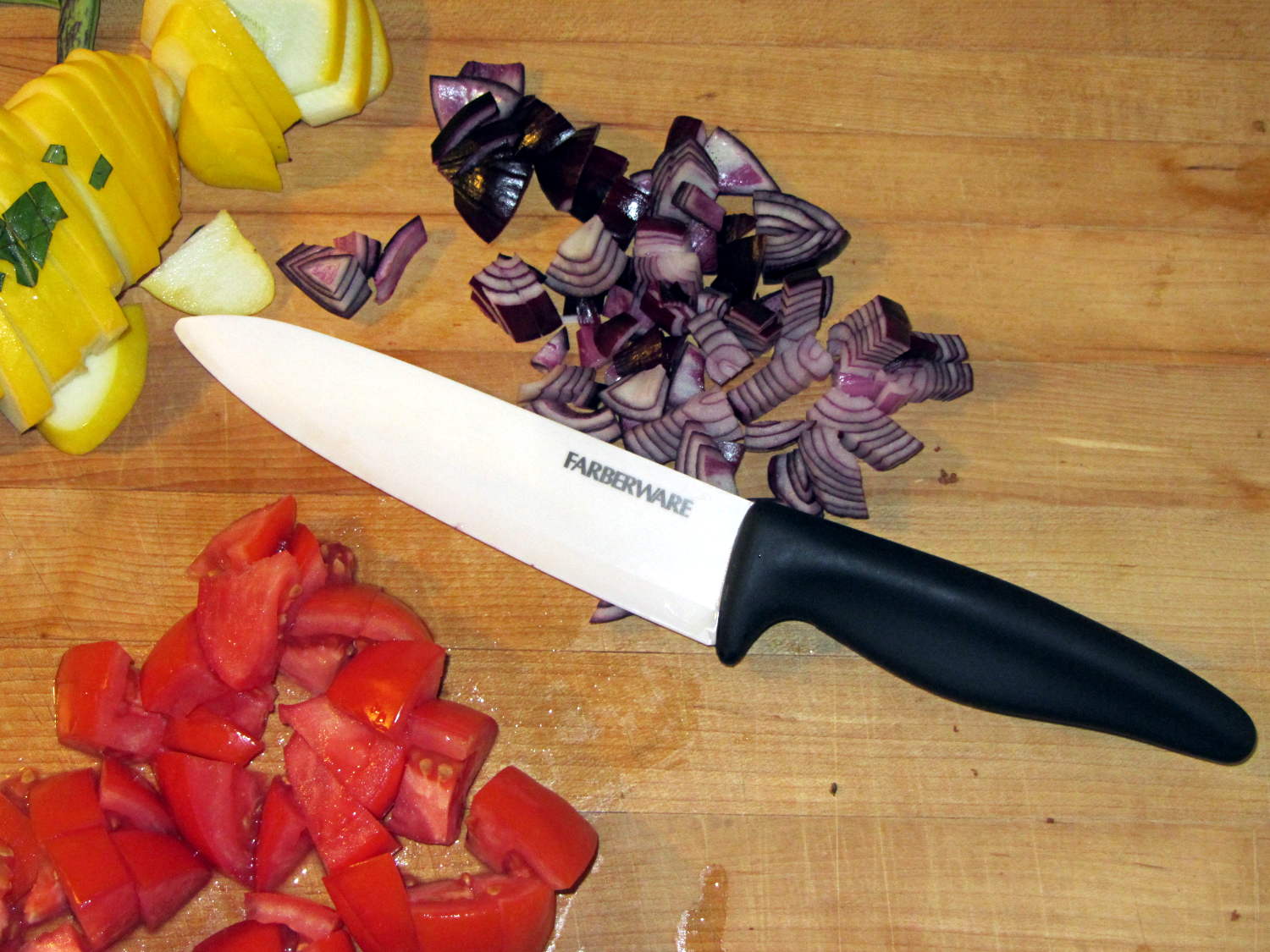
    In these degenerate times, it seems anyone can just buy a crysknife:

    Farberware ceramic knife
    Farberware ceramic knife

    Admittedly, it lacks the original’s kinjal shape and curved blade. We once had a double-edged, serrated kitchen knife and I swore a mighty oath on the bones of my ancestors to never, ever make that mistake again.

    Surprisingly, the plastic handle balances well with the ceramic blade: no need for another tungsten counterweight. The handle extends slightly below the blade’s heel, which may call for some abrasive adjustment.

    The blade is slightly thicker than the wonderful steel santoku knives we’ve been using forever and doesn’t taper uniformly from spine to edge, so it’s no good for constrained cutting (like quartering an apple). The hollow-ground section behind the edge forms a wedge that cracks apples apart, unlike the santoku’s full-width taper that just slides right through.

    I was mildly surprised to find that it’s no sharper (perhaps that’s “no more keen”) than our steel knives, but, then, I’m wicked with the sharpening steel. The edge arrived minus a few tiny chips and I suspect we’ll add more in normal use, right up to the moment when one of us drops it on the floor.

    A gotcha: that blade’s eyeblink  affordance is harmless plastic. I must remind myself it’s a real knife with a lethally sharp edge.

    Thus far, we’ve sheathed the blade unblooded, in clear violation of the Fremen ritual. May it ever be so…

  • Uphill Rain Leader

    You can’t make this stuff up:

    Expecting water to run uphill
    Expecting water to run uphill

    As nearly as I could tell, the vertical downspout along the edge of the building ends level with the top of the drain grate. If that convenient rock were high enough to level the last length of pipe, the elbow would be above the end of the downspout.

    The architectural drawings for the apartment complex surely didn’t look like that.

  • Interplak Water Jet: End of the Line

    The brittle tubing on Mary’s Interplak water jet continued to disintegrate, so I replaced the entire tube with Tygon:

    Interplak water jet - interior
    Interplak water jet – interior

    Nisley’s First Rule of Plumbing: Never, ever look inside the pipes delivering water to your faucet.

    Interplak handle - interior view
    Interplak handle – interior view

    That’s not quite inside the pipes, but it’s pretty grotendous, isn’t it?

    As expected, flexible tubing doesn’t transmit the pressure pulses nearly as well as the OEM rigid tubing, so we finally bought a new Waterpik. At least you can get replacement tubing for Waterpiks, but I’ll wait until it fails before stocking up.

    Contrary to what you might expect, I cut the Interplak’s cord, harvested the motor windings, and dumped the carcass in the trash.

  • Silicone Caulk + Desiccant = Win!

    After doing the second batch of quilting pin caps, I dropped the newly opened silicone caulk tube into a jar with some desiccant, which worked wonderfully well. Unlike the usual situation where the caulk under the cap hardens into a plug after a few weeks, the tube emerged in perfect condition. In fact, even the caulk in the middle of the conical nozzle was in good shape, with just a small cured plug on either end; it had been sitting inside a cloth wrap with no sealing at all.

    Here’s what it looked like after finishing the last of the most recent caps:

    Silicone caulk tube with silica gel
    Silicone caulk tube with silica gel

    The indicator card says the humidity remains under 10%, low enough to keep the caulk happy and uncured. Well worth the nuisance of having a big jar on the top shelf instead of a little tube next to the epoxy.

    Although I thought the desiccant was silica gel, it’s most likely one of the clay or calcium desiccants.

  • More Quilting Pin Caps

    Pinning the top of Mary’s latest quilt used more than 1600 pins: three boxes of specialized quilting safety pins, plus straight quilting pins tucked into all the 3D printed / silicone filled caps. Less than a quarter of the quilt top fits on the table:

    Quilt top with pins
    Quilt top with pins

    Although Mary doesn’t need them right now, I made another batch of 100 caps for her next project:

    Quilting pin caps - 4 x 25 - on platform
    Quilting pin caps – 4 x 25 – on platform

    I tweaked the OpenSCAD source to build a 10×10 array:

    Quilting Pin Cap - 10x10 array
    Quilting Pin Cap – 10×10 array

    But it turns out that a 5×5 array of caps, duplicated four times, works out better:

    Quilting Pin Cap - 5x5 array
    Quilting Pin Cap – 5×5 array

    Slic3r takes far longer to process the larger array than to make four copies of the smaller array.

    Half an hour later, they’re ready for silicone fill. In retrospect, natural PLA wasn’t a good choice for this job: there’s no way (for me) to take a picture of translucent silicone in crystalline PLA atop waxed paper on a white cutting board under fluorescent light…

    On the upside, however, you can see exactly how far the pin goes into the cap:

    Quilting pin in translucent cap
    Quilting pin in translucent cap