The Smell of Molten Projects in the Morning

Ed Nisley's Blog: Shop notes, electronics, firmware, machinery, 3D printing, laser cuttery, and curiosities. Contents: 100% human thinking, 0% AI slop.

Category: Electronics Workbench

Electrical & Electronic gadgets

  • HP 6201B Power Supply Meter Switch Rehabilitation

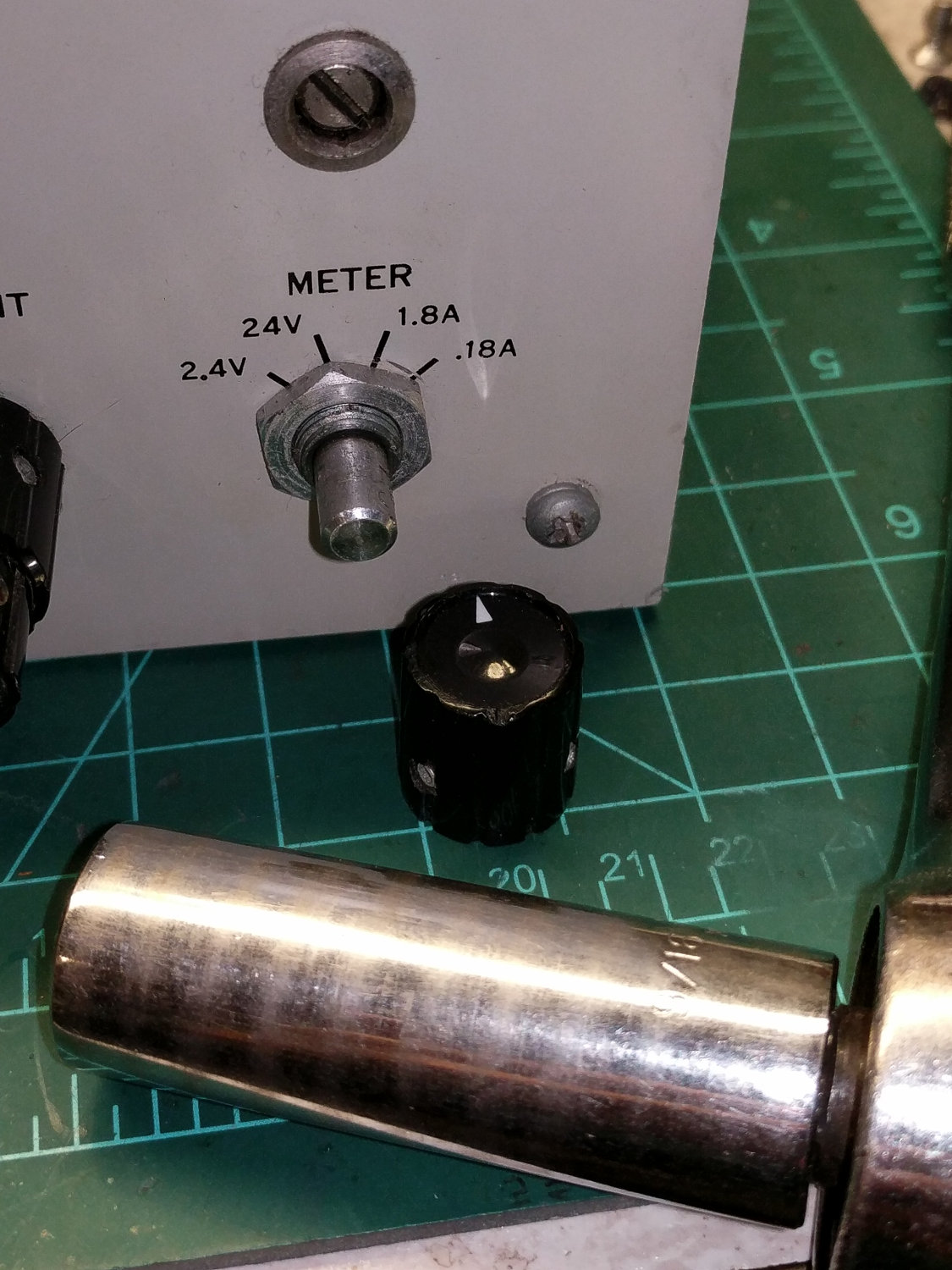
    The meter range switch on Squidwrench’s HP 6201B bench power supply became erratic enough to get me to tear it apart:

    HP 6201B Power Supply - meter switch nut
    HP 6201B Power Supply – meter switch nut

    For future reference, apply a 9/16 inch deep socket after loosening two teeny setscrews in the knob.

    The date codes suggest a mid-70s assembly, but the design dates back to the 60s with no plug-in anything:

    HP 6201B Power Supply - meter switch in panel
    HP 6201B Power Supply – meter switch in panel

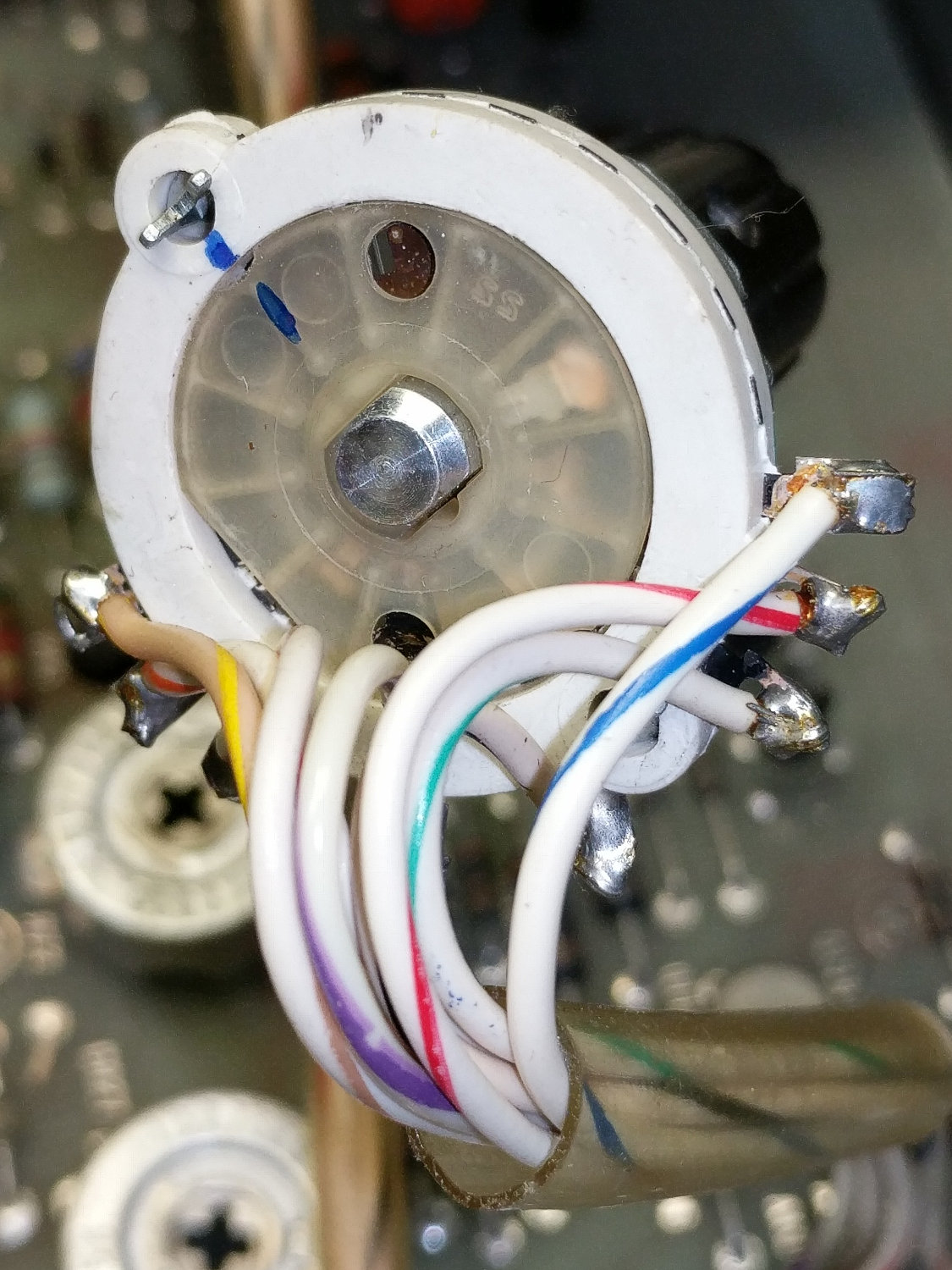
    Rather than unsolder eight switch leads, I wrangled it into a visible location:

    HP 6201B Power Supply - meter switch rear
    HP 6201B Power Supply – meter switch rear

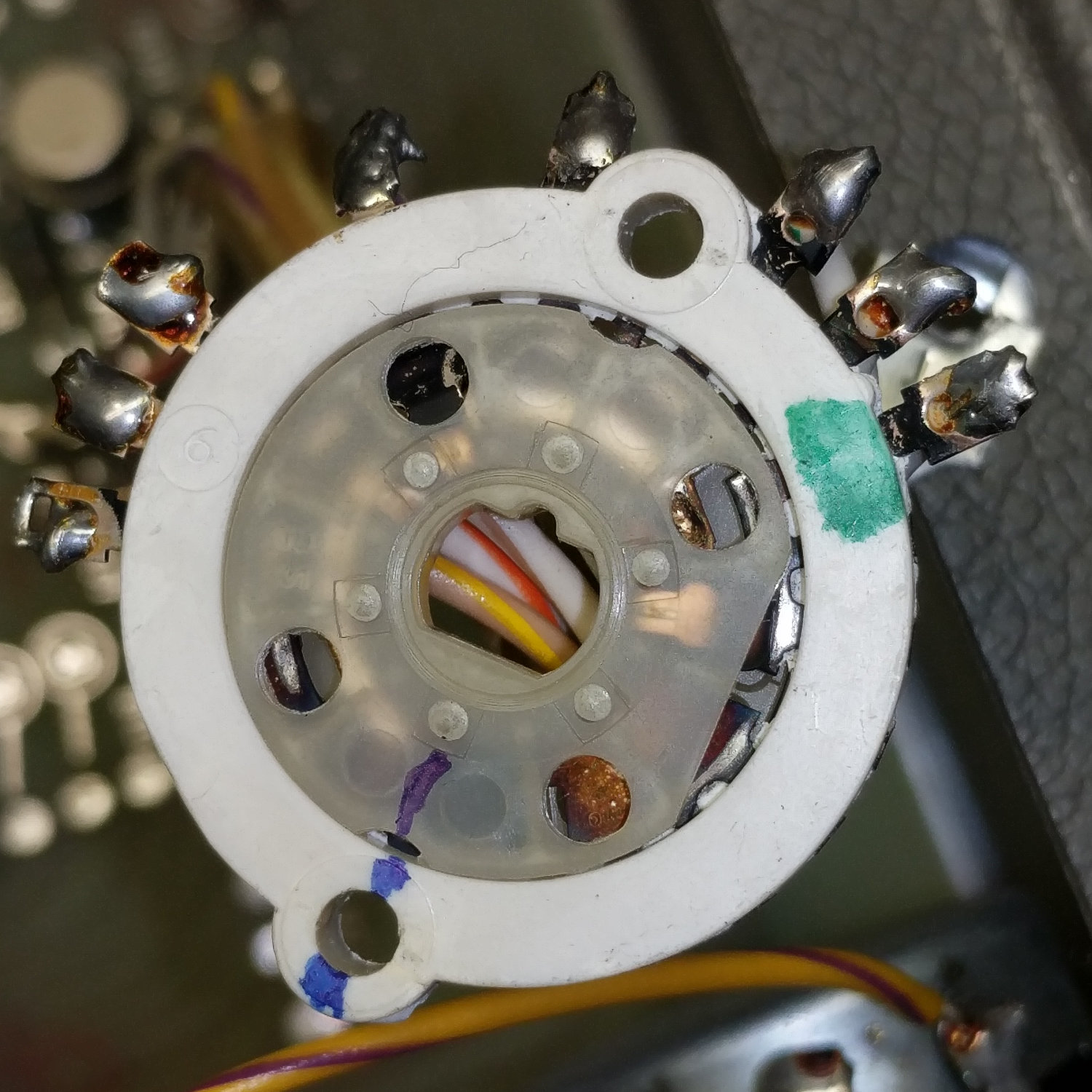
    The knob and shaft sit on a separate metal bracket held in the white plastic ring with a pair of expanded prongs. Squashing the prongs together released the bracket, so I could see both sides of the switch wafer:

    HP 6201B Power Supply - meter switch front
    HP 6201B Power Supply – meter switch front

    Note the copious markings which would, in the event of an actual finger fumble, give me a better chance of reassembling the spilled guts. Turned out not to be necessary, but it’s good to be prepared!

    The actual repair consisted of easing a drop of DeoxIT Red into each side, spinning the central switch wafer / contacts a few dozen times, then reassembling in reverse order. Re-bending the prongs turned out to be the most difficult part, eventually requiring the designated Prydriver, and ended well enough.

    A quick test with a 100 Ω power resistor shows the supply was working fine and the switch produced the expected results without glitches or twitches:

    HP 6201B Power Supply - test load
    HP 6201B Power Supply – test load

    You just can’t beat the performance of old lab equipment!

  • MPCNC: Guilloche Engraving First Light

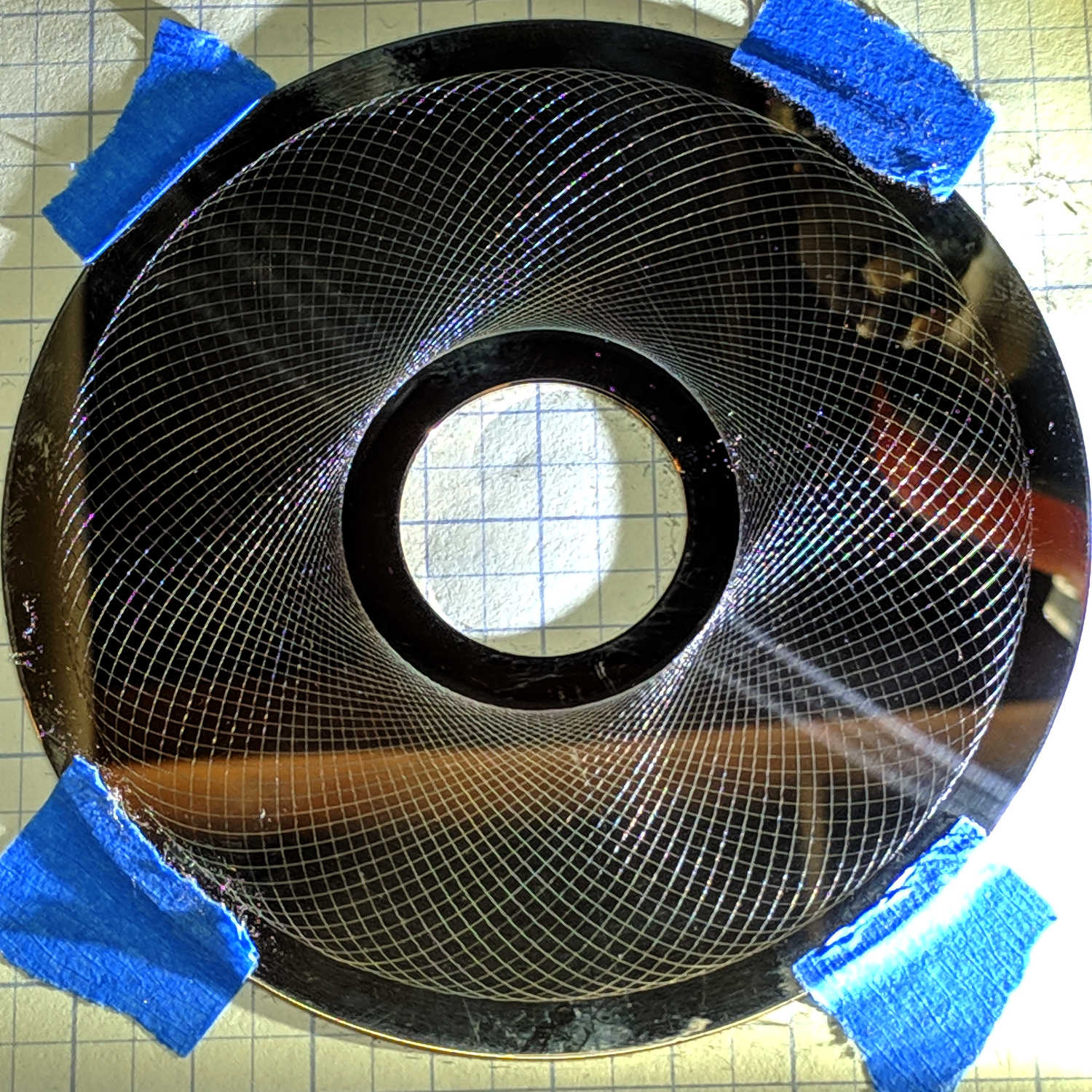
    A diamond point drag engraving bit in the MPCNC scratched a suitable Guilloché pattern into a scrap hard drive platter much much better than I had any reason to expect:

    MPCNC - Guilloche 835242896 - HD plattter - 0.1mm
    MPCNC – Guilloche 835242896 – HD plattter – 0.1mm

    That’s with a 0.1 mm cut depth, sidelit with an LED flashlight.

    Feeding those nine digits into the Guilloché pattern generator script should get you the same pattern; set the paper size to 109 mm and use Pen=0 to suppress the legend.

    The same pattern at 0.3 mm cut depth looks about the same:

    MPCNC - Guilloche 835242896 - HD plattter - 0.3mm
    MPCNC – Guilloche 835242896 – HD plattter – 0.3mm

    It’s slightly more prominent in real life, but not by enough to make a big difference. I should try a graduated series of tests, of course, which will require harvesting a few more platters from dead drives.

    Either side will look great under a 21HB5A tube, although the disks are fingerprint and dust magnets beyond compare.

  • Power Over Audio

    An obsolete Intuit / Roam Data credit card reader emerged from the heap:

    Intuit Roam Data Reader
    Intuit Roam Data Reader

    “Turn up the volume” suggested where the power comes from:

    Intuit Roam Data Reader - plug wiring
    Intuit Roam Data Reader – plug wiring

    They drive a LOUD, probably square-ish, audio signal through both “earphone”channels, rectify and regulate the output, and have plenty of power for the reader. The card data returns through the “mic” as another audio signal; I assume they choose an encoding well-suited for a dab of DSP decoding.

    Nowadays, of course, 3.5 mm jacks are obsolete, audio data travels by Bluetooth, and you must keep a myriad batteries charged at all times.

  • 2N3904 and 2N3906 Transistor Assortments: Consistency Thereof

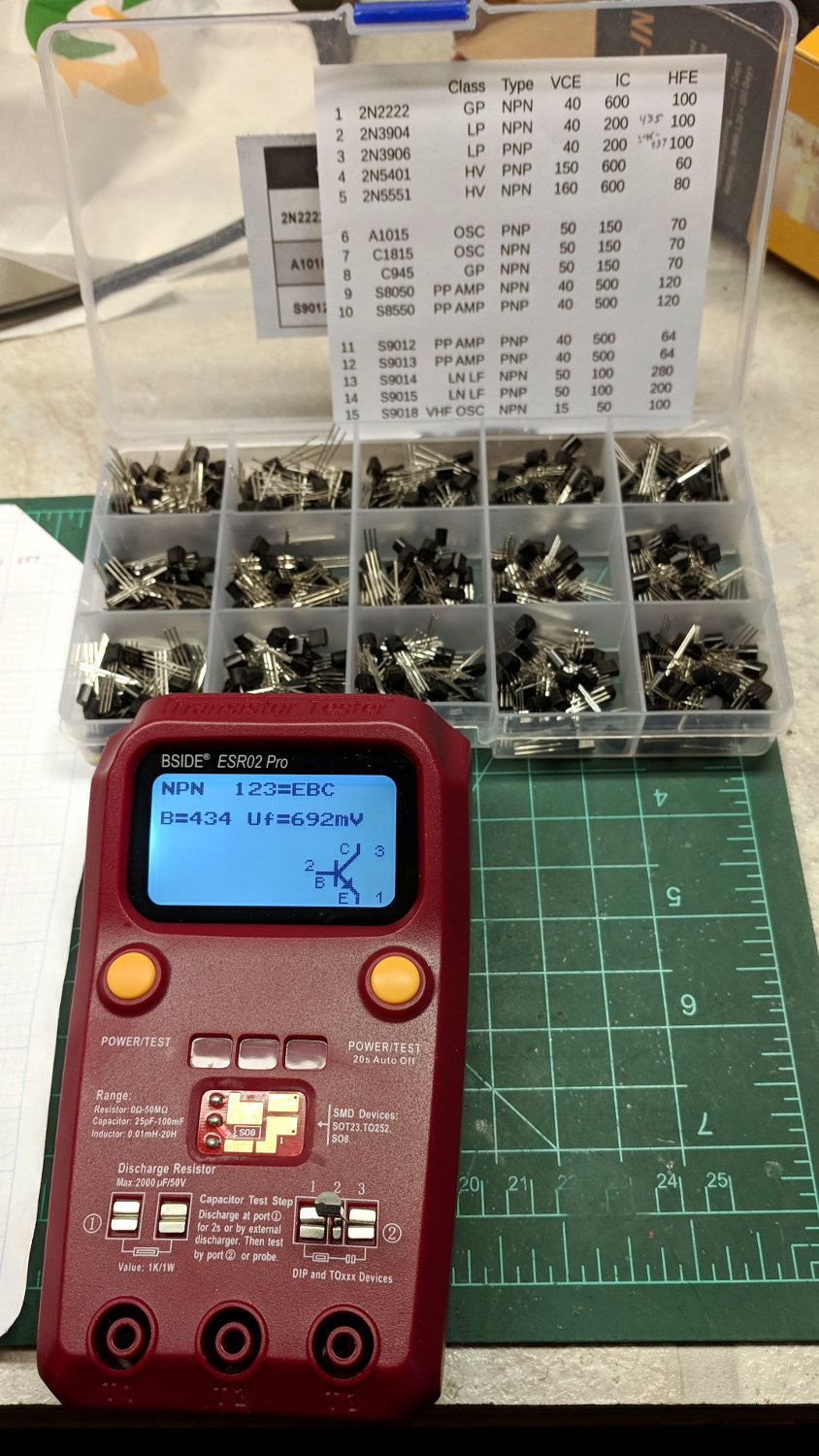
    A note about building a discrete equivalent of the classic LM3909 prompted me to measure some 2N3904 and 2N3906 transistors:

    ESR02 Tester - 2N3904 measurement
    ESR02 Tester – 2N3904 measurement

    The DC gain and VBE for each flavor look comfortingly uniform:

    Transistor measurements - 2N3904 2N3906
    Transistor measurements – 2N3904 2N3906

    Quite unlike those Hall effect sensors, indeed.

    Most of the VBE variation comes from temperature differences: re-measuring the 2N3904 transistors with VBE ≅ 672 mV put them with their compadres at 677 mV.

    The 2N3906 transistors have wider gain and VBE variations, so selecting a matched pair for the LM3909 current mirror makes sense.

    The sheet inside the lid collects some essential parameters for ease of reference:

                Class   Type   VCE     IC    HFE
    1   2N2222    GP     NPN    40    600    100
    2   2N3904    LP     NPN    40    200    100
    3   2N3906    LP     PNP    40    200    100
    4   2N5401    HV     PNP   150    600     60
    5   2N5551    HV     NPN   160    600     80
    
    6    A1015    OSC    PNP    50    150     70
    7    C1815    OSC    NPN    50    150     70
    8     C945    GP     NPN    50    150     70
    9    S8050   PP AMP  NPN    40    500    120
    10   S8550   PP AMP  PNP    40    500    120
    
    11   S9012   PP AMP  PNP    40    500     64
    12   S9013   PP AMP  NPN    40    500     64
    13   S9014   LN LF   NPN    50    100    280
    14   S9015   LN LF   PNP    50    100    200
    15   S9018   VHF OSC NPN    15     50    100
    

    You’re welcome.

  • Powered Prototype Board: Laying-on of Hands Repair

    One of my very first projects, after setting up my very first home shop in our very first home, was building an overly elaborate prototype board with five (!) linear power supplies:

    Proto Board - overview
    Proto Board – overview

    The components come from the mid-70s and the shop happened around 1980, so it’s been ticking along for nigh onto four decades. Of late, the supply voltages became erratic and I eventually popped the top:

    Proto Board - innards
    Proto Board – innards

    Yeah, linear pass transistor regulators driven from bulk cap storage, hand-hewn bridge rectifiers, and multi-tap transformers. Everything mounts on screws tapped into the 1/8 inch aluminum chassis, with power transistors on a huge finned heatsink attached to the rear panel. The thing weighs 11.6 pounds = 5.3 kg.

    Not a trace of firmware to be found. Heck, surface-mount components hadn’t yet come into common use.

    The circuitry lives on a crudely etched phenolic board:

    Proto Board - etched circuit board
    Proto Board – etched circuit board

    There may be a schematic somewhere in my collection, but it hasn’t surfaced in a long time. I’m mildly surprised I didn’t tuck it inside the case, which may have been a life lesson yet to be learned.

    Based on my recent experience with the Tek AM503, I wiggled the two metal-can regulators and the ceramic (!) regulator, gingerly plugged in the line cord, flipped the switch, and all the supply voltages once again work perfectly.

    Whew!


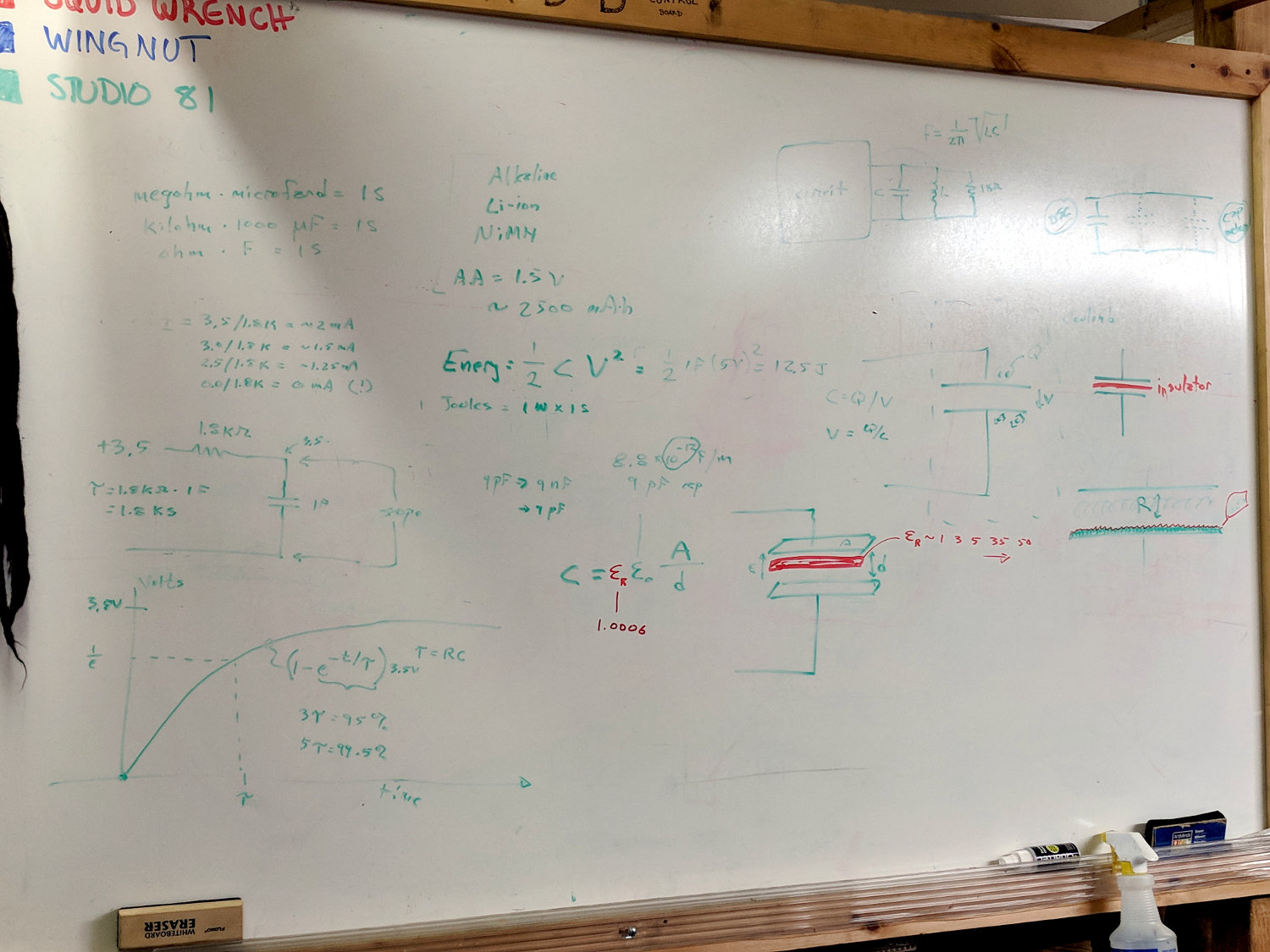
  • Squidwrench Electronics Workshop Session 6: Capacitors

    Capacitors as charge-storage devices with An introduction to Function Generators & Oscilloscopes

    Capacitor show-and-tell

    Capacitor show-n-tell
    Capacitor show-n-tell

    Things to remember

    • The green one over on the left is the 1 farad cap my EE prof said I’d never see: “It would be as big as a house”
    • The small disk in front of it is a 600 mF (milli, not micro) polyacene “battery” rated at 3.3 V
    • Air-variable and wax-dielectric caps = ghosts from the past
    • Reverse-biased diodes act as capacitors, due to charge separation
    • Silver-mica caps are pretty things to behold
    • Voltage rating vs size vs dielectric, a cap charged to 10 kV will get your attention

    Warmup exercise: Measure the caps with a variety of meters, noting they do not reach 1 farad. General patter, Q&A, introducing equations as needed.

    I will resolutely squash all discussion of capacitors as analog / small signal circuit elements.

    Cap construction

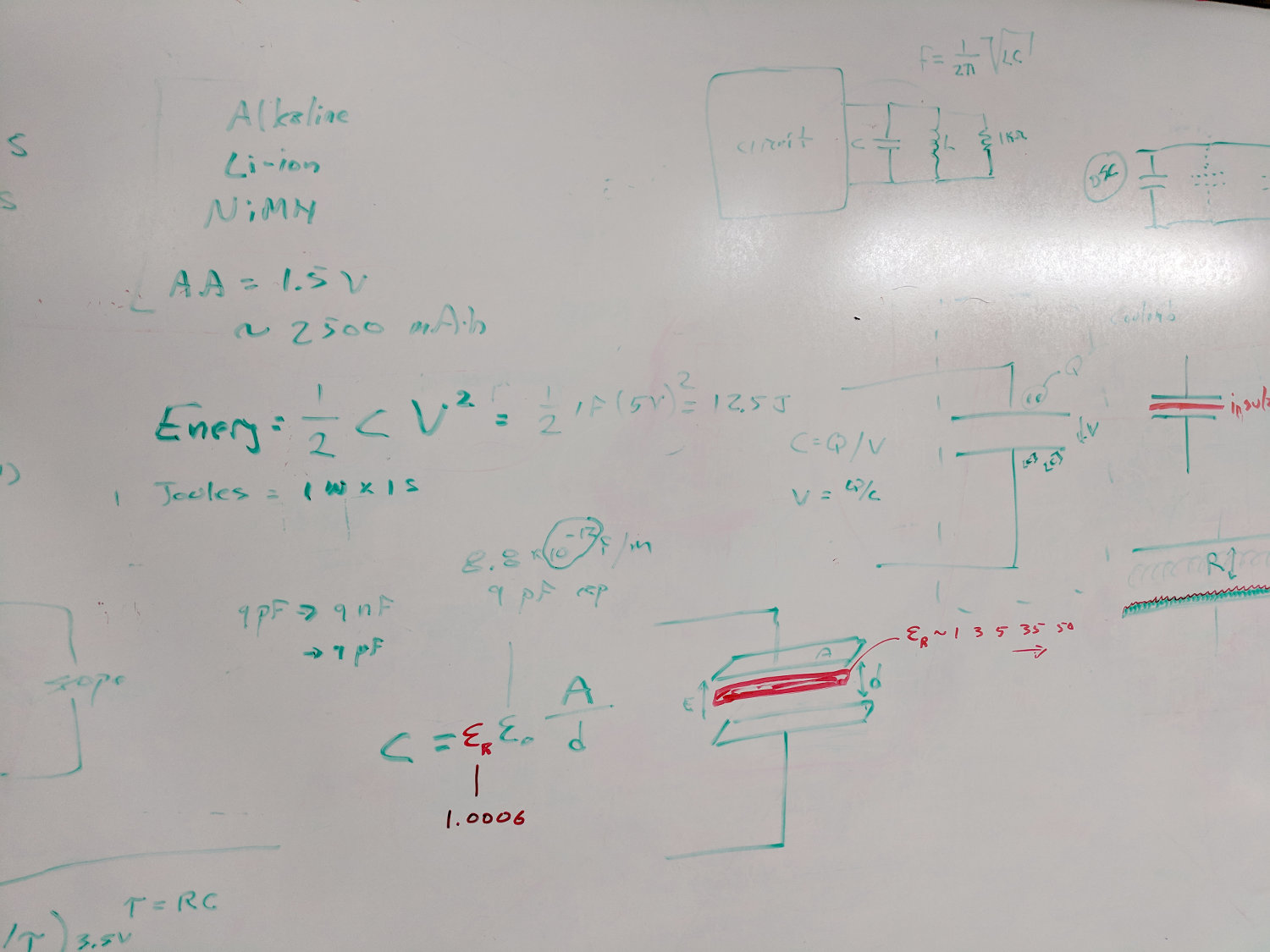
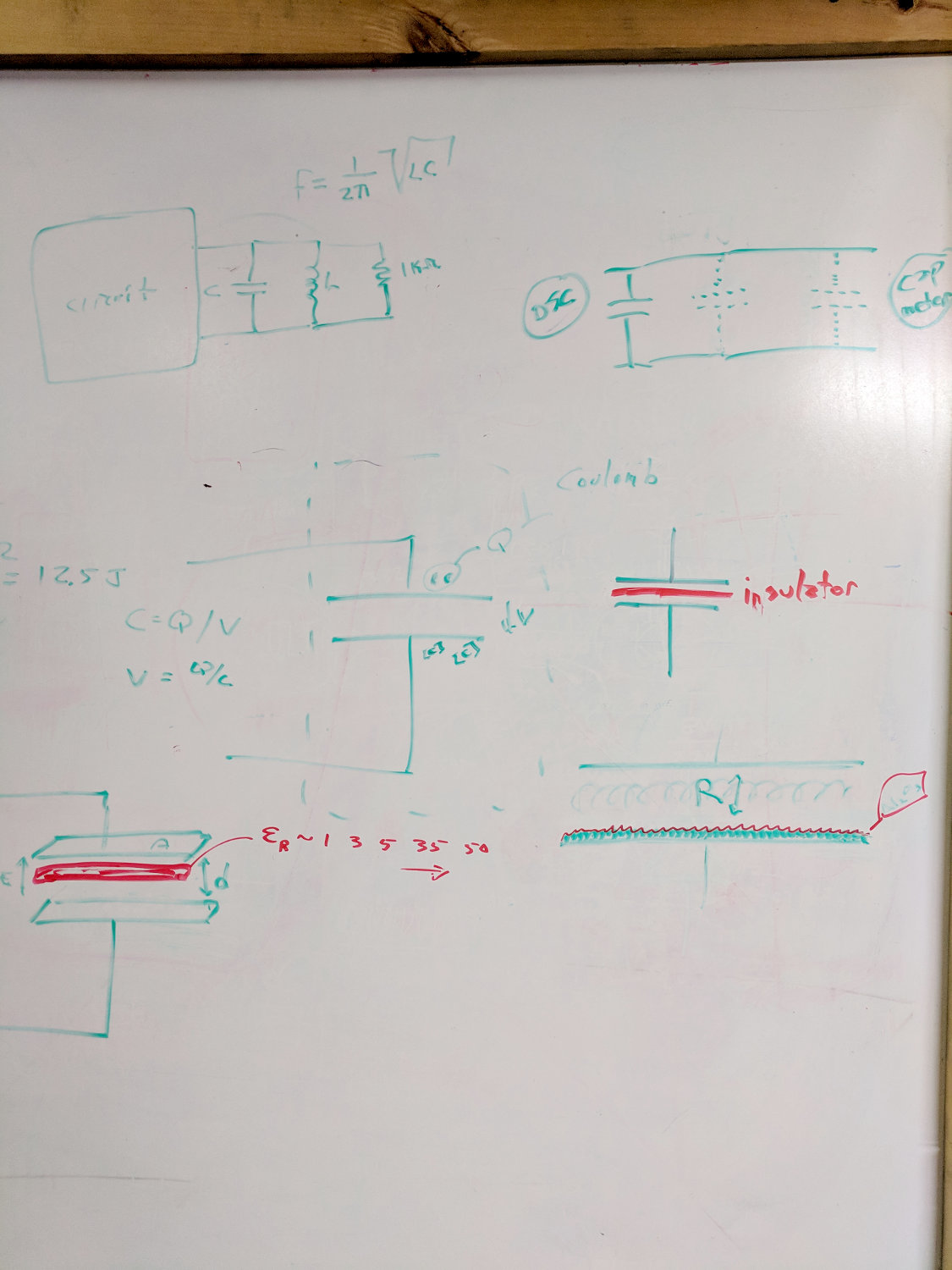
    • C = εA/d with ε = dielectric permittivity = ε0 × εR
    • ε0 = vacuum permittivity = 8.84 × 10⁻¹² F/m
    • εR = relative permittivity, air = 1.0006
    • dielectrics: wax vs paper vs plastics vs whatever
    • ignoring dissipation factor for now
    • caution on dielectric absorption
    • electrolytic caps vs capacitor plague
    • brave / daring / foolish: aluminum foil with chair mat dielectric (εR ≈ 3)

    Useful equations

    • C = Q/V and (nonlinearly) C = Δq/ΔV
    • thus Q = C × V, Δq = C × Δv = Δc × V
    • by definition, i = Δq/Δt, so i = C × Δv/Δt
    • “displacement current” vs “actual current”
    • stored energy = 1/2 × C × V²

    Quick demo

    • charge 1 F cap to 3.7 V at 20 mA from constant current power supply
    • estimate charge time
    • plot V vs T
    • disconnect power supply, connect white LED, observe light output for the next few hours

    Capacitor applications in charge-storage mode

    • Constant current → voltage ramp (scope horizontal)
    • Large cap = no-corrosion (kinda sorta) small-ish battery
    • Change plate d → microphone (need V)
    • Trapped charge in dielectric → Electret mic (no V, but need amp)
    • Change C (varactor) → parametric low noise amplifier (narrowband)

    Parallel caps

    • C = C1 + C2
    • expanded plate area “A”
    • capacitor paradox vs reality: never switch paralleled caps!

    Series caps

    • 1/C = 1/C1 + 1/C2
    • increased separation “d”, sorta kinda
    • floating voltage on center plates = Bad Idea

    Now for some hands-on lab action

    Connect function generator to resistor voltage divider

    Resistor voltage divider - oscilloscope connections
    Resistor voltage divider – oscilloscope connections

    • calculate total resistance and series current
    • calculate expected voltages from current
    • show input & output waveforms on scope
    • overview of oscilloscope controls / operations

    Replace lower R with C, then measure V across cap

    RC Circuit - integrator
    RC Circuit – integrator

    • series circuit: fn gen → R → C (C to common)
    • scope exponential waveform across C
    • not constant current → not linear voltage ramp
    • except near start, where it’s pretty close
    • e^-t/τ and (1 – exp(-t/τ))
    • time constant τ = RC (megohm × microfarad = ohm × farad = second)
    • show 3τ = 5% and 5τ < 1%
    • integration (for t << τ)

    Tek 2215A oscilloscope - cap as integrator
    Tek 2215A oscilloscope – cap as integrator

    Flip R and C, measure V across resistor

    RC Circuit - differentiator
    RC Circuit – differentiator

    • series circuit: fn gen → C → R (R to common)
    • scope exponential waveform across R  ∝ current through cap (!)
    • same time constant as above
    • differentiation (for t << τ)

    Tek 2215A oscilloscope - cap as differentiator
    Tek 2215A oscilloscope – cap as differentiator

    If time permits, set up a transistor switch

    NPN switch - Cap charge-discharge
    NPN switch – Cap charge-discharge

    • display voltage across cap
    • measure time constants
    • calculate actual capacitance

    Other topics to explore

    • measure 1 F cap time constant, being careful about resistor power
    • different function generator waveforms vs RC circuits
    • scope triggering
    • analog vs digital scope vs frequency

    All of which should keep us busy for the better part of a day …

  • Squidwrench Electronics Workshop: Session 5 Whiteboards

    Whiteboards from the SqWr Electronics Session 5, covering transistors as switches …

    Reviewing I vs V plots, starting with a resistor and then a transistor as a current amplifier:

    SqWr Electronics 5 - whiteboard 1
    SqWr Electronics 5 – whiteboard 1

    Reminder of why you can’t run a transistor at its maximum voltage and current at the same time:

    SqWr Electronics 5 - whiteboard 2
    SqWr Electronics 5 – whiteboard 2

    A resistor load line, with power calculation at the switch on and off coordinates:

    SqWr Electronics 5 - whiteboard 3
    SqWr Electronics 5 – whiteboard 3

    Detail of the power calculations, along with a diagram of the current and voltage when you actually switch the poor thing:

    SqWr Electronics 5 - whiteboard 3 detail
    SqWr Electronics 5 – whiteboard 3 detail

    Oversimplification: most of the power happens in the middle, but as long as the switching frequency isn’t too high, it’s all good.

    Schematic of the simplest possible switched LED circuit, along with a familiar mechanical switch equivalent:

    SqWr Electronics 5 - whiteboard 4
    SqWr Electronics 5 – whiteboard 4

    We started with the “mechanical switch” to verify the connections:

    SqWr Session 5 - Switched LED breadboard
    SqWr Session 5 – Switched LED breadboard

    Building the circuitry wasn’t too difficult, but covering the function generator and oscilloscope hookup took far more time than I expected.

    My old analog Tek 2215 scope was a crowd-pleaser; there’s something visceral about watching a live CRT display you just don’t get from the annotated display on an LCD panel.

    I’d planned to introduce capacitors, but just the cap show-n-tell went well into overtime. We’ll get into those in Session 6, plus exploring RC circuitry with function generators and oscilloscopes.