The Smell of Molten Projects in the Morning

Ed Nisley's Blog: Shop notes, electronics, firmware, machinery, 3D printing, laser cuttery, and curiosities. Contents: 100% human thinking, 0% AI slop.

Category: Electronics Workbench

Electrical & Electronic gadgets

  • Exposed Stepper Motor Windings

    Got a stepper motor from halfway around the planet from the usual eBay source, intended for a direct-drive extruder (at some point). This one has integral wire leads, which is fine with me, but the opening in the rear endcap reveals a bit more of the innards than one usually sees:

    ACT 17HS5425 stepper - exposed winding
    ACT 17HS5425 stepper – exposed winding

    Yup, that’s one winding peeking out. Although the wire insulation should take care of anything conductive, I’d expect the same casual attention to detail in the winding terminals.

    I’d worry more if this were being used in a metal-cutting operation, but a snippet of heatshrink tubing and a blob of hot-melt glue seem in order.

    For what it’s worth, the motor is an ACT 17HS5425:

    • 1.8°/step
    • 48 mm case length
    • 3.1 V
    • 2.5 A
    • 1.25 Ω
    • 1.8 mH
    • 48 oz·in holding torque
    • 2.8 oz·in detent torque
    • 68 oz·in rotor torque

    No torque curves and nothing more in the way of a datasheet.

  • Ampeg B-12-XY: Recapping

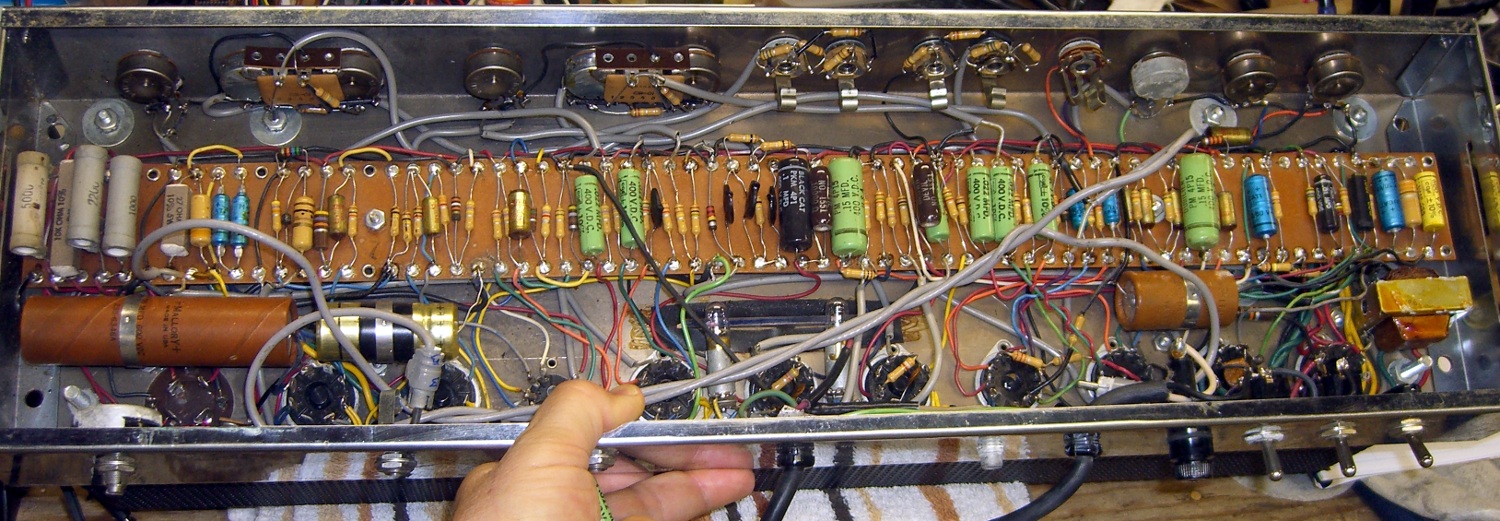
    Just for completeness, here’s the original underside:

    Ampeg B-12-XY - Underside - old caps
    Ampeg B-12-XY – Underside – old caps

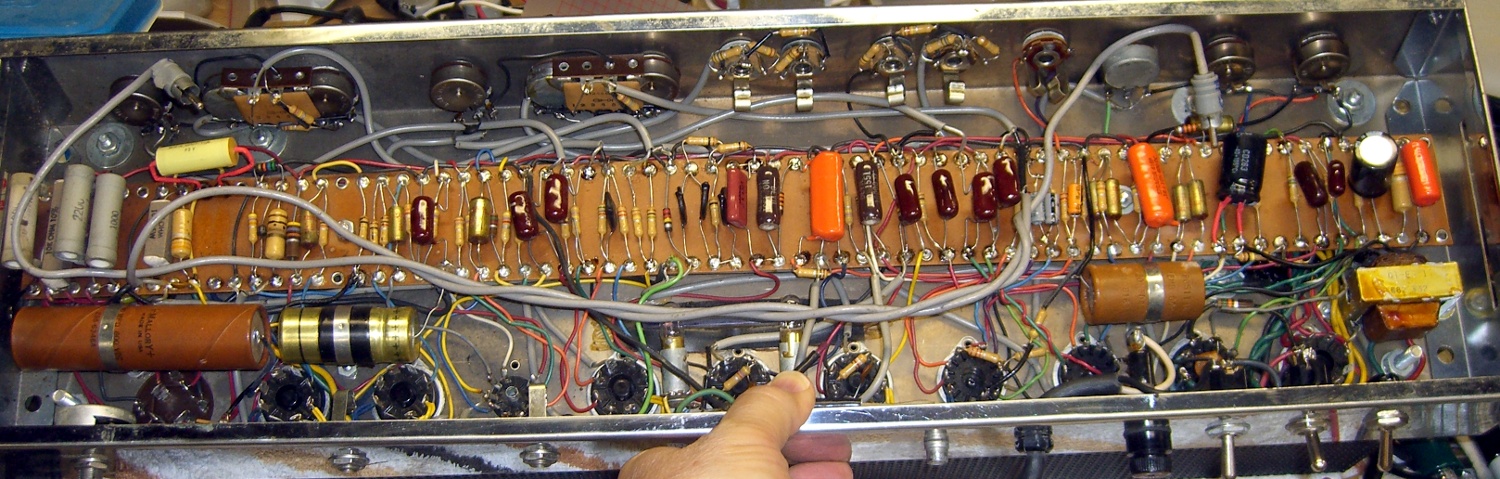
    And with the new caps, many from Eks’ stash and a few from mine:

    Ampeg B-12-XY - Underside - new caps
    Ampeg B-12-XY – Underside – new caps

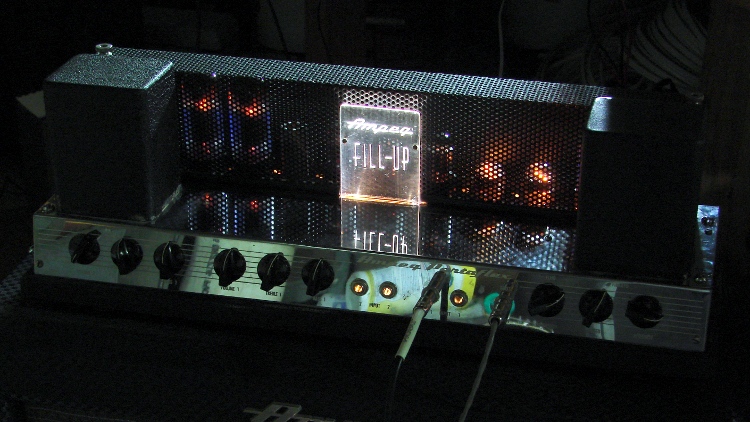
    With all those in place, the firebottles lit up properly, the power tube plates remained dark, and it sounded great. The edge-lit engraved acrylic panel in the middle is a wonderful custom mod!

    Ampeg B-12-XY Firebottles
    Ampeg B-12-XY Firebottles

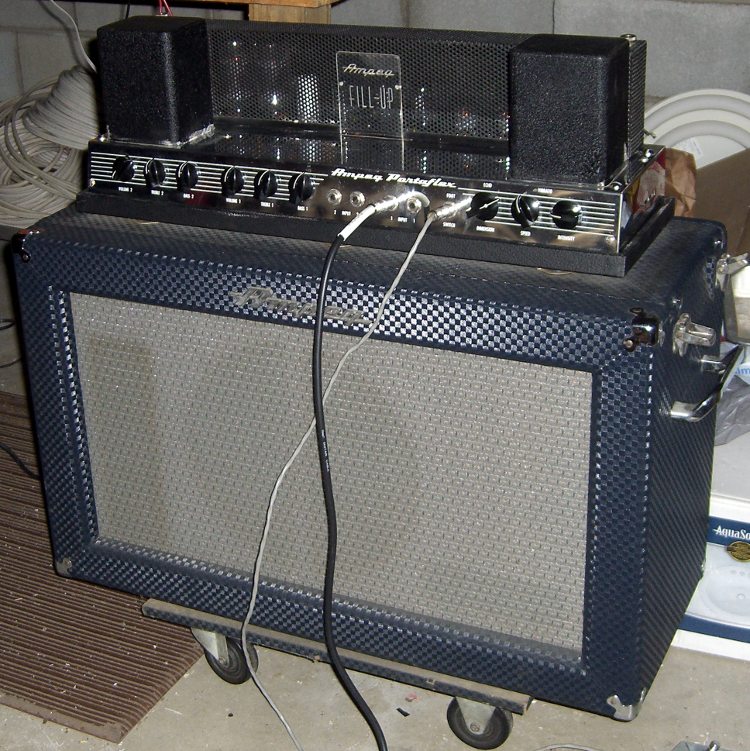
    It’s in mint condition, with the original footswitch and a remote Echo speaker box with a pair of drivers:

    Ampeg B-12-XY - ready to rock
    Ampeg B-12-XY – ready to rock

    It still has those original huge electrolytics, though. Eks says the best test comes after half an hour: if the cans remain cool, the leakage and ESR will be good enough.That’s the case, so we’re rolling with them. However, the amp has some residual hum that the Hum nulling pot can’t remove, plus a bit of noise, which means those ‘lytics probably hover at the bare minimum values required to keep it going.

    I discovered (inadvertently, of course) that swapping the two identical 6D10 triple triode tubes killed the Vibrato oscillator. That triode would oscillate for a few seconds after the footswitch grounded the cathode, but one tube didn’t have enough gain to keep it going. More likely than not, the feedback resistors have increased in value, too. Swapping the 6D10s restored it to operating condition.

    My Shop Assistant compared her tiny DSP Fender amp with this monster and concluded that DSP effects only sound good when you don’t have the original for comparison. Of course, you could lose that tiddly amp inside the Ampeg’s speaker case.

    I should’a learned to play the guitar…

  • Ampeg B-12-XY: Tin Whiskers!

    After Eks set me straight on cleaning the contacts involved with the Ampeg’s Echo circuitry, we emerged from his shop into brilliant sunshine. He looked into the thing and shouted “Tin whiskers!”

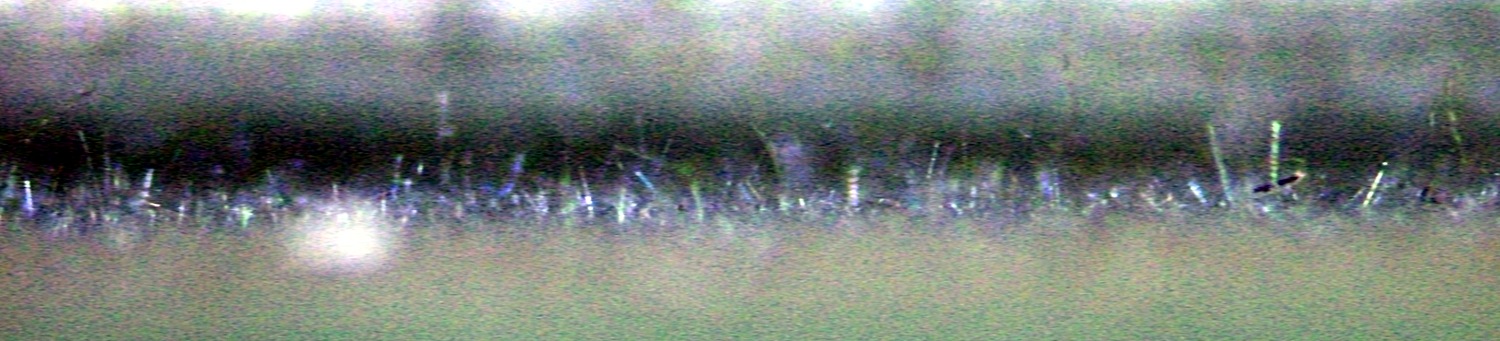
    It turns out the Hammond folks made the outer frame from tin- (or, shudder, cadmium-) plated steel that has grown a dense crop of whiskers on its interior surface. They glittered in the sunlight like a carpet of crushed glass, with the longest ones maybe 3 mm tall!

    This view looks nearly parallel to the side of the channel (upward as it mounts on the speaker box), with the steel wall to the bottom of the image. I applied gruesome contrast stretching to make the whiskers more visible:

    Ampeg Spring Echo Unit - Tin Whiskers
    Ampeg Spring Echo Unit – Tin Whiskers

    This is the first time I’d ever seen a tin whisker in person and there’s a bazillion of ’em in there!

    If that Ampeg had transistorized components, it’d be dead as a doornail! Fortunately, a tin whisker doesn’t stand a chance in an analog vacuum-tube circuit. The power supply puts 400-ish V into 40 μF caps, providing plenty of energy to vaporize the errant whisker; all you’d hear is a pop.

  • Ampeg B-12-XY: Echo Circuit

    Mad Phil asked me to fix up his trusty Ampeg B-12-XY (*) bass guitar amp, having recently fired it up and discovered that the power output tube plates glowed red-hot. I’d planned to replace the electrolytic caps, but Eks, who does this sort of thing all the time, suggested that leaky interstage coupling caps can also cause that problem; the leakage wrecks the phase splitter bias and thus kills the drivers.

    While poking around in the amp I found that the Echo hardware circuitry doesn’t match the schematic for either the B-12-X or B-12-XY. Mad Phil says that’s probably because he had the factory upgrade his original B-12-X to a B-12-XY for the munificent sum of $25, back in the day. It’s unlikely you’ll ever need this, but here’s what I found:

    Ampeg B-12-XY - as-found Echo circuit
    Ampeg B-12-XY – as-found Echo circuit

    The topology resembles the -XY schematic, but with different tube sections and part values.

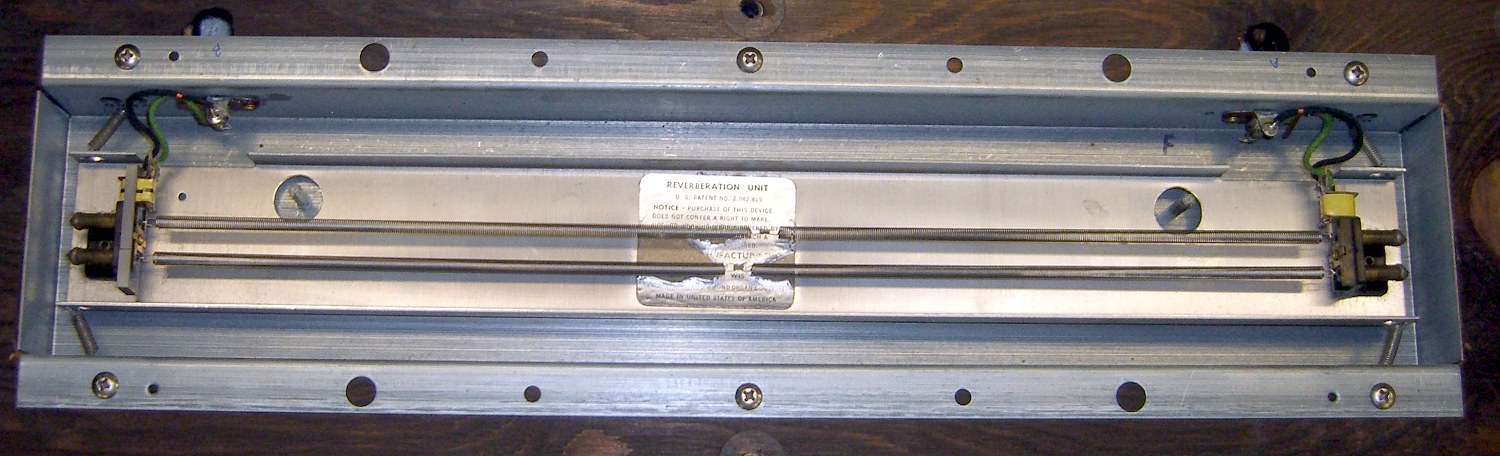
    The Echo unit over there on the left consists of two springs with magnetic transducers on each end, evidently made by the Hammond Organ folks, who should know something about reverb. This is the bottom view, with the unit attached to the board that supports the amp chassis:

    Ampeg Spring Echo Unit
    Ampeg Spring Echo Unit

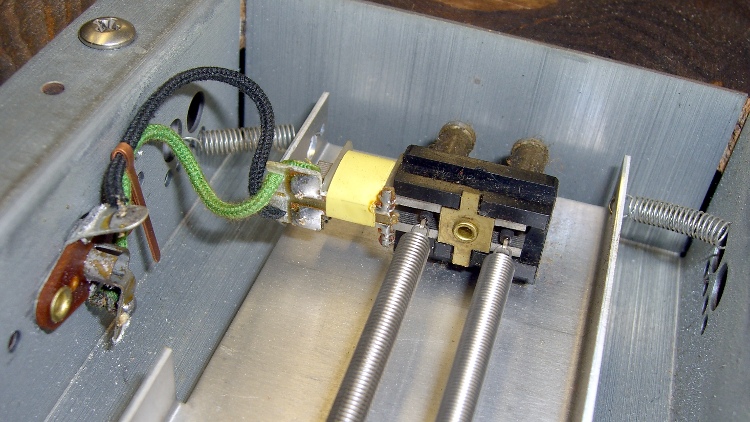
    The input transducer, just in case you forget to label the ends before you take it apart:

    Ampeg Spring Echo - input end
    Ampeg Spring Echo – input end

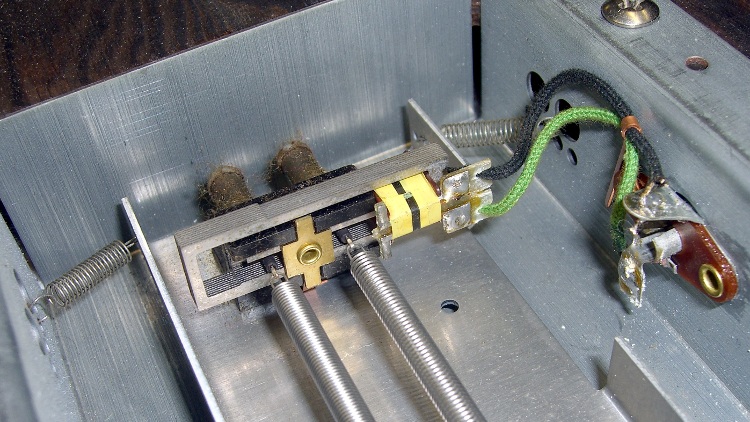
    And the output transducer:

    Ampeg Spring Echo - output end
    Ampeg Spring Echo – output end

    Getting the thing off the speaker box posed a bit of a problem. Remove the four big screws holding the chassis to the board, tilt it carefully forward, hold it in place while you remove the six nuts-and-washers from the vibration isolators, then transport the whole disjointed affair to the workbench. Turns out you (well, I) can’t get the RCA plugs out of the Echo unit’s sockets from the top of the board, but the unit’s mounting screws are on the bottom of the board, where you can’t get to them before you remove the board. Of course, the cables leading to the aforementioned RCA plugs tether the chassis to the Echo unit with pretty nearly no slack at all.

    With everything apart, I rounded the ends of the RCA plug cutouts enough to get them out from the top the next time around, with the board screwed in place atop the speaker box:

    Ampeg Spring Echo unit - top view
    Ampeg Spring Echo unit – top view

    After putting the whole thing together with new caps, the Echo circuit didn’t work. I had cleaned the contacts and connectors, but Eks showed me how it’s really done. Apart from the rotted caps, all the other problems came from minor corrosion in switches, connectors, and tube sockets. Now I know better.

    * Yes, the model numbers really end in X and XY.

  • MGE Ellipse 1200 Battery Arrangement

    The SLA batteries in the MGE Ellipse 1200 UPS finally gave out. This picture shows how they’re arranged inside the box:

    MGE Ellipse 1200 UPS - battery arrangement
    MGE Ellipse 1200 UPS – battery arrangement

    They’re 12 V 5 Ah batteries that are about 12 mm thinner than the garden variety 7 Ah batteries you can get everywhere; they’re not the same size as the generic 5 Ah batteries you might think would work. Of course, there’s not enough room inside the stylin’ case for the larger ones, either. I’m thinking of using fatter batteries anyway and putting a belly band around the gap. Maybe an external battery box with a chunky cable burrowing through a hole in the UPS case?

    For what it’s worth, APC absorbed MGE a while ago (so the MGE website redirects to APC), got Borged by Schneider, then spat out MGE’s consumer grade UPS units to Eaton. You won’t find any of that documented anywhere, but here’s the response from APC after I didn’t find this UPS on their list:

    I do apologize; when APC was acquired by Schneider Electric, the single phase UPS line that MGE once offered was sold to Eaton. Eaton now provides support for the MGE single-phase products. We do not sell batteries for these models. You will actually need to contact Eaton for further assistance regarding the MGE Ellipse units. You may click on the link below to go to Eaton’s website:

    http://powerquality.eaton.com/Default.asp

    The Eaton website does have a battery replacement for this one, but sporting the dreaded “Contact us for price” notation. Given that I got the UPS cheap-after-rebate, I’m thinking maybe this isn’t worth the effort.

  • Stepper Motor Back EMF

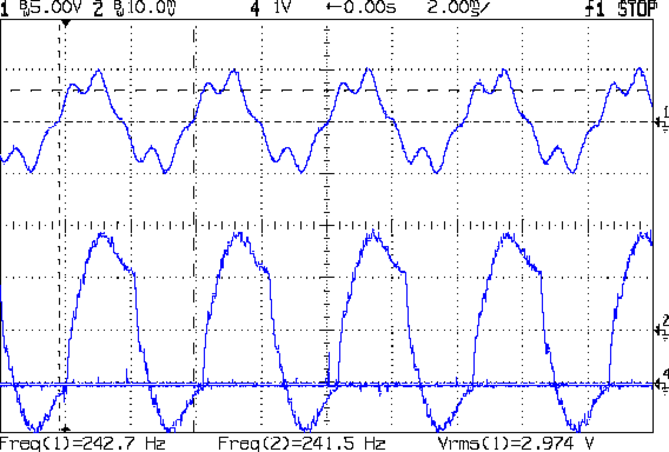
    Some simple measurements using that Pololu driver in its default mixed decay mode and that Arduino sync generator. The captions give the operating conditions; basically, I’m varying the rotation speed by cranking the signal generator driving the Pololu board.

    At 1 rev/s, it’s about as good as it gets:

    Back EMF - 9V 400mA 1 RPS
    Back EMF – 9V 400mA 1 RPS

    At 5 rev/s, the driver has trouble getting current out of the winding:

    Back EMF - 9V 400mA 5 RPS
    Back EMF – 9V 400mA 5 RPS

    At 10 rev/s, things are getting ugly:

    Back EMF - 9V 400mA 10 RPS
    Back EMF – 9V 400mA 10 RPS

    At 20 rev/s, the back EMF has pretty much taken control of the current and the driver is going along for the ride:

    Back EMF - 9V 400mA 20 RPS
    Back EMF – 9V 400mA 20 RPS

    At 25 rev/s, the driver produces only occasional dents in the waveform:

    Back EMF - 9V 400mA 25 RPS
    Back EMF – 9V 400mA 25 RPS

    At 25.3 rev/s, the motor stalled. Even with no back EMF (what with the rotor being stopped and buzzing in frustration), the driver can’t force the current to behave:

    Back EMF - 9V 400mA 25.3 RPS
    Back EMF – 9V 400mA 25.3 RPS

    I don’t have any way to measure the motor’s output torque, but at 1500 RPM there won’t be any worth mentioning.

    For what it’s worth, 25 rev/s means the driver is handling 40 k steps/sec = 25 µs/step. The motors in a Thing-O-Matic run at 3 rev/s to move the XY stages at 100 mm/s, so scale what you see here accordingly.

  • Beard Trimmer: NiCd Rejuvenation

    Strictly speaking, I do not have a beard: I simply do not shave (*). There being no money in selling Trimmers for the Non-shaving, a while back I bought a battery operated Beard Trimmer. The NiCd cells lasted for the predictable few years and recently gave up the ghost entirely: an overnight charged produced a weak buzz with no cutting action to speak of.

    The case uses one-time snap-together latches, which makes dismantling it a challenge. Start by removing all the gimcrackery on the business end, then pry out the two latches holding the it-was-white-once cutting length adjustment ring.  With that out of the way, undo the two latches inside the top and work your way down, prying the case halves apart in the way the overlap flange doesn’t like, so as to force the latches loose.

    This picture shows the six latches, three on each side. The ones just to the right of the blue impeller require the most cursing:

    Beard trimmer case and innards
    Beard trimmer case and innards

    The circuit board snaps out, with the two PCB contact areas clamped down by springy contacts leading to the motor.

    Beard trimmer - battery charger PCB
    Beard trimmer – battery charger PCB

    The two NiCd cells boast of their High Energy, but they’re only 600 mAh. That’s actually too much for this high-drain, short-run application, as they don’t completely discharge. They’re held in place on the right end with a blob of hot melt glue:

    Beard trimmer - NiCd cells
    Beard trimmer – NiCd cells

    I unsoldered the cells and gave ’em a brute-force overnight charge at C/10 = 60 mA, then ran a discharge test (clicky for more dots):

    Beard Trimmer - NiCd Discharge Test
    Beard Trimmer – NiCd Discharge Test

    Lookee that! The cells still deliver their rated capacity, even though they no longer worked with the stock charger. I repeated the slow-charge and discharge trick, which produced a perfectly overlapping trace.

    Flushed with success, I unleashed the built-in charger overnight, then produced a third overlapping trace.

    So they suffered from voltage depression, most likely due to never being completely discharged and then being overcharged far too often. That’s cured by a complete discharge and recharge, which worked perfectly.

    I hack back the overgrowth when it gets bushy and recharge the trimmer when it seems to be getting weak, which used to take a week or two. That’s a bad way to maintain a NiCd battery, particularly as the PCB applies a very low load to keep its computronium running, but I have better things to do than babysit a beard trimmer. Honest.

    Anyhow, assembly is in the reverse order and it’s perfectly happy again.

    I probably won’t change my evil ways, so the next time I’m sure the battery will be really and truly dead.

    (*)  Not shaving adds about ten minutes a day to my life, which I regard as a fair tradeoff over the course of several decades. It also added a decade to my apparent age, Back In The Day when that mattered. Now it seems to knock off a decade, which isn’t entirely a Bad Thing.