The Smell of Molten Projects in the Morning

Ed Nisley's Blog: Shop notes, electronics, firmware, machinery, 3D printing, laser cuttery, and curiosities. Contents: 100% human thinking, 0% AI slop.

Category: Electronics Workbench

Electrical & Electronic gadgets

  • Hall Effect Current Sensor: Winding and Armoring the Toroid

    Winding a slit ferrite toroid poses no challenge, so putting 25 turns of 26 AWG wire on it didn’t take long at all:

    F50-61 toroid - 25 turns 26 AWG
    F50-61 toroid – 25 turns 26 AWG

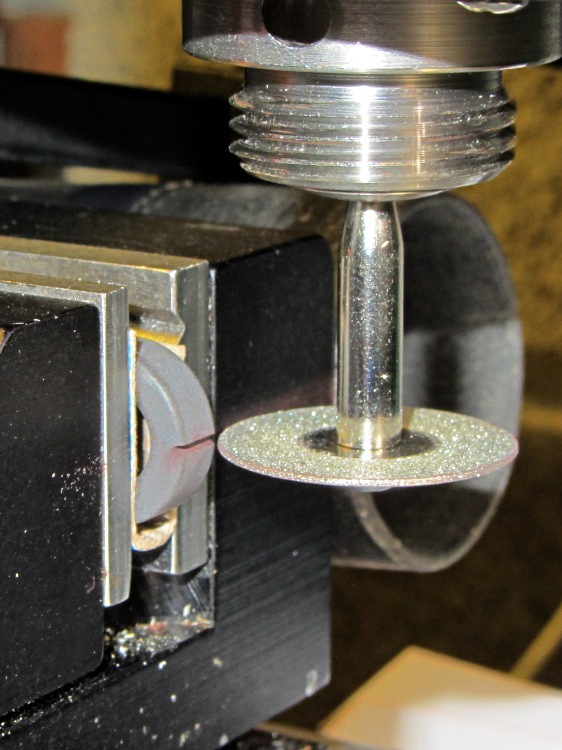
    However, a ferrite toroid doesn’t take kindly to being dropped and I figured that a slit toroid would crack under a stern look, so I decided to wrap some armor around it. A small squeeze bottle offered a cap just slightly larger than the winding, so I used that slitting saw to cut off a suitable ring.  The first step was to grab it in the 3 jaw chuck and align its axis parallel to the spindle:

    Aligning bottle cap in 3-jaw chuck
    Aligning bottle cap in 3-jaw chuck

    I wanted to cut off a slightly taller ring, but the clamping screw on the saw arbor just barely cleared the chuck for a 5 mm ring. I jogged around the chuck jaws to cut two slits in the cap that eventually joined near the back:

    Slicing ring from bottle cap
    Slicing ring from bottle cap

    That was about 1000 rpm, no coolant, and slow feed, but also a totally non-critical cut in plastic.

    I put a snippet of foam rubber in the slot, put the ring on a Kapton-covered build platform from the Thing-O-Matic, filled it with hot-melt glue, gooshed the toroid in place, and waited for cooling. Trimming and cleaning out the slit produced a hideously ugly, but (I hope) much more durable assembly:

    Slit ferrite toroid - with armor
    Slit ferrite toroid – with armor

    I’m reasonably sure I didn’t crack the ferrite while cleaning out the slit; that hot-melt glue is tenaciously gummy stuff!

    Now, to find out whether it actually works…

  • Slitting a Ferrite Toroid

    The object of the game: cut a slit into a ferrite toroid that will accommodate a Hall effect sensor. Those doodles showed that an FT50 (half-inch OD) toroid would be about right for the cheap AH49/EH49 Hall effect sensors on hand and those doodles shows that the permeability of the ferrite mix doesn’t make much difference. Not being quite sure how this would work out, I figured I’d start with the simplest possible setup and complexicate things until it worked…

    A fold of cereal box cardboard cushioned the brittle ferrite in the Sherline’s clamp and the vacuum hose in the background collects airborne grit. I touched off X=Y=Z=0 with the wheel at the center of the toroid’s equator:

    Slitting ferrite toroid - first pass
    Slitting ferrite toroid – first pass

    The first pass went swimmingly, with the diamond wheel far more concentric than I expected, using manual jogging along a 0.5 mm deep cut. The wheel is slightly over 0.5 mm thick, measured on the grit, and showed no sign of strain on a 1 mm deep cut at 100 mm/min, so I used manual CNC to run the wheel back and forth along the cut.

    After clearing the slot, I moved the wheel upward to + 0.5 mm, repeated the passes with a 1.5 mm depth of cut, then did the same at -0.5 mm. The end result was a nice slot with parallel sides:

    Slitting ferrite toroid - complete
    Slitting ferrite toroid – complete

    The actual gap measured 1.72 mm, not the 1.5 I wanted, which means the flux density will be lower than the previous calculations predict. Assuming the Z axis backlash compensation works as it should, then the kerf is 0.72 mm. Of course, that also assumes the arbor runs true and the wheel cuts symmetrically, neither of which I’d put (or, heck, have put) a lot of money behind. On the other paw, the sensors are 1.5 mm thick (just under the datasheet’s 1.6 mm spec), so +0.1 mm clearance on each side works a whole lot better for me than, say, -0.1 mm.

    All in all, there was no excitement, no muss, no fuss, no chipping, no breakage:

    FT50 ferrite toroid with slit
    FT50 ferrite toroid with slit

    Talk about beginner’s luck!

  • Hall Effect Current Sensor: More Toroid Numbers

    After rummaging in the collection, it turns out those calculations for the FT50-43 toroid aren’t relevant: I only have a few of them. It turns out that the actual material doesn’t affect the result nearly as much as you’d think, because the air gap for the Hall sensor controls the net permeability, so I’ll start sawing toroids that I have in abundance…

    The J ferrite mix has much higher permeability, at the cost of a lower Curie point. An FT50A toroid is slightly thinner and taller than an FT50, but I have good assortment of FT50A-J toroids:

    • 0.50 inch OD = 1.27 cm
    • 0.312 inch ID = 0.793 cm
    • 0.250 inch height = 0.635 cm
    • 0.152 cm2 area
    • 0.558 cm3 volume
    • 3.68 cm mean path length
    • μ = 5000
    • 4300 saturation flux (G) at 10 Oe
    • AL = 2970 nH/turn2

    For 1000 G flux in a 0.15 mm air gap:

    1000 = (0.4 π · 5000 · NI) / (3.68 + 5000 · 0.15) = 8.34 · NI

    So NI = 1000/8.34 = 120, essentially the same as NI = 122 for the FT50-43. Given that μ increased by nearly a factor of 6, that shows permeability doesn’t matter very much at all.

    There’s a bag of F50-61 toroids that I assume are actually FT50-61:

    • 0.50 inch OD = 1.27 cm
    • 0.281 inch ID = 0.714 cm
    • 0.188 inch height = 0.478 cm
    • 0.133 cm2 area
    • 3.02 cm mean path length
    • 0.401 cm3 volume
    • μ = 125
    • 2350 saturation flux (G) at 10 Oe
    • AL = 68.0 nH/turn2

    Running those numbers for the same flux and gap:

    1000 = (0.4 π · 125 · NI) / (3.02 + 125 · 0.15) = 7.21 · NI

    Which gives NI = 1000/7.21 = 139. That’s larger, but still in the same inconvenient range.

    I’ll start sawing a FT50-61 toroid…

  • Stepper Motor Driver Spec Comparison

    Being in the market for some more-or-less industrial stepper driver bricks, here’s a summary of what’s currently available on eBay from the usual vendors, copied-and-pasted directly from the descriptions with some fluff removed:

    M542 Stepper Driver Board Controller

    • Supply voltage from 20V DC to 50V DC
    • Output current from 1.0A to 4.5A
    • Self-adjustment technology, full to half current self-adjustment when motors from work to standstill via switching off SW4
    • Pure-sinusoidal current control technology
    • Pulse input frequency up to 300 KHz
    • TTL compatible and optically isolated input
    • Automatic half-current reduction as long as switching off SW4 when motors stop
    • 16 selectable resolutions in decimal and binary, up to 51,200 steps/rev
    • Suitable for 2-phase and 4-phase motors
    • Support PUL/DIR and CW/CCW modes
    • Short-voltage, over-voltage, over-current and short-circuit protection, protect the PC, motors, driver etc from being damaged

    M542H Stepper Driver Board Controller

    • Supply voltage from 20V DC to 100V DC
    • Output current from 1.0A to 4.5A
    • Self-adjustment technology, full to half current self-adjustment when motors from work to standstill via switching off SW4
    • Pure-sinusoidal current control technology
    • Pulse input frequency up to 300 KHz
    • TTL compatible and optically isolated input
    • Automatic half-current reduction as long as switching off SW4 when motors stop
    • 16 selectable resolutions in decimal and binary, up to 51,200 steps/rev
    • Suitable for 2-phase and 4-phase motors
    • Support PUL/DIR and CW/CCW modes
    • Short-voltage, over-voltage, over-current and short-circuit protection, protect the PC, motors, driver etc from being damaged

    2M542 Stepper Driver Board Controller

    • Suitable for 2-phase hybrid stepper motors (Outer diameter: 57,86mm)
    • H bridge bipolar constant phase flow subdivision driver
    • Speed self-adjustment technology
    • Easy current subdivision setting
    • 2–64 resolutions,16 operation modes
    • ENA mode
    • 8 dial switch for different functions
    • Undervoltage, Shortvoltage, overvoltage, overcurrent protections
    • Supply Voltage: 24~50V DC (Typical 36 V)
    • Output Current (peak): Min 1.0 A, max 4.2A
    • Logic Input Current: Min 7, typical 10, max 16 mA
    • Pulse Frequency: Max 200 KHz
    • Pulse Low Level of Time: 2.5 US
    • Cooling: Natural /mandatory
    • Working Surrounding: Avoid dust, oil mist and corrosive gas
    • Storage Temp: -10—80 deg
    • Working Temp: Max 65 deg
    • Surrounding Humidity: <80%RH without condensing and frost
    • Vibration: 5.9m/s²
    • Model: 2M542
    • Size: Approx. 4 5/8 x 3 x 1 5/16 inch (L x W x H)

    MA860H Stepper Driver Board Controller

    • Supply voltage from “18V AC to 80V AC” or “24V DC to 110V DC”
    • Output current from 2.6A to 7.2A
    • Self-adjustment technology, full to half current self-adjustment when motors from work to standstill via switching off SW4
    • Pure-sinusoidal current control technology
    • Pulse input frequency up to 300 KHz
    • TTL compatible and optically isolated input
    • Automatic half-current reduction as long as switching off SW4 when motors stop
    • 16 selectable resolutions in decimal and binary, up to 51,200 steps/rev
    • Suitable for 2-phase and 4-phase motors
    • Support PUL/DIR and CW/CCW modes
    • Short-voltage, over-voltage, over-current and short-circuit protection, protect the PC, motors, driver etc from being damaged
    • External Fan Design to avoid overheat

    2M420 Stepper Motor Driver controller

    • H-Bridge, 2 Phase Bi-polar Micro-stepping Drive
    • Suitable for 2-phase, 4, 6 and 8 leads step motors, with Nema size 17
    • Supply voltage from 20V DC to 40 DC
    • Output current selectable from 0.9 ~ 3.0A peak
    • Current reduction by 50% automatically, when motor standstill mode is enabled
    • Pulse Input frequency up to 200 kHz
    • Optically isolated differential TTL inputs for Pulse, Direction and Enable signal inputs
    • Selectable resolutions up to 25000 steps
    • Over Voltage, Coil to Coil and Coil to Ground short circuit protection.

    2M982 CNC Stepper Motor Driver

    • Supply voltage: 24~80V DC
    • Suitable for 2-phase stepper motors
    • Output current: Min 1.3A Max 7.8A
    • Speed self-adjustment technology
    • Pure-sinusoidal current control technology
    • Pulse input frequency: Max 200 KHz
    • Optically isolated input and TTL compatible
    • Automatic idle-current reduction
    • 15 selectable resolutions, MAX 12,800 steps/rev
    • PLS, DIR (CW/CCW), ENA mode
    • Undervoltage, Shortvoltage, overvoltage, overcurrent protections

    Leadshine DM1182

    • 2 Phase Digital Stepper Drive
    • Direct 115VAC input
    • Current 0.5 – 8.2A
    • Max 200 kHz

    In round numbers, the M542 seems to be the basic driver for NEMA 17 / 23 /34 steppers. Remember that current isn’t proportional to frame size.

    The M542H has a higher voltage limit that may be more useful with larger / multiple-stack motors; higher voltage = higher di/dt for a given inductance = same di/dt for higher inductance.

    The 2M542 seems to be slightly different from both of its siblings: higher minimum voltage, slightly lower maximum current, slower step frequency. Many of the listings apply both M542 and 2M542 to the same hardware in the same listing, so it’s not clear what you’d get in the box. Ask first, trust-but-verify?

    The MA860H seems appropriate for NEMA 34 / 42 and up , due to the much higher minimum current.

    The 2M420 seems to be intended for NEMA 17 /23 class steppers. It’s not available from nearly as many suppliers.

    The 2M982 looks like another NEMA 34 /42 and up driver.

    The DM1182 seems strictly from industrial, but if you don’t know what you need, it’s a do-it-all killer.

    As with all eBay listings, the picture need not match the description and neither may match what actually arrives in the box from halfway around the planet.

  • Logic Probe Tip Covers

    Our Larval Engineer received a logic probe / pulser set for Christmas:

    RSR Logic Probe Pulser Set - with formed covers
    RSR Logic Probe Pulser Set – with formed covers

    They’re the low-cost RSR-611 and -620 from the usual eBay vendor, not my ancient HP10525/10526 set, but they should suffice. Perhaps nobody uses logic probes these days, what with most of the parts being too small for even a needle tip, but …

    Anyhow, they didn’t have caps over the sharp probe tips, so I rummaged around until I found the stash of cigar tubes (some of which went into that air flow straightener) that were about the right size. I thought about 3D printing an adapter between tubes and probes:

    RSR Probe Cap Adapter - solid model
    RSR Probe Cap Adapter – solid model

    It’s actually a subtractive kind of thing, with a model of the probe tip subtracted from a suitable cylindrical object:

    RSR Logic Probe - solid model
    RSR Logic Probe – solid model

    But then I realized the tubes were thermoplastic, held each one over a stove burner until the open end went transparent and droopy, rammed it down over the probe tip, and trimmed off the ragged edge. Worked fine, fits securely, and even looks pretty good:

    RSR Covers - detail
    RSR Covers – detail

    I’ll never print the adapters, but maybe one of us will tweak the model to do something else…

    The OpenSCAD source code:

    // RSR Logic Probe / Pulser Cap
    // Ed Nisley KE4ZNU December 2012
    
    // Adapts cigar tube to probe body
    
    // Layout options
    
    Layout = "Build";
                        // Overall layout: Show Build
    			// Parts: Probe
    
    //- Extrusion parameters must match reality!
    //  Print with +1 shells and 3 solid layers
    
    ThreadThick = 0.25;
    ThreadWidth = 2.0 * ThreadThick;
    
    HoleWindage = 0.2;
    
    function IntegerMultiple(Size,Unit) = Unit * ceil(Size / Unit);
    
    Protrusion = 0.1;           // make holes end cleanly
    
    //----------------------
    // Dimensions
    
    ProbeDia = 18.0;				// dia of main body
    ProbeTipDia = 6.8;				// dia at end of plastic cone
    ProbeTipLen = 30.0;				// length of metal ferrule + tip
    ProbeConeLen = 17.5;			// cone taper length
    
    TubeOD = 17.25;
    TubeWall = 0.50;
    TubeID = TubeOD - 2*TubeWall;
    
    TubeLen = 15;					// slip fit over tube body
    
    BodyLen = 20;					// slip fit over probe body
    
    WallThick = 3.5*ThreadWidth;		// basic adapter wall thickness
    
    AdapterLen = TubeLen + BodyLen;
    AdapterOD = ProbeDia + 2*WallThick;
    AdapterSides = 4*4;
    
    //----------------------
    // Useful routines
    
    module PolyCyl(Dia,Height,ForceSides=0) {           // based on nophead's polyholes
    
    Sides = (ForceSides != 0) ? ForceSides : (ceil(Dia) + 2);
    
    FixDia = Dia / cos(180/Sides);
    
    cylinder(r=(FixDia + HoleWindage)/2,
             h=Height,
             $fn=Sides);
    }
    
    module ShowPegGrid(Space = 10.0,Size = 1.0) {
    
        Range = floor(50 / Space);
    
        for (x=[-Range:Range])
            for (y=[-Range:Range])
                translate([x*Space,y*Space,Size/2])
                %cube(Size,center=true);
    
    }
    
    module Probe() {
    	union() {
    		cylinder(r=((ProbeDia + HoleWindage)/2),
    				 h=(BodyLen + 1.2*Protrusion),$fn=2*AdapterSides);
    		translate([0,0,(BodyLen + Protrusion)])
    			cylinder(r1=(ProbeDia + HoleWindage)/2,
    					 r2=ProbeTipDia/2,
    					 h=ProbeConeLen,$fn=2*AdapterSides);
    		cylinder(r=ProbeTipDia/2,h=(BodyLen + ProbeConeLen + ProbeTipLen),$fn=2*AdapterSides);
    	}
    }
    
    module ProbeSleeve() {
    
    	difference() {
    		cylinder(r=AdapterOD/2,h=AdapterLen);
    		translate([0,0,-Protrusion])
    			Probe();
    		PolyCyl((TubeOD + HoleWindage),(AdapterLen + Protrusion),2*AdapterSides);
    	}
    }
    
    //----------------------
    // Build it!
    
    ShowPegGrid();
    
    if (Layout == "Show")
        ProbeSleeve();
    
    if (Layout == "Build")
        translate([0,0,AdapterLen])
    		rotate([180,0,0])
    			ProbeSleeve();
    
    if (Layout == "Probe")
    	Probe();
    
  • Cheap LED Flashlight Switch Disassembly

    The pushbutton switch on the end cap of a cheap LED flashlight became intermittent, for reasons that should be obvious:

    LED Flashlight switch - intact
    LED Flashlight switch – intact

    Pulling the spring contact out revealed the usual situation inside:

    LED Flashlight switch - spring removed
    LED Flashlight switch – spring removed

    I thought that the discolorations around the central plug indicated a solder joint between the two, but the scratches showed that the plug was actually a press-fit plastic cylinder. Having nothing to lose, I pried the rubber dome off the outside of the switch, balanced the cap’s outer rim on the bench vise, centered an aluminum cylinder over the switch post, and gave it a hammer shot:

    LED Flashlight switch - guts
    LED Flashlight switch – guts

    It appears the Basement Warehouse Wing inventory lacks a push-on switch that fits the cap, so this one goes on the pile of potentially useful parts. If a suitable switch appears, I know what to do with it, but if I should need a nice aluminum cylinder that fits a trio of AA cells before then, well …

  • Tektronix 2215A Oscilloscope Power Switch Rebuild

    My trusty Tek 2215A oscilloscope might be useful for a Larval Engineer engaged in late-night debugging away from the lab, but the power switch has become flaky: sometimes the ‘scope didn’t turn on at all, sometimes the switch required multiple pokes, sometimes everything worked fine. Removing the cover revealed there’s a long plastic bar connecting the power button on the front panel (to the right in the picture) to the power switch near the rear panel AC line socket, tucked under the EMI filter with the red sticker:

    Tek2215A - internal top view
    Tek2215A – internal top view

    Removing the high voltage shield below the PCB reveals the switch has DPDT terminals, but it’s wired as DPST:

    Tek2215A power switch - PCB terminals
    Tek2215A power switch – PCB terminals

    This knowledge will come in handy later…

    Unsoldering the switch and wriggling the bar out of the front panel puts the switch on the bench, solder terminals upward. A plastic shell snapped around the actual switch insulates the top of the six terminals from prying fingers:

    Tek2215A power switch - bottom
    Tek2215A power switch – bottom

    Remove the shell, remove the toggle-action U-shaped steel pin, release the spring, and pull off the top plate:

    Tek2215A power switch - internal
    Tek2215A power switch – internal

    Remove the plunger hardware, remove the rocker arms and their springs:

    Tek2215A power switch - disassembled
    Tek2215A power switch – disassembled

    One contact on each rocker shows signs of distress, but the other button remains pristine (having never seen any voltage differential):

    Tek2215A power switch - rockers
    Tek2215A power switch – rockers

    Pull out the fixed contact tabs and note that they’ve been scorched a bit. The one on the right corresponds to the bottom rocker above:

    Tek2215A power switch - contact tabs
    Tek2215A power switch – contact tabs

    I cleaned everything with a fiber wipe wetted in DeoxIT, then decided that I’d take the easy way out. The tabs have heavy silver plate on both sides, so I flipped them over and reinstalled them with the unused side facing the rockers. The rockers went back in with their unused contact buttons facing the flipped tabs, so we now have fresh, shiny new contact surfaces. Reassemble the switch, soldered it in place, button up the case, and a firm push on the button lights the ‘scope exactly the way it should.

    While I had the cover off, I measured the ESR of all those electrolytic capacitors: they’re in fine shape!

    The next time the switch needs repair, in another couple of decades, someone can swap in the completely unused tabs from the other end of the switch, then pick whichever contact buttons look best… [grin]