The Smell of Molten Projects in the Morning

Ed Nisley's Blog: Shop notes, electronics, firmware, machinery, 3D printing, laser cuttery, and curiosities. Contents: 100% human thinking, 0% AI slop.

Category: Electronics Workbench

Electrical & Electronic gadgets

  • Victoreen 710-104 Ionization Chamber: Shield Support

    Although I’d thought of a Mu-metal shield, copper foil tape should be easier and safer to shape into a simple shield. The general idea is to line the interior with copper tape, solder the joints together, cover with Kapton tape to reduce the likelihood of shorts, then stick it in place with some connector pin-and-socket combinations. Putting the tape on the outside would be much easier, but that would surround the circuitry with a layer of plastic that probably carries enough charge to throw things off.

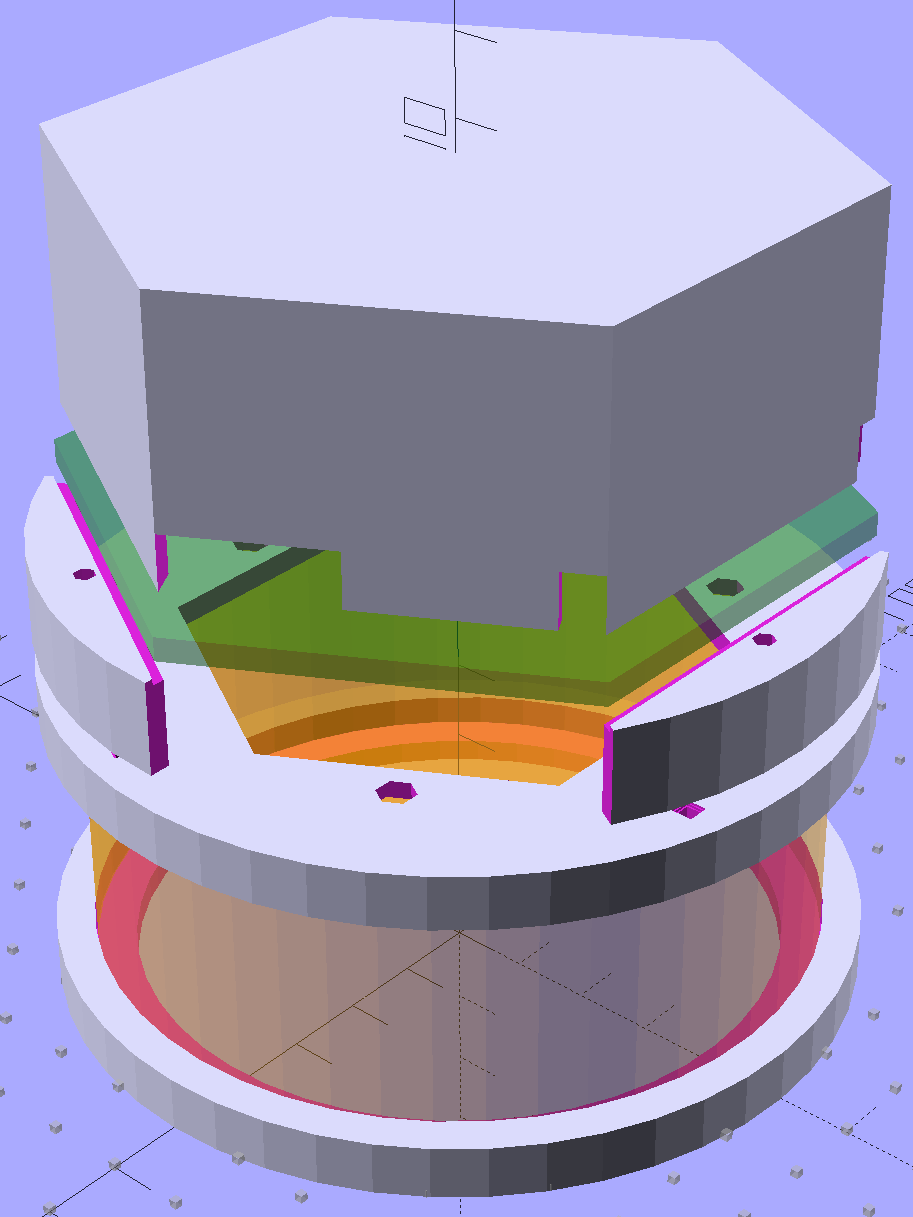
    Anyhow, the hexagonal circuit board model now sports a hexagonal cap to support the shield:

    Victoreen 710-104 Ionization Chamber Fittings - Show with shield
    Victoreen 710-104 Ionization Chamber Fittings – Show with shield

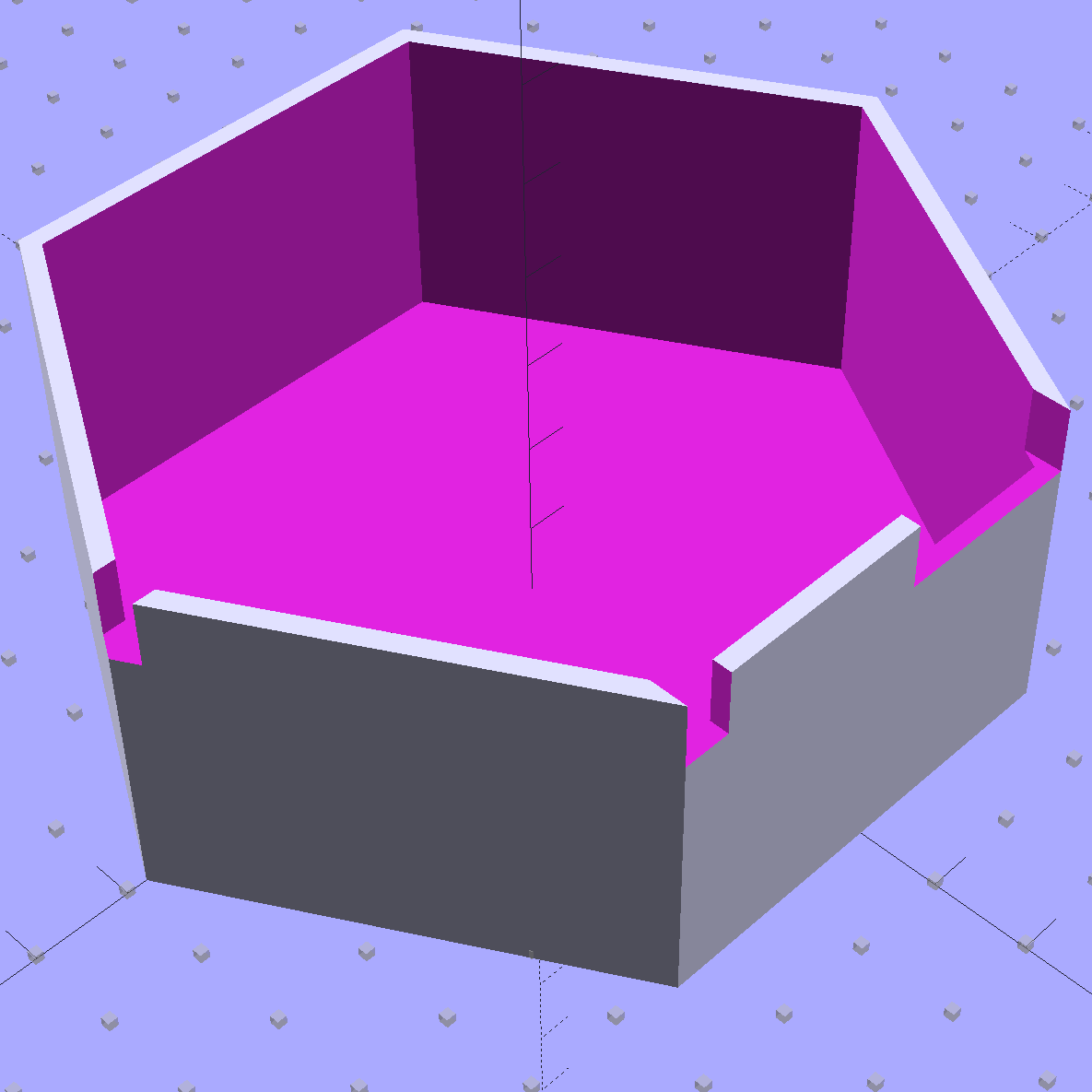
    The ad-hoc openings fit various switches, wires, & twiddlepots:

    Victoreen 710-104 Ionization Chamber Fittings - Shield
    Victoreen 710-104 Ionization Chamber Fittings – Shield

    Ya gotta start somewhere.

    The OpenSCAD source code:

    // Victoreen 710-104 Ionization Chamber Fittings
    // Ed Nisley KE4ZNU July 2015
    
    Layout = "Show";
    					// Show - assembled parts
    					// Build - print can parts + shield
    					// BuildShield - print just the shield
    					// CanCap - PCB insulator for 6-32 mounting studs
    					// CanBase - surrounding foot for ionization chamber
    					// CanLid - generic surround for either end of chamber
    					// PCB - template for cutting PCB sheet
    					// PCBBase - holder for PCB atop CanCap
    					// Shield - electrostatic shield shell
    
    //- Extrusion parameters must match reality!
    //  Print with 2 shells and 3 solid layers
    
    ThreadThick = 0.25;
    ThreadWidth = 0.40;
    
    HoleWindage = 0.2;
    
    Protrusion = 0.1;			// make holes end cleanly
    
    AlignPinOD = 1.75;			// assembly alignment pins = filament dia
    
    inch = 25.4;
    
    function IntegerMultiple(Size,Unit) = Unit * ceil(Size / Unit);
    
    //- Screw sizes
    
    Tap4_40 = 0.089 * inch;
    Clear4_40 = 0.110 * inch;
    Head4_40 = 0.211 * inch;
    Head4_40Thick = 0.065 * inch;
    Nut4_40Dia = 0.228 * inch;
    Nut4_40Thick = 0.086 * inch;
    Washer4_40OD = 0.270 * inch;
    Washer4_40ID = 0.123 * inch;
    
    //----------------------
    // Dimensions
    
    OD = 0;											// name the subscripts
    LENGTH = 1;
    
    Chamber = [91.0 + HoleWindage,38];				// Victoreen ionization chamber dimensions
    
    Stud = [										// stud welded to ionization chamber lid
    	[6.5,IntegerMultiple(0.8,ThreadThick)],		// flat head -- generous clearance
    	[4.0,9.5],									// 6-32 screw -- ditto
    ];
    NumStuds = 3;
    StudSides = 6;									// for hole around stud
    
    BCD = 2.75 * inch;								// mounting stud bolt circle diameter
    
    PlateThick = 3.0;								// layer atop and below chamber ends
    RimHeight = 4.0;								// extending up along chamber perimeter
    WallHeight = RimHeight + PlateThick;
    WallThick = 5.0;								// thick enough to be sturdy & printable
    CapSides = 8*6;									// must be multiple of 4 & 3 to make symmetries work out right
    
    PCBFlatsOD = 85.0;								// hex dia across flats + clearance
    PCBClearance = ThreadWidth;						// clearance on each flat
    PCBThick = 1.1;
    PCBActual = [PCBFlatsOD/cos(30),PCBThick];
    PCBCutter = [(PCBFlatsOD + 2*PCBClearance)/cos(30),PCBThick - ThreadThick];		// OD = tip-to-tip dia with clearance
    
    echo(str("Actual PCB across flats: ",PCBFlatsOD));
    echo(str(" ... tip-to-tip dia: ",PCBActual[OD]));
    echo(str(" ... thickness: ",PCBActual[LENGTH]));
    
    HolderHeight = 11.0 + PCBCutter[LENGTH];		// thick enough for PCB to clear studs
    HolderShelf = 2.0;								// shelf under PCB edge
    PinAngle = 15;									// alignment pin angle on either side of holder screw
    
    echo(str("PCB holder across flats: ",PCBCutter[OD]*cos(30)));
    echo(str(" ... height: ",HolderHeight));
    
    ShieldInset = 1.0;								// shield inset from actual PCB flat
    ShieldWall = 2.0;								// wall thickness
    Shield = [(PCBFlatsOD - 2*ShieldInset)/ cos(30),35.0];		// electrostatic shield shell shape
    
    //----------------------
    // Useful routines
    
    module PolyCyl(Dia,Height,ForceSides=0) {			// based on nophead's polyholes
    
      Sides = (ForceSides != 0) ? ForceSides : (ceil(Dia) + 2);
    
      FixDia = Dia / cos(180/Sides);
    
      cylinder(r=(FixDia + HoleWindage)/2,
               h=Height,
    	   $fn=Sides);
    }
    
    //- Locating pin hole with glue recess
    //  Default length is two pin diameters on each side of the split
    
    module LocatingPin(Dia=AlignPinOD,Len=0.0) {
    
    	PinLen = (Len != 0.0) ? Len : (4*Dia);
    
    	translate([0,0,-ThreadThick])
    		PolyCyl((Dia + 2*ThreadWidth),2*ThreadThick,4);
    
    	translate([0,0,-2*ThreadThick])
    		PolyCyl((Dia + 1*ThreadWidth),4*ThreadThick,4);
    
    	translate([0,0,-Len/2])
    		PolyCyl(Dia,Len,4);
    
    }
    
    module ShowPegGrid(Space = 10.0,Size = 1.0) {
    
      RangeX = floor(100 / Space);
      RangeY = floor(125 / Space);
    
    	for (x=[-RangeX:RangeX])
    	  for (y=[-RangeY:RangeY])
    		translate([x*Space,y*Space,Size/2])
    		  %cube(Size,center=true);
    }
    
    //-----
    
    module CanLid() {
    
    	difference() {
    		cylinder(d=Chamber[OD] + 2*WallThick,h=WallHeight,$fn=CapSides);
    		translate([0,0,PlateThick])
    			PolyCyl(Chamber[OD],Chamber[1],CapSides);
    	}
    
    }
    
    module CanCap() {
    
    	difference() {
    		CanLid();
    
    		translate([0,0,-Protrusion])											// central cutout
    			rotate(180/6)
    				cylinder(d=BCD,h=Chamber[LENGTH],$fn=6);						//  ... reasonable size
    
    		for (i=[0:(NumStuds - 1)])												// stud clearance holes
    			rotate(i*360/NumStuds)
    				translate([BCD/2,0,0])
    					rotate(180/StudSides) {
    						translate([0,0,(PlateThick - (Stud[0][LENGTH] + 2*ThreadThick))])
    							PolyCyl(Stud[0][OD],2*Stud[0][LENGTH],StudSides);
    						translate([0,0,-Protrusion])
    							PolyCyl(Stud[1][OD],2*Stud[1][LENGTH],StudSides);
    					}
    
    		for (i=[0:(NumStuds - 1)], j=[-1,1])									// PCB holder alignment pins
    			rotate(i*360/NumStuds + j*PinAngle + 60)
    				translate([Chamber[OD]/2,0,0])
    					rotate(180/4 - j*PinAngle)
    						LocatingPin(Len=2*PlateThick - 2*ThreadThick);
    	}
    
    }
    
    module CanBase() {
    
    	difference() {
    		CanLid();
    		translate([0,0,-Protrusion])
    			PolyCyl(Chamber[OD] - 2*5.0,Chamber[1],CapSides);
    	}
    }
    
    module PCBTemplate() {
    
    	difference() {
    		cylinder(d=PCBActual[OD],h=max(PCBActual[LENGTH],3.0),$fn=6);		// actual PCB size, overly thick
    		translate([0,0,-Protrusion])
    			cylinder(d=10,h=10*PCBActual[LENGTH],$fn=12);
    	}
    }
    
    module PCBBase() {
    
    	difference() {
    		cylinder(d=Chamber[OD] + 2*WallThick,h=HolderHeight,$fn=CapSides);		// outer rim
    
    		rotate(30) {
    			translate([0,0,-Protrusion])										// central hex
    				cylinder(d=(PCBActual[OD] - HolderShelf/cos(30)),h=2*HolderHeight,$fn=6);
    
    			translate([0,0,HolderHeight - PCBCutter[LENGTH]])					// hex PCB recess
    				cylinder(d=PCBCutter[OD],h=HolderHeight,$fn=6);
    
    			for (i=[0:NumStuds - 1])											// PCB retaining screws
    				rotate(i*120 + 30)
    					translate([(PCBCutter[OD]*cos(30)/2 + Clear4_40/2 + ThreadWidth),0,-Protrusion])
    						rotate(180/6)
    							PolyCyl(Tap4_40,2*HolderHeight,6);
    
    			for (i=[0:(NumStuds - 1)], j=[-1,1])								// PCB holder alignment pins
    				rotate(i*360/NumStuds + j*PinAngle + 30)
    					translate([Chamber[OD]/2,0,0])
    						rotate(180/4 - j*PinAngle)
    							LocatingPin(Len=PlateThick);
    		}
    
    		for (i=[0:NumStuds - 1])												// segment isolation
    			rotate(i*120 - 30)
    				translate([0,0,-Protrusion]) {
    					linear_extrude(height=2*HolderHeight)
    						polygon([[0,0],[Chamber[OD],0],[Chamber[OD]*cos(60),Chamber[OD]*sin(60)]]);
    				}
    	}
    }
    
    //-- Electrostatic shield
    //		the cutouts are completely ad-hoc
    
    module ShieldShell() {
    
    CutHeight = 7.0;
    
    	difference() {
    		cylinder(d=Shield[OD],h=Shield[LENGTH],$fn=6);
    		translate([0,0,-ShieldWall])
    			cylinder(d=(Shield[OD] - 2*ShieldWall/cos(30)),h=Shield[LENGTH],$fn=6);
    
    		translate([Shield[OD]/4 - 20/2,Shield[OD]/2,(CutHeight - Protrusion)/2])
    			rotate(90)
    				cube([Shield[OD],20,CutHeight + Protrusion],center=true);
    
    		translate([-Shield[OD]/4 + 5/2,Shield[OD]/2,(CutHeight - Protrusion)/2])
    			rotate(90)
    				cube([Shield[OD],5,CutHeight + Protrusion],center=true);
    
    		translate([-Shield[OD]/2,0,(CutHeight - Protrusion)/2])
    				cube([Shield[OD],5,CutHeight + Protrusion],center=true);
    
    	}
    
    }
    
    //----------------------
    // Build it
    
    ShowPegGrid();
    
    if (Layout == "CanLid") {
    	CanLid();
    }
    
    if (Layout == "CanCap") {
    	CanCap();
    }
    
    if (Layout == "CanBase") {
    	CanBase();
    }
    
    if (Layout == "PCBBase") {
    	PCBBase();
    }
    
    if (Layout == "PCB") {
    	PCBTemplate();
    }
    
    if (Layout == "Shield") {
    	ShieldShell();
    }
    
    if (Layout == "Show") {
    	CanBase();
    	color("Orange",0.5)
    		translate([0,0,PlateThick + Protrusion])
    			cylinder(d=Chamber[OD],h=Chamber[LENGTH],$fn=CapSides);
    	translate([0,0,(2*PlateThick + Chamber[LENGTH] + 2*Protrusion)])
    		rotate([180,0,0])
    			CanCap();
    	translate([0,0,(2*PlateThick + Chamber[LENGTH] + 5.0)])
    		PCBBase();
    	color("Green",0.5)
    		translate([0,0,(2*PlateThick + Chamber[LENGTH] + 7.0 + HolderHeight)])
    			rotate(30)
    				PCBTemplate();
    	translate([0,0,(2*PlateThick + Chamber[LENGTH] + 15.0 + HolderHeight)])
    		rotate(30)
    			ShieldShell();}
    
    if (Layout == "Build") {
    
    	translate([-0.50*Chamber[OD],-0.60*Chamber[OD],0])
    		CanCap();
    
    	translate([0.55*Chamber[OD],-0.60*Chamber[OD],0])
    		rotate(30)
    			translate([0,0,Shield[LENGTH]])
    				rotate([0,180,0])
    					ShieldShell();
    
    	translate([-0.25*Chamber[OD],0.60*Chamber[OD],0])
    		CanBase();
    	translate([0.25*Chamber[OD],0.60*Chamber[OD],0])
    		PCBBase();
    }
    
    if (Layout == "BuildShield") {
    
    	translate([0,0,Shield[LENGTH]])
    		rotate([0,180,0])
    				ShieldShell();
    
    }
    
  • HP 7475A Plotter: LED Lighting

    If white LED strips had existed in the early 1980s, the engineers responsible for the HP 7475A plotter would surely have done this:

    HP 7475A Plotter - LED paper illumination
    HP 7475A Plotter – LED paper illumination

    Not, that’s not stretched vertically: I bought a ream of B-size paper (11×17 inches) just for plotter demos.

    Although the power supply does have a +12 V output, it comes from a TO220 transistor without a heatsink. The +5 V supply uses a robust TO3 transistor on a huge quad heatsink that can surely dissipate another watt or two without getting any sweatier.

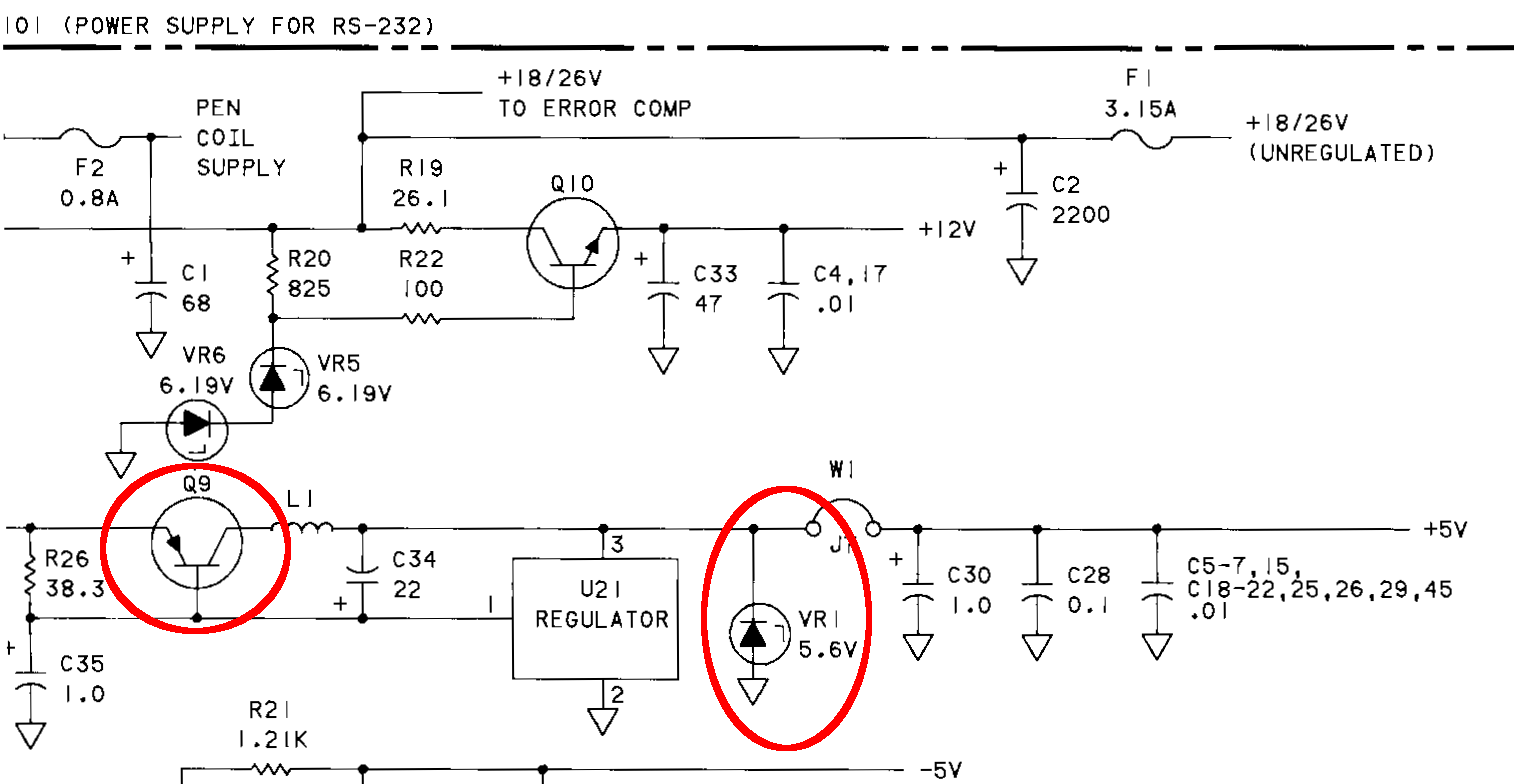
    I powered the LEDs from a dirt-cheap boost converter that provides a convenient brightness adjustment; it’s set to 10.5 V and that’s plenty bright enough. The converter attaches to pair of wires soldered across VR1, which is probably a crowbar that blows F3 (not shown) in the event the regulator fails hot:

    HP 7475A - LED power tap - schematic
    HP 7475A – LED power tap – schematic

    They don’t make power supplies like that any more.

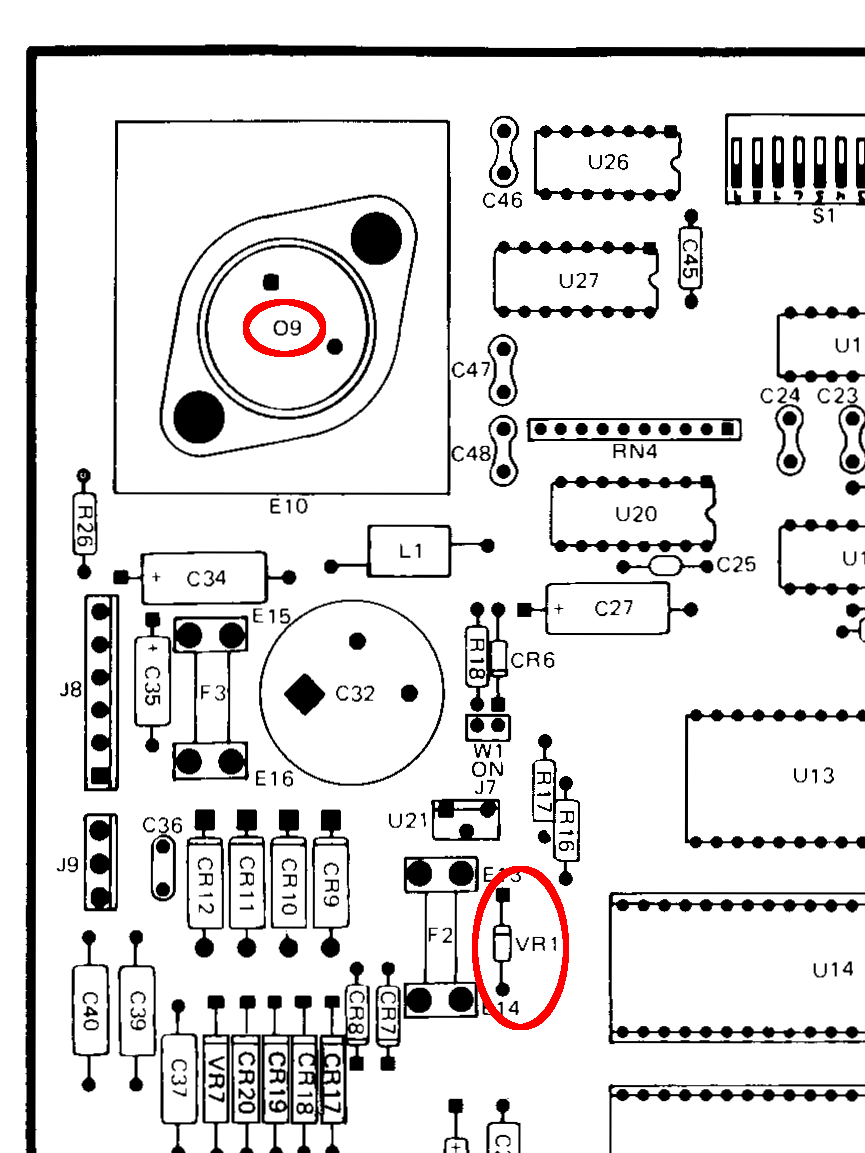
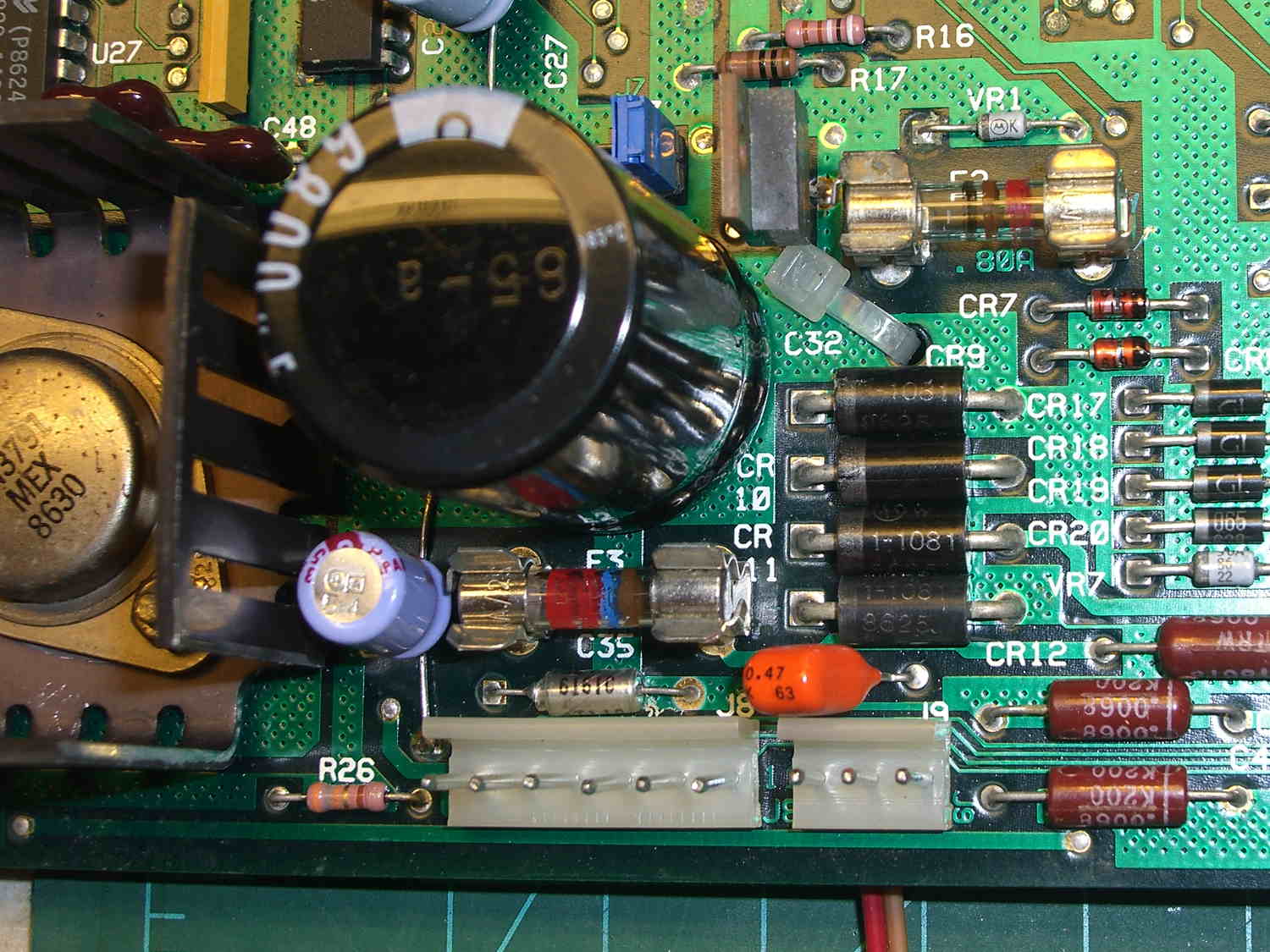
    The part locations (“O9” looks like a typo):

    HP 7475A - LED power tap
    HP 7475A – LED power tap

    The PCB has holes in exactly the right spot for a zip tie anchoring the wires exiting to the bottom:

    HP 7475A Plotter - LED power tap - PCB top
    HP 7475A Plotter – LED power tap – PCB top

    This vertiginous view shows the inside of the case atop the chassis, with the boost converter affixed to the galvanized steel pan with foam tape and the LED wires stuck down with Gorilla Tape:

    HP 7475A Plotter - LED strip and boost converter
    HP 7475A Plotter – LED strip and boost converter

    Red silicone tape around a PCB-mount coax jack rounds out a true hack job.

    Although I didn’t bring the plotter to the CNC Workshop, that venue’s dim light reminded me that you can never have enough light when you’re showing off your toys: the LED panels on the M2 and the LED light bars on the Model 158 sewing machine were the brightest spots to be seen.

  • Electrometer Amp: Darlington NPN

    I soldered up the simplest possible “electrometer amplifier” at Squidwrench, based on Charles Wenzel’s writeup:

    Electrometer Amp - MPSA14 NPN Darlington
    Electrometer Amp – MPSA14 NPN Darlington

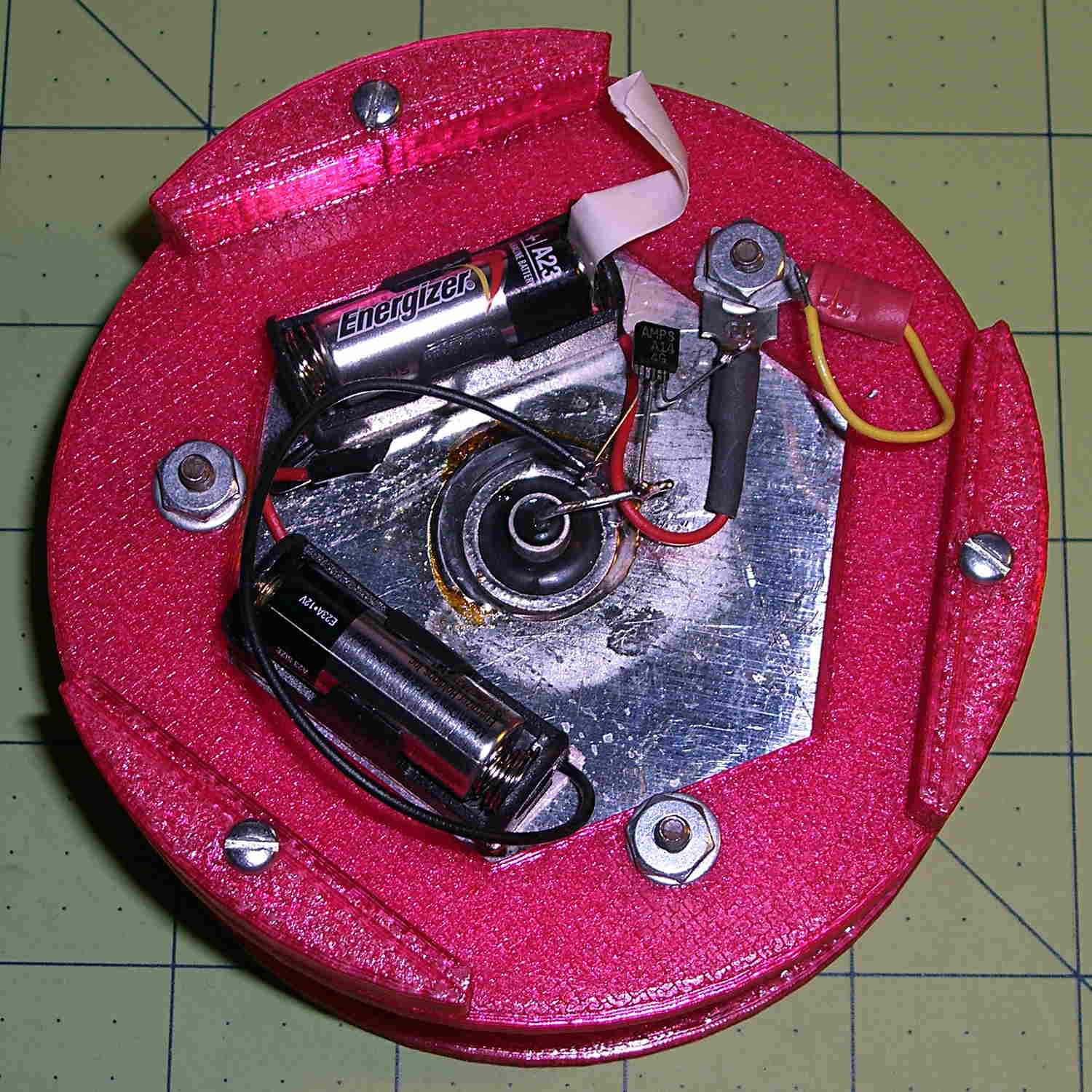
    It’s an MPSA14 NPN Darlington transistor, with the base soldered directly to the Victoreen 710-104 ionization chamber collector pin. The flying leads connect to an ordinary digital voltmeter set to read voltage, rather than current, so that you see the voltage created by the transistor’s collector current through the meter’s input resistance.

    The MPSA14 data sheet specifies DC current gain hFE > 10 k for low collector currents, with a graph suggesting it might be somewhat larger. Alas, all those are for “ordinary” currents, not the countably finite number of electrons coming from an ionization chamber, but let’s assume 10 k is close.

    I used a Radio Shack 22-805 DMM, set to auto-ranging DC volts. The specs say the input “impedance” is 10 MΩ for all voltage ranges, so let’s run with that, too.

    With 24 V (actually 24.6 V) applied to both the chamber (through the red wire) and the DMM (through the yellow wire), it read 250 mV: a mere 25 nA through the 10 MΩ meter resistance.

    Assuming a transistor gain of 10 k, that’s a chamber current of 2.5 pA.

    The ionization chamber specs say it produces 5 pA at 0.5 röentgen/hour → 100 mR/h produces 1 pA.

    No, I do not believe the Squidwrench Operating Table is bathed in gamma radiation at 250 mR/h.

    I should wipe down the transistor to see if that reduces the external leakage, then try a few others, but obviously the signal will remain lost in the noise.

    We replaced the DMM with an oscilloscope and 10 MΩ probe, which conclusively demonstrated that unshielded high-impedance circuits make excellent 60 Hz receivers.

  • Victoreen 710-104 Ionization Chamber: Hex Circuit Board

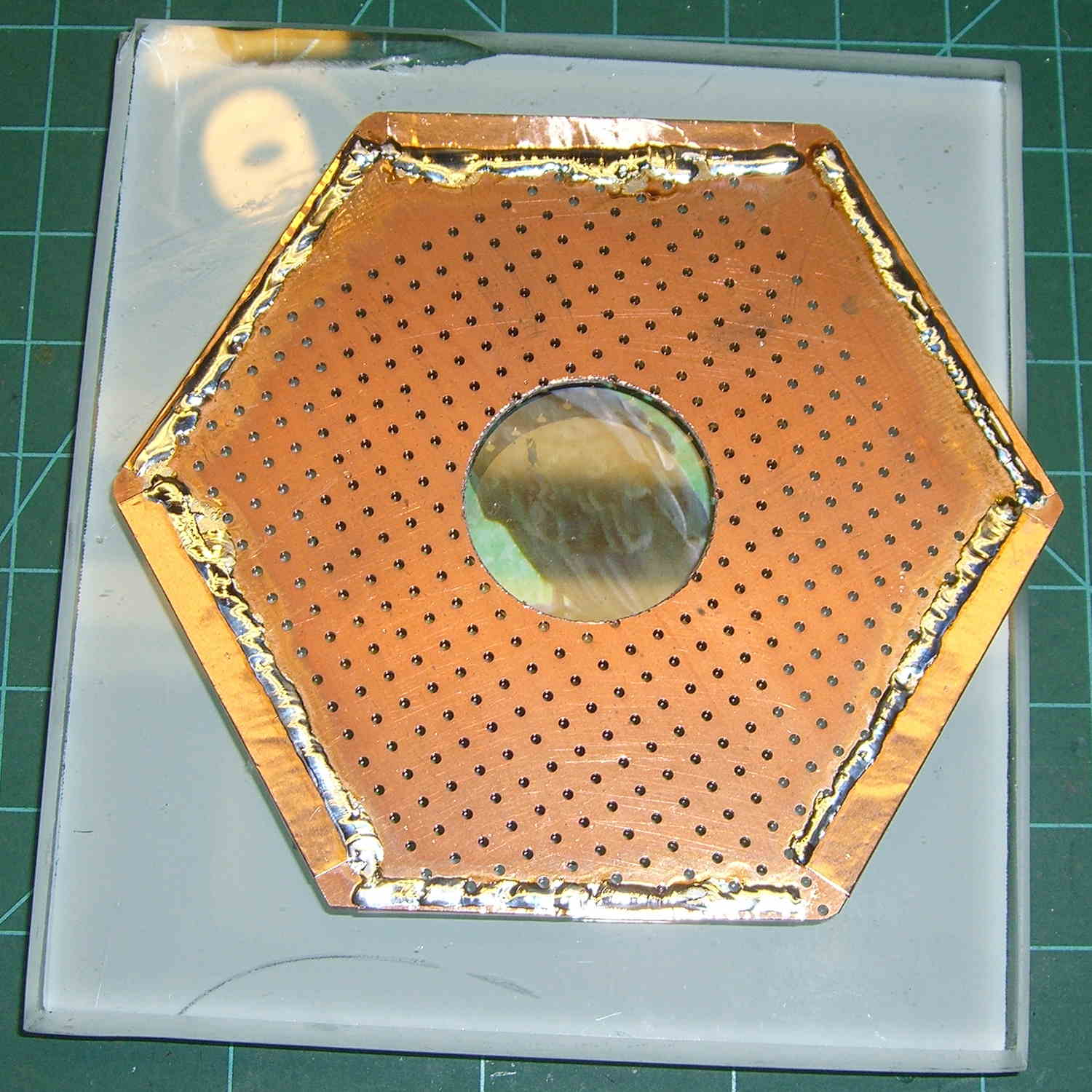
    Just to have something to work with, I cut a hex from a sheet of double-sided PCB stock and bonded the edges with copper foil:

    Victoreen 710-104 - Hex PCB - top
    Victoreen 710-104 – Hex PCB – top

    Slightly wider tape on three edges will clear the board supports:

    Victoreen 710-104 - Hex PCB - bottom
    Victoreen 710-104 – Hex PCB – bottom

    For unknown reasons, the PCB has arrays of plated-through holes firmly bonding the top and bottom copper, so that’s pretty much solid copper with a glass-epoxy core. I think somebody (else) harvested it from a locally important company many, many decades ago, but it arrived with no provenance.

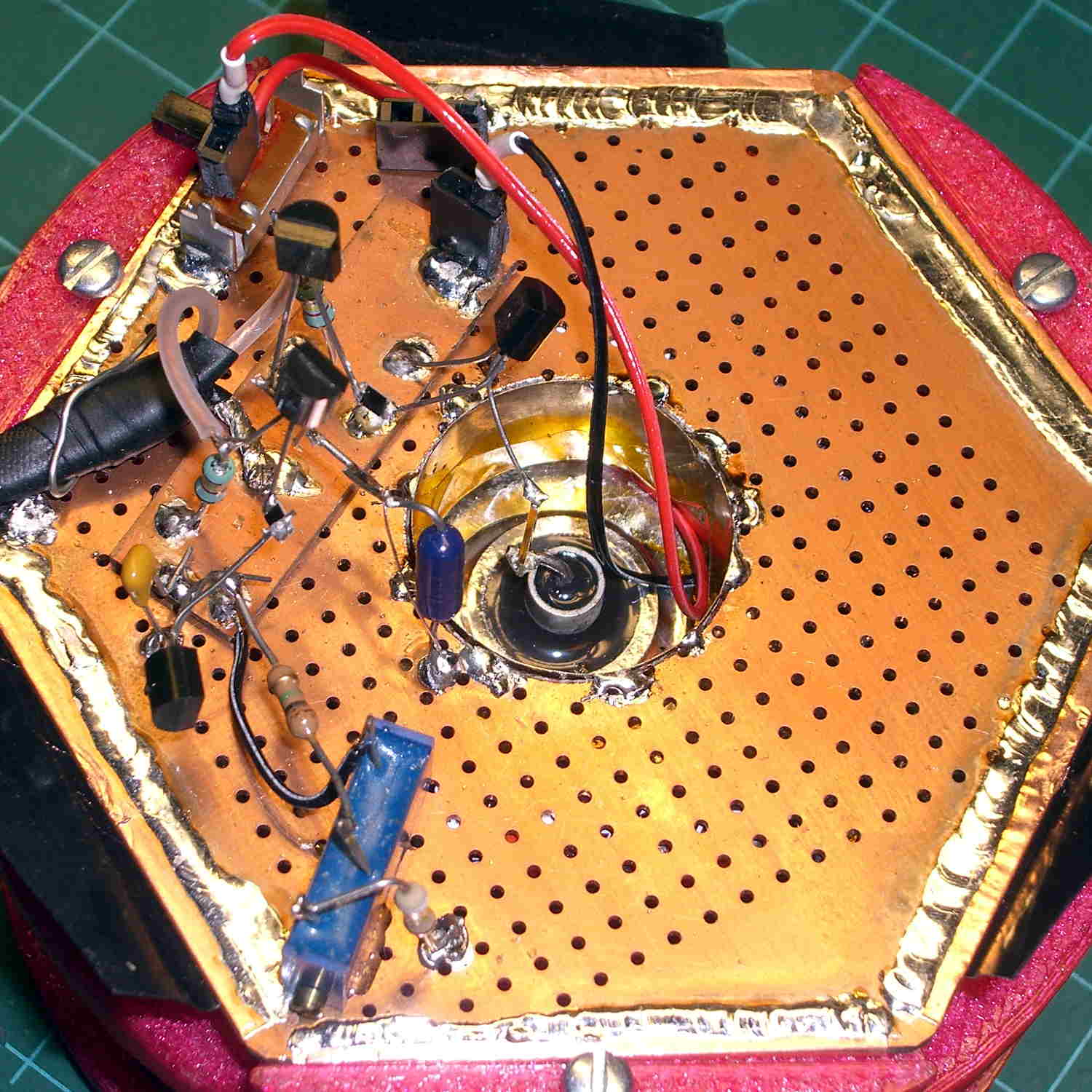
    The first pass at the electrometer circuitry will be air-wired for low leakage, which is pretty much the only way I have to actually get low leakage; the holes should help glue the parts to that copper plane.

    I’m not at all convinced the big hole in the middle is strictly necessary. The chamber has 10 pF from pin to can that should swamp any stray capacitance unless I do something really stupid.

    The copper foil stockpile remains hidden, so maybe I’ll build a shield from adhesive copper tape along the lines of the WWVB receiver shield in the Totally Featureless Clock:

    Completed shield enclosure
    Completed shield enclosure

    Given my weak origami-fu and the need for hexagonality, I should print a 3D template.

    It’s worth remembering that both the hex and the shield will be at the can’s +24 V potential, not “ground”. That makes no difference to the external circuitry, but will certainly cause me to blow a few junctions along the way.

  • Victoreen 710-104 Ionization Chamber: Circuit Fixture

    The general idea is to put the electrometer circuitry directly atop the Victoreen 710-104 ionization chamber, so as to minimize the distance from the center collector electrode to the electrometer input. After a few false starts, this looked promising:

    Victoreen 710-104 Ionization Chamber Fittings - Show layout
    Victoreen 710-104 Ionization Chamber Fittings – Show layout

    The hexagonal circuit board fits the can so nicely that I’ll run with it, despite the over-the-top twee factor. Because it’s so hard to freehand a hex, I printed the green object as a tracing template, despite having the Slic3r preview show the parts just barely fitting on the M2 platform:

    Victoreen 710-104 Ionization Chamber Fittings - Build layout
    Victoreen 710-104 Ionization Chamber Fittings – Build layout

    Fortunately, my configuration hand is strong:

    Victoreen 710-104 Fittings - on M2 platform
    Victoreen 710-104 Fittings – on M2 platform

    The skirt measures 0.25±0.05 around the entire perimeter, with a slight positive bias (platform too low) along the left side and a corresponding negative bias on the right. Both sides look just fine to me.

    A pair of alignment pegs hold each board support in place while gluing:

    Victoreen 710-104 Fittings - clamping
    Victoreen 710-104 Fittings – clamping

    Next time around, I’ll glue the supports with the circuit board template laid in place to ensure the edges have the proper orientation, but they came out surprisingly close just by matching the outer perimeters. Of course, I probably bandsawed / belt sanded the carefully traced hex just slightly off-kilter.

    The outer perimeter has 48 sides. Making it a multiple of three means each board support has the same pattern of sides and all will be interchangeable. Making it a multiple of four means each quadrant has the same pattern of sides and the ring looks pleasingly symmetrical. The factor-of-three is most important: you want interchangeable supports. Trust me on this.

    The bottom ring keeps the solder dimple that seals the can base off the desk, but I also stuck a quartet of rubber feet on the can for better traction.

    Here’s what it looks like with the two A23 12 V bias batteries in their holders, affixed to the can with foam tape:

    Victoreen 710-104 Fittings - assembled
    Victoreen 710-104 Fittings – assembled

    The OpenSCAD source code includes a few more tweaks:

    // Victoreen 710-104 Ionization Chamber Fittings
    // Ed Nisley KE4ZNU July 2015
    
    Layout = "Show";
    					// Show - assembled parts
    					// Build - print them out!
    					// CanCap - PCB insulator for 6-32 mounting studs
    					// CanBase - surrounding foot for ionization chamber
    					// CanLid - generic surround for either end of chamber
    					// PCB - template for cutting PCB sheet
    					// PCBBase - holder for PCB atop CanCap
    
    BuildTemplate = false;			// true to build PCB template along with everything else
    
    //- Extrusion parameters must match reality!
    //  Print with 2 shells and 3 solid layers
    
    ThreadThick = 0.25;
    ThreadWidth = 0.40;
    
    HoleWindage = 0.2;
    
    Protrusion = 0.1;			// make holes end cleanly
    
    AlignPinOD = 1.75;			// assembly alignment pins = filament dia
    
    inch = 25.4;
    
    function IntegerMultiple(Size,Unit) = Unit * ceil(Size / Unit);
    
    //- Screw sizes
    
    Tap4_40 = 0.089 * inch;
    Clear4_40 = 0.110 * inch;
    Head4_40 = 0.211 * inch;
    Head4_40Thick = 0.065 * inch;
    Nut4_40Dia = 0.228 * inch;
    Nut4_40Thick = 0.086 * inch;
    Washer4_40OD = 0.270 * inch;
    Washer4_40ID = 0.123 * inch;
    
    
    //----------------------
    // Dimensions
    
    OD = 0;											// name the subscripts
    LENGTH = 1;
    
    Chamber = [91.0 + HoleWindage,38];				// Victoreen ionization chamber dimensions
    
    Stud = [										// stud welded to ionization chamber lid
    	[6.5,IntegerMultiple(0.8,ThreadThick)],		// flat head -- generous clearance
    	[4.0,9.5],									// 6-32 screw -- ditto
    ];
    NumStuds = 3;
    StudSides = 6;									// for hole around stud
    
    BCD = 2.75 * inch;								// mounting stud bolt circle diameter
    
    PlateThick = 3.0;								// layer atop and below chamber ends
    RimHeight = 4.0;								// extending up along chamber perimeter
    WallHeight = RimHeight + PlateThick;
    WallThick = 5.0;								// thick enough to be sturdy & printable
    CapSides = 8*6;									// must be multiple of 4 & 3 to make symmetries work out right
    
    PCBFlatsOD = 85.0 + 2*ThreadWidth;				// hex dia across flats + clearance
    PCBThick = 1.1;
    PCB = [PCBFlatsOD / cos(30),PCBThick - ThreadThick];		// OD = tip-to-tip dia
    
    echo(str("Actual PCB across flats: ",PCBFlatsOD - 2*ThreadWidth));
    echo(str(" ... tip-to-tip dia: ",(PCBFlatsOD - 2*ThreadWidth)/cos(30)));
    echo(str(" ... thickness: ",PCBThick));
    
    HolderHeight = 11.0 + PCB[LENGTH];				// thick enough for PCB to clear studs
    HolderShelf = 2.0;								// shelf under PCB edge
    
    echo(str("PCB holder height: ",HolderHeight));
    echo(str(" ... across flats: ",PCBFlatsOD));
    
    //----------------------
    // Useful routines
    
    module PolyCyl(Dia,Height,ForceSides=0) {			// based on nophead's polyholes
    
      Sides = (ForceSides != 0) ? ForceSides : (ceil(Dia) + 2);
    
      FixDia = Dia / cos(180/Sides);
    
      cylinder(r=(FixDia + HoleWindage)/2,
               h=Height,
    	   $fn=Sides);
    }
    
    //- Locating pin hole with glue recess
    //  Default length is two pin diameters on each side of the split
    
    module LocatingPin(Dia=AlignPinOD,Len=0.0) {
    	
    	PinLen = (Len != 0.0) ? Len : (4*Dia);
    	
    	translate([0,0,-ThreadThick])
    		PolyCyl((Dia + 2*ThreadWidth),2*ThreadThick,4);
    
    	translate([0,0,-2*ThreadThick])
    		PolyCyl((Dia + 1*ThreadWidth),4*ThreadThick,4);
    		
    	translate([0,0,-Len/2])
    		PolyCyl(Dia,Len,4);
    
    }
    
    module ShowPegGrid(Space = 10.0,Size = 1.0) {
    
      RangeX = floor(100 / Space);
      RangeY = floor(125 / Space);
      
    	for (x=[-RangeX:RangeX])
    	  for (y=[-RangeY:RangeY])
    		translate([x*Space,y*Space,Size/2])
    		  %cube(Size,center=true);
    }
    
    //-----
    
    module CanLid() {
    	
    	difference() {
    		cylinder(d=Chamber[OD] + 2*WallThick,h=WallHeight,$fn=CapSides);
    		translate([0,0,PlateThick])
    			PolyCyl(Chamber[OD],Chamber[1],CapSides);
    	}
    	
    }
    
    module CanCap() {
    
    	difference() {
    		CanLid();
    		
    		translate([0,0,-Protrusion])											// central cutout
    //			cylinder(d=(BCD - 2*5.0),h=Chamber[LENGTH],$fn=CapSides);
    			rotate(180/6)
    				cylinder(d=BCD,h=Chamber[LENGTH],$fn=6);
    			
    		for (i=[0:(NumStuds - 1)])												// stud clearance holes
    			rotate(i*360/NumStuds)
    				translate([BCD/2,0,0])
    					rotate(180/StudSides) {
    						translate([0,0,(PlateThick - (Stud[0][LENGTH] + 2*ThreadThick))])
    							PolyCyl(Stud[0][OD],2*Stud[0][LENGTH],StudSides);
    						translate([0,0,-Protrusion])
    							PolyCyl(Stud[1][OD],2*Stud[1][LENGTH],StudSides);
    					}
    					
    		for (i=[0:(NumStuds - 1)], j=[-1,1])									// PCB holder alignment pins
    			rotate(i*360/NumStuds + j*15 + 60)
    				translate([Chamber[OD]/2,0,0])
    					rotate(180/4)
    						LocatingPin(Len=2*PlateThick - 2*ThreadThick);
    	}
    
    }
    
    module CanBase() {
    	
    	difference() {
    		CanLid();
    		translate([0,0,-Protrusion])
    			PolyCyl(Chamber[OD] - 2*5.0,Chamber[1],CapSides);
    	}
    }
    
    module PCBTemplate() {
    	
    	difference() {
    		cylinder(d=((PCBFlatsOD - 2*ThreadWidth)/cos(30)),h=max(PCB[LENGTH],3.0),$fn=6);		// actual PCB size, overly thick
    		translate([0,0,-Protrusion])
    			cylinder(d=10,h=10*PCB[LENGTH],$fn=12);
    	}
    }
    
    module PCBBase() {
    
    	difference() {
    		cylinder(d=Chamber[OD] + 2*WallThick,h=HolderHeight,$fn=CapSides);
    		
    		rotate(30) {
    			translate([0,0,-Protrusion])										// central hex
    				cylinder(d=(PCBFlatsOD - 2*HolderShelf)/cos(30),h=2*HolderHeight,$fn=6);	
    				
    			translate([0,0,HolderHeight - PCB[LENGTH]])							// hex PCB recess
    				cylinder(d=PCB[OD],h=HolderHeight,$fn=6);
    				
    			for (i=[0:NumStuds - 1])											// PCB retaining screws
    				rotate(i*120 + 30)
    					translate([(PCBFlatsOD/2 + Clear4_40/2 + ThreadWidth),0,-Protrusion])
    						rotate(180/6)
    							PolyCyl(Tap4_40,2*HolderHeight,6);
    							
    			for (i=[0:(NumStuds - 1)], j=[-1,1])								// PCB holder alignment pins
    				rotate(i*360/NumStuds + j*15 + 30)
    					translate([Chamber[OD]/2,0,0])
    						rotate(180/4)
    							LocatingPin(Len=PlateThick);
    		}
    		
    		for (i=[0:NumStuds - 1])												// segment isolation
    			rotate(i*120 - 30)
    				translate([0,0,-Protrusion]) {
    					linear_extrude(height=2*HolderHeight)
    						polygon([[0,0],[Chamber[OD],0],[Chamber[OD]*cos(60),Chamber[OD]*sin(60)]]);
    				}
    	}
    	
    
    }
    
    
    //----------------------
    // Build it
    
    ShowPegGrid();
    
    if (Layout == "CanLid") {
    	CanLid();
    }
    
    if (Layout == "CanCap") {
    	CanCap();
    }
    
    if (Layout == "CanBase") {
    	CanBase();
    }
    
    if (Layout == "PCBBase") {
    	PCBBase();
    }
    
    if (Layout == "PCB") {
    	PCBTemplate();
    }
    
    if (Layout == "Show") {
    	CanBase();
    	color("Orange",0.5)
    		translate([0,0,PlateThick + Protrusion])
    			cylinder(d=Chamber[OD],h=Chamber[LENGTH],$fn=CapSides);
    	translate([0,0,(2*PlateThick + Chamber[LENGTH] + 2*Protrusion)])
    		rotate([180,0,0])
    			CanCap();
    	translate([0,0,(2*PlateThick + Chamber[LENGTH] + 5.0)])
    		PCBBase();
    	color("Green",0.5)
    		translate([0,0,(2*PlateThick + Chamber[LENGTH] + 7.0 + HolderHeight)])
    			rotate(30)
    				PCBTemplate();
    }
    
    if (Layout == "Build") {
    	
    	if (BuildTemplate) {
    		translate([-0.50*Chamber[OD],-0.60*Chamber[OD],0])
    			CanCap();
    			
    		translate([0.55*Chamber[OD],-0.60*Chamber[OD],0])
    			rotate(30)
    				PCBTemplate();
    	}
    	else {
    		translate([-0.25*Chamber[OD],-0.60*Chamber[OD],0])
    			CanCap();
    	}
    		
    	translate([-0.25*Chamber[OD],0.60*Chamber[OD],0])
    		CanBase();
    	translate([0.25*Chamber[OD],0.60*Chamber[OD],0])
    		PCBBase();
    }
    
  • Victoreen 710-104 Ionization Chamber: Mounting Dimensions

    Mounting a circuit board atop the Victoreen 710-104 ionization chamber requires figuring out the location of those 6-32 studs:

    Victoreen 710-104 Ionization Chamber - oblique
    Victoreen 710-104 Ionization Chamber – oblique

    Given that it dates back to the early Cold War days, the bolt circle dimensions are all hard inch:

    Victoreen 710-104 Ionization Chamber - mounting dimensions
    Victoreen 710-104 Ionization Chamber – mounting dimensions

    I embossed the studs into a pad of Geek Scratch Paper, eyeballed the stud-to-stud spacing from a cheap ruler, back-calculated the BCD, rounded it from 2.742 to the obvious 2.75, then fed that into the first BCD calculator that appeared in the obvious search.

    The can is just over 3.5 inch OD and stands 1.5 inch tall.

    The can will run at +24 V in relation to the rest of the circuitry, so the studs must be insulated from the PCB’s copper pours. That, most likely, will require some 3D printed doodads.

    The circuitry must live inside a grounded metallic can that excludes random electric fields. Somewhere in the pile, I have a few sheets of Mu-metal that, while grossly overqualified for the task (even without heat treatment), should solder up nicely…

  • CNC Workshop 2015: Arduino Survival Guide, Workshop Edition

    MOSFET RDS Tester - Arduino
    MOSFET RDS Tester – Arduino

    Armed with bags of electronic parts and boxes of meters, I’ll be helping folks at the CNC Workshop understand the electrical limitations of the Arduino microcontrollers they’re building into projects.

    The presentation in PDF form:

    Arduino Survival Guide – Workshop Edition – CNC Workshop 2015

    We’ll wing it with the source code, because nothing’s more than a few lines long…