The Smell of Molten Projects in the Morning

Ed Nisley's Blog: Shop notes, electronics, firmware, machinery, 3D printing, laser cuttery, and curiosities. Contents: 100% human thinking, 0% AI slop.

Author: Ed

  • Security by Photographic Obscurity: FAIL

    Gas Storage Tank
    Gas Storage Tank

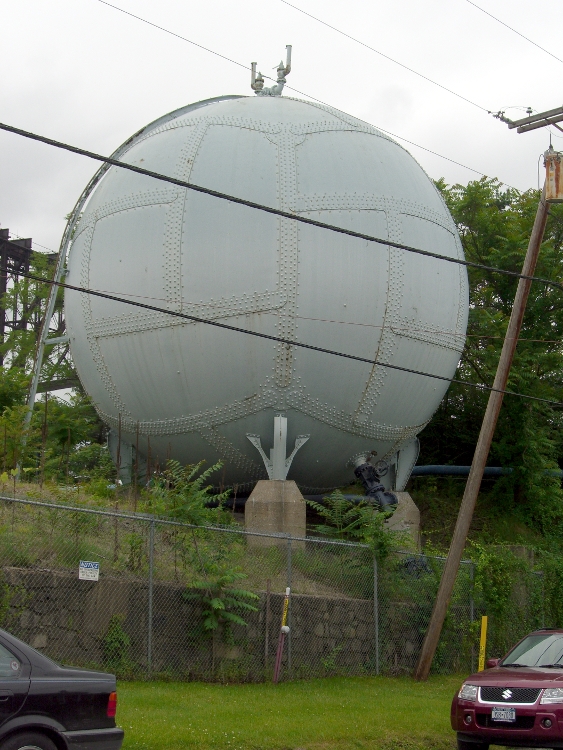
    We biked along the Poughkeepsie waterfront and spotted this stately gas storage tank. The shape tells you it’s a pressure vessel, not a simple fluid tank. I think Central Hudson has an underwater gas pipeline across the Hudson right about there; the waterfront is rife with oil storage tanks and suchlike, although less than in days of yore.

    As you might expect, I took the picture from a public area, pretty much in front of a house across the street. It’s not like this was a risky high-security red-flag penetration operation; we rode to the end of Dutchess Avenue (the better part of 600 feet), soaked up some of the decaying industrial-age vibe, turned around, and rode back up the hill.

    Dutchess Avenue - Google Obscured View
    Dutchess Avenue – Google Obscured View

    I made a ten-cent bet with myself that the Google-Eye view of the area would be blurred out “for security reasons” and, yup, won that sucker. This isn’t a case of JPG compression: notice how (relatively) crisp the railroad tracks are?

    Dutchess Ave - Topo Map
    Dutchess Ave – Topo Map

    The 1955 topographic map hanging on our wall (I’m a map junkie) was revised in 1981 and leaves very little to the imagination. It not only shows oil storage tanks standing on those now-empty concrete pads, but it also labels the area. Admittedly, it doesn’t show the gas tank, so the tank hasn’t been there for more than, oh, a quarter-century.

    I submit to you that the best way for an evildoer to pick a high-value target is to browse the maps and look for low-res areas. Here in mid-state New York, that’s an infallible way to find things like big petroleum storage facilities (or just look along the waterfront), airports with military-grade runways (the Dutchess County Airport evidently doesn’t count), oil / coal / nuke power plants, and good stuff like that. Then the bad guy gets in his car, drives over, gets some ground truth, and away they go.

    A lazy bad guy could even write a Google Maps app that quietly and slowly scanned a given area for low-res points of interest.

    That’s what Bruce Schneier calls a Movie Plot Threat. Ruining the resolution doesn’t change anything; you don’t need high-res imagery to blow something up.

    Sheesh & similar remarks.
  • SRAM Twist Grip Shifter Pointer Repair

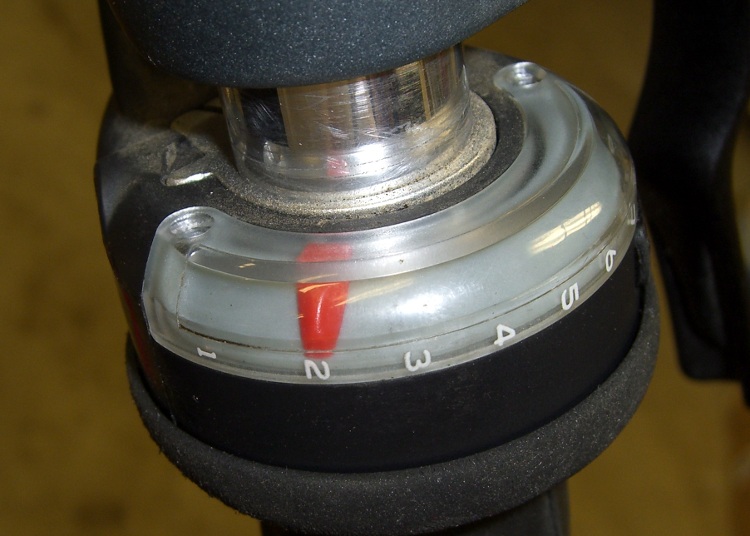
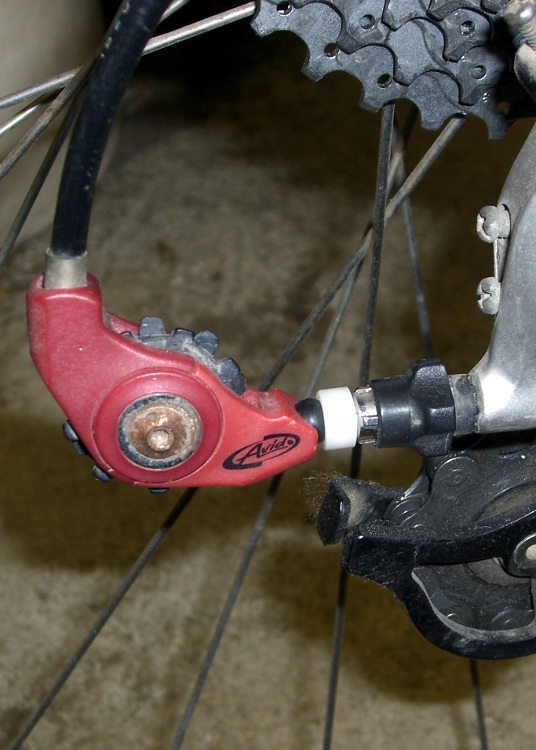
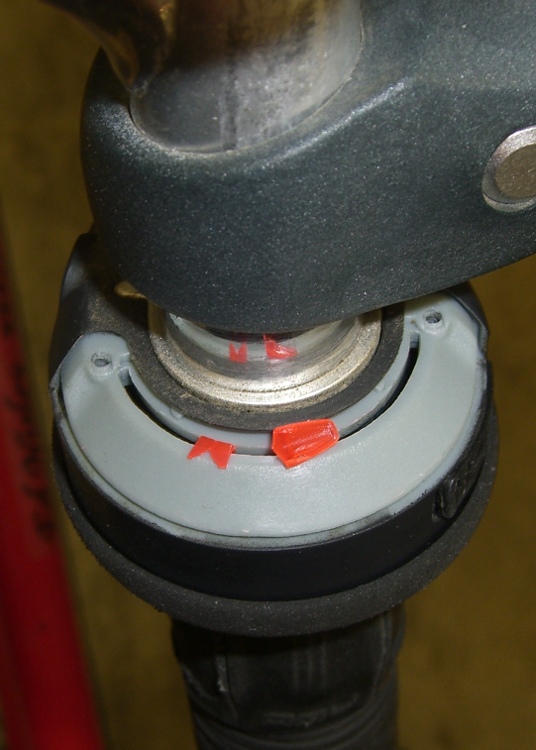
    The little red pointer inside my Tour Easy’s rear SRAM Grip-Shift broke. Back in the old days, this wouldn’t be a problem, as we used friction shifters on the downtube (as we rode to school, uphill, in the snow, both ways) and knew by feel which gear was engaged. But that was then, this is now, and fixing things is what I do anyway.

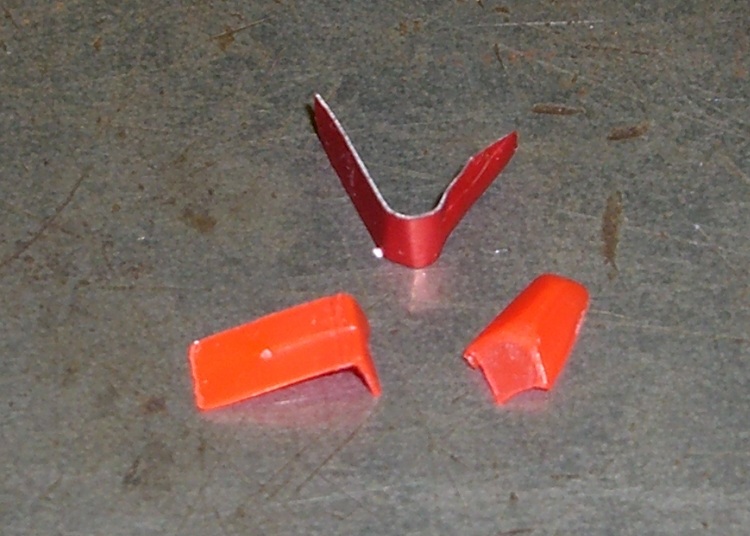
    The pointer turned out to be a thin plastic strip, molded into an L with a domed arch over the pointy end. It simply rests in a slot in the shifter mechanism, held in place by the transparent cover (which, mercifully, came off without dismantling the bike or even removing the cable).

    I made a similar replacement from thin red-anodized aluminum, but that didn’t work out at all. The mechanism snaps from one gear to the next at roughly the speed of heat, accelerating the pointer so rapidly that the aluminum deformed. Score one for plastic!

    Actually, I made two aluminum pointers. Prototype One vanished into the Sargasso heap in front of the Solvents & Lubricants Shelves at the first upshift; that’s when I discovered just how much snap that shifter applies to the pointer. Made another one, installed the cover, and then discovered it wasn’t going to work.

    So I applied some Plastruct solvent adhesive to the broken plastic bits, lined the parts up on my crusty surface plate, applied a bit of gentle pressure overnight, and in the morning had a like-new pointer. It installed just fine and works like the original.

    Solvent-bonded plastic is supposed to be just about as strong as the original material. We’ll see just how long this repair lasts…

    Pop Quiz: Do you know the first four derivatives of position w.r.t. time?

    Answer: Velocity, acceleration, jerk, and snap. You could look it up…

    Update: Alas, the repair lasted only about two weeks before failing at the same spot. Some deep rummaging produced a similar (but more thoroughly dead) SRAM shifter. Turns out the pointers are similar, so I salvaged the older one. Ya gotta have stuff… and remember it, too, which is becoming something of a challenge.

  • GPS Position Jitter

    GPS Position Jitter
    GPS Position Jitter

    Everybody seems to forget that those wonderfully precise GPS coordinates have an underlying error on the order of 20 meters, more or less, kinda sorta.

    A friend took a bicycling vacation, riding about 50 miles a day, and camped overnight. Evidently his GPS tracker developed a nasty case of insomnia and wandered all over the campsite: the first two points might be actual motion, but the rest were in the wee hours of the morn when he says he was sound asleep.

    It became painfully obvious over the course of his journey that you cannot depend on continuous satellite uplink coverage. Even though he was riding on rail trails and open roads, the every-ten-minute position uplink to low earth orbit would vanish for hours at a time. The GPS tracker has a 911 button, but it might be a long time before they could figure out where he was.

    Memo to Self: get those GPS-to-APRS gadgets built for our bike trips…

  • Tour Easy Rear Brake Noodle Extension

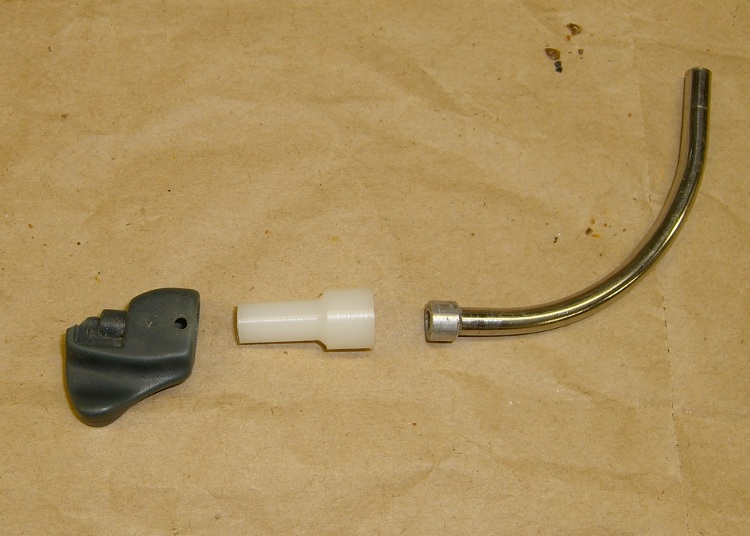
    Noodle Extension and Parts
    Noodle Extension and Parts

    Our Tour Easy recumbents have linear-pull brakes on the rear and, for some reason, the noodle on Mary’s bike didn’t quite clear the frame: the cable bent slightly around the frame when the brake was active.

    That made the brake difficult to adjust, as linear-pull brakes depend on an exact balance between the restoring springs on each side. With the cable pulling to the right, the left-side pad would contact the rim first and give the brake lever a mushy pull until the right-side pad clamped down.

    A quick lathe session applied to some nylon scrap turned out an extension tube that fit between the steel noodle and the (slightly broken) plastic hoodickie that engages the brake arm. I used nylon (or something slippery like that) to make sure the cable wasn’t going to bind on it.

    Epoxy Potting
    Epoxy Potting

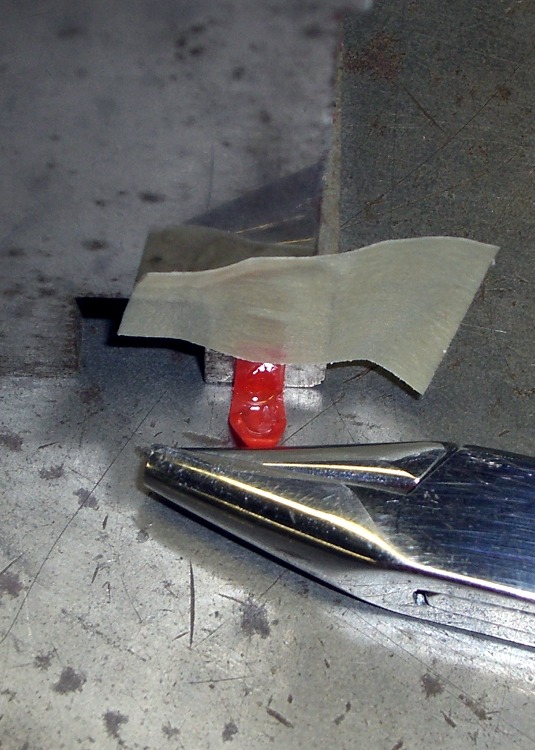
    The noodle originally fastened into the plastic hoodickie with a small collar that snapped into a pair of holes, but I took a shortcut: JB Kwik Epoxy. The shank end of a small drill slip-fit into the hoodickie’s cable passage kept the extension aligned while the epoxy set up. The masking tape prevented the epoxy from drooling out through the two small holes: the cured epoxy plug will have a pair of retaining posts in exactly the right places. The smears on the plastic parts chipped right off, not that anybody will ever notice.

    I’m depending on spring force to hold the noodle in the extension, which seems to be working just fine. This is one of those jobs where everything’s under compression all the time and the cable tension ensures good alignment.

    The socket on the extension’s fat end is a snug fit to the collar swaged on the noodle; other noodle varieties seem to have other sorts of ends, so check to make sure this will work for you.

    Noodle Extension Installed
    Noodle Extension Installed
    Added Brake Cable Clearance
    Added Brake Cable Clearance

    These pix show the brake assembly from below (the paint failed on the frame cross-member early on and I’ve been meaning to slather some rust converter on that spot for years. Sigh.) and the now-positive clearance between the brake cable and the frame with the brake applied.

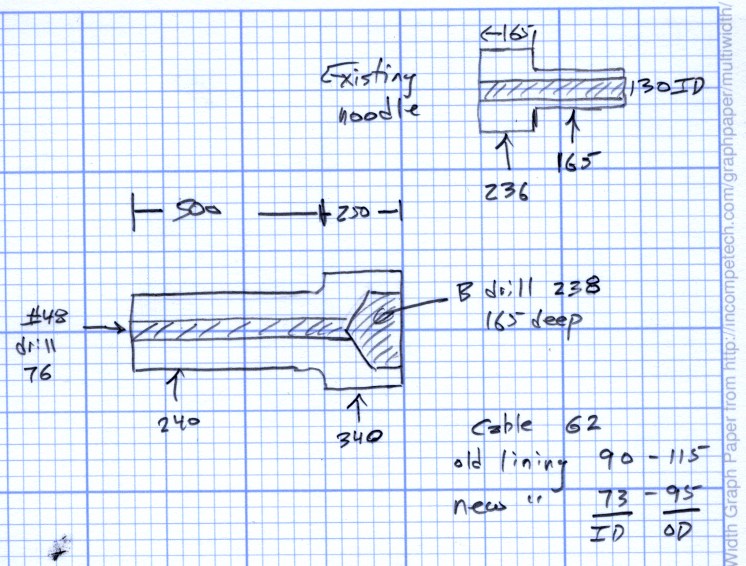
    And, for future reference, the dimensions…

    Noodle and Extension Dimensions
    Noodle and Extension Dimensions
  • Avid Rollamajig Repair

    Avid Rollamajig with new ball socket
    Avid Rollamajig with new ball socket

    Mary’s shifter cable broke at the rear derailleur, causing the Avid Rollamajig to undergo spontaneous auto-disassembly. The only part we couldn’t find was the socket between the ball and the derailleur’s adjusting thimble.

    Good news: my parts heap had the Rollamajig from my bike, which I’d replaced because the most recent derailleur has an integrated gadget that serves much the same purpose.

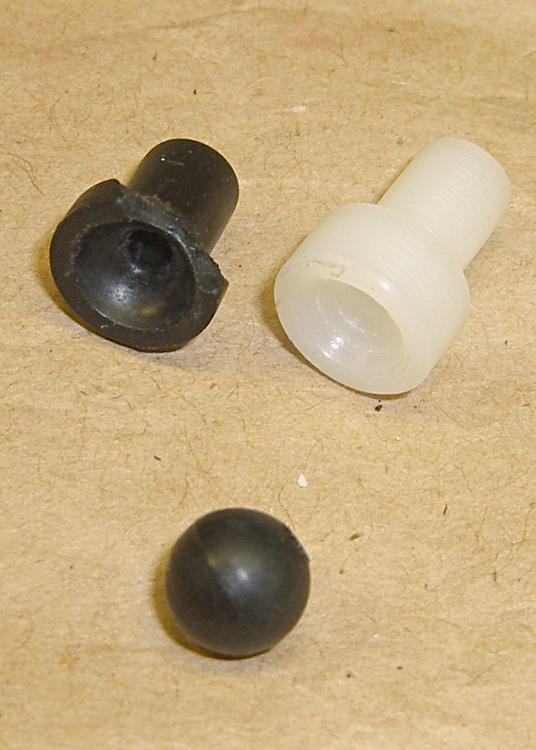
    Bad news: the socket had a chunk broken out of it and I didn’t want to put a broken part on Mary’s bike.

    Good news: at least I could measure the dimensions to build a new socket.

    Bad news: it needs a spherical socket for what measures out to be a 6.8 mm (0.268 inch) plastic ball and that’s not one of the three ball-end mills I have in the tooling cabinet.

    Good news: this isn’t a really critical high-speed / high-stress rotating joint. Pretty good will be close enough.

    Sherline chuck in lathe chuck
    Sherline chuck in lathe chuck

    Turning the part was a quick lathe job on a random hunk of what’s probably nylon.

    Bad news: the nylon was a rectangular cutoff from a slab and the three-jaw chuck on my lathe has been firmly stuck for the last year. It’s resisted all the non-Armageddeon-scale techniques; I fear I must machine the damn thing off.

    So I…

    • mounted the nylon in the Sherline 4-jaw chuck
    • grabbed that teeny little chuck in the lathe’s much bigger 3-jaw
    • converted one end of the square hunk into a cylinder
    • removed the small chuck
    • mounted the cylinder end in the 3-jaw
    • completed the mission
    Offset roughing mill
    Offset roughing mill

    Lacking the appropriate ball-end mill, I offset a ball-end roughing mill in the tailstock chuck so the near side was at the right radius from the lathe axis, then poked it into the end of the socket-to-be.

    Which, of course, produced a not-quite-spherical dent that was a bit too shallow, so I chucked up a too-small ball mill (on the centerline) and carved out the bottom of the socket. The result was a more-or-less spherical socket of about the right depth, pretty much.

    The right way to do this, and what I was going to do before I came to my senses, was turn the part on the lathe, drill the axial cable hole, then chuck it up on the Sherline CNC mill. Getting a spherical socket of exactly the right radius and depth using a too-small ball-end mill is then a simple matter of G-Code. Maybe I should write that up for my Digital Machinist column…

    Yeah, you could use a ball-turning attachment, if you should happen to have one. Sue me.

    Broken and new sockets
    Broken and new sockets

    Anyhow, it all worked out OK. The new socket is slightly longer than the old one, as it’s made to fit the derailleur thimble at hand. The end around the socket is slightly thicker, too, as it seemed more meat would add more durability where it was most needed.

    The Rollamajig seems to be discontinued, although some of the smaller online sources still offer it. Building one looks like a straightforward shop project to me.

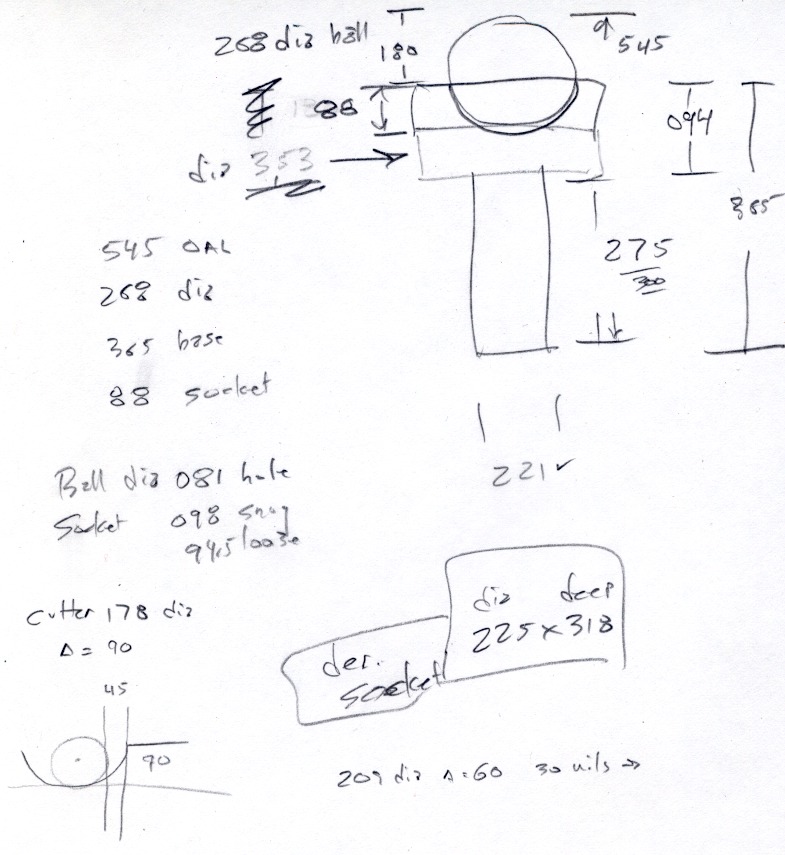
    Ball socket dimensions
    Ball socket dimensions

    The sketch has dimensions in inches, because I was doing this on the lathe. Our daughter measured it in metric and came out with much the same answers, so it’s all good.

  • Serial Ports in Wine

    Setting up serial ports in Wine is evidently automagic for the old-standard-hardware ports that appear as /dev/ttyS0. Unfortunately, that seems to not work for USB serial ports that appear as /dev/ttyUSB0 (or whatever is next in line when it’s plugged in).

    The quick-and-dirty solution is to set up symlinks, thusly:

    cd ~/.wine/dosdevices
    ln -s /dev/ttyUSB0 com3

    and so forth. As long as the USB gadget pops up with the same number, that’ll work.

    It is best to avoid any built-in hardware ports that already have automagic com1 / com 2 / whatever identifiers. Start with com3 or higher unless you know com1 / com2 are vacant. I suppose some laptop IRDA (remember that?) ports may still show up as com3 / com 4.

    Unlike the other devices, there’s no trailing colon. They’re also lowercase, although Windows sort of expects uppercase; that’s evidently handled under the covers.

    This would be better handled by UDEV magic that creates the appropriate links on the fly based on the USB device ID, but just hand-creating the links works well enough for my simple needs so far.

  • Cellular Toad

    Toad in planter cell
    Toad in planter cell

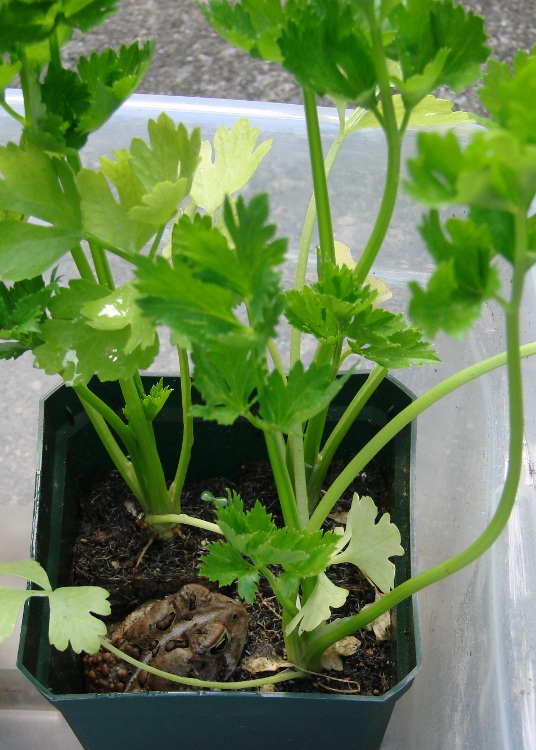
    Mary left a plant starter pot on the patio overnight and found an unexpected resident when she picked it up: a toad tucked neatly into a vacant cell.

    It’s difficult to tell with toads, but we think that’s a smug expression. The cell was just exactly body-sized, so maybe it’s a snug expression.

    Toad in garden
    Toad in garden

    Put back in more natural surroundings, in the garden with abundant flies & bugs, the critter faded right out of sight.

    The plant is celeriac, which sounds like it should be a computer built around 1946…