Ed Nisley's Blog: Shop notes, electronics, firmware, machinery, 3D printing, laser cuttery, and curiosities. Contents: 100% human thinking, 0% AI slop.
Some years ago, a friend convinced me I needed an Inova X1 LED flashlight. He was right; I’ve carried one in my belt pack ever since and, in fact, added a couple of X5s to the household armory.
Perforce, this is an old X1 with a coated glass lens to make the best of the LED. Newer X1s don’t have (or, likely) need the lens, as LED technology has made great strides in the last few years.
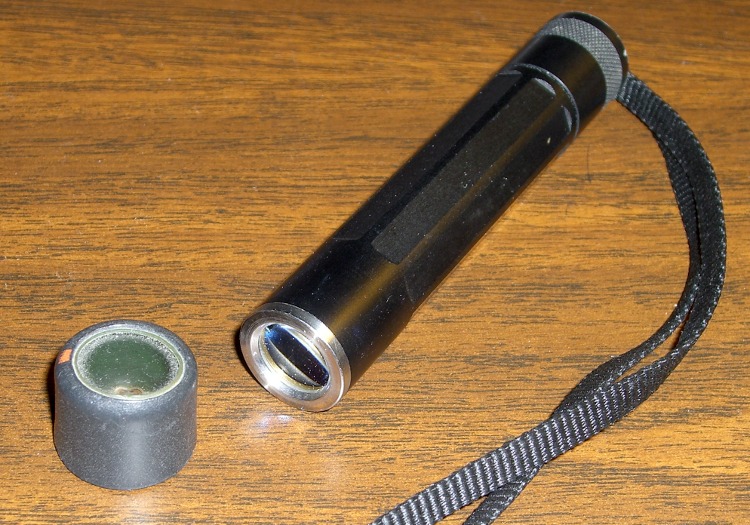
I couldn’t bear the thought of that lens rattling around in my belt pack, chewed upon by the assortment of other crap in there. So I made a lens protector: a length of heatshrink tubing with a polypropylene window. You might want to do the same for your flashlight to keep from grinding up the optical surfaces on its shiny end.
This tubing has an internal thermoplastic glue, but ordinary tubing would likely work as well. Position the tubing over the end of the flashlight with a few millimeters sticking out. Cut a circle from the clamshell case around some piece of consumer electronics, drop it on top of the lens, and shrink the tubing around the flashlight: watch it wrap right over the end and hold the circle in place. A dot or three of urethane glue may help for glue-less tubing.
It’s transparent enough for most purposes, but when you really need more light or a tighter beam, pull it off. That’s aided by dabbing a trace of oil on the X1, which you can get directly from the (outside) of your nose. Yeah, gross, but it’s a renewable natural resource…
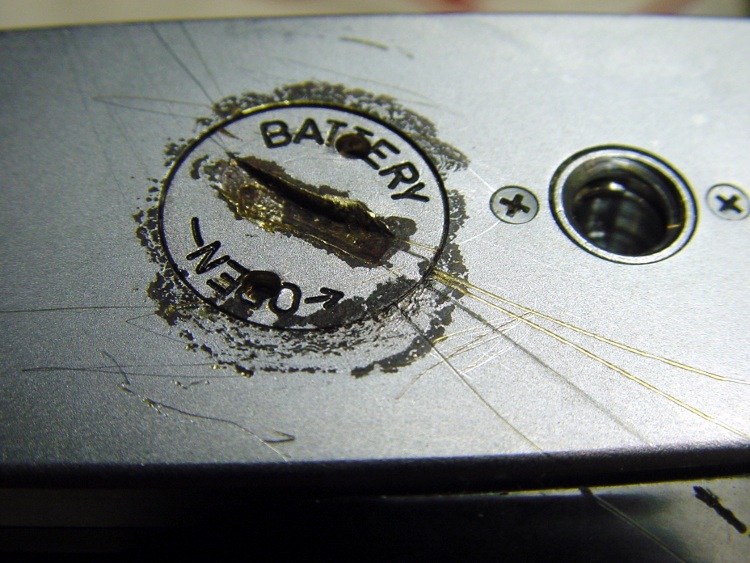
Some years ago a friend brought a favorite old camera that he’d just rediscovered. As you might expect, the exposure meter battery had long since died and its lid was rust-welded in place. Alas, he’d tried and failed to remove the lid by applying, mmmm, inappropriate tools to the coin slot.
I proposed building a quick-and-dirty pin wrench from an aluminum knob, which requires a matching pair of holes in the lid. Given that the lid was already pretty well pooched, he had no objection.
IIRC, I laid a strip of masking tape over the lid, laid out the holes perpendicular to the slot, then drilled them out by eyeball. The trick is to avoid drilling into the battery; it’s likely all dried out by now, but there’s no reason to release any more of that glop than absolutely necessary.
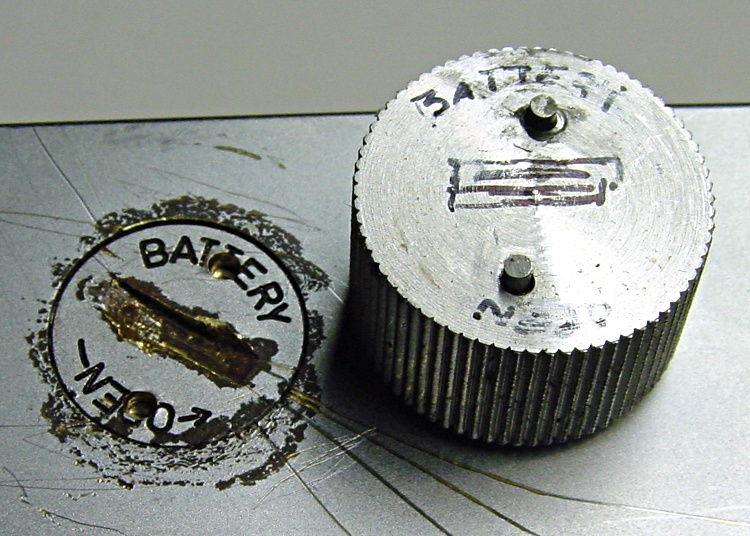
Battery cover wrench
Then I turned the threaded boss off the bottom of the knob and drilled two slightly larger holes separated by the same distance. This would be ideal for manual CNC, but I didn’t have the Sherline at the time, difficult though that may be to imagine.
When you can’t do precision work, epoxy is your friend.
Lay new tape over the battery lid
Cut two lengths of music wire with a diameter to match the holes in the battery lid using a Dremel abrasive cutoff wheel
Stuff the wire stubs into the holes, wipe off excess epoxy
Jam the pins through the tape into the holes in the battery lid
Wait for a few minutes…
You can see the top pin is slightly offset in its hole, but the epoxy ensures that the pins are an exact fit to the lid. The tape prevents the wrench from becoming one with the battery lid. Not drilling into the battery means the pins bottom out on the battery. Music wire means the pins won’t bend; copper wire doesn’t work in this application.
If you’re good with the Dremel, the pins will be not only the same length, but the proper length. IIRC, I made them a bit long and then trimmed them to fit.
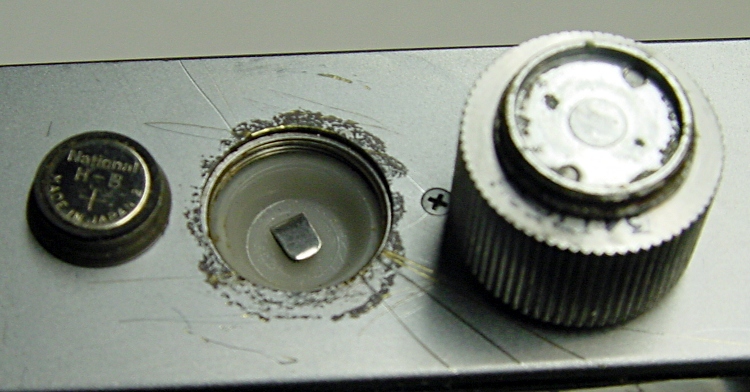
Battery lid removed
When the epoxy cures:
Remove the wrench
Remove the tape
Install the wrench
Twist the lid right off.
Works like a champ!
Much to our surprise, the inside of the battery compartment wasn’t a mass of corrosion and the threads were actually in pretty good shape, all things considered. It’s not clear why the lid was so corroded, but there you have it.
He went home happy… taking the wrench along, although we hope it’ll never be used again.
(I found these pix while I was looking for something else. My close-up technique has improved over the years: a tripod, bright lights, and the smallest possible aperture are my friends.)
Having had both of our commercial antenna mounts fail, I decided to make something that could survive a direct hit. It turns out that the new mounts are utterly rigid, which means the next failure point will be either the antenna mast or its base structure. We’ve occasionally dropped the bikes and when the antenna hits something on the way down, the mount is not the thing that bends…
Incidentally, the Nashbar 5-LED blinky white light aimed rearward seems to push motorists over another few feet to the left. Nobody quite knows what we are from a distance, but they do notice that something is up ahead. That’s just about as good as it gets; we tend to not ride in the wee hours of the morning when bike lights just give drunks an aiming point.
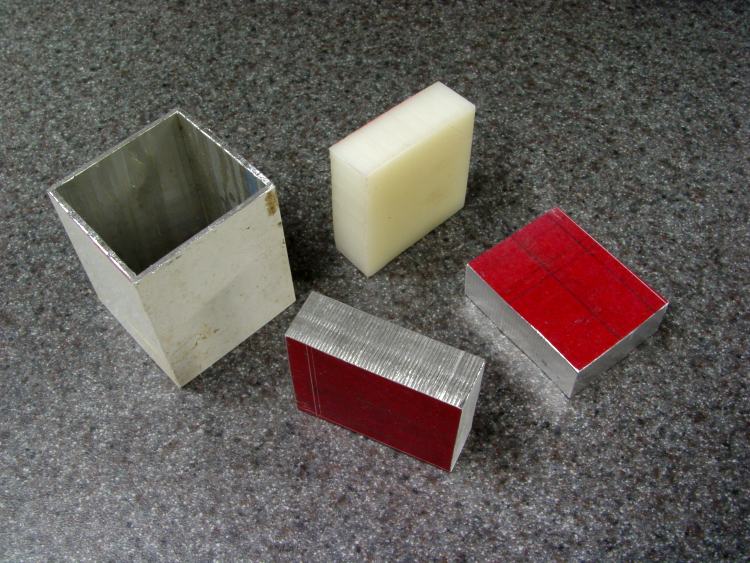
Rough-cut stock
The overall structure is a 2-inch square aluminum extrusion, with a hole in the top that matches the right-angle SO-239 base connector salvaged from the Diamond mount and a 1/2″ nylon stiffener plate in the middle. A pair of relentlessly square circumferential clamps attach it firmly to the top seatback rail. A coaxial cable pigtail ensures that the antenna base makes good electrical contact with the seat. I’m not convinced the bike makes a good counterpoise, so we’re now using dual-band antennas that are half-wave on VHF.
Stainless-steel hardware holds everything together, as I’m sick and tired of rust.
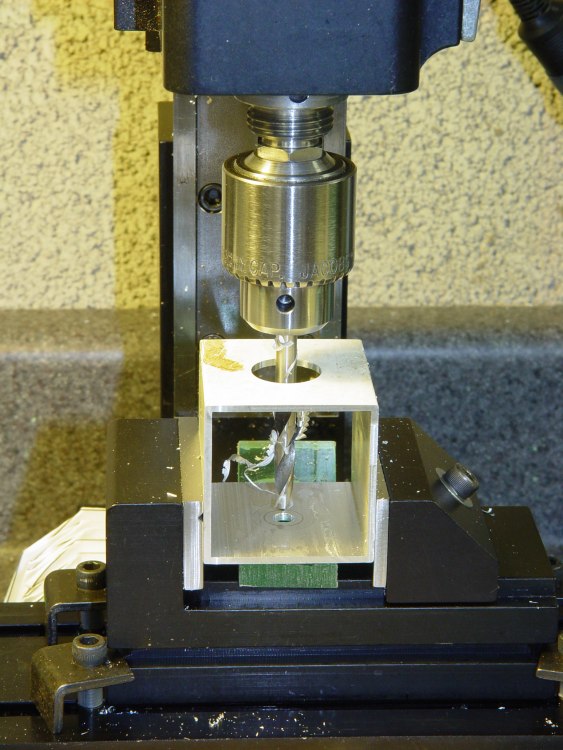
Drilling box beam
Not having a huge drill, I helix-milled the SO-239 hole, then reached down through the box to drill the hole for the plastic block retainer screw. Flip the box in the vise, drill four holes for the clamps (I love manual CNC for that sort of thing), manually deburr the holes, and it’s done.
The block of plastic is a tight slip fit inside the box extrusion, with slightly rounded corners to suit. I milled the slot across the top to a slip fit around the SO-239 connector.
The two clamps were the most intricate part of the project and got the most benefit from CNC.
Helix-milling the seat-bar clamp
The clamp hole must have exactly the same diameter as the seat top tube. I helix-milled the hole to an ordinary 5/8″; I have trouble drilling holes that large precisely in the right spot with the proper final diameter. Milling takes longer, but the results are much better.
Helix-mill the other block while you have the position set up, then flip and reclamp to drill the pair of holes that match the box extrusion. Drill 10-32 clearance (#9) all the way through.
Flycutting the Clamp Slit
Bandsaw the blocks in half, paying some attention to getting the cut exactly along the midline, then flycut the cut edge to make it nice & shiny & even. That should result in 1 or 2 mm of slit between the blocks when they’re clamped around the seat rail.
Finished seat-bar clamps
Break those relentlessly sharp edges & corners with a file.
I finagled the dimensions so a 1-1/2″ socket-head cap screw would have just enough reach to fill a nut, with washers under the screw and nut. Your mileage may vary; I’ve gotten reasonably good at cutting screws to length.
Normally, you tap one side of each clamp for the screws, but in this situation I didn’t see much point in doing that: the box must attach firmly to the clamps and I was going to need some nuts in there anyway.
Finished parts
With all those parts in hand, assembly is straightforward. Secure the SO-239 with its own thin nut, screw the plastic block in place, hold the clamps around the seat bar, poke the cap screws through, dab some Loctite on the threads, install nuts, and tighten everything. That all goes much easier with four hands!
The grounding braid fits into a huge solderless connector that must have been made with this application in mind. It originally fit a 1/2″ lug, but with enough meat that I could gingerly file it out to 5/8″ to fit the SO-239 inside the aluminum extrusion. I’ve had those connectors for years without knowing what they were for!
I eventually came up with a simpler and even more ruthlessly rugged mount that’ll appear in my column in the Autumn 2009 Digital Machinist. More on that later… [Update:There]
We used Diamond K540KM truck mirror-bracket antenna mounts clamped to the top seatback rail on our Tour Easy recumbents for several years, but they weren’t entirely satisfactory. The vibration from our ordinary on-road bike rides (a TE isn’t an off-road bike!) fractured the stamped-steel base after four years.
Antenna Bracket Repair
I fixed that by screwing a steel plate across the crack. It became obvious that these mounts weren’t suited to the application when the second mount failed shortly thereafter.
Broken Diamond K540KM Antenna Mount
But we kept using them and, as you might expect, Mary’s mount failed in the middle of a 350-mile bike ride when the die-cast support dingus broke. The fresh granular metal fracture looks dead white in the picture.
I lashed the pieces together with a multitude of cable ties and we completed the mission. When I rolled our bikes into the Basement Laboratory Bike Repair Wing after returning home, the mount on my bike failed.
These mounts aren’t intended for “high vibration” applications and, it seems, bicycles produce much higher vibration than trucks. I’m certain that the frequency range is higher, although I’m not sure about the amplitude.
Obviously, it was time for something better… which meant some quality shop time. More on that tomorrow.
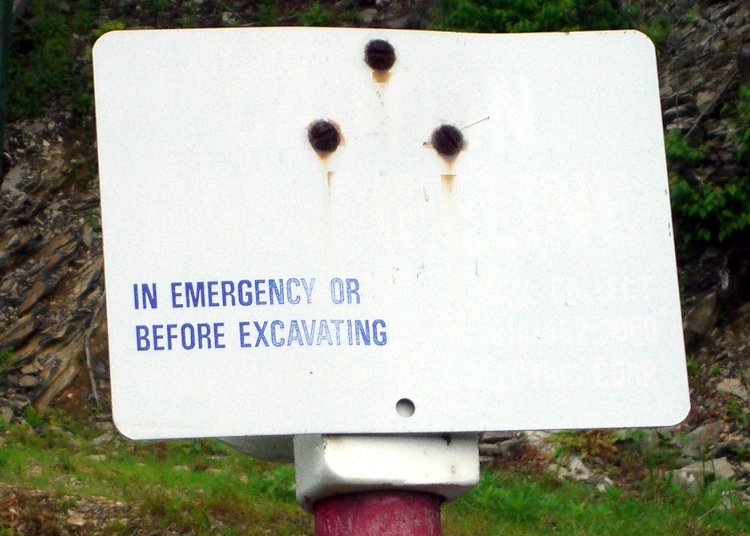
Saw this on a family bike ride. It’s atop a Central Hudson gas pipeline, pretty much directly across the Hudson from that gas storage tank, although on a local branch line.
Other such gas-pipeline signs have contact information, like the phone number, printed in red ink. Alas, red ink absorbs UV and eventually bleaches away. It’s not like this is an unknown phenomenon that’s happened here for the first time.
What’s odd about this, though, is that the pole supporting the sign and the pipe leading to the sampling head (?) were both recently repainted with nice red paint. One would think the painter would be empowered to report problems like this, but I’m guessing that job has been subcontracted out through so many layers that the actual guy-with-the-brush neither knows nor cares what he’s painting.
I’d report it, but I’m unwilling to invest half an hour being told that my call is important to them.
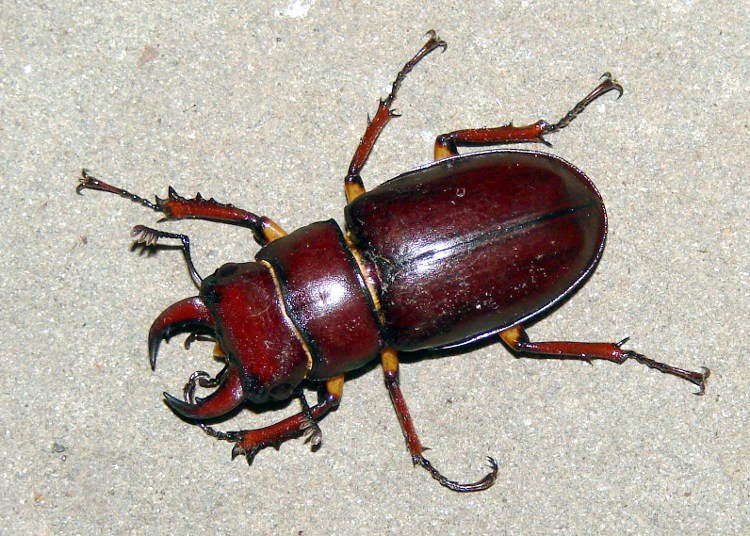
This scary-but-innocuous fellow landed on our doorstep last night.
Staghorn Beetle
He’s a staghorn beetle and, as nearly as we can tell, uses the mandibles to demonstrate his superiority over the rest of the staghorn beetles in the neighborhood.
My buddy Eks recently acquired a “guaranteed broke” Tektronix 492 spectrum analyzer that turned out to have a defunct memory board: the ROM holding the initial boot firmware has a bad checksum. He verified that by swapping in a memory board from another 492 and found it worked perfectly.
The original board used Mostek MK36400 8Kx8 masked ROMs, but they can be replaced by either 27HC641 or (in a pinch) a quartet of 2716 EPROMs. Being a stickler for authenticity, Eks picked up some 27HC641 chips. That means we need a device programmer, as none of the burners we have know anything about 27HC641s. There are other ways of getting the job done, but this has the advantage of getting me some face time with my role model for being a Renaissance Man.
Tek EPROM Power Supply Breadboard
To make a long story somewhat shorter, the 27HC641 is a 8Kx8 EPROM in a 24-pin package with the usual 12 address lines, 8 data lines, power, ground, and a single chip-select / output-enable / programming-voltage pin. Normal EPROMs in 28-pin packages have separate pins for all those functions to make life easier.
Anyhow, the CE/VPP supply must provide 30 mA at 12.5 V as well as the usual minuscule FET logic currents at 5 V and 0 V. The VCC supply must cough up a staggering 90 mA during normal operation at 5 V and 30 mA at 6 V during programming. Both supply voltages must switch between three levels: unnaturally high during programming, 5 V for normal operation, and 0 V for output-enable and during chip removal / installation in the programming socket.
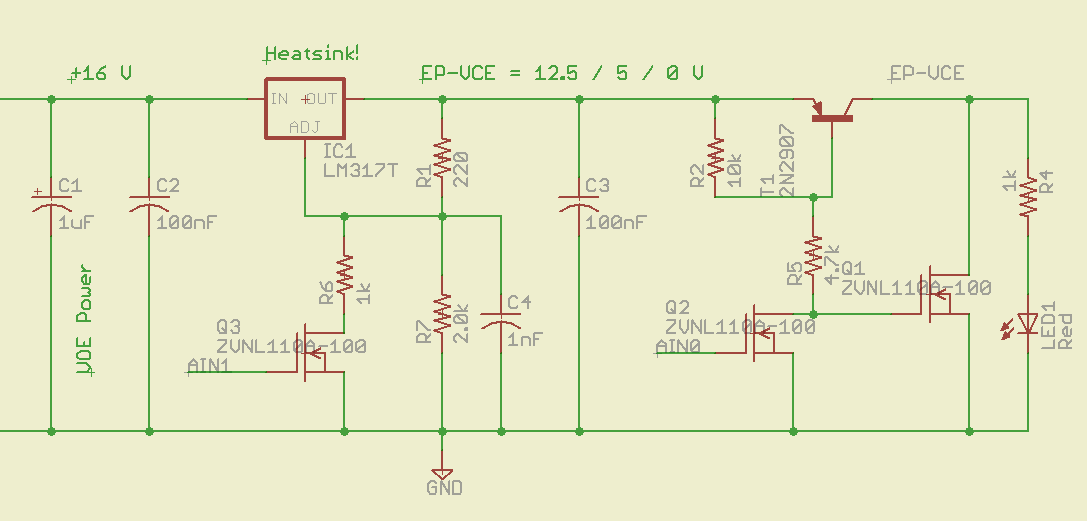
This being an entirely one-off project, I used good old LM317T regulators with a handful of transistor switches to vary the voltage and clamp the output to ground. The CE/VPP supply looks like this:
Schematic of VPP-VCE pin supply
An Arduino will drive the gates of Q2 & Q3, with all the programming logic and timing handled by software. The shortest VPP pulse is a millisecond long, so that’s not a real restriction, and the verification can happen at nose-pickin’ speed. That simplifies a lot of other things about the project, too.
Switch: 12.5 to 5 V
Q3 selects the output voltage: gate high = 5 V, gate low = 12.5 V. The scope shot shows the gate driven with a 500-Hz square wave, which is about the right width for the programming pulse.
I prototyped this on a solderless breadboard (ptooie) as shown above with 5% resistors, so the actual voltages aren’t quite nominal. The readout says 13.28 and 5.3 V, which will need some trimming to get inside the EPROM’s 5% spec.
The 1 nF cap at the LM317 Adjust terminal encourages stablity by knocking off the high-frequency stuff and slowing down the transitions just a smidge. The datasheet suggests up to 10 µF, which turns the transitions into triangles.
The LM317 can only supply current to its load, so reducing the output voltage requires the load to draw current from C3. Because this is essentially a DC application, C3 can be quite small: there won’t be any other switching going on during the programming pulse. The datasheet recommends 1 – 10 µF, but definitely more than 5 nF.
The LED is actually a key part of the circuit, as it draws current to pull the output voltage downward: more LED current = faster transition time. However, higher C3 = slower transitions.
Fall time: 12.5 to 5 V
Seen at a higher magnification, the falling edge of the output waveform shows a decay that lasts 50 µs or so. The LED draws maybe 12 mA at 13 V, so the voltage across C3 should drop at
(1/100 nF) x (12 mA) = 120 V/ms
Applying a straightedge to the early part of that curve looks like 25 V in 100 µs; call it 250 V/ms, maybe a bit less.
What’s a factor of two among friends, particularly given the tolerances on ceramic caps?
T1 and Q1 (I don’t know why Eagle’s models use both T and Q as transistor prefixes, it’s probably an international thing) switch the output line between the LM317 and ground; I suspect just turning T1 off would work as well, but this way the chip pin is firmly held to 0 V, where it should be, regardless of leakage and other oddities.
Switch: 5 to 0 V
Because Q1 crops both sides of the transistion, the rise and fall happen in nanoseconds rather than microseconds.
So, now that I know this will actually work, I can build a PCB and write some firmware…
Memo to Self: make sure the code waits for the output transitions. Methinks delayMicroseconds() will be a constant companion.









 The Smell of Molten Projects in the Morning