The Smell of Molten Projects in the Morning

Ed Nisley's Blog: Shop notes, electronics, firmware, machinery, 3D printing, laser cuttery, and curiosities. Contents: 100% human thinking, 0% AI slop.

Author: Ed

  • APRS Coverage in Eastern PA

    PHG Plot - Sojourn - KE4ZNU-9
    PHG Plot – Sojourn – KE4ZNU-9

    I was running my GPS-to-APRS tracker while on a bicycling vacation along rail-trail paths around southeast PA. I expected good coverage in urban areas and not much in the woods, which is pretty much how it worked out.

    Here’s a plot of my track (from aprs.fi), with superimposed half-size PHG (Power-Height-Gain) “circles” for the digipeaters that caught my signal. Clicky for many more dots.

    The first part of the ride, from BB62 in Camden NJ to Pottstown PA, had good coverage.

    A bus jaunt from Pottstown to White Haven, just north of I80 along the Lehigh River gorge, accounts for the abrupt jump. I dropped off the face of the earth at White Haven, riding south along the Lehigh River to Jim Thorpe, then along some undeveloped trails to resurface just north of Allentown.

    Strangely, there are no points east from Allentown to the Delaware, then south along the river & canal to Trenton. We stayed overnight on Bull’s Head Island where, as nearly as I could tell, there were no other APRS signals at all.

    A plot of all the APRS activity (and, thus, all the active digis) for a different 24 hours shows the gaps in coverage match up fairly well with where I wasn’t heard. These are also half-size circles, but don’t take topography into account. Notice that the trails along the Delaware run right through the no-coverage zone!

    PHG Allentown to Camden - 24 hours
    PHG Allentown to Camden – 24 hours

    I’m not sure why the digis caught me going into Allentown and not going out, but the vagaries of RF propagation remain inscrutable. Even if the digipeater could receive a clear signal, a collision between two transmitters can kill both packets stone cold dead. In addition, I’m using 100 Hz tone squelch and some receivers may not decode packets with tones.

    Another possibility is a path (WIDE1-1, WIDE2-2) that allows only two hops to an Internet gateway. In those remote regions, it may well be that I should have had a path allowing three or four hops. However, I wasn’t hauling along all the programming gear to tweak the TinyTrak3+ on my bike. If I lived around there, I’d have a better appreciation of what’s needed to get out of the valleys.

    In any event, it was an interesting exercise…
  • Epson R380 Waste Ink: Gadzooks!

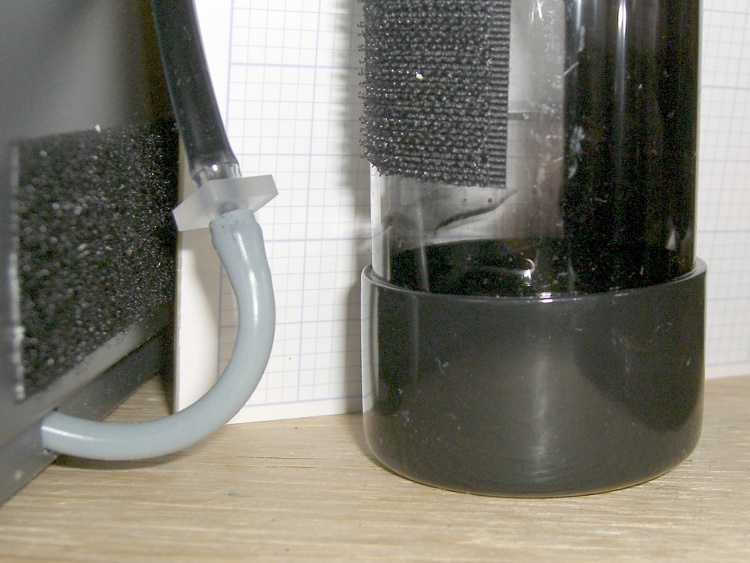
    The amount of ink dumped into the external waste ink tank is staggering. A single head cleaning results in a stream of ink pouring into the tank. After a few weeks of watching that, I stood the tank on end: to my astonishment, the ink pretty much fills the black endcap.

    Waste ink collection
    Waste ink collection

    In round numbers, the cylinder is 40 mm ID and the cap is 20 mm tall. Volume of a cylinder is πr2h, so you’re looking at 25×103 mm3 of waste ink.

    Seeing as how 1 mm3 = 0.001 ml, the tank currently holds about 25 ml of ink!

    The printer has six cartridges. Assuming head cleanings drain an equal amount from each cartridge, that’s 4 ml apiece. Given that the large OEM ink cartridges come with 11 ml of ink, you can do the math: a third of a cartridge of each color just for head cleanings so far.

    I do not object to head cleanings; that’s how they keep all those teeny little nozzles free of gunk. However, coupling that ink usage with minuscule ink tanks is robbery, plain and simple.

    The next time you hear a printer manufacture tout their greenness, you can spit right into their shadow for me.

  • HT GPS + Audio: Revised Schematic

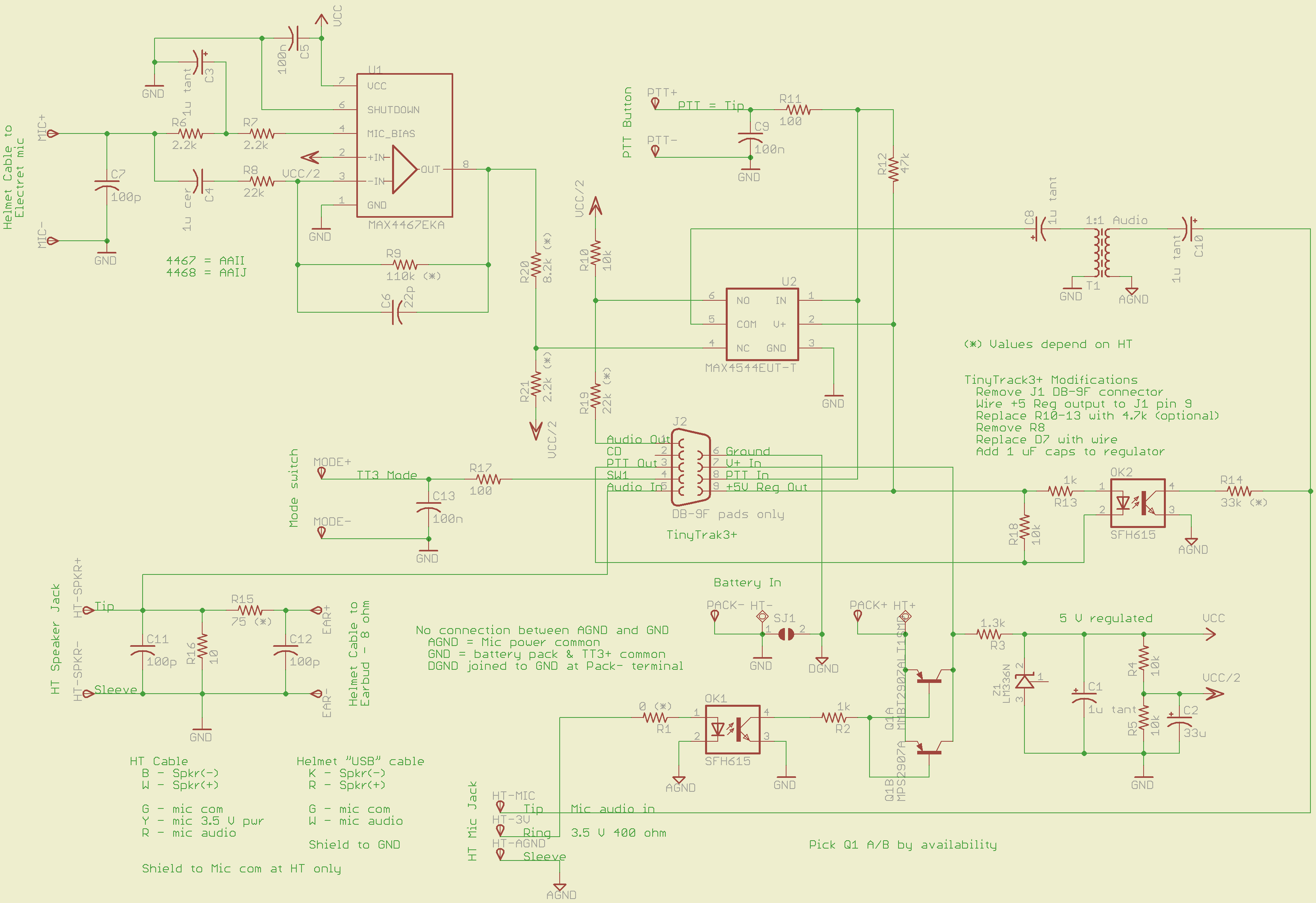
    This is a tweak to the previous design, based on some road testing.

    An attenuator on the output of the MAX4467 voice amp allows gains below unity. Right now, the MAX4467 has Av=5 and the attenuator cuts it back by about 1/5, so the overall gain is about unity. I have a bunch of surplus electret mic capsules and some have come through really hot; this allows backing the gain way down with the mic amp set to Av=1.

    That requires stiffening the Vcc/2 supply by swapping in a 33 µF cap for the original 1 µF unit. If you don’t do that, the amp turns into a oscillator: the attenuator jerks the Vcc/2 supply around, which feeds back to the non-inverting input of the MAX4467. In principle, the gain should be less than unity, but I wouldn’t bet on it.

    The MOSFET relay sometimes didn’t quite turn on from the piddly 4 mA available through the ICOM IC-Z1A’s mic power supply; it was vaguely temperature dependent. I returned to an ordinary optocoupler with a CTR of about 100% driving a 2N2907 PNP transistor, as in the first-pass design that you never saw.

    The two 2N2907 devices allow either a through-hole TO-92 or SMD SOT-3 package, depending on what you have and the power dissipation you need. In my situation, the SMD version suffices, with less than 100 mV of VCE saturation.

    Let me know if you need the Eagle PCB files or PCB layouts.

    Clicky for a bigger image…

    GPS + Voice HT Interface schematic - revised 15 July 2010
    GPS + Voice HT Interface schematic – revised 15 July 2010

    [Update: I’m not convinced the Vcc/2 supply is stiff enough. I ripped out the attenuator and cut the amp gain to 1.0. If I get some really hot capsules, I’ll think it over a bit more.]

  • Earbud Cushion Replacement

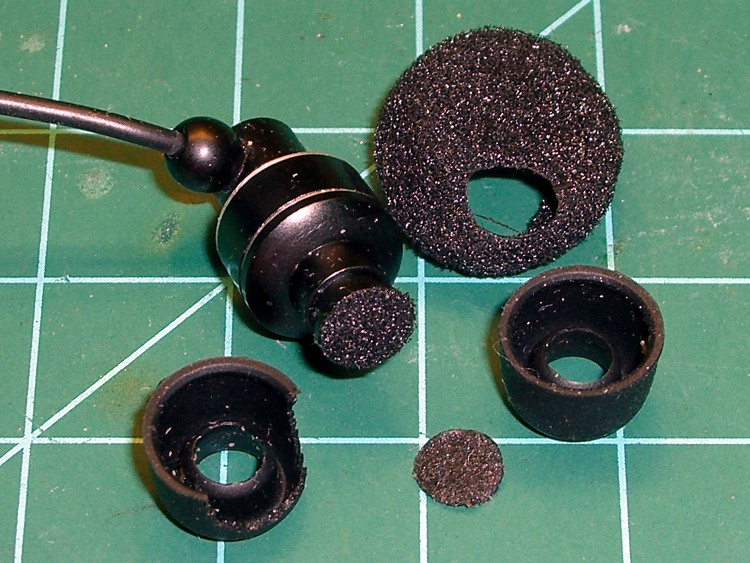
    Somehow I managed to shred the silicone cushion of the earbud on my bike radio. As nearly as I can tell, it got caught between the seat and the back; the missing part certainly isn’t inside my ear.

    Anyhow, I have a bag of spare cushions from all the other earbuds, so this isn’t a showstopper.

    The adhesive snot holding the earwax filter in place also failed, so I figured I should fix that while I had the hood up. The old filter was all ooky with earwax & oil & dried sweat, which meant that any new adhesive wouldn’t stick. I chopped a disk from a random foam earbud cover with a 7/32-inch hollow punch and glued it in place with some acrylic sealant.

    Earbud cushion and wax filter replacement
    Earbud cushion and wax filter replacement

    While I had the sealant out, I replaced the tape sealing the vent hole (on the other end of the earbud) with a dot of glop, much as I should have done originally.

  • A Night Visitor

    One of those midnight “I heard such a clatter” events: somebody or something was kicking a can all over the driveway.

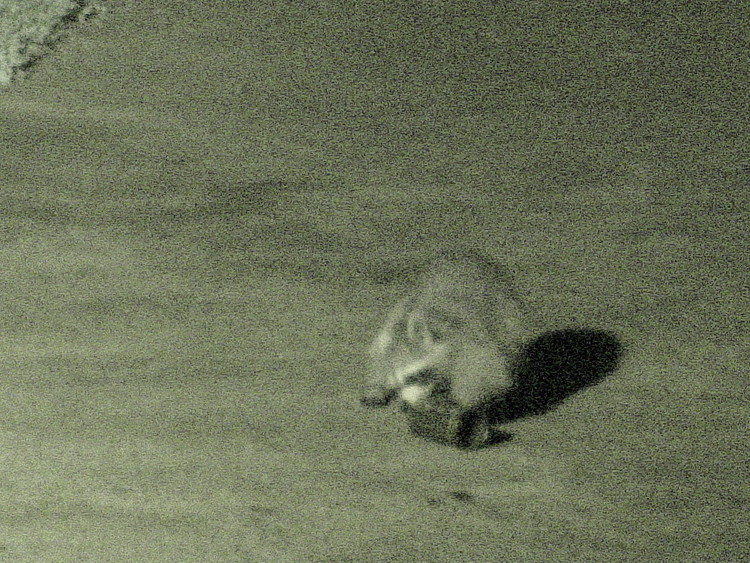
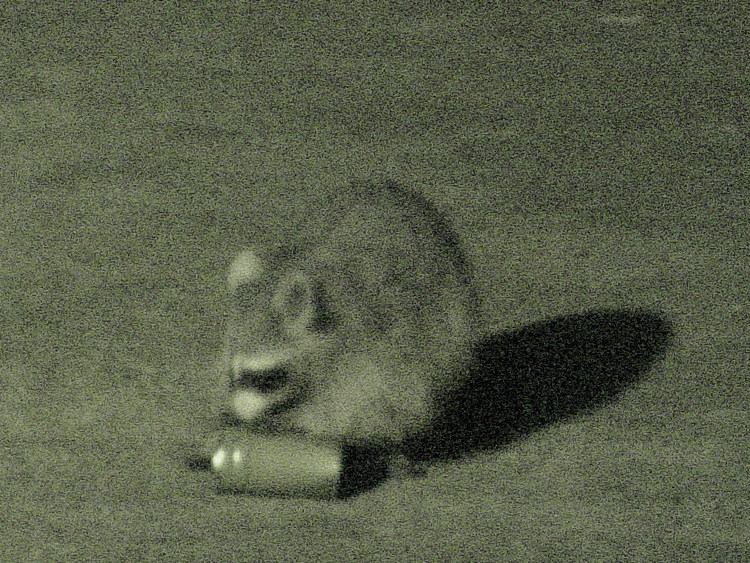
    Turned out that a raccoon found the stack of carefully rinsed salmon cans in the recycling bin and was puzzling over how to get them apart. Evidently he figured there was something really delicious hidden in there somewhere!

    I had time to fiddle with the camera before he gave up and wandered away on his rounds…

    These are in near-IR “Nightshot” mode with my ancient DSC-F717 and the 1.7X teleconverter. They’re automagic crops from larger frames, walloped en masse with ImageMagick:

    
    for f in *jpg ; do mogrify -crop 1200x900+700+450 -resize 750x563 $f ; done


    The gritty texture plays hell with JPEG compression, but that’s what the camera delivers. An incandescent spotlight on the driveway contributes the deep shadow, but an ordinary camera (my DSC-H5) produced completely black images, even with the high-power flash setting.

    Memo to self: start keeping the recycling bin inside the garage. But will that just piss off the bears that are moving (back) into the county?

  • Tour Easy Seat Clamp Doodles

    Tour Easy seat clamp doodles
    Tour Easy seat clamp doodles

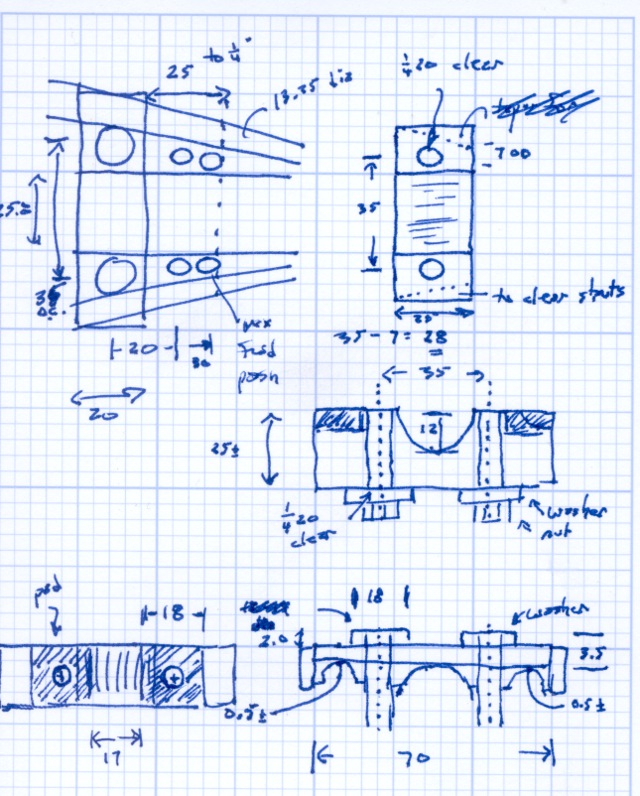
    I’ve managed to lose enough weight off my butt (it doesn’t go away, it just becomes leg muscle for a few months) that I must move the seat on my Tour Easy forward maybe 5 mm. Alas, I’ve run out of adjustment room: the frame is a Medium Large and I probably should have gotten a Medium; that decision was forced by getting a much-too-small Linear many years ago.

    The general idea here is to bolt the seat to an aluminum circumferential clamp just forward of the plate and tubes that normally secure the seat to the frame. That moves the clamping bolts about 15 cm forward, but they slide in slots along the seat bottom.

    The bolts are 1/4-20 stainless carriage bolts, with the square shank under the head sliding in those slots. I think the clamp can be about the same thickness as the existing tubes, so the same bolts will work.

    The main frame tube runs slightly above the two small tubes that stiffen the rear triangle. It’s not clear those clearances in the clamp must be contoured to fit the tubes exactly; a simple flat cutout will probably work just fine.

    The top of the clamp must have two bosses to support the seat base around the clamping screws. A line of rivets down the middle secures the seat base to the contoured (carbon?) fiberglass pan holding the foam cushion.

  • Bicycle Tire Liners FTW!

    Gashed tread
    Gashed tread

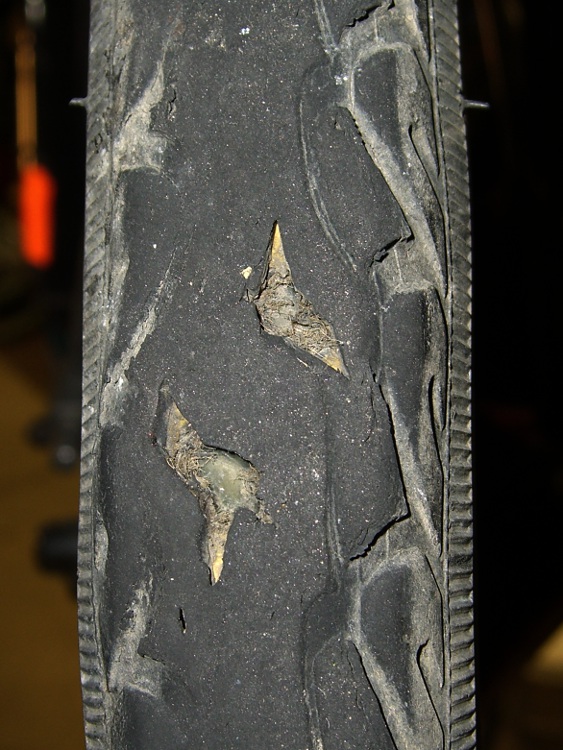
    We’re getting set up for a bicycle vacation and I did a quick tire inspection… good thing, too, considering the gashes I found in the rear tire on Mary’s Tour Easy.

    I put Schwalbe Marathon 700x35C tires on the back of our ‘bents, for well and good reason: Marathons have plenty of rubber and include a Kevlar puncture-resistant layer. In this case, that was just barely enough!

    Here’s a cross-section through the tire; the Kevlar layer is yellow, with the tire carcass fibers inward of that.

    Schwalbe Marathon tire cross-section
    Schwalbe Marathon tire cross-section

    The greenish-yellow tint in the left-hand gash (in the top picture) is the Slime tire liner (they prefer “tube protector”) showing through. Here’s what the liner looked like after we pulled the tire off; the liner shows some damage, but it’s just surface scuffing.

    Scuffs on tire liner
    Scuffs on tire liner

    Quite by coincidence, the gashes straddled the overlapped end of the liner. The end of the liner is on the tube side; I haven’t trimmed or tapered the end of this one.

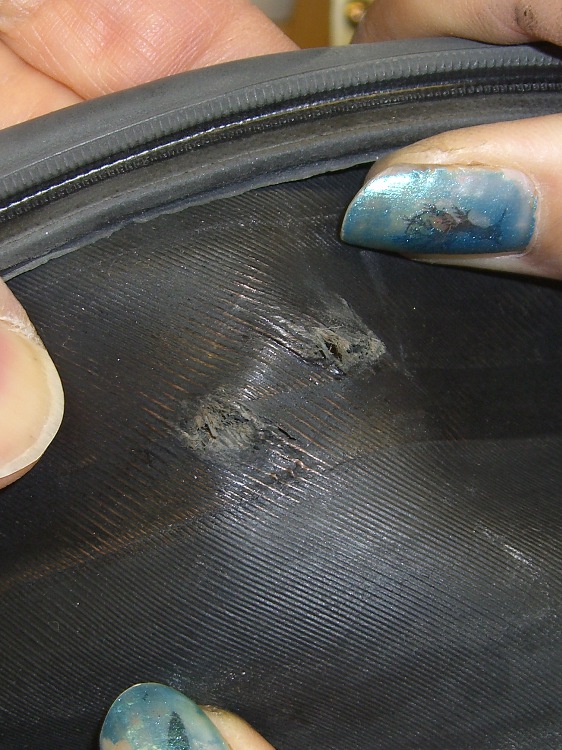
    Here’s what the inside of the tire looked like; the Kevlar fought the gashes to a standstill and left the carcass mostly intact. The painted and illustrated fingernails belong to my shop assistant.

    Scuffs inside tire carcass
    Scuffs inside tire carcass

    Here’s a cross-section through the Kevlar layer. I don’t know what Mary ran over, but it was most likely a sizable chunk of the broken glass that litters the roads around here. I doubt anybody gets prosecuted for littering, but as far as I’m concerned, a fitting punishment would be collecting the glass from a few miles of roadway: crawling on hands and knees, picking up fragments with their lips.

    Cuts through tire anti-puncture layer
    Cuts through tire anti-puncture layer

    I put a new tube in a new Marathon (for obvious reasons, I have a supply of both on the shelf at all times), we positioned the liner, pumped it up, and it’s all good.