Ed Nisley's Blog: Shop notes, electronics, firmware, machinery, 3D printing, laser cuttery, and curiosities. Contents: 100% human thinking, 0% AI slop.
You know those slide-out ads, the ones that emerge from the lower-right corner of your screen, demanding your attention? The ones that aren’t pop-ups, so pop-up blockers don’t work on them?
Just had this one appear.
Focus Your Attention Online
Words fail me.
BTW, if you figure out how to block those mumble things, let me know!
So I bought an octet of Sanyo Eneloop NiMH cells from the usual Amazon source and ran a few charge / discharge tests, with the hope of powering my Sony DSC-H5 for more than a few dozen minutes at a time. It’s Marching Band season!
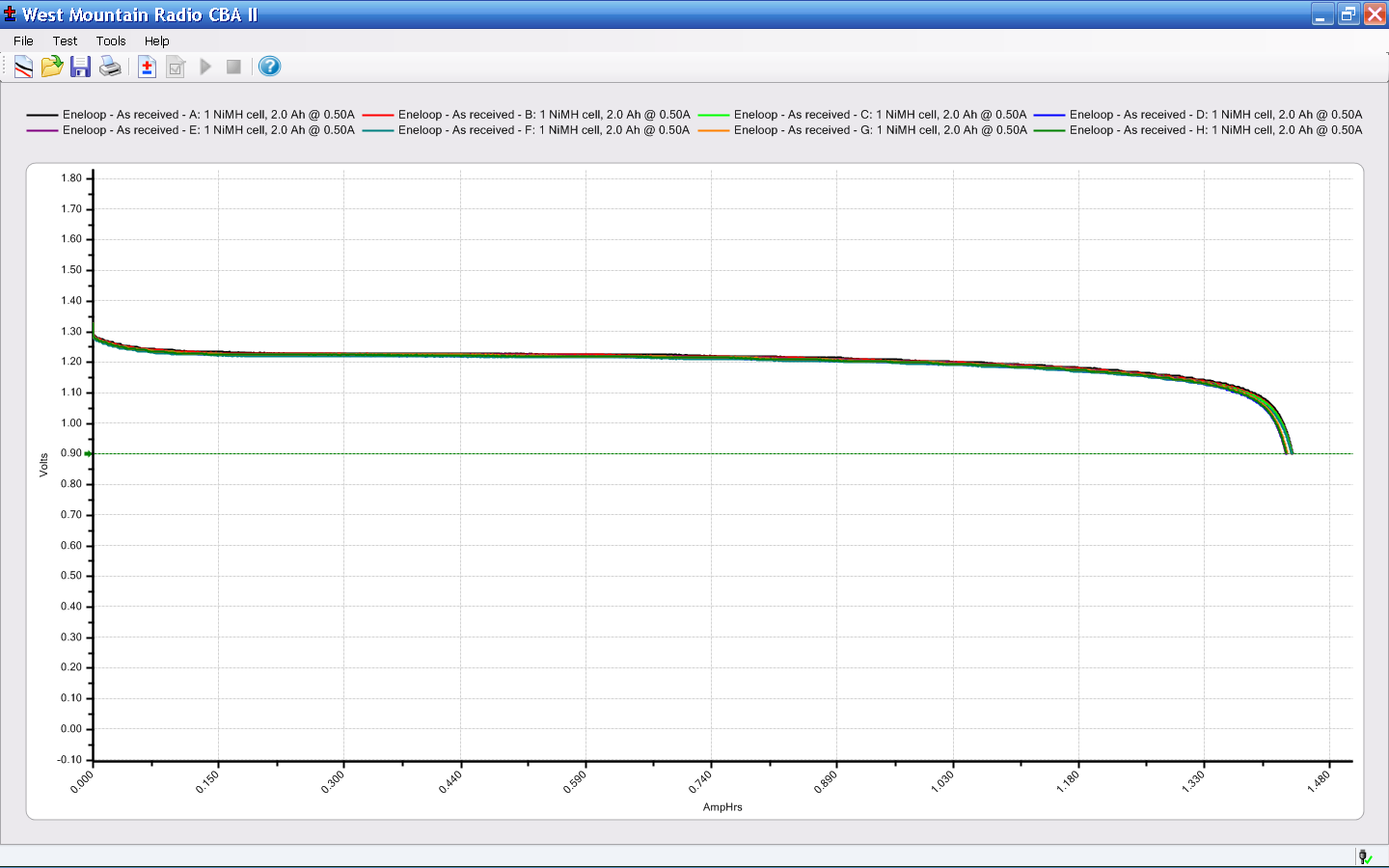
The cells bear a laser-etched 09-10-IF date code that I assume means October 2009, because they arrived in early September 2010. Rumor has it that Eneloop cells come off the manufacturing line factory-charged to 75% of their nominal 2.0 Ah; all eight arrived with the same charge: 1.43 Ah. Given the vagaries of measuring battery capacity, that’s 95% of what they started with, nearly a year ago.
The eight 500 mA constant current discharge curves are essentially identical:
Eneloop – As received
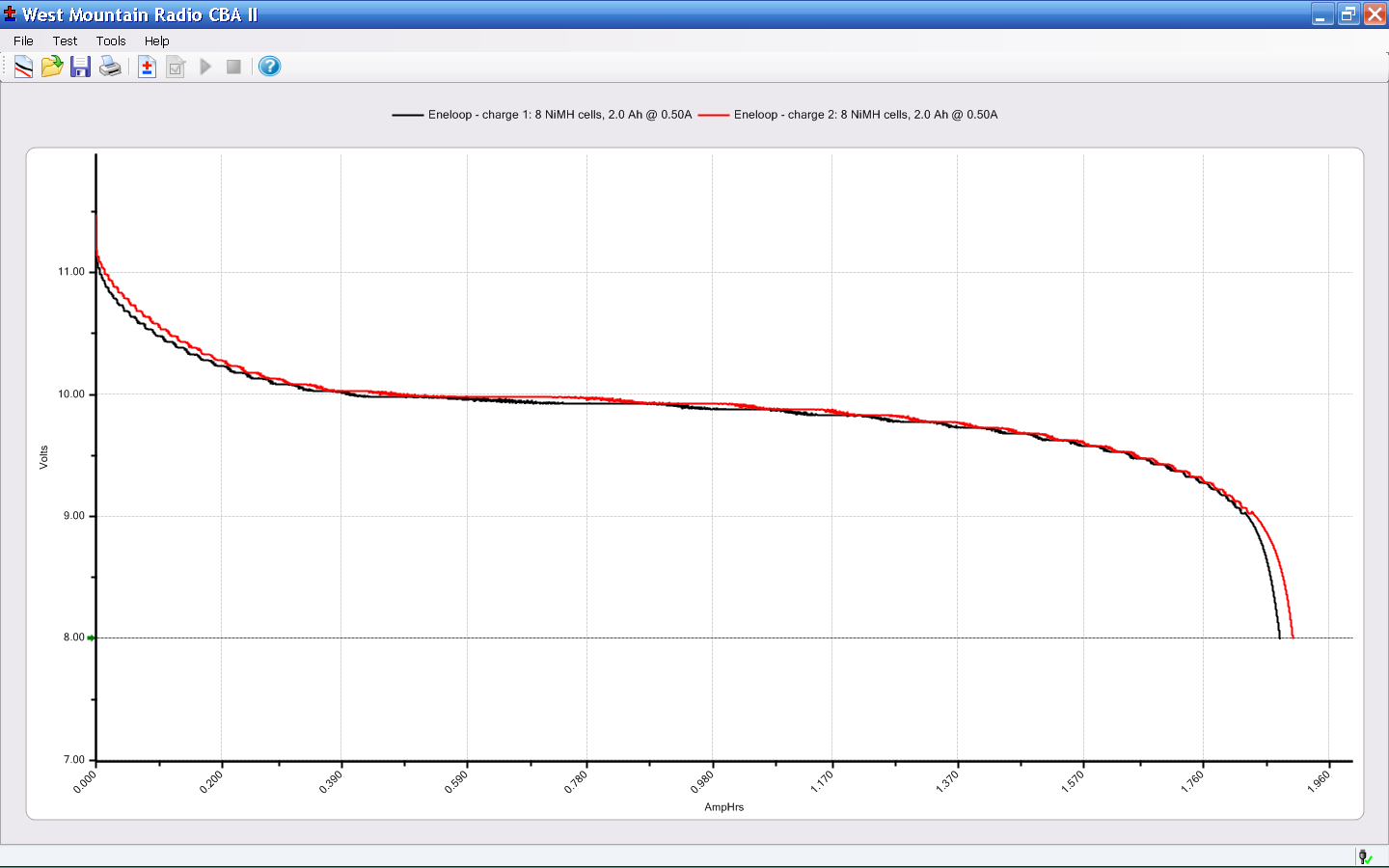
The first charge after that test was individual cells in a 400 mA charger, the second as a complete 8-cell pack with a 900 mA charger. Those two discharge curves for the pack, again at 500 mA, also overlay nicely:
Eneloop – 8-cell pack
The pack voltage remains above 9.6 V for about 1.5 Ah, far better than the tired assortment of cells in my collection (albeit those were measured at 1 A, not 500 mA).
These should get me through an entire day of Marching Band travel, setup, practice, and competition!
On my way back from a ride around the block the back tire went pfft thump thump thump. I’m 1.5 miles from home: fix or walk?
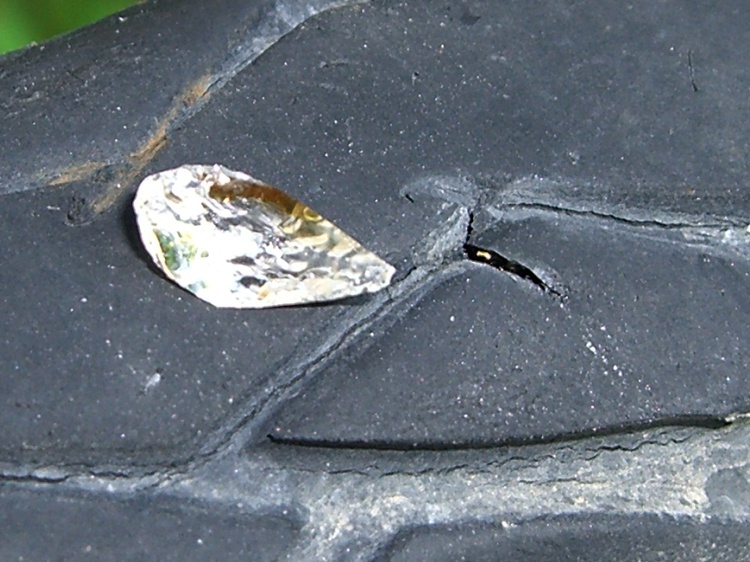
The first step: always examine the tire to find the puncture, before you move too far. Finding something sticking out of the tire means you’re well on your way to fixing the flat. Lose the entry point and you’re left to blow up the tire and listen for escaping wind. So I picked up the butt end of the bike, spun the wheel, and this little gem heaved into view…
That area of the road has seen several collisions in recent months that left the shoulder littered with broken automotive glass. The shard in my tire glistened like a diamond, because one side was flat and mirrored; perhaps it’s from a headlamp reflector or side mirror. The pointy end went into the tire, of course…
Glass fragment and puncture
Well, a single-point failure like that is easy to fix, so:
remember that the hole is a few inches spinward of the label
shift to small chainring / small sprocket
get the tool bag out
lay the bike down (it’s a recumbent, this is no big deal)
release the rear brake
release the skewer and whack the hub out of the dropouts
apply tire irons to get the tire off
pop the tube out and examine the innards
No pix of any of that, but suffice it to say I was astonished to discover that the glass penetrated the Marathon tire’s Kevlar belt just barely far enough to poke the Slime tire liner, but not enough to leave more than a hint of a mark on the tube. Definitely not a puncture and certainly nothing that would account for a sudden flat.
That glass shard is not why the tire went flat! Tire liners FTW!
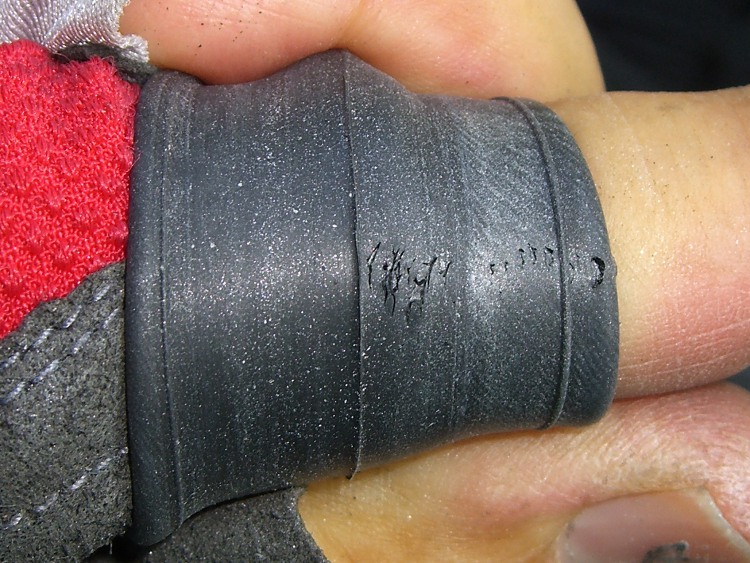
Examining the rest of the tube revealed this situation a few inches anti-spinward of the glass fragment.
Failed tube rubber
There’s a row of holes across the tube, with no corresponding tire or liner damage at all. As nearly as I can tell, the tube rubber simply pulled apart across that line, all at once, and the air went pfft just like you’d expect.
That’s not survivable, but I don’t carry a spare tube (well, two spare tubes: 700x35C rear and 20×1.25 front) on rides around the block. Long bike tours? Yup, spare tires & tubes because I’m that type of guy.
Anyway, I’ve got the tube in hand, so what’s to lose? Scuff it up with the sandpaper and yipes…
Tube after scuffing
What’s not obvious in the picture is that all those little spots around the big holes are pinholes. The whole area of the tube must have gotten just barely enough rubber to cover the mold.
I know as well as you do this isn’t going to have a happy outcome, but I slobber on the cement, let it dry, squash on a big patch, install the tube & tire, fire a 16-gram CO2 cartridge into it, and … it doesn’t seal.
The tube is several-many years old, probably from whoever was supplying Nashbar at the time, and it served well, so it gets a pass. I’d rather tubes fail in the garage than on the road and sometimes they do, but that’s not the usual outcome.
My ladies were out gardening at the time and a long wheelbase ‘bent isn’t the sort of thing you can stuff into a friend’s car. Not to mention that my ladies had the magic phone.
So I walked home.
Sometimes a man’s gotta do what a man’s gotta do.
Memo to Self: Schwalbe tube at 8910. Reversed(*) the Marathon’s direction.
(*)They’re directional, but when they get about halfway worn I don’t see that it makes much difference. The rear tire on my bikes wears asymmetrically: probably too many tools in the left underseat bag.
When I replaced the kitchen counter & installed a new sink, I added a soap dispenser, mostly because the stainless steel sink had three holes that needed filling. After nigh onto a decade, the dispenser pump is now getting sticky: difficult to push down and reluctant to pop up.
Soap dispenser pump
The problem seemed to be that the O-ring wasn’t sliding nicely along the internal bore.
The catch is that both ends have ball check valves, so you can’t just squirt lube into the bore. I tried prying the thing apart, but the snap-together cap has a really aggressive closure.
So I shoved the exit valve ball (on the left of the picture) out of the way with a pin punch, wedged it into the end of the spring, and squirted the least amount of silicone lube I could manage into the pump. A bit of fiddling un-wedged the ball and got it back in position.
The pump works fine now, but I have my doubts as to how long the lube will last with continuous exposure to soap and constant sliding.
The thing probably needs a new O-ring and I’m certain of two facts:
I bought a pair of stainless-steel water bottles on sale from the usual Amazon sub-supplier at a small fraction of “regular price”: roughly 11 bucks delivered. My ladies use water bottles pretty heavily and these looked like good, durable bottles.
Of course, you wash new water bottles before putting them into service. It’s a darn good thing I got the first look inside; these were filthy!
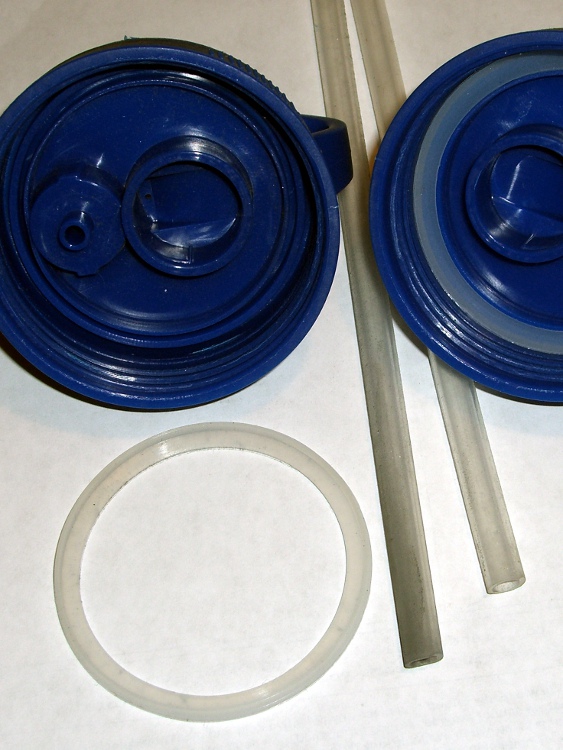
The caps have nice flexible silicone-rubber “straws” extending down into the bottles. The straw on the left was literally black with a coating of fine, powdery dust. The one on the right was merely gray.
The interior of the bottle with the dirtiest straw was, as you might expect, coated with black dust. The other bottle was comparatively clean, although I suspect the straw collected much of the free-floating dust.
I’m guessing the dust was part of the final polishing for the stainless bottles, although I can’t imagine how it got past final QC. Oh, yeah, they’re made in China, as is everything else these days.
All the parts cleaned up nicely after an attack with the bottle and tubing brushes, then two passes through the dishwasher.
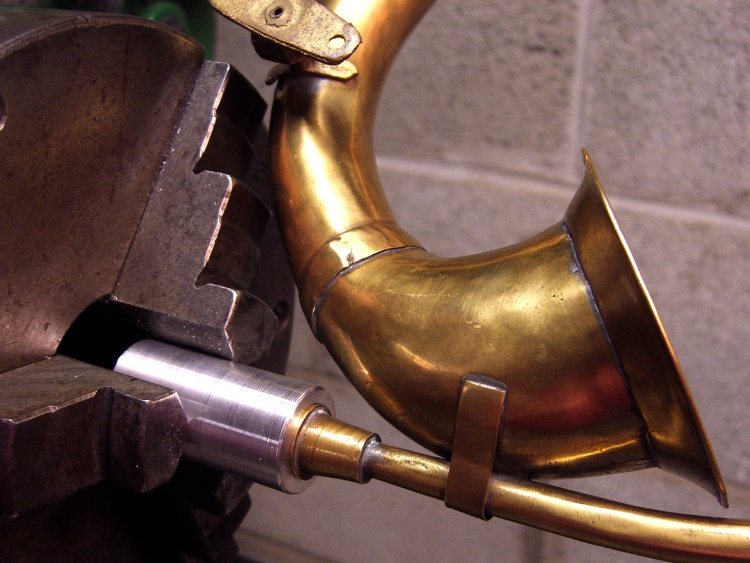
My shop assistant came home with a five-dollar tag sale find: either a genuine antique car horn or a reasonable facsimile lashed together by an underemployed Pakistani shipbreaker. The original rubber bulb had long since rotted away, but the brass reed worked fine and the horn gave off a mighty honk! when given sufficient wind.
She bought a replacement bulb with hardware definitely made by the shipbreakers, knowing full well that the internal thread on the end of the new bulb’s brass stem couldn’t possibly match up with the external thread on the old horn. We sketched out some possibilities and decided to make a bushing over the horn’s stem with an internal thread: easier than a very short, perilously thin, double-threaded adapter ring.
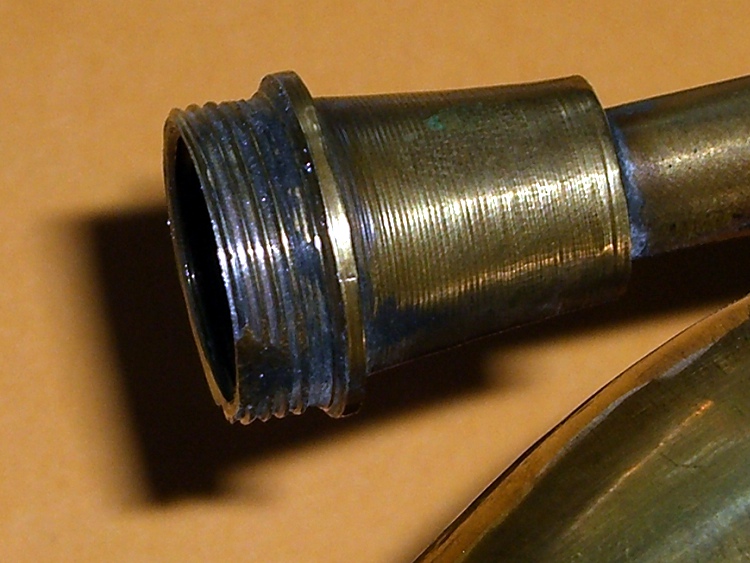
She measured various dimensions of both pieces and we consulted Machinery’s Handbook. The horn has a really crusty 32-tpi thread somewhere between 1/2 and 9/16 inch, which is not standard at all. Heck, it’s not even metric. (#include standard-metric-goodness-rant)
Horn fitting
The fitting also has an internal pipe thread (!) for the brass reed assembly. We eventually filed a few bits off the reed’s mounting dingus in order to clear the final bushing ID.
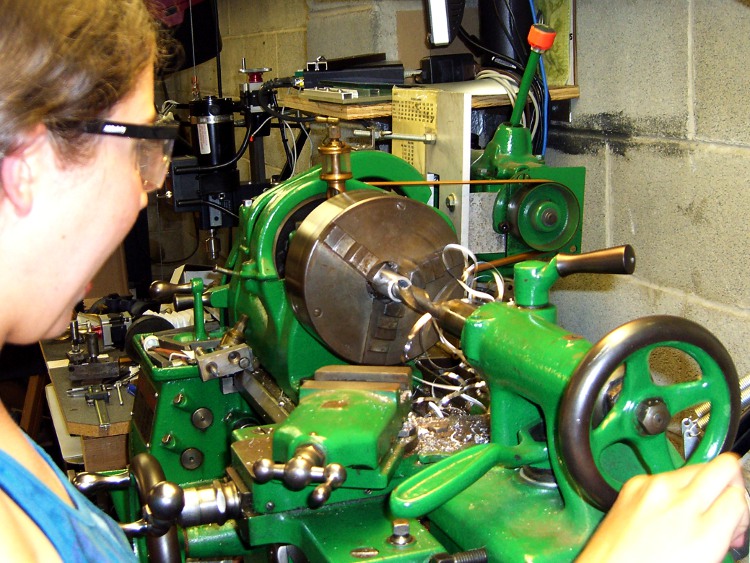
Some poking forced the scrap pile to disgorge an aluminum cylinder of exactly the right size for the bushing, with a nice half-inch hole right down the middle. Using a half-inch bolt with a center-drilled end as a mandrel, we brass-hammered it to line up pretty true, and she cleaned off the OD while learning about the quick-change gearbox; a round-nose bit at 104 tpi puts a nice zeepy (her term) finish on aluminum.
We left it stout, rather than trying to turn it down to a thin and elegant shell, because that was the easiest way to get things done. She’ll epoxy it to the horn stem and apply some Loctite to the horn bushing.
A lot of rummaging in the tool cabinet’s recesses produced a taper-shank drill slightly larger than the bulb stem. She drilled out most of the cylinder’s guts, leaving just enough for the threads at the far end, counting 1/10-inch turns on the tailstock all the way.
Shop Assistant Making Swarf
That pile of razor-edged swarf is now prized possession…
She bored out the narrow end to what seemed like the right minor diameter, given that we really didn’t have anything more than a guesstimate of the thread dimensions. I figured we could just continue threading, eating away at the ID, until it fit.
I don’t do a lot of internal threading, but we found a suitable threading tool, lined things up, and she learned about single-point threading by cutting a thread to match that horn. No measurements worth mentioning; this wasn’t the sort of job requiring a Go-NoGo gage.
I stayed away while she completed the threading, apart from consoling her when she discovered why you shouldn’t hand-rotate the chuck with the quick-change gearbox disconnected. We picked up the thread again and she completed the mission.
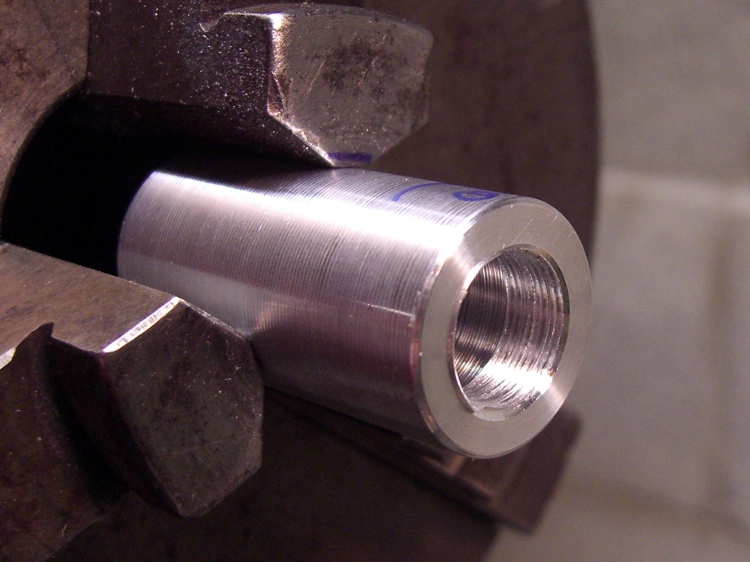
Here’s the raw thread before beveling the entrance.
Horn Bushing
And then it fit! Verily, the horn itself was the Go-NoGo gage.
Horn in bushing
This was the second part she’s turned on the lathe; I’d say she’s doing just fine.
With transformer, circuitry, and firmware in hand, the final step is to get juice to the workpiece. Resistance soldering depends on passing a high current through a relatively low resistance: the power varies as the square of the current, so more current is much better.
The catch is that the transformer produces a relatively low voltage, so the initial circuit resistance must be exceedingly low. With 5 Vrms from the transformer secondary, a mere 0.5 Ω in the secondary circuit limits the maximum current to 10 A. Even with most of that in the joint, it’s not gonna work as you expect.
I scrounged some very flexible 6-conductor signal cable with several shields that, with everything conductive crimped-and-soldered together on both ends, worked out to 1 mΩ/foot. A pair of 7-foot leads with copper lugs swaged-and-soldered on each end, bolted together to the transformer secondary, produced 280 A at 4.1 V: a bit over a kilowatt. The secondary winding and lugs evidently contribute 4 mΩ of resistance to the total.
CAUTION – That much current makes the cables twitch in their own magnetic field. If you wear finger rings, bracelets, or metallic body jewelry, remove it. A metallic ring looks like a single shorted secondary winding that can couple magnetic flux from the cables and get surprisingly hot surprisingly quickly.
Don’t put the rings in your pocket, either. Your pants are not a good magnetic shield.
With that in mind, some electrodes:
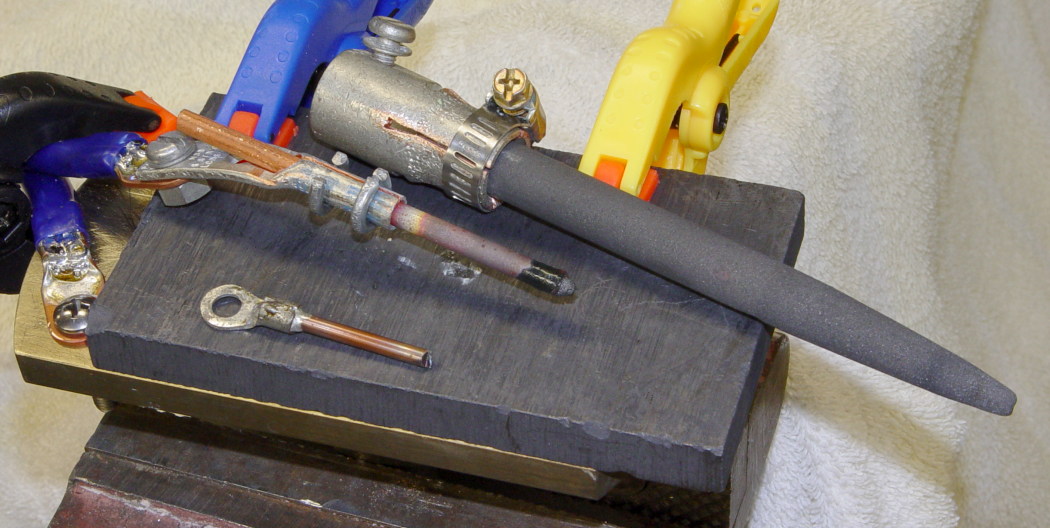
Electrodes
The black block is a slab of machinable graphite clamped to a brass plate that probably served as a wall bracket in a previous life. It serves as a nice base for most operations: conductive, non-sticky for solder, doesn’t produce nasty arc scorches. A cable from the secondary bolts firmly to the brass plate and the vast surface area provides a low-resistance contact. The cheesy plastic clamps work fine: the block doesn’t get too hot.
The huge electrode comes from a carbon-arc spotlight. It’s actually too long, with too much resistance, and doesn’t work well at all.
The tiny electrode is a steel welding rod (for gas welding). It works well for very small setups, but has essentially no resistance and requires low duty cycles.
The Goldilocks electrode in the middle is a length of 5/32-inch carbon gouging rod (for arc welding). It has a copper coating that tends to burn off near the tip, but the overall resistance remains low enough that the joint heats well. The middle glows yellow-hot if you overdo things, hence the discolored section.
To date, I’ve used a few inches off the end of one 12-inch rod. There are 49 more rods in the package. If you build one of these things and don’t want to pass a similar box along to your heirs, drop me a note and I’ll send you a rod.
The scrap box emitted a sturdy cardboard tube that slipped over the cable so well that I simply gave up thinking about making an actual handle with a contact switch and all that stuff.
Resistance soldering electrode handle
All the electrodes terminate in homebrew clamps made from copper lugs that bolt to the transformer’s secondary terminals with 10-32 machine screws. The gouging rod has steel rings (forged from husky wire) holding the lug closed around the rod; they’re a pain to (re)move, but ensure very solid contact. The cable termination is swaged-and-soldered.
AA Cell Clamping PliersCenter Electrode – Front Detail
I have not yet conjured up a pair of tweezers, as almost everything I’ve done has been suitable for pressing against the carbon plate.
One exception: a pair of snap-ring pliers became a clamp for AA cell positive terminals and worked well in that capacity, along with a repurposed oil burner tungsten electrode that even provided its own ceramic handle.
If I ever get around to building tweezers, I’d probably use chunks of that tungsten rod. It’d be easy to put a contact switch in there, too.
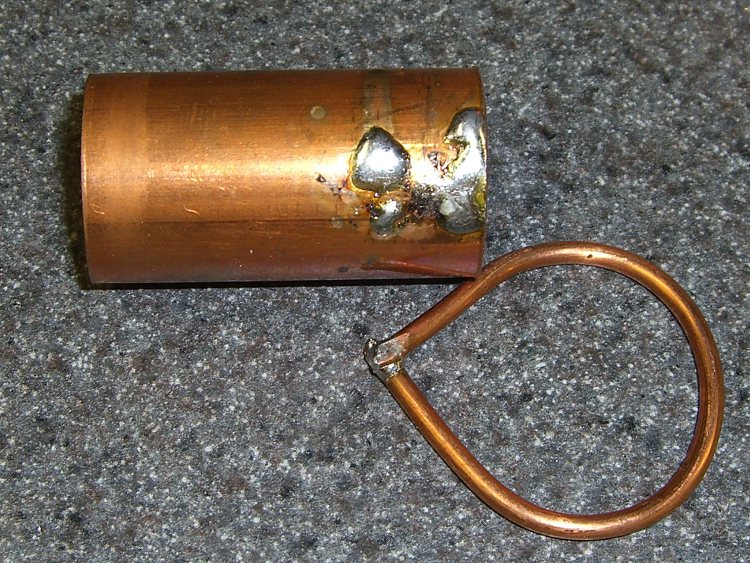
Right after I got it working, I grabbed some copper junk and tried it out:
Resistance soldering test pieces
Notice that there’s not enough heat in the surrounding metal to discolor it. I’m not always that lucky good, but it’s possible.
The copper wire was instructive: even though copper is a great conductor, the joint is the lowest-resistance part of the circuit and gets all the heat. If you think of it as a parallel circuit, the ring has a relatively high resistance and sees much less current.
Cleanliness and good joint preparation are vital, because any nontrivial resistance will reduce the heat to zilch. The tip of the carbon electrode sometimes acquires an insulating flux coating; a swipe on a file solves that problem
Solder foil works well, because the current passes through the solder and starts the melting process in the middle of the joint. That’s easier than fiddling with solder wire, although your mileage may vary depending on what the joint looks like.
It’s a great tool; I wonder how I got along without it.
Now, I really must put that widowmaker breadboard inside an enclosure. There’s a dead dehumidifier near the bench (slated to contribute its compressor as a vacuum pump for a hold-down chuck on the mill) with a case that just might be the right size…







 The Smell of Molten Projects in the Morning