Ed Nisley's Blog: Shop notes, electronics, firmware, machinery, 3D printing, laser cuttery, and curiosities. Contents: 100% human thinking, 0% AI slop.
In addition to those after-restoration images, here are some pix from an old family album that show our 1957 Studebaker President in its prime.
I think these were taken around 1970, but I really don’t know. As with many family pix, I also have no idea why these were so important…
The photos were in bad shape, as you can see in the lower-right image, with the magenta dye having faded very little over the decades compared to cyan and yellow; they’ve been brutally color-corrected and contrast-stretched. They were also printed on horrible satin-finish paper and that fishnet overlay is painfully obvious.
If you need an original image for some perverse purpose, let me know…
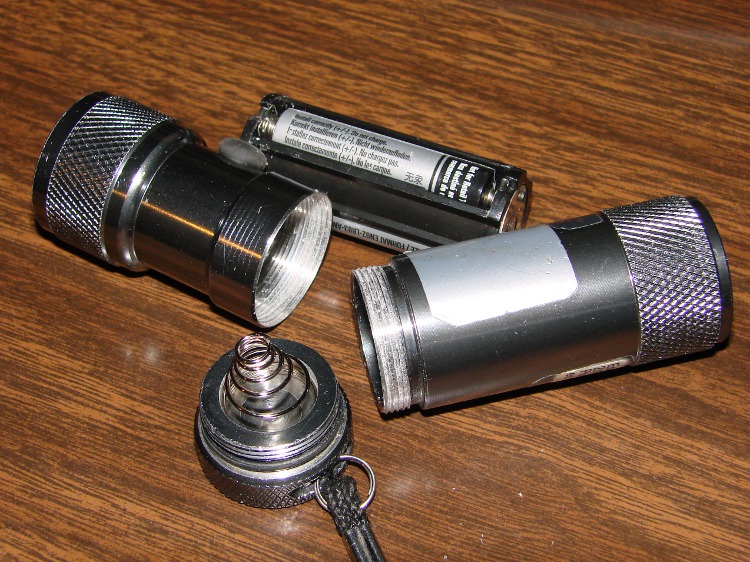
Of late I’ve been toting an LED flashlight / laser pointer around in my pocket for peering into dark corners and highlighting interesting objects. It started flickering and I discovered the joint just aft of the switch had become slightly loose.
Disassembled LED Flashlight
Well, I always wondered how the thing came apart and now I know!
The threadlocking compound seems to have turned into dusty white powder, although my pocket doesn’t seem all that hostile an environment.
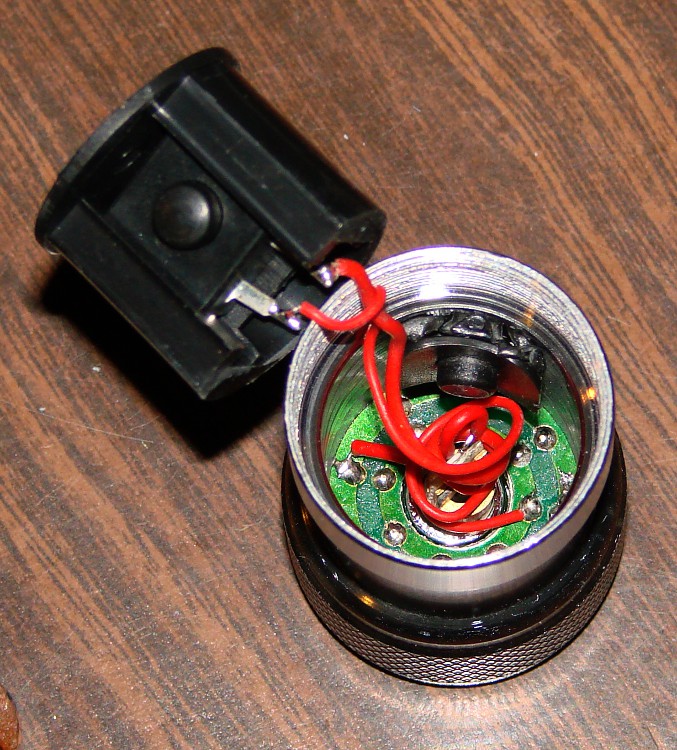
Flashlight innards
The switch assembly pulls out, revealing the LED circuit board with the laser module in the middle. The two wires correspond to the two ON states: flashlight and laser.
For what it’s worth, the 8 LEDs draw 130 mA (16 mA each), far more than the 3 mA each in that pathetic work light.
The laser draws 20 mA.
Screwed everything back together and it works fine again…
It seems Evolution 2.32 moved its email files from ~/.evolution/mail/local (where I previously tweaked their location) to ~/.local/share/evolution/mail. As a result, Evolution fired up with all its various options and accounts still in place, but with a completely default set of folders.
After considerable thrashing around, all that’s required is a simple:
cd ~/.local/share/evolution
mv local local.base
ln -s /NFS-mounted-directory/Mail local
And it all works again.
This actually happened in 2.31.6, but the Arch Linux version jumped from 2.30.3 to 2.32.0 in one fell swoop. Some version of the Evolution changelogs are there, but the money quote is:
Evolution 2.31.6 2010-08-02
---------------------------

Evolution now complies with the XDG Base Directory Specification [1],
which means user-specific data is no longer stored under ~/.evolution.
Instead, data is partitioned into three base directories controlled by
environment variables:

   $XDG_DATA_HOME/evolution    (default: $HOME/.local/share/evolution)
   $XDG_CACHE_HOME/evolution   (default: $HOME/.cache/evolution)
   $XDG_CONFIG_HOME/evolution  (default: $HOME/.config/evolution)

Data which is managed by Evolution will be migrated from $HOME/.evolution
on startup.

[1] http://standards.freedesktop.org/basedir-spec/basedir-spec-latest.html
I think the “migration” tripped over the symlink I used to aim just the mail folder to the NFS mount.
One could argue that such a wrenching change should get some advance warning, but …
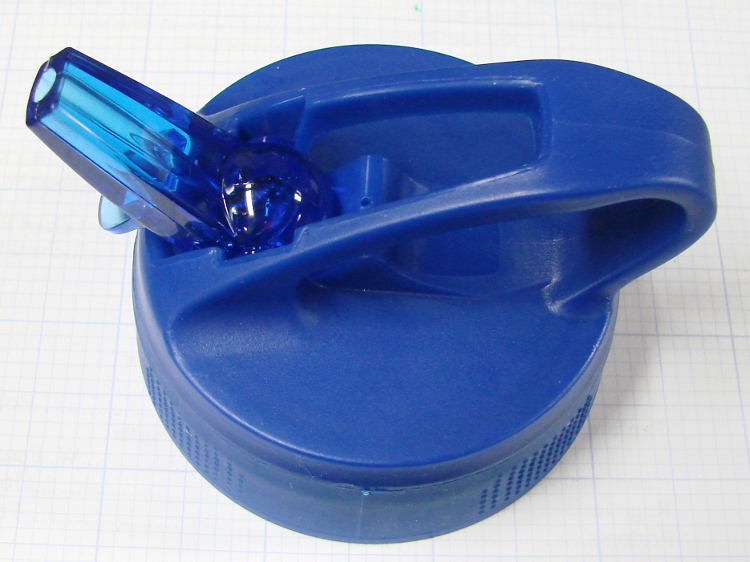
Those water bottles turned out to have an unexpected feature: the vent hole dribbles when they’re laid sideways. I think it’s an unfortunate side effect of a product cheapnification: the spout is slightly concave on the side that could seal the vent, so surface tension sucks water out of the hole.
The hole is to the right of the spout, in the center of the transverse ridge. Looks like a little black dot here; clicky for a somewhat bigger image.
Water bottle cap showing vent hole
The solution is to put a silicone plug at the Spot Marked X on the spout, which I marked by running a small punch through the vent hole and scarring the spout. You might be able to see the tiny mark on the spout if you look closely.
The spout comes out of the cap with a firm pull, but the sockets in the cap are obviously not intended to take much of that abuse. It’s not clear to me that the designers of these things ever take cleaning into consideration; past experience says you must completely dismantle fluid-facing components to get the crud out.
Anyway.
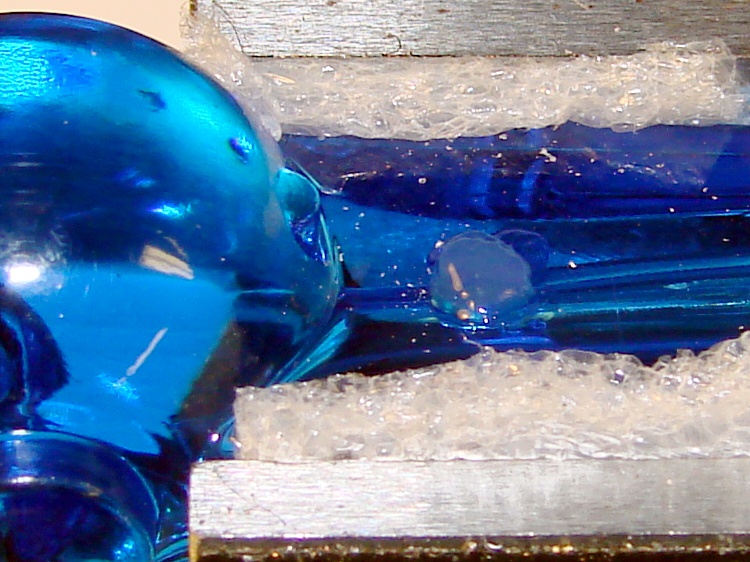
Chuck the spout up in the Sherline mill, align over the spot, and mill a 1/8 inch diameter flat-bottom hole 0.100 inch deep. The spout has a large finger-friendly flange directly underneath the Spot Marked X, so this setup isn’t quite as precarious as it looks.
Milling socket for vent plug
Dab in a little silicone caulk, leave a mostly flat surface standing just higher than the spout’s concavity, and we’ll see how well it works.
Vent plug
The little nub just to the left of the new plug (on the ball-shaped part of the spout) engages the edge of the socket in the cap to sorta-kinda hold the spout closed. Doesn’t really accomplish much, but it’s a nice thought.
If there’s anything to reincarnation, next time around I’m going to put in a request to be a Staff Turtle at the Vassar Farm Environmental Station.
Vassar Farm Turtles
Taken with my Casio EX-Z850 pocket camera, underexposed 2/3 stop to avoid blowing out the highlights even more. This is a dot-for-dot crop from the middle of a much larger 8 MP image, crisped up just slightly. Terrible results, but it’s better than the big camera I didn’t drag along on a guided geology tour (which ended with a generous handful of fine clay from the stream a bit further along).
And, yeah, I know the whole reincarnation thing says you get what you deserve, not what you want. On the other flipper, nobody really knows how it all works, so I’m not losing hope.
So Kohl’s sent Mary a killer deal coupon and we bought some odds and ends, including a new cutting board to replace the decades-old one that I’ve been flycutting clean every few years. Evidently bamboo is the new Right Stuff for cutting boards; it’s certainly eyeshattering.
The thing spent the last few days soaking up a slathering of canola oil, in the hope it won’t soak up other juices.
Recess for cutting board foot
The instructions say to store the board standing on end so it dries properly. Evidently you’re supposed to hang it from the ring screwed into one end, but a corresponding hook (not supplied) just doesn’t doesn’t have a place on our counter / cabinet / backsplash. However, we could stand it up, leaning against an under-cabinet shelf next to the toaster oven, if only it wouldn’t slide away.
This calls for some aftermarket tweakage!
So I hauled it to the Basement Laboratory Woodworking Wing and installed a pair of silicone rubber feet in little recesses.
I grabbed a 7/16-inch end-cutting end mill in the drill press, because even the manual mill doesn’t have enough height for the board on end and the drill press doesn’t have enough reach for a Forstner bit without fiddling around with the emergency drop stopper clamp. The drill press does have a good vise and an XY table, so I got it pretty close to dead center on the third dark stripe from each edge.
The feet are about 1/4 inch tall: I went down half that in the hopes they wouldn’t bump off quite so easily.
Silicone foot in cutting board
But that didn’t quite work: the adhesive on the feet doesn’t grip the rather porous endgrain bamboo nearly well enough: a foot popped off after a day. I added a layer of Genuine 3M double-stick foam tape to the feet and that’s holding just fine.
The Arduino Mega has an SMD voltage regulator soldered to a copper pad connected with thermal vias to a similar pad on the bottom surface. The datasheet says the (roughly) 10×10 mm copper pad sets RθJA=55 °C/W, more or less; probably a bit less with the double-sided setup.
It’s the chubby black slab snuggled up just to the right of coaxial power input jack. The four vias on each side go to an isolated copper pad under the solder mask on the other side.
Arduino Mega voltage regulator
The board draws about 75 mA with nothing fancy on the I/O pins, so the regulator dissipates half a watt with a 12 VDC input supply. Figuring an ambient of 30 °C, the junction temperature is ticking along at 50-60 °C.
That’s all well and good, but my rule of thumb for semiconductors is:
If you can’t hold your thumb on it for any length of time, it’s too damn hot.
That regulator fails my rule of thumb even before I start adding LEDs and other doodads.
A bit of rummaging turned up an old Thermalloy sample box with a DIP heatsink. A dab of quick-setting epoxy and there it is:
Arduino Mega regulator with heatsink
Now, I’ll grant you there are a number of things wrong with that approach, but my thumb is much happier. If it gets unhappy, I’ll just crack that puppy off and stick something larger in its place.








 The Smell of Molten Projects in the Morning