The Smell of Molten Projects in the Morning

Ed Nisley's Blog: Shop notes, electronics, firmware, machinery, 3D printing, laser cuttery, and curiosities. Contents: 100% human thinking, 0% AI slop.

Author: Ed

  • Improved Tool Length Probe Switch

    This relay-like object appeared while shoveling off the Electronics Workbench. Most likely, it started life in the white-goods world, where recurring cost is everything:

    Original relay
    Original relay

    Now, doesn’t that look just like a tool length probe? It’s certainly less hideous than the one that’s been working fine on my Sherline mill, ever since I figured out how to make tool length probing work.

    Here’s what caught my eye:

    • Plenty of switch overtravel
    • Nice metal bracket with screws
    • All the vital pieces in one convenient assembly!

    Some brute force removed the spring and actuator, a few shots with a chisel broke the adhesive holding the coil in place, and this collection of parts emerged relatively unscathed:

    Disassembled relay parts
    Disassembled relay parts

    Another shot with a pin punch removed the post from the frame. I intended to un-bend the L-shaped feature that held the post, enlarge the hole, and screw it to the mill. Alas, they formed the angle by notching the steel and it cracked when I un-bent it. No great loss.

    The two bumps on the frame held the (now defunct) restoring spring. I simply filed those off while cleaning up the broken edges.

    Drill a 10-32 clearance hole, solder a cable with a 3.5 mm stereo plug to the switch, add a plastic cable clamp, screw it to the end of the tooling plate, and it’s all good. That’s the butt end of a broken 2 mm end mill poking down from the spindle…

    New tool length probe in action
    New tool length probe in action

    Does it work any better than the previous kludge?

    A G-Code routine that displays the Z-axis coordinate where the switch trips looks like this:

    (Tool length probing test)
    
    (--------------------)
    ( Initialize first tool length at probe switch)
    (    Assumes G59.3 is still in machine units, returns in G54)
    ( ** Must set these constants to match G20 / G21 condition!)
    
    #<_Probe_Speed> =        400            (set for something sensible in mm or inch)
    #<_Probe_Retract> =        1            (ditto)
    
    O<Probe_Tool> SUB
    
    G49                     (clear tool length compensation)
    G30                     (move above probe switch)
    G59.3                   (coord system 9)
    
    G38.2 Z0 F#<_Probe_Speed>           (trip switch on the way down)
    G0 Z[#5063 + #<_Probe_Retract>]     (back off the switch)
    G38.2 Z0 F[#<_Probe_Speed> / 10]    (trip switch slowly)
    
    #<_ToolZ> = #5063                    (save new tool length)
    G43.1 Z[#<_ToolZ> - #<_ToolRefZ>]    (set new length)
    
    G54                     (coord system 0)
    G30                     (return to safe level)
    
    O<Probe_Tool> ENDSUB
    
    (-------------------)
    (-- Initialize first tool length at probe switch)
    
    O<Probe_Init> SUB
    
    #<_ToolRefZ> = 0.0      (set up for first call)
    O<Probe_Tool> CALL
    #<_ToolRefZ> = #5063    (save trip point)
    
    G43.1 Z0                (tool entered at Z=0, so set it there)
    
    O<Probe_Init> ENDSUB
    
    (--------------------)
    ( Set up length)
    
    G21                     ( metric units)
    
    (msg,Verify G30.1 above tool change switch, hit Resume)
    M0
    (msg,Verify blunt tool installed, hit Resume)
    M0
    
    O<Probe_Init> CALL
    
    (debug,Initial Z trip = #<_ToolRefZ>)
    
    O100 REPEAT [10]
    
    O<Probe_Tool> CALL
    #<DeltaZ> = [#<_ToolZ> - #<_ToolRefZ>]
    (debug,Z trip=#<_ToolZ> DeltaZ=#<_DeltaZ>)
    
    O100 ENDREPEAT
    
    M2
    

    Which produced these results:

    Trial	Z-axis mm	Delta mm
    1	26.376973	-0.000000
    2	26.376307	-0.000666
    3	26.374976	-0.001997
    4	26.376307	-0.000666
    5	26.375641	-0.001332
    6	26.374310	-0.002663
    7	26.374976	-0.001997
    8	26.373645	-0.003328
    9	26.373645	-0.003328
    10	26.372979	-0.003994
    11	26.372979	-0.003994
    
             Maximum	-0.000000
             Minimum	-0.003994
             Range  	 0.003994
    

    Notice that the results have six figures after the decimal point, but they’re really less precise: you’ll find four pairs of duplicates, which seems highly unlikely. I think the values are quantized to about 25 µ-inch and displayed as whatever the metric equivalent might be.

    The corresponding plot looks like this:

    Probe Repeatability
    Probe Repeatability

    The trend line is highly suspect, but the slope shows that the trip point gets lower by one wavelength of violet light (393 microns) per trip. The total difference is a whopping 0.004 mm during the test, call it 160 millionth of an inch.

    Both of those are better, by roughly a factor of two, than the previous probe switch.

    Bottom line: That’s OK for the sort of machining I do… ship it!
  • Peltier Cooler Test

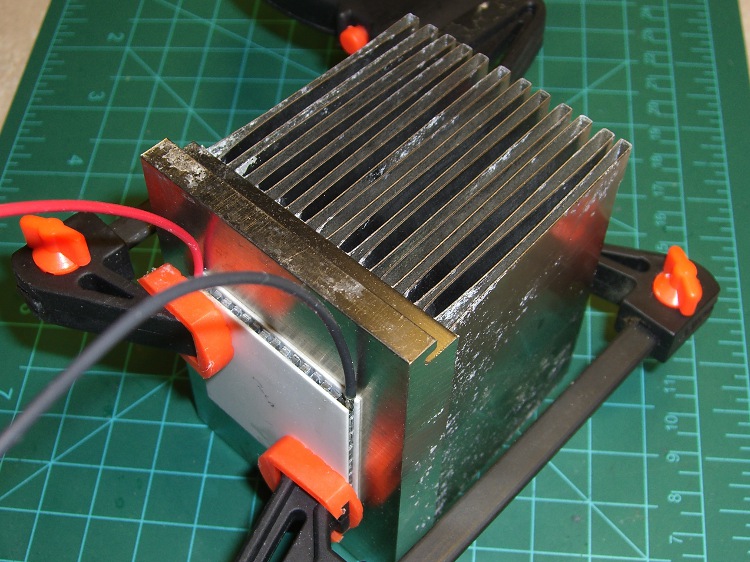
    This Peltier cooler just emerged from a pile o’ stuff on the Electronics Workbench, so I combined it with a scrap CPU heatsink (using plain old water as “thermal grease”) and fired it up to get some quick numbers for future reference.

    Peltier cooler test lashup
    Peltier cooler test lashup

    It draws 3 A (the bench supply’s current limit) at 5 V. The cold side got down to 19 °F with the hot side at 75 °F: ΔT = 56 °F.

    That’s with zero thermal load, other than whatever arrives from plain old air and those two plastic clamps. It looks like a nice one, so it’s maybe 10% efficient and could pump a watt, barely enough to cool a simple circuit.

    Freezes a drop of water just fine, though.

    The I-V curve is nearly bar-straight over the first five volts: call it 620 mΩ. The thing would draw 7.5 A at 12 V, call it 90 W, and could pump maybe a whopping 9 W from the cold side.

    Actually getting good numbers would require some serious work that I’m not up for. In particular, everything has a serious temperature coefficient, so nothing would be the way it looks. I have doubts about the efficiency guesstimate; I’d like to actually measure that sometime.

    But it confirms my opinion of Peltier coolers between hundred-watt CPUs and water-cooled heatsinks: pure delusion.

  • New Eyeglasses

    Just got two eyeglasses from a different supplier halfway around the planet, with satisfactory results.

    The frames have the largest lenses I could find that weren’t totally dorky; I still want slightly taller lenses, but that’s not the style these days. Their 35 mm lenses are slightly larger than the 35 mm lenses from previous vendor, but IMHO still not quite tall enough for progressive bifocals. The closeup curves seem to start lower on the lens, which is fine.

    The 20 mm nose bridge is a Good Thing and made the nosepiece adjustments much easier than before.

    Metal Eyeglasses-Vincent
    Dimensions
    Width 137 mm
    Earpiece 144 mm
    Lens width 50 mm
    Lens height 35 mm
    Nose bridge 20 mm
    

    I used a 60 mm Near Pupillary Distance (for the bifocal lens area), which worked fine, although 1 mm might be better.

    The regular glasses have the usual options and work fine. The 1.6 “super thin” refractive index (vs 1.5 “regular” in the sunglasses) makes the lenses noticeably thinner than the sunglasses, but I’m not sure it’s worth the upcharge.

    - I use my Glasses for: Progressive - Bifocal without a line
    - Lens upgrades 5: Progressive Lens (no line)
    - Right Sphere(SPH): -3.50
    - Right Cylinder (CYL): +0.50
    - Right Axis: 180
    - Right Addition (near) ADD: +2.25
    - Left Sphere(SPH): -3.50
    - Left Cylinder (CYL): +0.75
    - Left Axis: 155
    - Left Addition (near) ADD: +2.25
    - Pupillary Distance (PD): 62
    - Near PD: 60
    - Lens upgrades 3: Super Thin (1.6)
    - Eye Protection and Eyeglasses 1: Anti-Scratch
    - Eye Protection and Eyeglasses 2: Anti-Reflective
    - Eye Protection and Eyeglasses 3: UV Coating
    

    For the sunglasses I tried Old School with-a-line bifocals and, frankly, don’t like them much at all. The line is very distracting in sunlight, which is where I wear sunglasses. Good news: the line falls directly across the fairing on my bike, so I can see the “dashboard” on the handlebars quite clearly. Bad news: the correction is a bit much for the automobile dashboard and, unlike the no-line bifocals, I can’t tune for best picture by nodding my head.

    Their 80% gray tint is significantly lighter than the previous vendor’s 80%; next time go for 90%. Good news: unlike the previous vendor, these folks have no trouble with AR/UV coatings over a tint.

    - I use my Glasses for: Bifocal - Both distance and reading with a line
      - Lens upgrades 4: Bifocal Lens (with line)
      - Division of lenses: 70% Distance - 30% Reading
      - Right Sphere(SPH): -3.50
      - Right Cylinder (CYL): +0.50
      - Right Axis: 180
      - Right Addition (near) ADD: +2.25
      - Left Sphere(SPH): -3.50
      - Left Cylinder (CYL): +0.75
      - Left Axis: 155
      - Left Addition (near) ADD: +2.25
      - Pupillary Distance (PD): 62
      - Near PD: 60
      - Lens upgrades 1: Standard (1.5)
      - Eye Protection and Eyeglasses 1: Anti-Scratch
      - Eye Protection and Eyeglasses 2: Anti-Reflective
      - Eye Protection and Eyeglasses 3: UV Coating
      - Tint Key: Grey 80%
      - Eye Protection and Eyeglasses 4: Color Tint
    

    A list of old frame sizes is there.

  • Steel Stair Stringer: Just Make It Fit

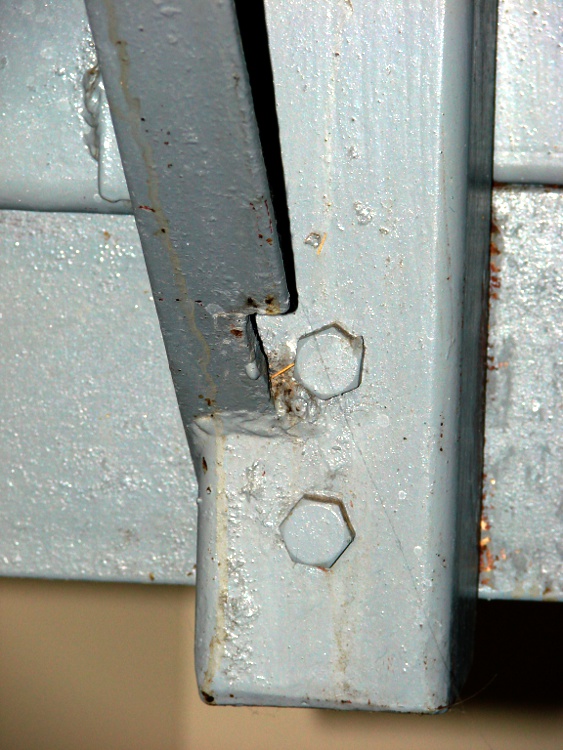
    Stair stringer cut out for bolt
    Stair stringer cut out for bolt

    Saw this in the Syracuse Sheraton: every stringer in the stairwell had a torch-cut opening so they could bolt the flight to the landing.

    I don’t know if the flights came pre-assembled (minus the concrete, I assume), but the cutouts definitely have that “WTF do we do now?” aspect about them, don’t they?

    Ah, well. I’ve been there & done that, too.

    Haven’t you?

  • Oil Filter: Oops

    So I swapped in the snow tires and did the fall oil change a few days ago. Everything went smoothly, although the oil filter, as usual, blooshed oil over the front of the engine and, despite my padding the area with rags, onto the exhaust plumbing.

    Digression: I don’t understand why the Toyota engineers felt they had to tuck the oil filter below the exhaust header, behind the front downpipe, and over the flexible coupling to the forward cat converter, with the mounting tube pointed upward. It might have something to do with their rotating the entire engine rearward to get a lower hoodline. It seems to me that angling the filter so it can’t drain and must dump its contents atop the exhaust system isn’t Good Design; I’ve been muttering about it for the last decade.

    Anyway, the new filter screwed on easily, its seal ring (seemed to) seat against the block, and one final turn snugged it up just fine. The last fraction of that turn felt gritty, as though part the shell kissed the block, but I attributed that to the fact I was using a different filter style.

    I added the usual 5 quarts of oil, wiped up the spills, cleaned off the exhaust pipes, declared victory, called it a day, and put away the tools. Later that evening, I checked for leaks, found nothing, and we drove to a meeting about 12 miles away. As you might expect, the van smelled strongly of hot oil: you cannot wipe all the oil off those pipes.

    Oil trails on driveway
    Oil trails on driveway

    The next morning, Mary drove to an all-day class about 15 miles away and, about noon, I rolled out my bike to go grocery shopping… only to discover what you see in the picture (minus the sawdust patch) on the driveway.

    This is what we call in the trade A Very Bad Sign.

    There are three oil tracks:

    • Right-front track = outbound to evening trip
    • Rightmost heavy track = return
    • Leftmost track = outbound to morning trip

    Now, the fact that there’s no huge oil slick means the drain plug is in place and properly sealed. The oil evidently leaks out only under pressure, so the filter isn’t sealed against the block. This can be due to a number of causes, the most common of which is leaving the rubber ring from the old filter stuck to the block. I checked the old filter, which was still in the trash: the seal was still in place, so that wasn’t contributing to the problem.

    Regardless, the car was bleeding to death. I called Mary and she reported a dry dipstick.

    So I loaded a 5-quart jug of oil into the right pannier, dumped all the tools that might possibly come in handy into the left pannier, topped both off with many rags, stopped at an auto parts store along the way for a new filter, and rode those 15 miles at a pretty good clip. When I got to the parking lot, it was easy to find the van: simply follow its trail. The van sat atop a disturbingly large slick, evidently caused by oil draining off every local minimum inside the engine compartment and under the forward half of the chassis.

    The filter was still firmly screwed in place, but when I got it off and compared it with the new filter, they were different: the offending filter was slightly larger in diameter and the threaded hole was noticeable larger. Although it threaded on, the threads weren’t properly engaged, the larger diameter shell did hit the engine block, and it most certainly wasn’t sealed properly.

    I installed the new filter, poured in 3 quarts to the get the oil level midway into the dipstick’s OK range, wiped off some of the oil that coated essentially every part of the engine compartment, and we drove home trailing a cloud of hot oil fumes.

    As it turned out, the old filter was the same brand as the one that didn’t seal, but with different numbers and a different prefix: the correct filter is a 3614, the wrong one was 3593. Of course, the boxes and illustrations are identical, with slightly different contents. I’m sure they’re adjacent on the shelf and migrate into each other’s slot. It’s worth noting that the filter I bought while on the way to fix the problem was a different brand sporting a part number totally unrelated to 3614.

    The butt end of the van was covered with oil, as though the droplets blew out under the chassis and got sucked up against the rear surface; the window was a mess. I sprayed on stout detergent and wiped it clean, but I think we must treat the poor thing to an all-over car wash with the special undercarriage scrub option.

    No harm done, as nearly as I can tell, although it’s an exceedingly good thing we weren’t driving off to the grandparents!

  • Blog Impulse Response

    Those of you following the blog comments by RSS probably noticed a frenzy of commentary on the bed bug posts last week. Turns out that hackaday.com posted an article mentioning my Hot Box Disinsector on the afternoon of 22 November, producing this blip in the traffic numbers:

    Page Views - November 2010
    Page Views – November 2010

    I noticed the jump shortly before suppertime, at which point the WordPress counters weren’t keeping up with the hit rate: the statistics page produced essentially random numbers for the next day.

    About 1/4 of the newcomers (welcome!) read all of the bed bug articles, punching the views up by an order of magnitude. Of course, for a real website, 16k hits per day rounds off to zero, but it’s still invigorating for a simple guy like me.

    WordPress.com inserts ads on their blogs, over which I have no control. As nearly as I can tell, most of my articles have such esoteric topics that they attract no ads at all, but, wow, Google sure knows exactly what to do with bed bugs!

    Now, I’ll return to my usual practice of fixing stuff and writing about how that goes down…

  • Monthly Aphorism: On Ratios

    • When they give you two numbers, divide them.

    The Great Green, one of my better IBM managers, used the ratios of key numbers to quickly evaluate proposals. Conversely, if a proposal didn’t have any key numbers, he knew the author was blowing smoke.

    He attended a school budget meeting many years ago, wherein someone kvetched about the cost of and need for a semitrailer of paper every year. He estimated the number of sheets, divided by the number of students, then divided by the number of days in a school year. The answer came out to about one sheet of paper per student per day, which seemed like a perfectly reasonable number to him…