Ed Nisley's Blog: Shop notes, electronics, firmware, machinery, 3D printing, laser cuttery, and curiosities. Contents: 100% human thinking, 0% AI slop.
You probably can’t see the “Test!” engraved below the blue logo, as it just changed the texture of the envelope without producing a visible mark.
The upper-right “Test!” ran at 10% (of 60 W) at 400 mm/s, with the others at 15% and 20%. The results suggest that it’s possible to remove ink and leave a visible mark, but it’s neither pretty nor dependable.
Somebody’s gotta have a weather-stable, super-flexy, dual-color, laserable material, but so far it’s hidden below my horizon.
It comes apart by rotating the lock ring (the one with right-angle ears sticking out on either side) 1/8 turn in the other direction from whichever way you think it should rotate. Hold the spray bar, shove the ears, and the spray arm will drop off:
Samsung dishwasher top nozzle – unlocked
The inside of the spray bar shows the locking details:
Samsung dishwasher top nozzle – sprayer
Now, here’s the tricky part.
The small ring under the locking ring, the one with two square nubbins pointing downward, snaps onto the pipe carrying the water. There’s a shallow notch around the pipe, the inside of the ring has a shallow lip, and the ring holds the whole affair onto the pipe.
Contrary to what I thought, the two nubbins do not latch onto anything. Apparently, they hold the ring in the proper position relative to the arm’s interior and that’s it.
The only way to reassemble the arm is to snap the small ring into place, with the lock ring above it, then install the arm and turn the lock ring 1/8 turn the other way. You (well, I) cannot snap the assembled arm into place, because the nubbins don’t provide enough oomph to seat the small ring on the pipe.
Unless I write that down, I will never remember it …
Protip: Needle nose tweezers are invaluable for picking crud out of the nozzles. Iterate on picking and flushing with water until nothing more comes out, then expect to repeat the process several times as more crud emerges from the depths of the plumbing.
Although it is apparently possible to disassemble the spray arm by unlatching all the snaps along the edge, I’d reserve that for a moment when lives depended on unclogging the nozzles.
Which turned out to be entirely too stiff, which wasn’t surprising given that Trolase Thin is intended for signage stuck on flat or slightly curved surfaces.
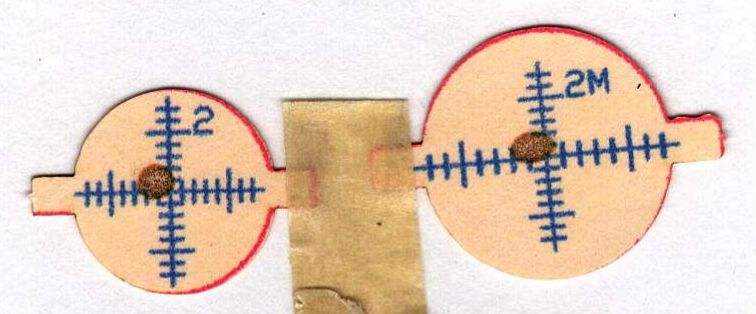
Despite being “paper”, laser testing paper is also too stiff:
Laser test paper – outdoor labels – 2024-06-22
The wrinkles and cracks on the left end of the tags shows the plastic coating makes it basically impossible to shape / bend the paper enough to wrap around a plant stem, then push it through the hole (offscreen to the left). I was not surprised too much by this discovery.
Those two strips now hang outside the kitchen window (left end upward), where they’ll get enough sun and rain to keep a plant happy, and I’ll see how well the engraved / damaged plastic coating stands up to that sort of abuse.
After whittling the wood to kinda-sorta go in there, I pressed it against snippets of carbon paper (remember carbon paper?) to mark the contact points and carve them off:
Wood desk chair – leg filler – carbon paper fitting
This occupied most of a SquidWrench remote meeting, but eventually sank it flush with the leg:
Wood desk chair – leg filler – side
Now, that’s not the prettiest job you’ve ever seen, but it gets worse:
Wood desk chair – leg epoxy shaping
This time around, I tinted the epoxy with brown and black dye, which knocked the color back to something tolerable and increased the curing time well beyond the usual couple of hours. Fortunately, I wasn’t in a hurry and it was pretty much done by the next afternoon.
Whereupon I mixed up another bodacious batch of epoxy:
Wood desk chair – caster pin prep
The Kapton tape wrap kept (most of) the epoxy out of the end of the sockets. I buttered up the sockets just below their serrated heads and tapped them into the legs:
Wood desk chair – caster pin installed
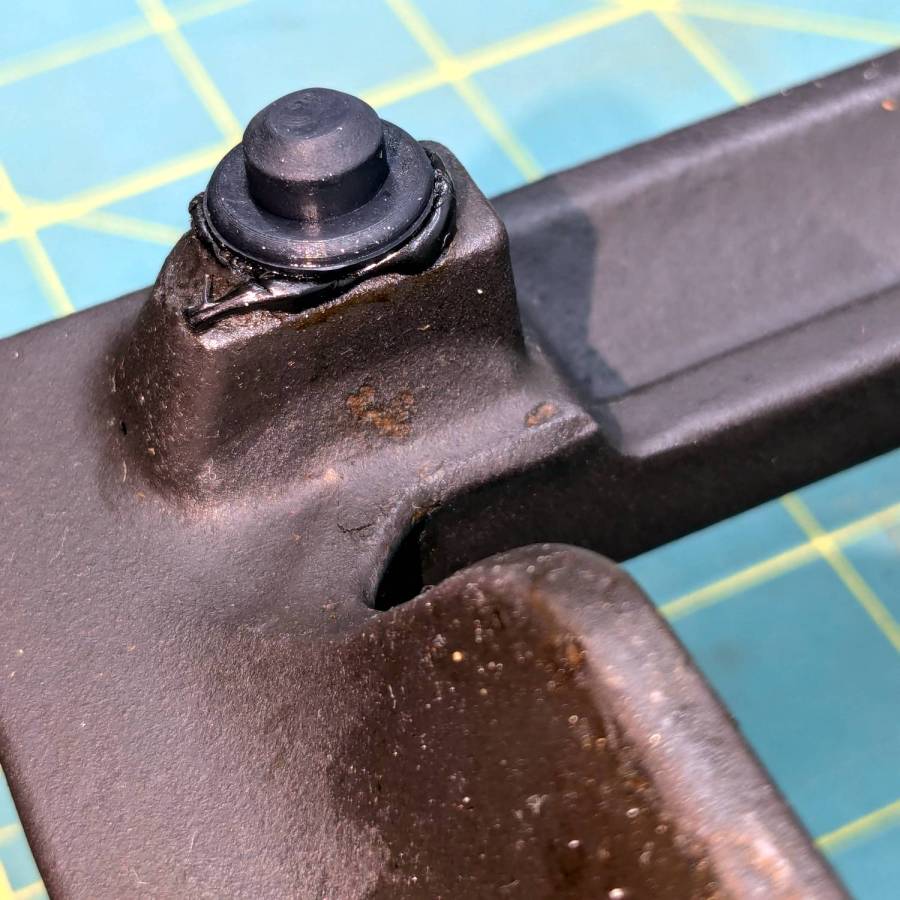
Yeah, I wiped that down a little better before another overnight cure left the four pins firmly secured in their legs; the pins still rotate (albeit stiffly) in the sockets, although the casters really swivel on their pins.
A cast iron fitting of the kind they just don’t make any more holds the legs in place:
Wood desk chair – bottom plate
My screw collection lacks chonky wood screws, but I doubt anybody will ever notice that shiny crosspoint screw.
In any event, the plate holds the legs in tapered slots along the cast iron base that also guides the height adjusting leadscrew under the seat:
Wood desk chair – leg wedge shims
The wood dovetails in the legs were a bit worn / shrunken, so I shimmed them with two strips of 3.5 mil = 0.09 mm stainless steel tape on each side and tapped the legs into place with a plastic mallet. The steel is completely invisible from outside and the legs are magically solid, just like they should be.
As expected, the new casters clash horribly with the chair’s classic style:
Wood desk chair – repaired
Somewhat to my surprise, it’s now undergoing a field test at Mary’s desk, where it replaces a chair she never liked. The seat adjusts down enough to let her feet reach the floor (which most modern chairs do not) and the edge doesn’t press on the back of her legs. We fiddled with the backrest height / angle / tension and it feels surprisingly good.
You gotta admire something with that kind of durability and repairability.
A good refinishing job would definitely improve its appearance, but that’s well beyond my abilities.
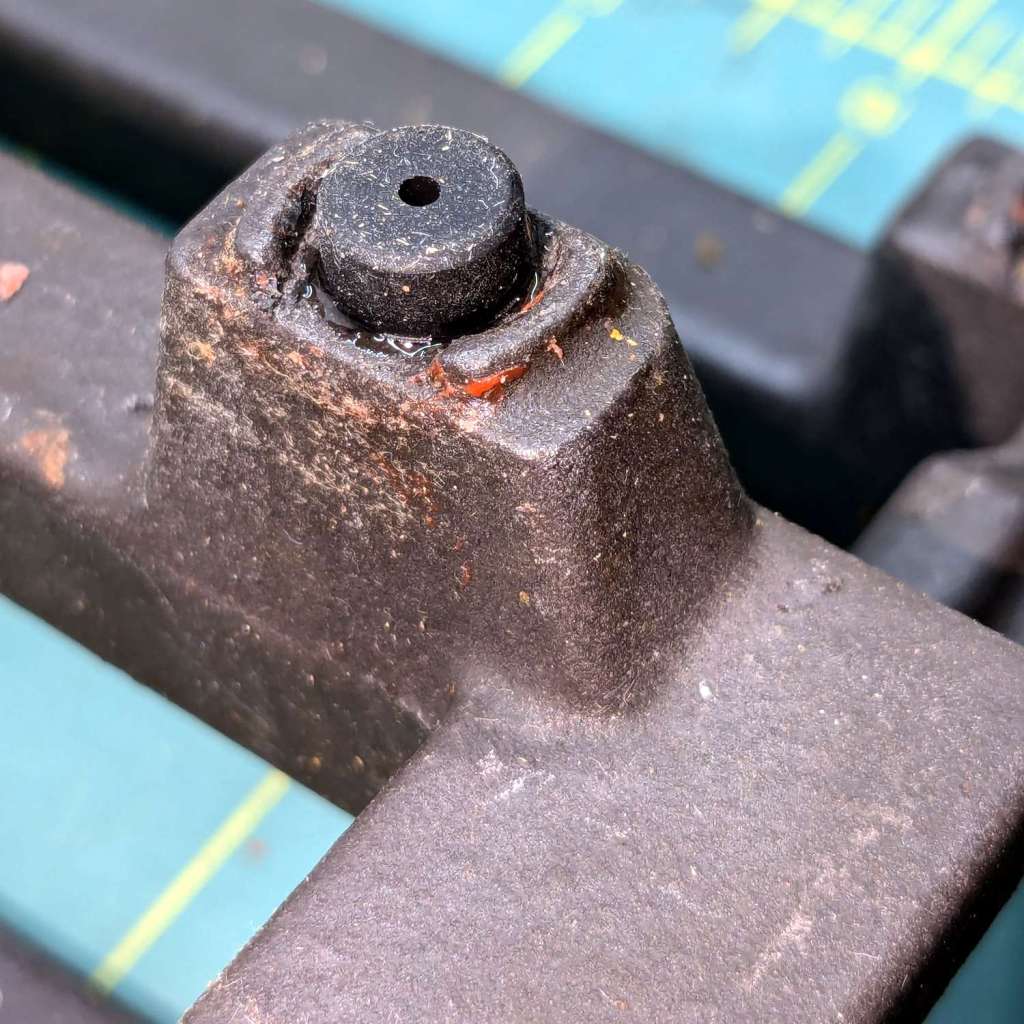
The Screen Filter (DD81-02011A) in our Samsung dishwasher (DW80K7050US) turned out to have a mold defect from the factory that’s been sitting there since the previous owners had it installed back in 2018:
Samsung dishwasher screen filter – gap
The mesh apparently didn’t quite make it into the molded plastic, so that little gap has been letting debris in the wash water circulate through the spray bars and clog the orifices.
That’s a bead of EVA hot melt glue that will probably withstand the 163 °F = 73 °C “sanitize” cycle we haven’t had any occasion to use and seems no more toxic than anything else around here.
Protip: if your dishwasher has a filter, it’s likely clogged with a nasty accumulation of gunk, too …
For several decades, a succession of PCs in the basement have served files and shared printers, the former through NFS and the latter through CUPS. When the Epson R380 finally went casters-up, I got an Epson ET-3830 printer with a network interface, leaving only our venerable HP Laserjet 1200 shared through the server.
For reasons I do not profess to understand, whatever magic shared the printers rotted away over the last month (or, more likely, software updates), to the extent that we could no longer reliably print to the Laserjet. Various software tinkerings being unavailing, I dropped just under thirteen bucks to make the problem Go Away™:
HP Jetdirect 175x – installed
It’s a new-old-stock HP Jetdirect 175x print server from the turn of the millennium, with an Ethernet jack on the back and a USB 1.0 (yes, one-point-zero) jack on the front. It’s roughly contemporaneous with the Laserjet and designed to work with it.
The thing started up in DHCP mode, so I had to ask the router where it was on the network. Configuration then amounted to putting it in static (“Manual”) IP mode, assigning an address, and restarting it.
Aim the CUPS servers on our desktop PCs at the new address, fire off a test page, It Just Worked™, and we’re once again printing like it’s 1999.