Ed Nisley's Blog: Shop notes, electronics, firmware, machinery, 3D printing, laser cuttery, and curiosities. Contents: 100% human thinking, 0% AI slop.
The backside of the Lenovo N5901 Mini Wireless Keyboard (which arrived with the aforementioned Q150) has a black-on-black power switch with ON and OFF legends (yes, I think they’re backwards, too) embossed in the matte black case: under anything less intense than enhanced interrogation lighting, you (well, I) can’t determine the switch position.
Of course, the myriad certifications / ratings / labels required for compliance with all the regulations are perfectly legible:
Lenovo Mini Keyboard – enhanced labels
Working a dab of white correction fluid into the letters makes them blindingly obvious; the smudges around the letters will wear off in short order.
I should probably add a bit of white to the switch background as well.
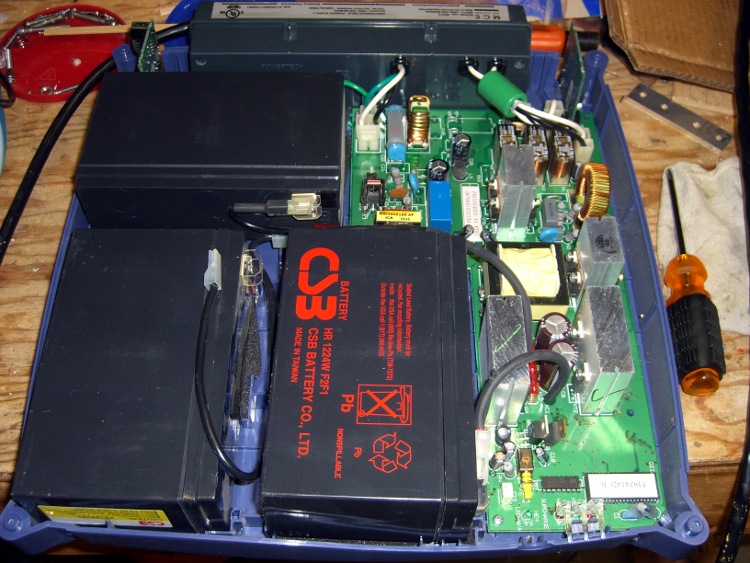
The SLA batteries in the MGE Ellipse 1200 UPS finally gave out. This picture shows how they’re arranged inside the box:
MGE Ellipse 1200 UPS – battery arrangement
They’re 12 V 5 Ah batteries that are about 12 mm thinner than the garden variety 7 Ah batteries you can get everywhere; they’re not the same size as the generic 5 Ah batteries you might think would work. Of course, there’s not enough room inside the stylin’ case for the larger ones, either. I’m thinking of using fatter batteries anyway and putting a belly band around the gap. Maybe an external battery box with a chunky cable burrowing through a hole in the UPS case?
For what it’s worth, APC absorbed MGE a while ago (so the MGE website redirects to APC), got Borged by Schneider, then spat out MGE’s consumer grade UPS units to Eaton. You won’t find any of that documented anywhere, but here’s the response from APC after I didn’t find this UPS on their list:
I do apologize; when APC was acquired by Schneider Electric, the single phase UPS line that MGE once offered was sold to Eaton. Eaton now provides support for the MGE single-phase products. We do not sell batteries for these models. You will actually need to contact Eaton for further assistance regarding the MGE Ellipse units. You may click on the link below to go to Eaton’s website:
The Eaton website does have a battery replacement for this one, but sporting the dreaded “Contact us for price” notation. Given that I got the UPS cheap-after-rebate, I’m thinking maybe this isn’t worth the effort.
After driving for five hours I’m never at my best, so I parked with atypical abandon at the motel: on the downhill side of a pull-though parking space. Usually I park off to one side of the lot, directly under a lamp that lights the car and shadows the interior, with the hatch backed against the pole. I claim the stupid excuse.
The next morning we hiked out for breakfast and returned to find emergency vehicles scattered all over the motel’s lot. Even from a distance, we knew this might not have a good outcome for us: that’s our van going nose-to-nose with the EMS Medic’s SUV:
EMS Medic parking – overview
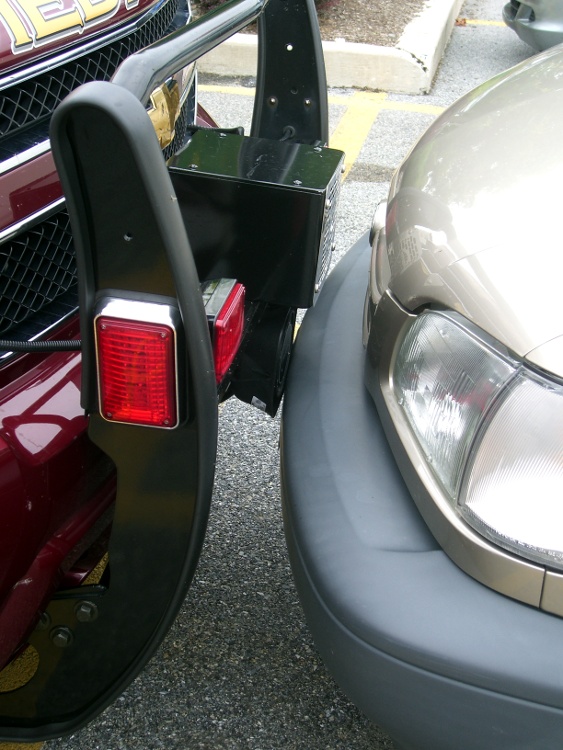
Up close, the situation turned out to be much much much better than I expected:
EMS Medic parking – bumper detail
The siren was just kissing the front bumper of our van. I think the SUV rolled forward an inch when they released the brakes after slapping the tranny into Park and bailing out.
For what it’s worth, those fancy pusher bars on the front must be strictly for looks, because the siren & its control box really do stick out far beyond the bars. At the first serious contact they’ll crush back into the grille and do about a kilobuck worth of damage to the front end.
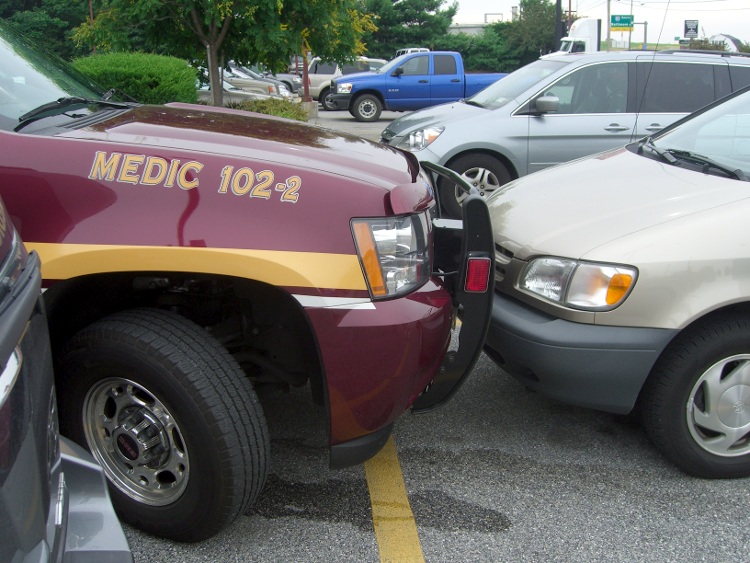
I think the driver wasn’t fully aware of how much snout that SUV has. It looks to be shiny-new, so perhaps this was the first close quarters parking experience:
EMS Medic parking – position detail
I left a polite note on the driver’s side window pointing out that another two inches would mean we’d be filling out paperwork until noon.
They were gone by the time we left. The siren snagged the corner of the license plate and bent it out as they departed, but that’s not the first bend in that particular bit of sheet metal.
If any of you have a friend on the York PA Medic / EMS staff, give ’em a friendly heads-up for me, OK?
Memo to Self: Always park off to the side, dammit!
OK, this resembles dynamiting fish, but I can’t help myself. A cute little Lenovo Q150 with a D525 dual-core Atom and nVidia ION graphics just arrived, which, perforce, has Windows 7 preinstalled. The first step is to get Windows activated, updated, and settled down… the second step being, of course, to shrink that partition to a nub and install Linux for actual use.
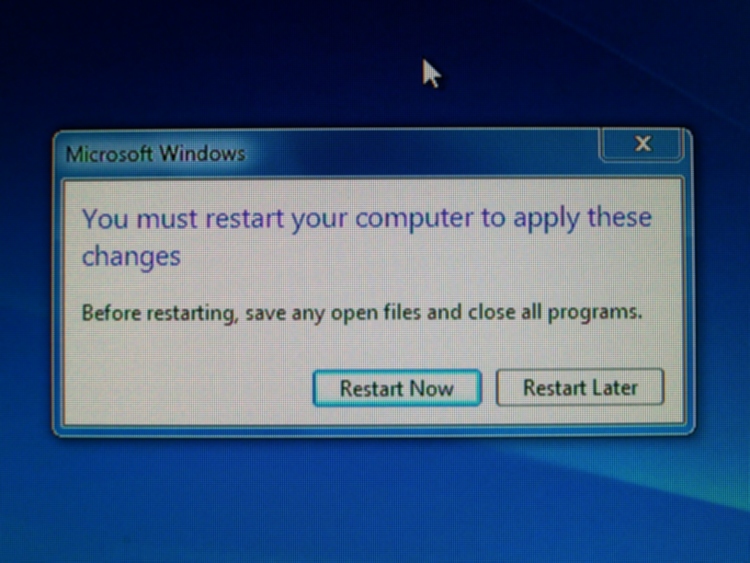
After a bit of huffing & puffing, reading (*) & clicking of many EULAs, and the first round of updates:
Windows 7 – You must restart your computer
Every time I see that, I think of the old dialog box joke:
Mouse motion detected. Windows NT must reboot to apply this change. [OK]
Then it had to update .NET, which produced this unbelievable body count of changes:
Windows 7 – Applying update operation
And then another few rounds of updates, the last of which evidently crashed & burned. The Get help with this error link was, mmm, unhelpful; it simply reported they hadn’t the foggiest idea what went wrong. Rebooting and retrying the automated updates presumably worked:
Windows 7 – Some updates were not installed
Doing all of that while puttering around with other stuff occupied the better part of a day, after which one owns a PC with an operating system installed. Yeah, you do get a UI that exposes IE 9, but if you want to do something with the PC, well, that requires installing applications.
I loves me my default Windows desktop background, from a long-ago crash inside a VM:
BSOD – fatal app exception
(*) Yes, I do read them, mostly for comic relief. The general practice of forcing you to scroll through a sheaf of typewriter-formatted pages in a 2×3 inch peephole centered in a huge monitor suggests that they really don’t want you to know what’s going on. Anyone who suggests buying commercial software because it has a reputable company standing behind it has obviously never gone to the trouble of reading the relevant EULA.
Spotted this one in a rest stop along I-84. I suppose it’s perfectly safe, but those anchoring hooks really don’t inspire much confidence, even if the only way you could jounce that crane sideways would involve flipping the flatbed. Right?
Yes, it was hanging over the other side just as far.
Come to think of it, the tractor that towed this assembly wasn’t present. Perhaps someone discovered / was informed it really isn’t a Good Idea / legal to haul an excavator at 65 mph in this configuration?
It turns out that an ordinary carbide glass drill works just fine on glazed clay pots. Use a low RPM and very slow feed, flood the scene with water, and drill from the other side after the point breaks through.
Glass drill for plant pot hole
The glaze inside the pot already had a flaw that let the water into the clay, from whence it seeped out through the unglazed lower rim. I suppose saturating the clay can’t possibly be good, but I’ve done this to many glazed pots over the years and none of them have ever complained, so it’s all good.
Some upcoming presentations on 3D printing need a way to show what’s going on inside the box. I’ve had various webcams affixed to various parts of the Thing-O-Matic, but nothing worked quite right: the camera was either in the wrong spot, at the wrong angle, or just flat-out in the way.
The helmet mirror project produced a trio of three-draw telescoping shafts that looked promising, so I drilled suitable holes in two chunks of scrap make-from plastic and produced a pole mount for a Logitech camera without doing a bit of machining. The camera wants to clamp onto a notebook and works fine atop a block of acrylic, with the cable secured to the base of the pole to prevent the whole thing from falling over at the slightest tug.
I briefly considered printing a nice clip to hold the cable to the pole, then came to my senses and used a cable tie. After all, that’s what they’re for, right?
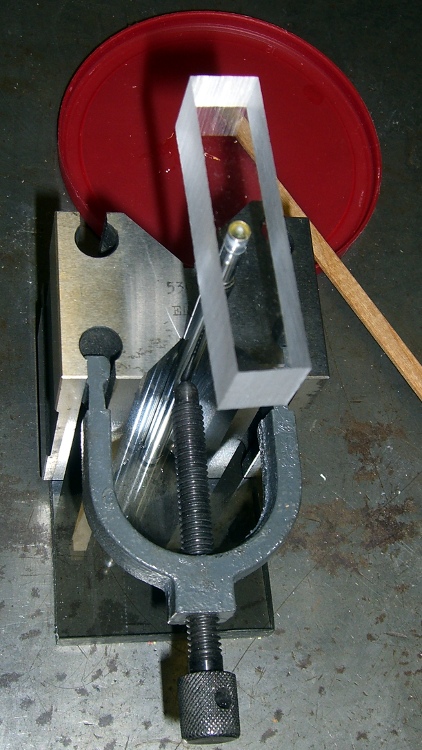
A dot of clear epoxy in each hole prevents the blocks from rotating on the shafts; they’re sufficiently un-round to give it a decent grip. I clamped the pole in a V-block to keep it perpendicular to the base while the epoxy cured:
Webcam pole – clamping
The white LEDs under the Z-stage produce far too much glare and reflect in the Kapton tape; a switch to knock ’em off for video viewing seems in order.
(If anybody else is keeping track, this is Post 1000. Although we humans love numbers with plenty of zeroes, Post 10000 will pose a challenge…)





 The Smell of Molten Projects in the Morning