Ed Nisley's Blog: Shop notes, electronics, firmware, machinery, 3D printing, laser cuttery, and curiosities. Contents: 100% human thinking, 0% AI slop.
After measuring & fiddling around with all those capacitors, the rest of the board went together fairly easily:
GPS-HT Wouxun interface – brassboard
It’s difficult to test from the Basement Laboratory, although the tones and audio levels sound about right.
The next step: conjure up a box. That shape has nothing to recommend it, so I’m doodling an extrusion-like shell with endcaps that should work better and look nicer… but that’s behind some other stuff that must happen first.
The MOSFET resistance tester I’m twiddling up for my next column will hold the transistor-under-test at a more-or-less constant temperature using a PWM-controlled Peltier module. The Peltier driver looks like this:
Peltier Driver
The overall idea is that the relay selects heating or cooling and the MOSFET PWM adjusts the power to keep the module at the right temperature. The feedback comes from a thermistor epoxied to the aluminum block holding the MOSFET, which in turn is epoxied to the module and then to a CPU cooler with a fan. More on that later…
Those fat lines mark the high-current paths: 3.3 A with a 5 V supply, as this Peltier module has about 1.5 Ω resistance. Some early tests show the resulting 17 W can pump the test block down to at least 5 °C and up to at least 40 °C in a few tens of seconds, even without any significant PI (no D) loop tweaking.
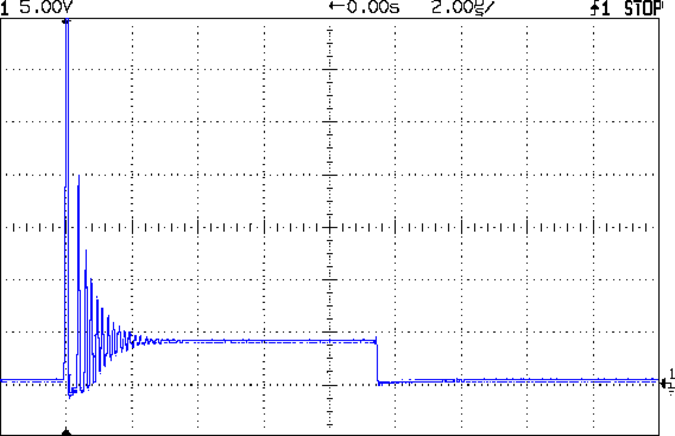
When I fired it up a test program that just cycles the PWM up and down, the green LED lit up properly in cooling mode, but the red LED also glowed dimly. Probing the drain showed this nasty ringing when the IRLZ14 MOSFET turned off:
Peltier Turn-Off Transient
The initial spike happens when the drain current pushes the MOSFET body diode into reverse breakdown at about 70 V (off scale high in the image). The drain goes slightly negative for the next half-cycle as the diode slams into forward conduction, then the energy engages in some serious 5 MHz ringing while it dissipates in the Peltier’s resistance.
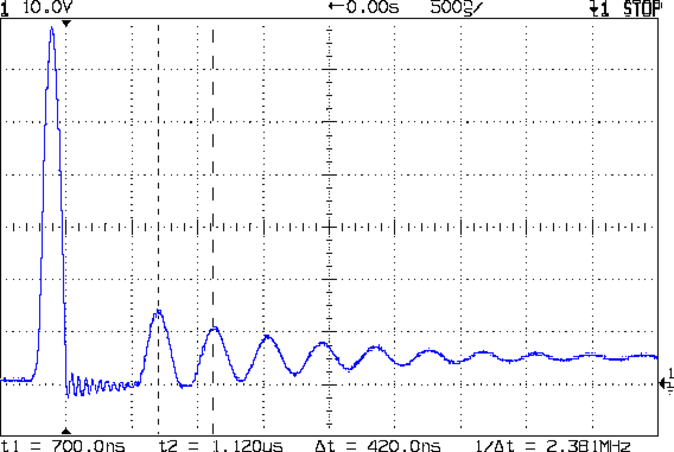
A bit of fiddling revealed that a 1.5 nF cap dropped the ringing to 2.8 MHz and a 2.5 nF cap put it at 2.4 MHz:
Peltier Drain – 2.5 nF
Notice that just putting a capacitor across the MOSFET doesn’t reduce the ringing. What’s needed here is some additional energy dissipation.
Splitting the difference says 2.3 nF would reduce the resonant frequency by a factor of 2, so the original stray capacitance is about (2.3 nF / 3) = 770 pF.
Knowing the resonant frequency and stray capacitance, the stray inductance falls out:
L = 1/[(2∏ 2.5x10⁶)2 770x10-12] = 5.4x10-6 = 5.4 µH
The Peltier module doesn’t have nearly that much inductance, so it’s hidden in the wiring and relays.
Knowing L and C, the characteristic impedance of the circuit is:
Z = √(L/C) = 84 Ω
The snubber cap should be at least a factor of 4 larger than the stray capacitance, which gives 3 nF. Some rummaging produced a small 3.9 nF 100 V Mylar cap (measuring 3.7 nF, close enough) and an 82 Ω resistor, which gave this pleasing result when soldered across the MOSFET source & drain:
Peltier Drain – 82 ohm 3.9 nF snubber
The upper trace shows a pair of 32 kHz PWM pulses. The lower trace gives a magnified view of one pulse; the peak remains at about 70 V just after turn-off, because that 3.3 A must go somewhere: that’s why MOSFETs have husky body diodes with reverse-breakdown specs.
A better view of the snubbed peak shows it’s all over in about 400 ns:
Peltier Drain – 32 kHz PWM snubbed – detail
The lower trace is the MOSFET gate drive pulse at the Arduino pin, showing the Miller capacitance delaying the transition. It turns out that removing the 22 Ω gate damping resistor doesn’t improve things, but, given the speed of the transition, I think it’s good enough.
The MOSFET burns at (3.3 A × 70 V) = 230 W during that 100 ns peak, which works out to a mere 23 µJ (assuming constant current, which isn’t the case). The IRLZ14 has a 40 mJ single-pulse rating, so it’s in good shape.
The DC dissipation is (3.3 A)2 x 20 mΩ = 2 W: the huge heatsink I stuck on the MOSFET doesn’t have a chance to get warm during the short tests so far.
The red LED remains dimly lit, which goes to show how sensitive a human eye can be: the negative transient is barely 100 ns long!
So the Credit Card Services scammers have a new back end name: Universal Card Services. According to the pleasant voice, UCS can reduce my credit card rates “from zero to six percent”… whether that’s the final rate or the reduction amount is not clear.
As with CCS, they “work with your credit card company” to reduce your rates. The pleasant boiler-room voice gave some numbers:
Citi 2-6% reduction
BoA 4-8% reduction
Capital One isn’t cooperative (I wonder why?)
They are evidently scraping the bottom of the barrel of desperate credit card users: you must have a balance of at least $1500 (!) and a rate of at least 6%.
If I were willing to agree that I met those requirements, he’d “qualify me” and pass me on to the “low interest rate advisor” who would tell me more about the company. He “had only been working there for a month” and really couldn’t tell me more than the company name; the “advisor” would answer all my questions about where the company was located, what their phone number might be, and so forth and so on.
I asked again where they were located and click that was the end of that.
Elapsed time: 4:33. Not a record, but not bad at all.
I suppose I must start lying to them in order to make more progress… perhaps I should feed the “advisor” one of our old credit card numbers that’s been closed due to fraudulent activity? Nah, that’d give them entirely too much information.
The on-line driver safety review course that gets us a 10% premium reduction has a few glitches:
Driving Quiz
They evidently randomize the answer choices without considering spatial constraints. One question had “All of the above” as the first choice, with all of the other choices being valid.
The helpful tech support voice said they’re looking into fixing that…
OK, time for a Pop Quiz: Is it possible for a human being to write perfect straight lines diagonally across a ruled pad?
Answer: Evidently so. Consider this screen grab…
Driving Plan Image
Taking the course online has the advantage of not requiring a trip or two to a classroom, but kills an hour a day for a week. It’s still a win, although it’d be much better if they didn’t use Adobe Flash.
My old BOB Yak trailer mounts to the bike axle with stainless steel grenade pins, which works fine. After all these years, alas, the rubber straps securing the pins to the frame have rotted away. The original straps are nicely molded affairs:
BOB Yak – original pin strap
I snipped a large O-ring, deployed four small cable ties, and this ought to last for another decade:
BOB Yak – new pin strap
The strap in the first picture hadn’t quite broken, but the rubber was cracked and ready to snap. So I made a preemptive strike…














 The Smell of Molten Projects in the Morning