The Smell of Molten Projects in the Morning

Ed Nisley's Blog: Shop notes, electronics, firmware, machinery, 3D printing, laser cuttery, and curiosities. Contents: 100% human thinking, 0% AI slop.

Author: Ed

  • Power Supply Banana Jack Misfit

    After butchering that fancy Tektronix test lead thing for the SMD tweezers, I hung the bitter end in my cable tangle. Turns out I needed a power cord to bring up the brassboard of the Wouxun GPS interface, so I soldered it up, went to plug it in, and … the Tek plugs didn’t fit the plated supply jacks.

    Power Supply Banana Jacks
    Power Supply Banana Jacks

    Now, if I had to choose whether Tek plugs are oversized or Made In China jacks are undersized, well, you can probably guess my answer.

    Turns out that the jacks should be 4 mm ID, which is actually a 5/32 hard-inch size because banana jacks date back to the days before millimeters became a force to be reckoned with. They were actually 3.8 mm ID, which wouldn’t usually matter except for the fact that the Tek plugs have a nice solid bullet end that’s just about exactly 4 mm OD.

    So I chucked up a 5/32 inch drill, perched the power supply on a block of wood (to clear the fuse & cord in on the back panel) on the drill press table, and hand-held it while clearing out the holes with a low spindle speed. You can see the nice, shiny brass inside those jacks in the photo; they used to have lumpy silvery plating inside that was probably responsible for much of the 0.2 mm shrinkage.

    The jacks also don’t have the usual crosswise hole near the base to accept a bare wire, which is an occasional nuisance. I was tempted to drill that hole, but decided I’ll leave that project for another time.
  • Website Pwnage

    Despite the fact that nobody bothers to crack your web passwords, as it’s easier for them to crack the entire server and scoop out everyone’s personally sensitive bits like so much caviar, all websites remind / require you to pick strong passwords. So, when I registered myself on a high-value website, I did what I always do: ask my password-generation program for a dollop of entropy.

    It came up with something along the lines of:

    Gmaz78fb'd]

    You can see where this is going, right?

    Pressing Submit (which always makes me whisper Inshallah with a bad accent) produced:

    The mumble.com website is temporarily unavailable. Please try again later.

    Little Bobby Tables rides again!

    [Yes, pwnage.]

  • Harbor Freight Bar Clamp: Handle Hole Support Plugs

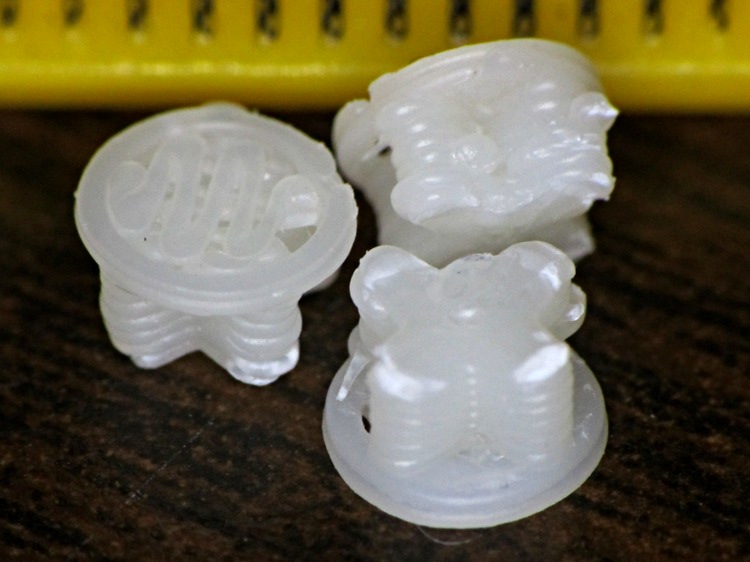
    Having printed up three of those handles for Show-n-Tell, I preemptively installed one in the hasn’t-failed-yet clamp, and poked the support out of another to show how it works. They’re just the cutest little buttons:

    HF bar clamp handle - support plug
    HF bar clamp handle – support plug

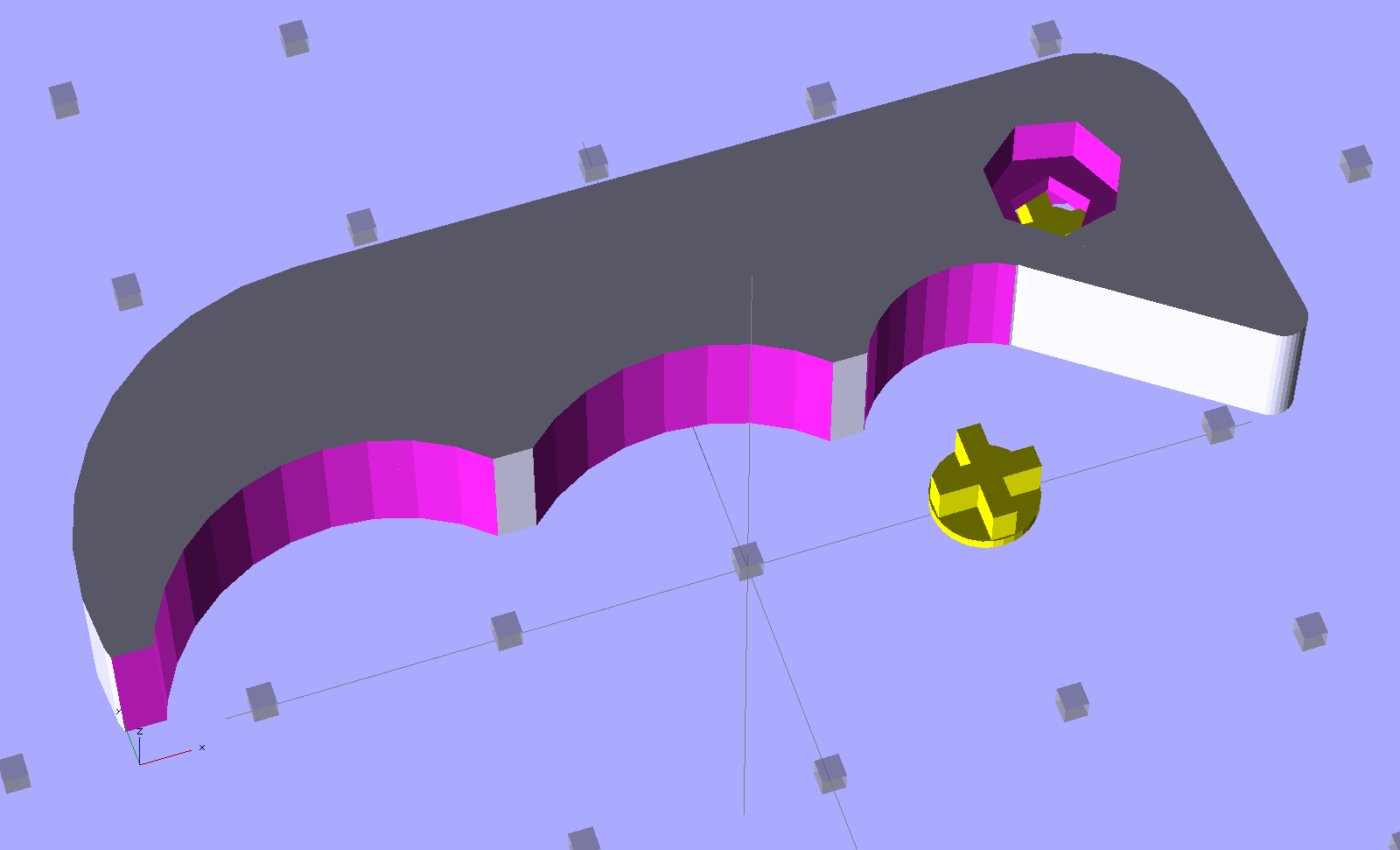
    The fins are a touch under 4.5 mm end-to-end and 1 mm (2 × 0.5 mm) across, with layer thickness = 0.25 mm. The first layer fill looks a bit lackadaisical, but the bottom of the surrounding handle came out glass-solid with barely visible joints between the threads, so the settings work fine for larger objects.

    HF Bar Clamp - support - solid model
    HF Bar Clamp – support – solid model

    The tip of each fin has a scar where the overlying perimeter thread bonded to it. Skeinforge is set to extrude the perimeter first, which would squirt that circle (well, pentagon) into mid-air… which is why this support plug lies in wait below.

  • Computer Amusements

    A friend asked me to scrub and rebuild an ancient IBM Thinkpad 760XD (there were good reasons for this task that aren’t relevant here), which led to a blast from the past:

    Windows 98 Welcome
    Windows 98 Welcome

    After Windows settled down from its obligatory reboots, installing the exceedingly complex MWave DSP drivers from three diskettes (!) produced this classic result:

    Windows 98 - BSOD
    Windows 98 – BSOD

    Ordinarily, I’d suggest installing some flavor of Linux, but the 760XD’s BIOS can’t boot from either CD or USB, so you’d be forced to sneak the install files onto the hard drive, hand-craft a suitable boot diskette (!), and then perpetrate some serious fiddling around. That made even less sense than (re-)installing Windows 98.

    However, given that exposing a fresh Windows 98 installation to the 2012 Internet would resemble tossing a duckling into a brush chipper, we agreed that this laptop’s next experience should be at an upcoming e-waste recycling event.

    The next morning confronted me with this delightful reminder that nobody knows how to handle boot-time errors, not even on a 2011 PC:

    Lenovo - USB Keyboard not found
    Lenovo – USB Keyboard not found

    The keyboard cable had gotten dislodged when the USB hub fell from its perch along the back edge of the desk. It’s fine now…

  • Geek Accessories: Cases Therefore

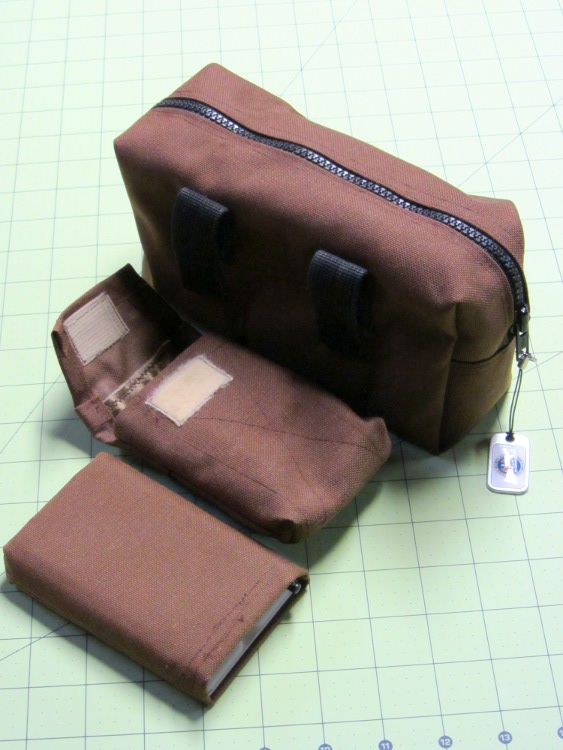
    Mary made me several presents early this year: a new belt pack, a camera case for the Canon SX230HS, and a touchup for the Zire 71 case:

    Belt pack - camera case - PDA case
    Belt pack – camera case – PDA case

    The belt pack has an interior lining with many side pockets for the stuff I deem essential; it’s also large enough to hold both the camera and the PDA when I’m out biking around. The camera case includes a pocket nestling a battery against the camera’s front side, beside the lens cap. The Zire case, well, at some point I suppose I’ll be forced to get a phone, but, until then, this will suffice.

    They’re all made from coated pack cloth, not that I expect to dunk myself in water (or that it’d do any good), but it seems to never wear out.

    *hugs*

    (And, yes, it probably should be “Therefor”, but …)

  • 1 mH Choke on FT50A-77 Toroid

    While doodling about a bike taillight, I figured out the numbers for a 1 mH toroid on a ferrite FT50A-77 core. Even though I’m not going to use it, I may as well write it down so I remember what to do the next time around…

    FT50A-77 Toroid data:

    • 0.5 OD x 0.312 ID x 0.25 long, inch
    • Mean path length: MPL = 3.68 cm
    • Cross section: XC = 0.52 cm2
    • Volume: V = 0.558 cm3
    • AL = 1080 mH/1000 turn
    • μ = 2000 (in gauss/oerstead, most likely)
    • Saturation = 4500 gauss
    • Tempco = 0.6%/°C
    • Winding length = 0.688 inch/turn

    Those mixed units barely make sense and then only in the USA; using cm for the magnetic dimensions gives CGS results. In some parallel universe, this would not be an issue.

    The inductor:

    • For 1 mH, turns = 1000 √(1 mH / (1080 mH/1000 turns)) = 30.4 turn
    • Wire length = 31 turn × 0.668 inch/turn + 3 inch = 24 inch

    Core saturation check for 100 mA:

    • 100 mA x 30 turn = 3 ampere·turn
    • Magnetomotive force = mmf = 0.4 π × 3 A·t = 3.8 gilbert
    • Magnetizing force = H = mmf/MPL = 3.8 Gi / 3.68 cm = 1.0 oerstead
    • Flux density = B = μ H = 2000 G/Oe × 1.0 Oe = 2000 G < 4500 G, so OK

    I think the saturation check works, but the units always make my head hurt…

  • APRS Packet Routing

    This might be another personal best in a different category:

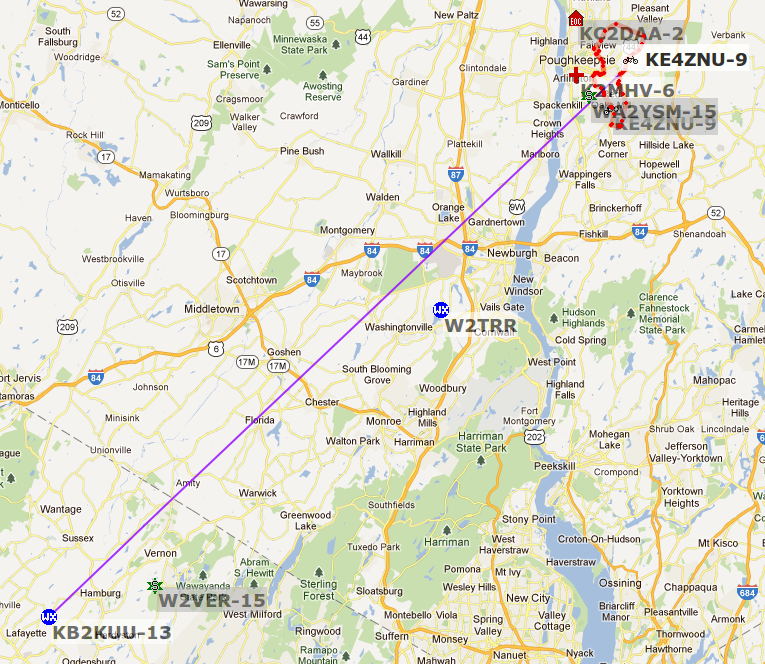
    KE4ZNU-9 APRS to KB2KUU-13 - Lafayette NJ
    KE4ZNU-9 APRS to KB2KUU-13 – Lafayette NJ

    The path from KE4ZNU-9 (on my bike in Pleasant Valley) to KB2KUU-13 near Lafayette, NJ, spans a bit over 90 km / 55 miles, which isn’t bad for a 5 W (that’s optimistic) hand-held radio through a dual-band mobile antenna bolted to the seat frame with my head much too close to the base. The topography lay in my favor, though: Pleasant Valley sits near the top of the Wappingers Creek watershed (admittedly, barely 200 feet above sea level) and the valleys run southwest-to-northeast all along this part of the East Coast. The KB2KUU-13 antenna may be only 20 feet above average terrain, but that puts it 600 feet above sea level with a commanding view to the northeast.

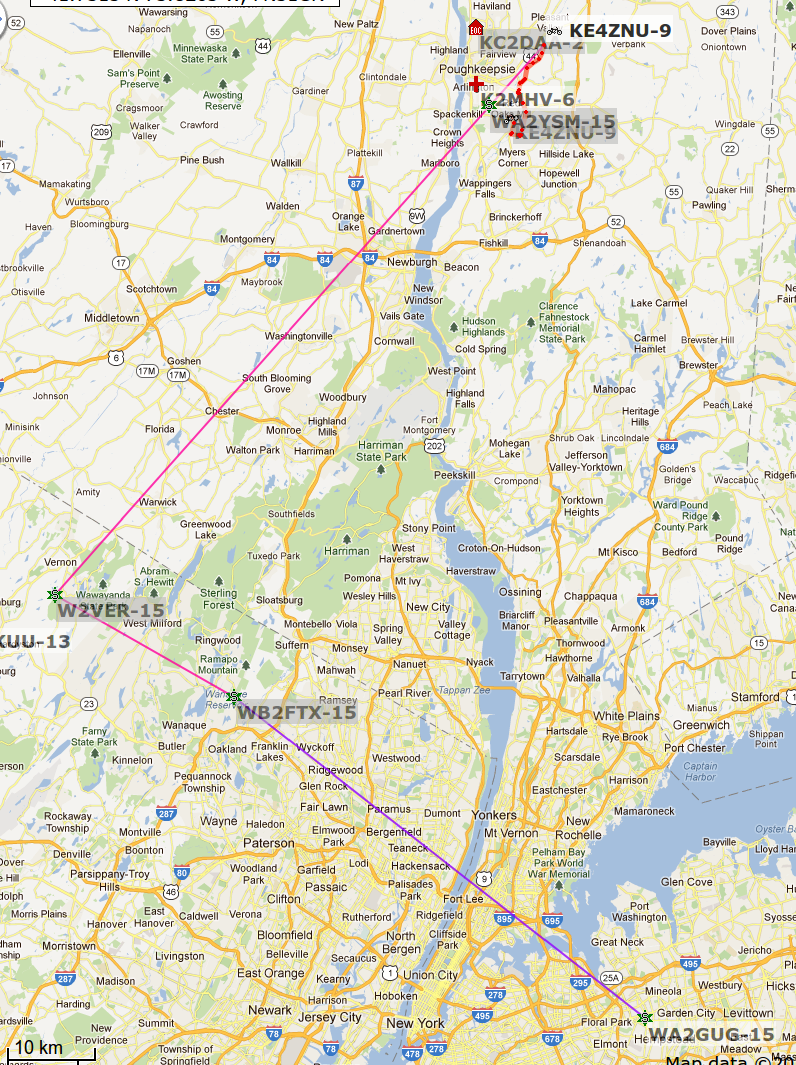
    Another packet sent a few minutes later took a much longer path to an APRS iGate:

    KE4ZNU-9 APRS to WA2GUG-15 - Long Island - 2012-02-01
    KE4ZNU-9 APRS to WA2GUG-15 – Long Island – 2012-02-01

    The first hop covered about 80 km / 50 miles to W2VER-15. That antenna is 320 feet above average terrain, but that’s with a 1400 foot base: a ridge near Hamburg Mountain. The next hop is about 20 miles to WB2FTZ-15, then 60 km / 40 miles across the plains and out to WA2GUG-15 near Hempstead on Long Island.

    Normally, of course, a closer digipeater snags packets from my bike; most go through WA2YSM-15 or KC2DAA-2 to K2MHV-6 and probably don’t clog up the entire eastern seaboard. It’s hard to tell, though, because the APRS database records only the first successful capture of a given packet.

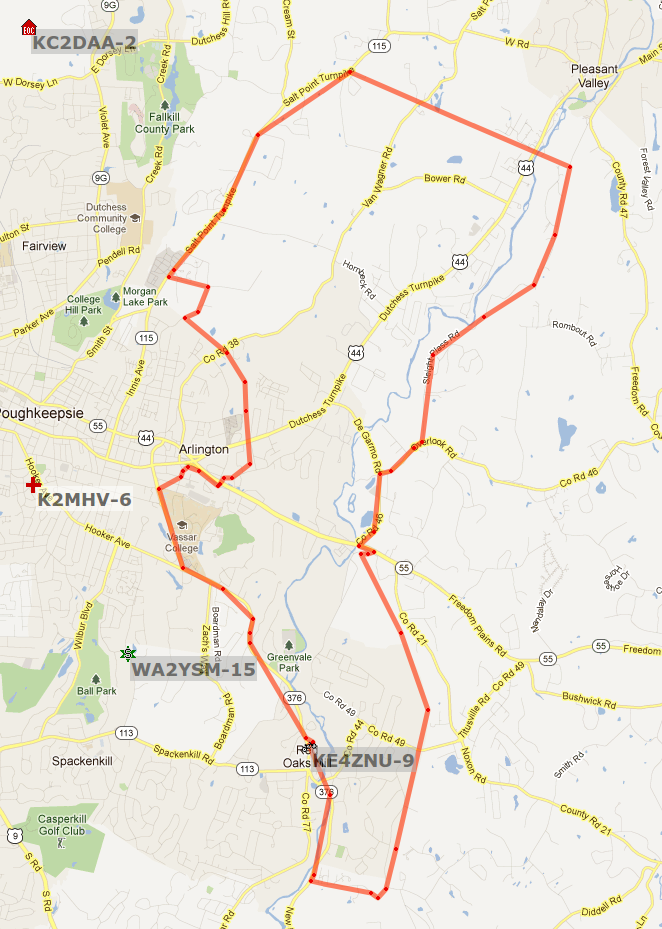
    The whole bike ride looked like this:

    KE4ZNU-9 trip - 2012-02-01
    KE4ZNU-9 trip – 2012-02-01

    The APRS spots missed the sprint along West Road into Pleasant Valley, but you get the general idea: 22 miles, 15 mph average speed, temperature around 58 °F, a fine day for a ride!