Ed Nisley's Blog: Shop notes, electronics, firmware, machinery, 3D printing, laser cuttery, and curiosities. Contents: 100% human thinking, 0% AI slop.
A USB cable carries the analog mic and earbud audio for our bike helmets; the connectors are cheap, durable, and separate easily. I cut a 2 m “USB extender” cable (which, according to the USB guidelines, isn’t supposed to exist) near the A male connector, then wire that part to the helmet and the A female part to the GPS+voice board.
The latest USB extender cable included a surprise:
In previous USB extenders the red / black wires were a slightly larger gauge than the green / white data pair, but in this cable they’re not. That might matter if one expected the cable to carry, oh, let’s say an amp of battery charging current.
After replacing the Y axis leadscrew, I decided that the X axis leadscrew was in fine shape, because it’s tucked under the table and not exposed to the swarf and grit that fell on the Y axis screw before I installed the bellows. Being that sort of bear, I couldn’t throw out the worn Y axis leadscrew, so I had two rather delicate rods that really needed more protection than a twist of paper.
So I sawed off a length of 1 inch PVC pipe, faced the ends in the lathe, and added two rubbery endcaps from the heap:
Sherline leadscrews stored in PVC pipe
That fits neatly into the big box alongside the rotary table, with the bag of assorted nuts so they’re all together.
Despite what you see there, the screws are wrapped in paper with a bit of oil, so it’s all good.
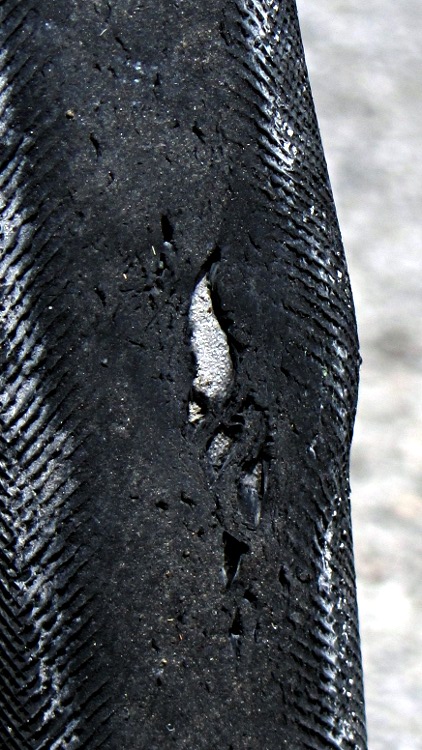
So, as you might expect, I couldn’t let the aneurysm on that tire get away without a closer look: had to haul the poor thing out of the trash and dissect it. Here’s what it looked like on the bike:
Primo Comet Aneurysm – inflated
The outer rubber has disintegrated and is pulling away from the Kevlar belt underneath, but it’s still holding air!
Cutting that section out of the tire and flattening it makes things look almost normal:
Primo Comet Aneurysm – flattened
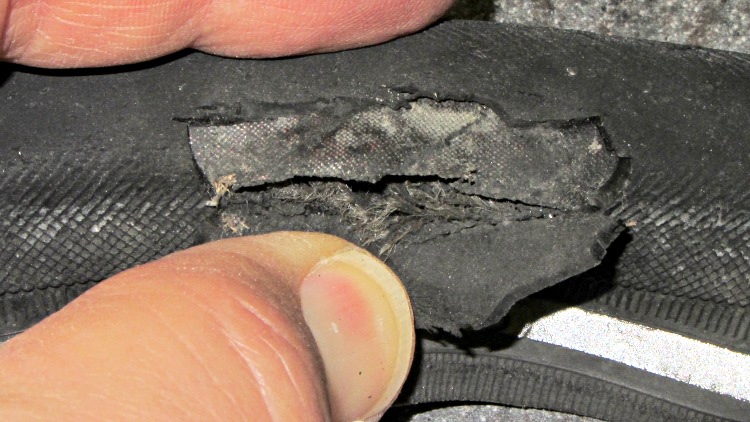
Peeling the rubber off the carcass reveals that the body cords have either broken or ripped loose under the belt:
Primo Comet Aneurysm – peeled
There was no external damage over that part of the tire and I was wrong about a gash in the Kevlar belt. However, the ends of the belt overlap just above and to the right of my thumb, so perhaps there’s a manufacturing flaw in there somewhere.
A three-pack of 100-tooth 2 inch cutoff saw blades followed me home from Harbor Freight a while ago. Although they’re intended for a craptastic HF tabletop saw, I thought they might come in handy on the Sherline for slicing lengths of brass tubing. The reviews for the saw indicate the blades are no good for steel, barely adequate for brass, and dandy for wood; they have nowhere near enough teeth for a screw cutoff blade.
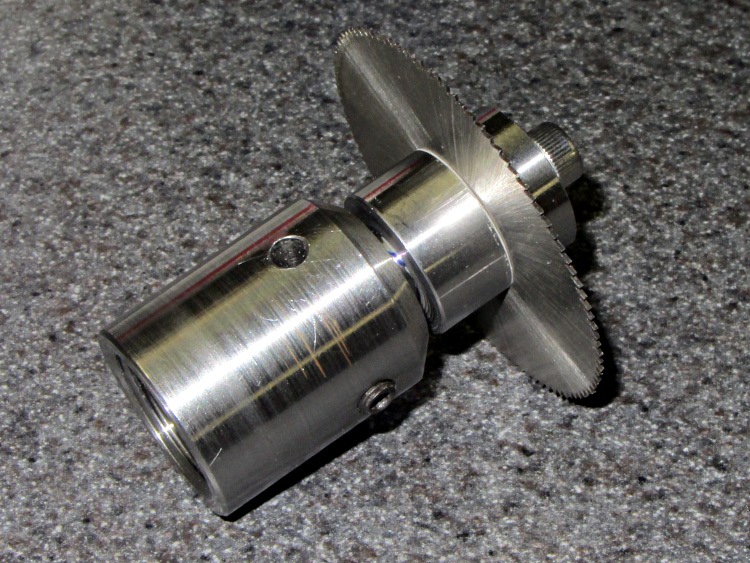
None of the arbors in my collection fit a blade with a 3/8 inch hole, so a bit of lathe work produced one while the 3D printer cranked out a GPS+audio case:
Cutoff saw arbor in Sherline toolholder
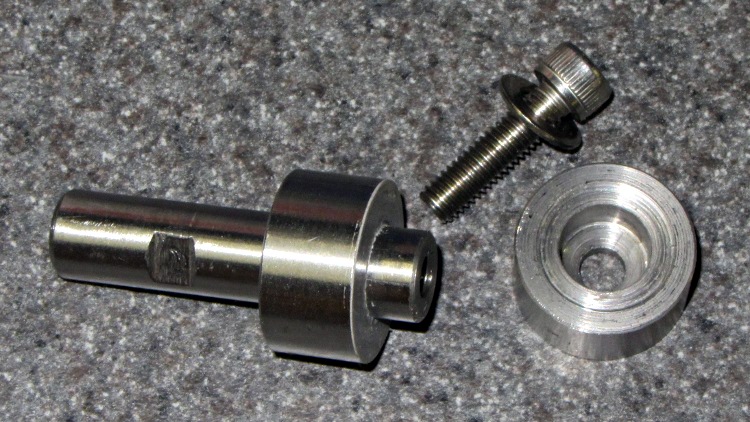
The shaft is 3/8 inch drill rod and the collars are 3/4 inch drill rod, both of O1 oil-hardening steel that will remain forever unhardened, fitting into a Sherline endmill toolholder. I drilled-and-bored the collars to a slip fit on the shaft, then epoxied the rear one in place:
img_2156 – Cutoff saw arbor – parts
I drilled a 0.6 inch deep blind hole in the shaft and tapped it 10-32 all the way down for a 1/2 inch SHCS. A bag of assorted 10-32 taps produced a bottoming tap that came in handy, but I put tapping in the same category as parallel parking: I’ll walk half a mile to not parallel park the van. Couldn’t avoid it this time.
The flat on the shaft came from a bit of hand filing, which was easier than setting up the mill.
The front collar’s undercut ensures just the rim contacts the blade. The photo shows the vanishingly thin layer of epoxy on the rear collar that mooshed out as I clamped the stack together:
Fixed (rear) collar
Waxed paper with a 3/8 inch hole punched in the middle
Cutoff blade
Split lockwasher for a bit of space
Loose (front) collar
Socket head cap screw
After the epoxy cured, a pass through the lathe skimmed off that thin epoxy layer and trued up the fixed collar face to eliminate the last bit of wobble. The radial runout remains just enough so that one tooth tings before the others engage, but I’m not entirely convinced that’s due to the (minimal) shaft-to-blade clearance.
In use, putting the split lockwasher between the loose collar and the SHCS provides a little clamping compliance.
At some point, I’m sure this thing will come in handy…
Quite some time ago I picked up a trio of IBM Thinkpad 560Z laptops from the usual eBay suppliers as part of a DDJ column project. One turned into a digital picture frame, our Larval Engineer has another (because it was maxed out with 128 MB of RAM), and I just fired up the third (96 MB!) to discover whether it could serve as a text-only terminal without too much trouble.
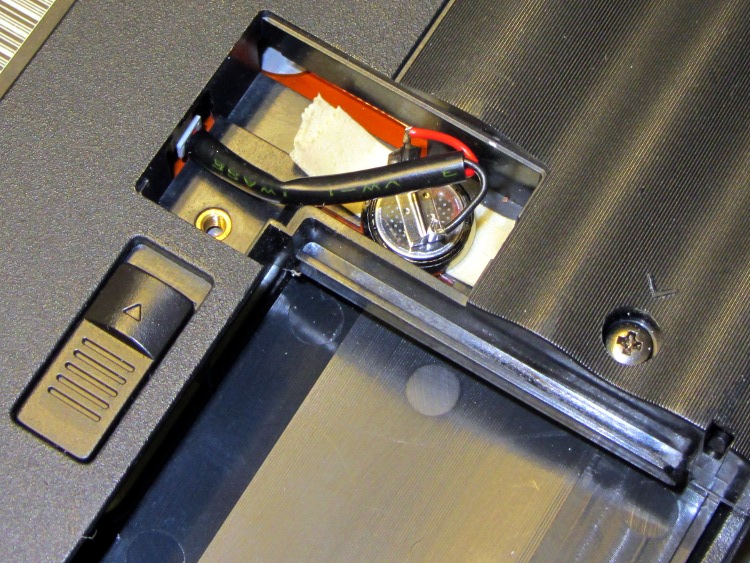
Alas, the BIOS battery was dead. I’d replaced the dead OEM cell some years back with a (surplus) lithium cell that’s a bit too small, so it only lasted a few years rather than a decade, but the cells were on the shelf. Soooo, I put in another one, just like the other one:
Thinkpad 560Z BIOS battery
After nudging the date & time into the current millennium, it then failed to boot Ubuntu 8.04: evidently the mighty 4 GB CompactFlash drive (jammed into a CF-to-IDE adapter) has bit rot.
It’s a prime candidate for the text-only version of Tiny Core Linux, except that a 560Z can’t boot from either USB or CD-ROM, which means getting the files on the “hard drive” requires extraordinary fiddling. Drat!
FWIW, when this battery fails, I think the (empty) main battery compartment has room for a CR123A cell that should outlast the rest of the hardware. I could blow two bucks on a replacement from eBay, but what fun is that?




 The Smell of Molten Projects in the Morning