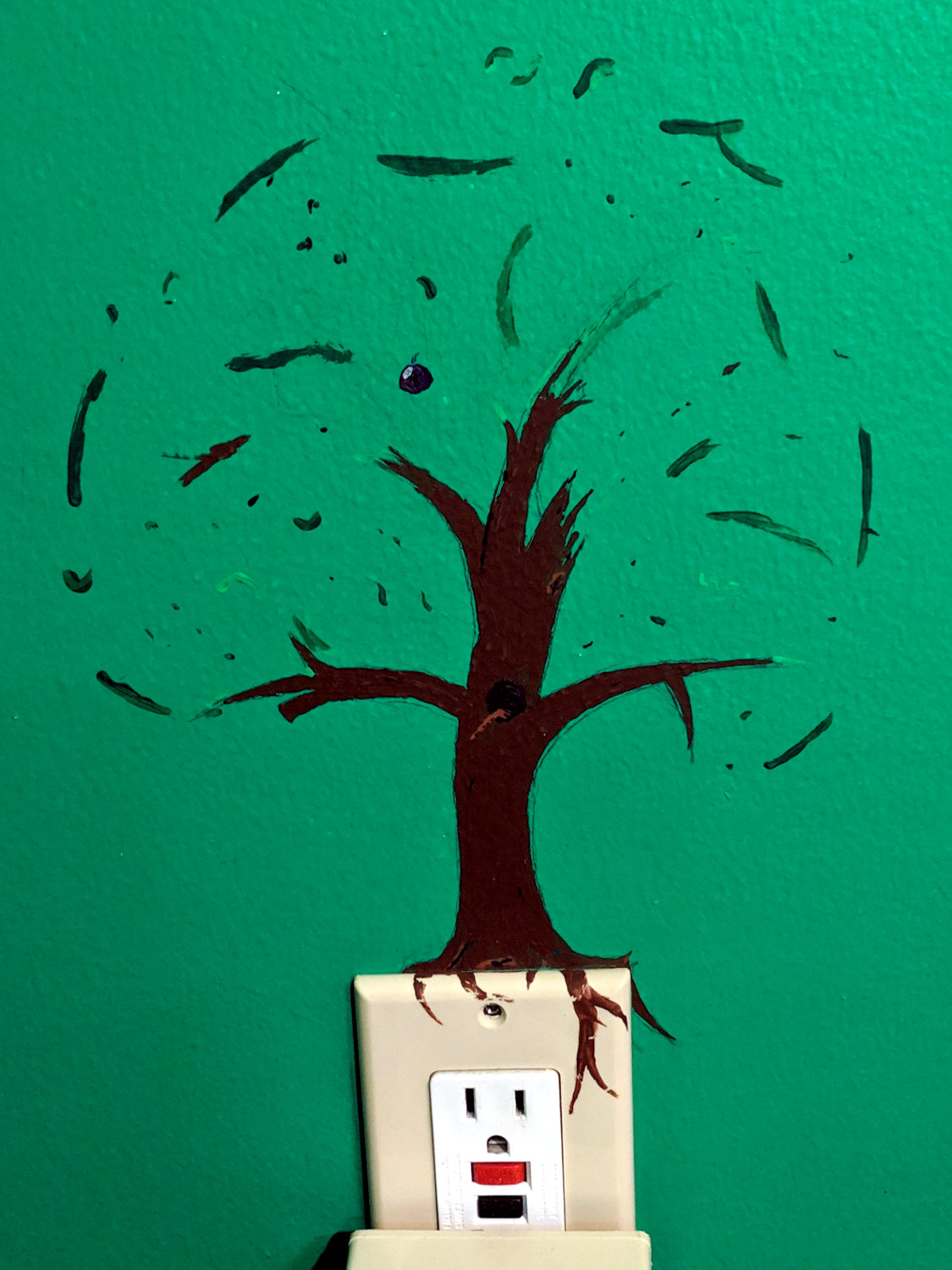
One day, long ago, this tree grew in a certain bedroom:
And then a flower appeared in the laundry room:
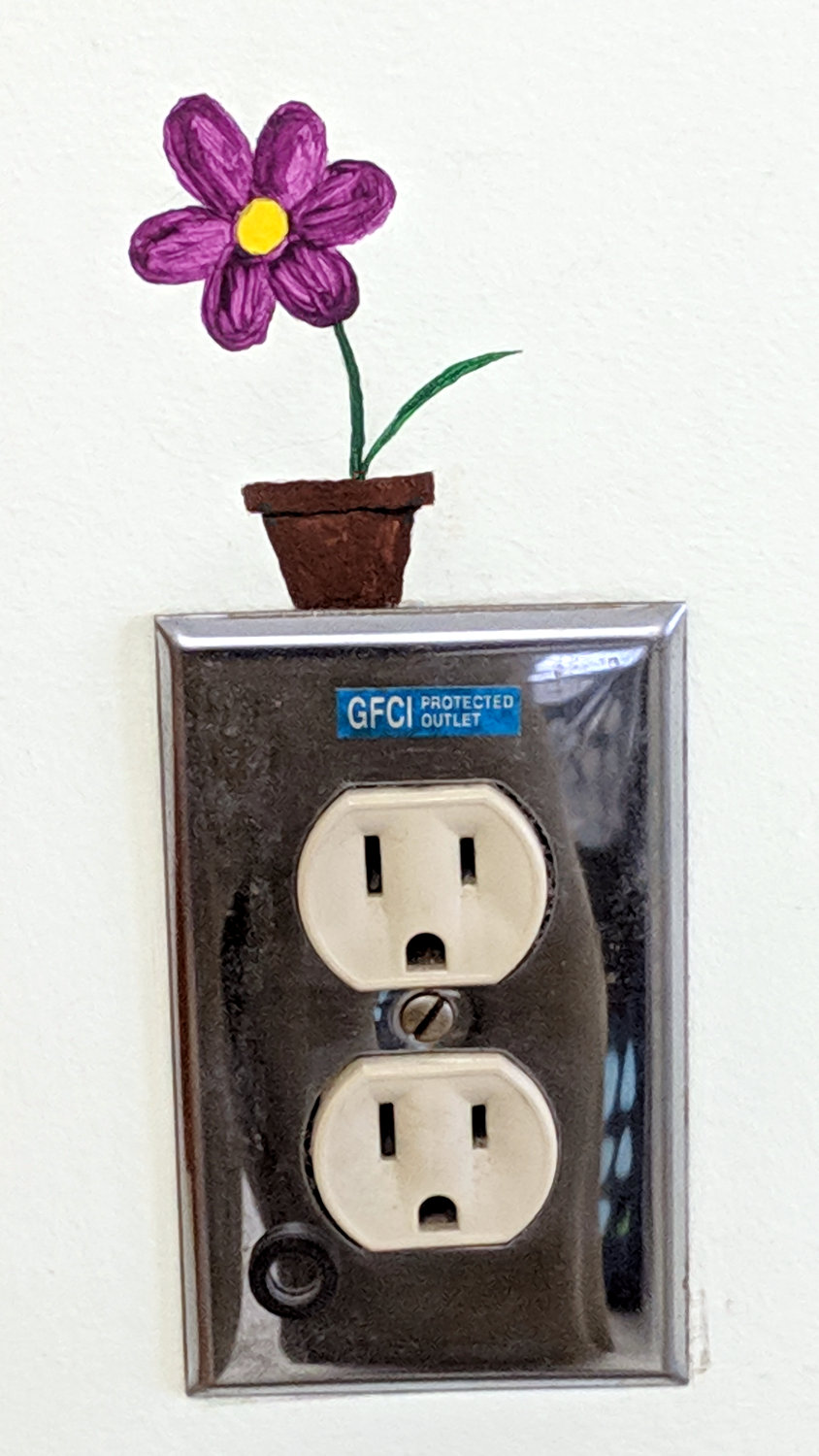
Much to our delight, she asked for forgiveness, not permission … which was, of course, granted immediately.
The Smell of Molten Projects in the Morning
Ed Nisley's Blog: Shop notes, electronics, firmware, machinery, 3D printing, laser cuttery, and curiosities. Contents: 100% human thinking, 0% AI slop.
One day, long ago, this tree grew in a certain bedroom:
And then a flower appeared in the laundry room:
Much to our delight, she asked for forgiveness, not permission … which was, of course, granted immediately.
The original astable multivibrator ran from a dead CR123 primary lithium cell:

With a terminal voltage falling from barely 3 V, the LED drew about 3 mA (1 mA/div), tops, without a ballast resistor:

Hacking in a charged NP-BX1 secondary lithium cell boosted the supply to 4 V:
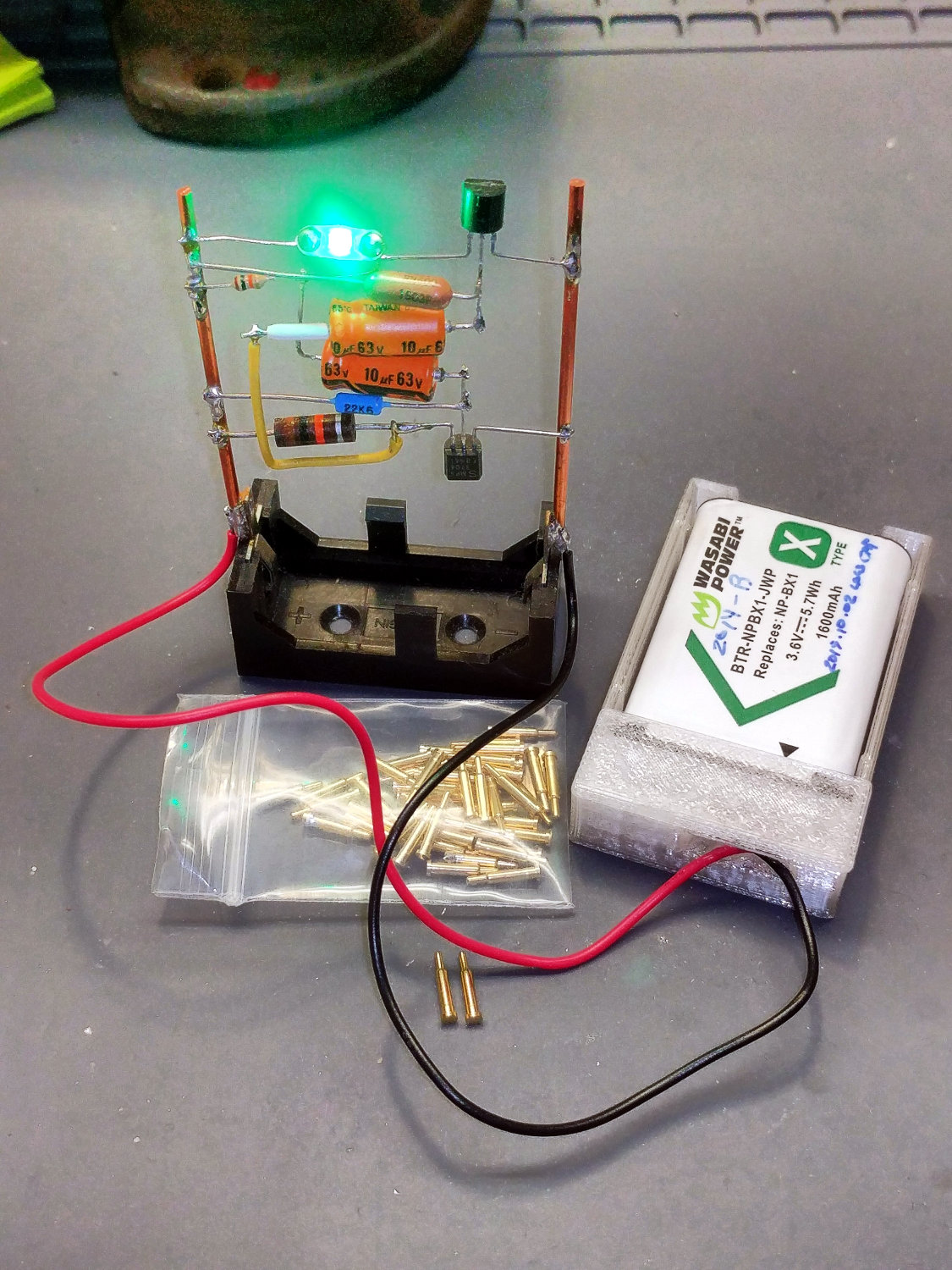
Which, diodes being the way they are, raised the LED current to nearly 400 mA (100 mA/div):
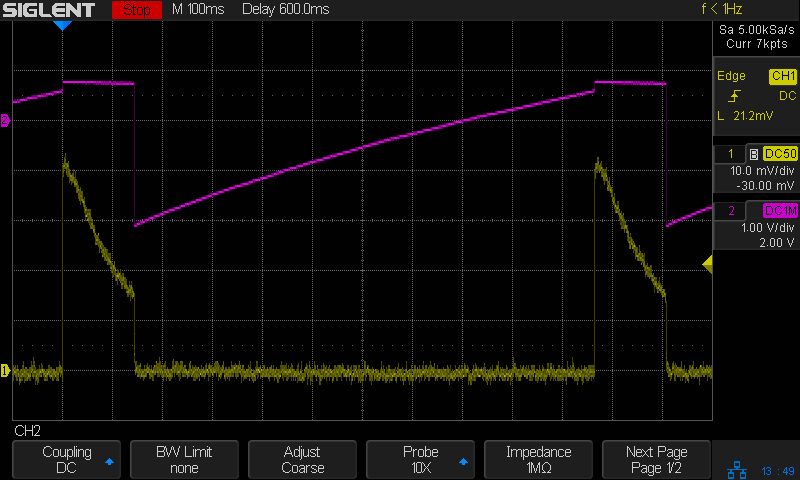
Somewhat to my surprise, a few weeks of abuse didn’t do any obvious damage to the LED, but I added a resistor while I was soldering up another holder:

There’s not quite enough room for a 1/8 W axial resistor, so why not blob in a surface-mount resistor?
Which cuts the current down to a mere 15 mA (10 mA/div) from a lithium battery at 4 V:
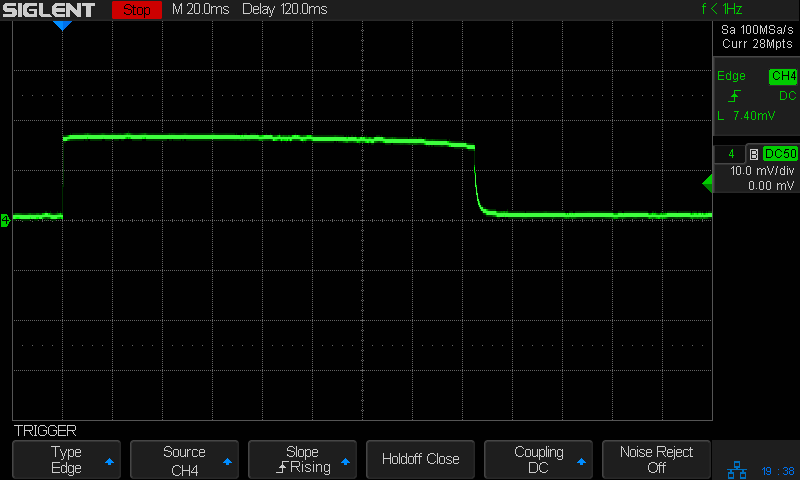
It’s still blindingly bright, but now I don’t feel bad about it.
The stops aligning the top two drawers of an old desk vanished, so I got the job of replacing them. They’re hammered into the wood frame:

And stand up just enough to engage the back of the drawer face:
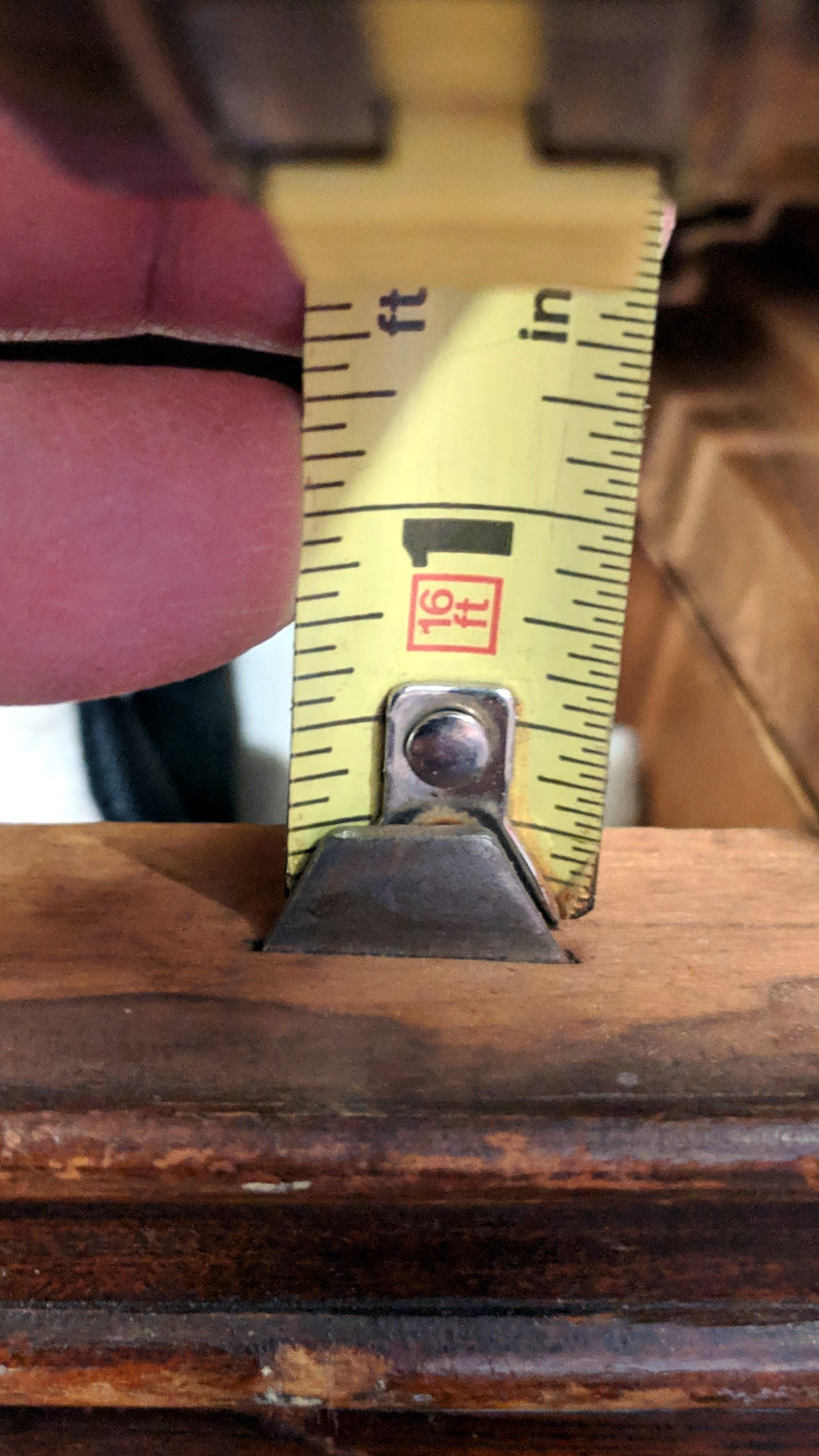
Back in the Basement Laboratory Shop Wing, I harvested steel strips from a defunct PC case, rubber-hammered them flat, sharpened a cold chisel (un-hardened, so it always needs sharpening), and got to work:
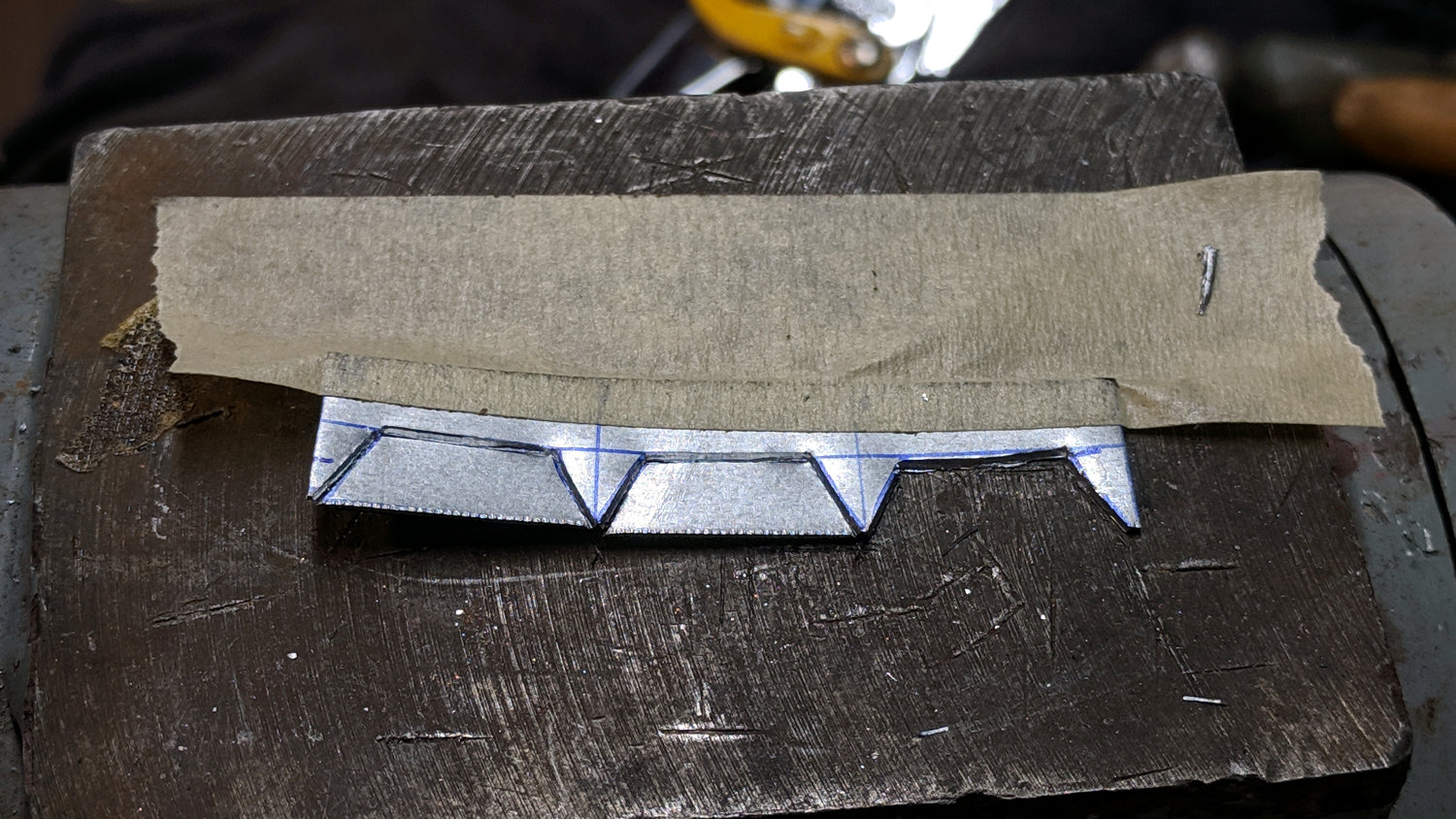
The pointy sides should have sharp edges, which you get for free with a chisel. You also get a bench full of little steel slivers perfectly suited for embedding in human flesh. Wearing eye protection is more than just a good idea, too.
Introducing what will become the visible edges to Mr Disk Sander makes them marginally less hazardous:

A slightly fuzzy picture of a test fit shows the stops should suffice:

Which they did:
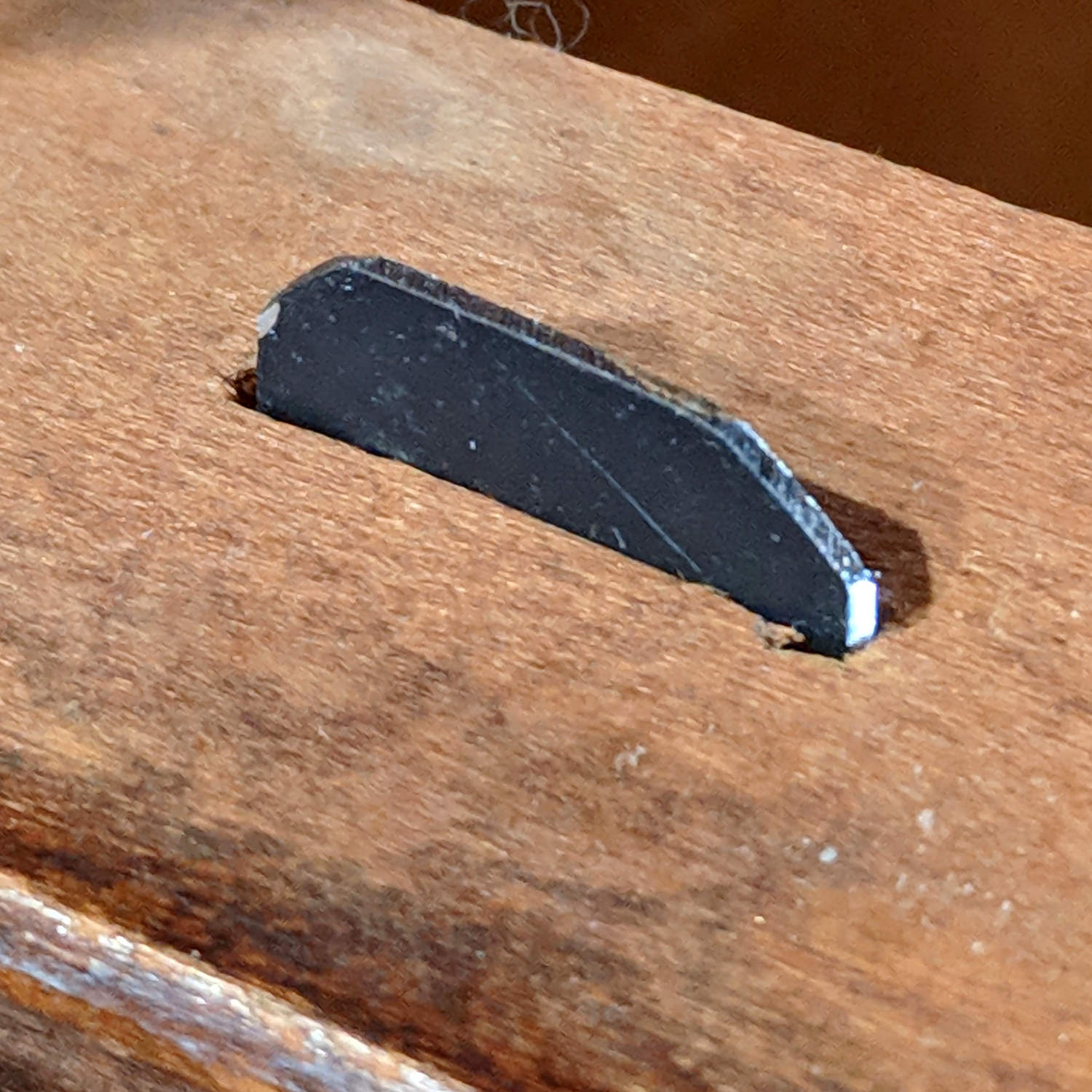
Nobody will ever notice the blob of hot melt glue behind each one:

Done!
Adapting the NP-BX1 battery holder to use SMT pogo pins worked well:
The next step is to add sockets for those 14 AWG wires:
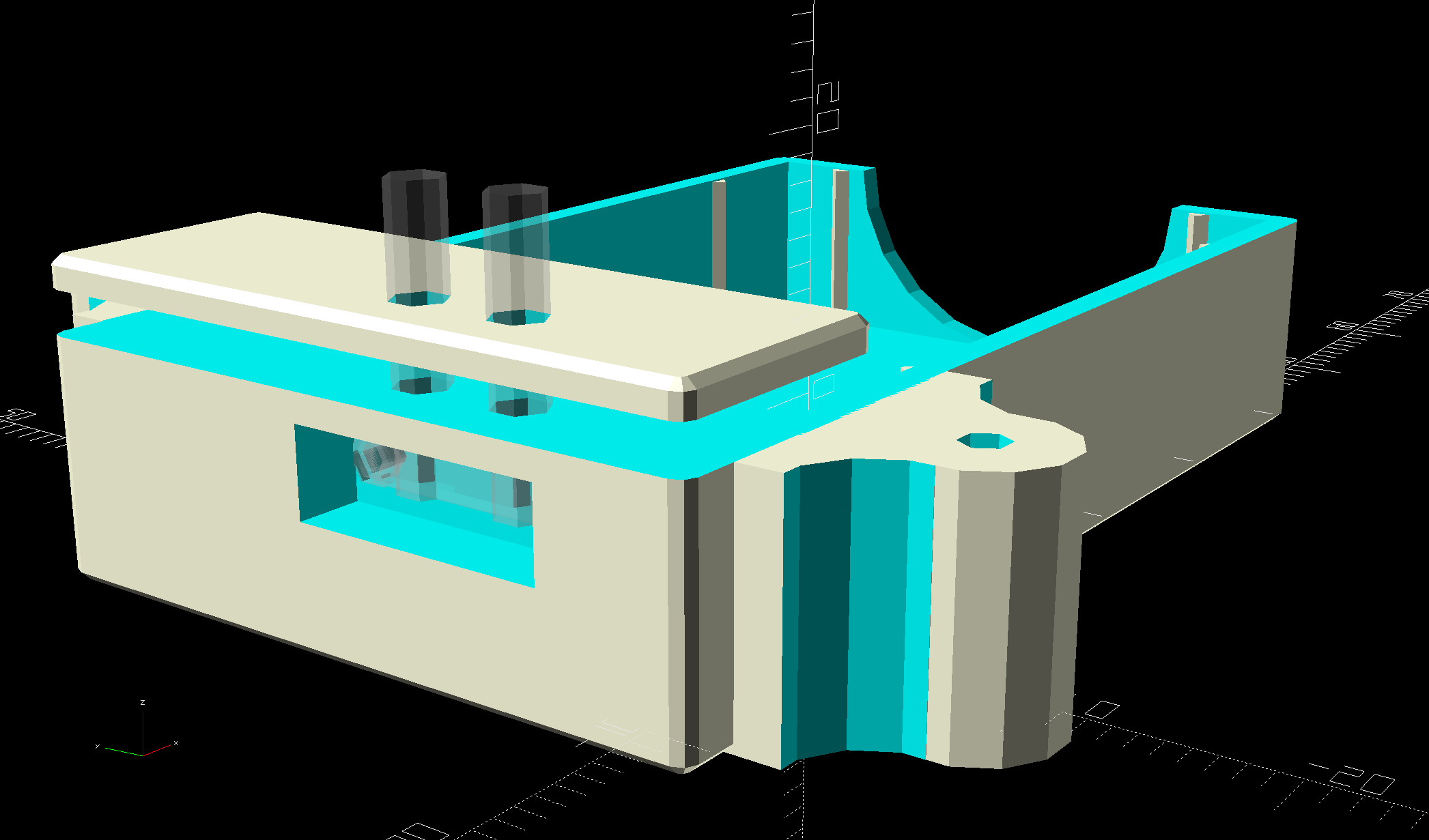
Start by reaming / hand-drilling all the holes to their nominal size and cleaning out the pogo pin pocket.
Solder wires to the pogo pins and thread them through the holder and lid:
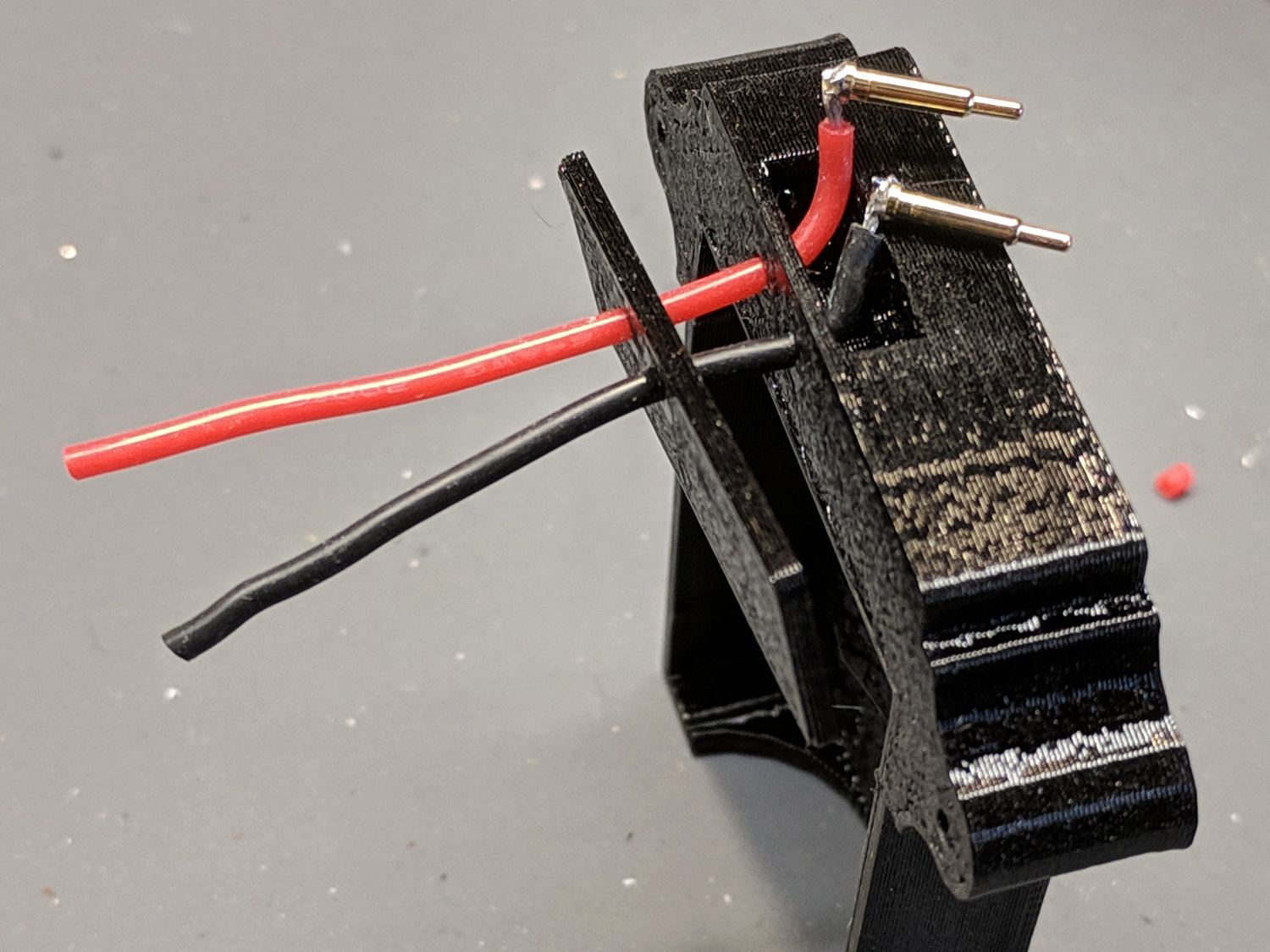
That’s nice, floppy silicone-insulated 24 AWG wire, which may be a bit too thick for this purpose.
The pogo pins will, ideally, seat with the end of the body flush at the holder wall. Make it so:
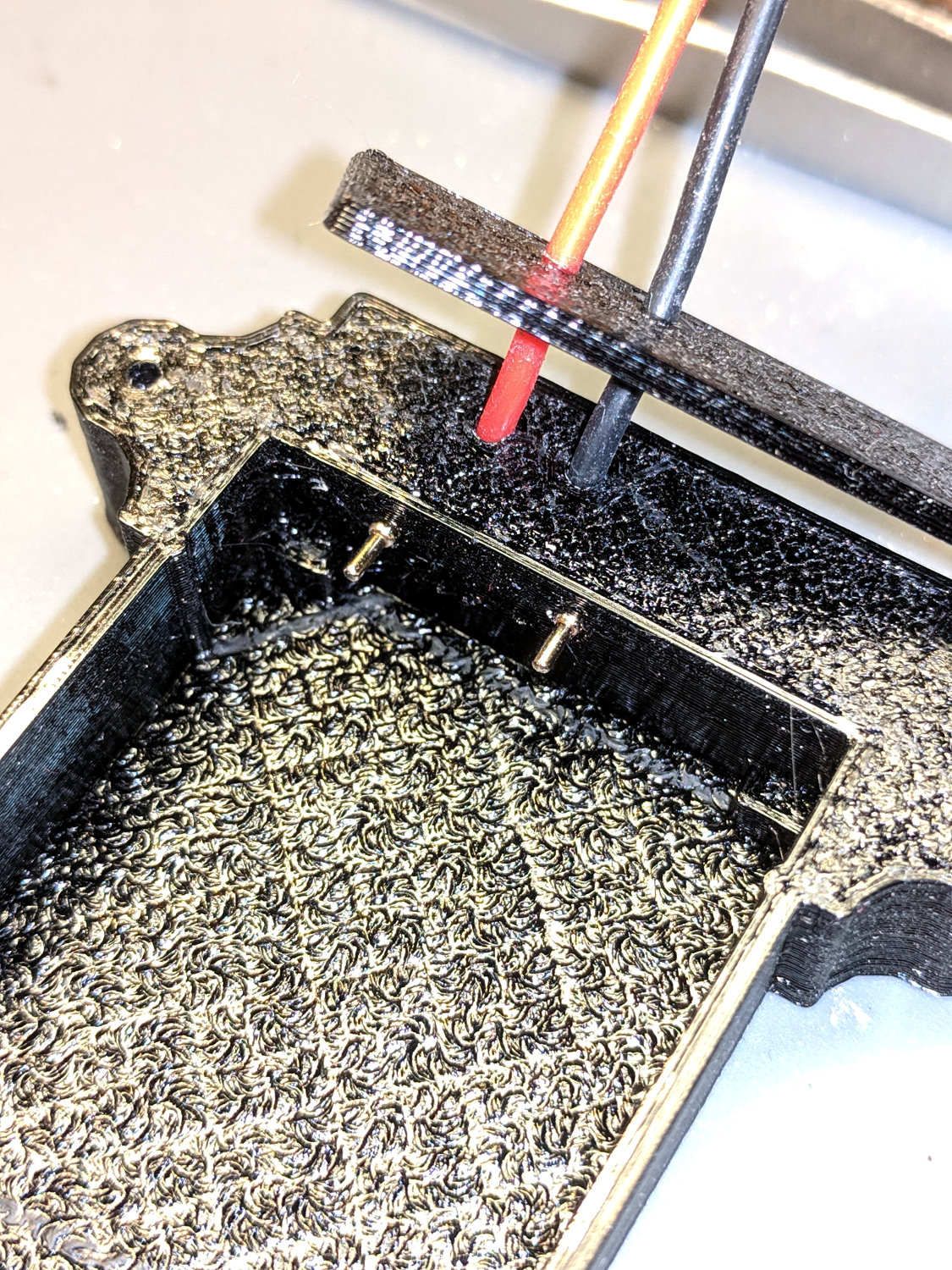
Dress the wires neatly into their pocket:

Butter the bottom of the lid with epoxy, clamp in place, set it up for curing, then fill the recess:

While it’s curing, make a soldering fixture for the 14 AWG wires:
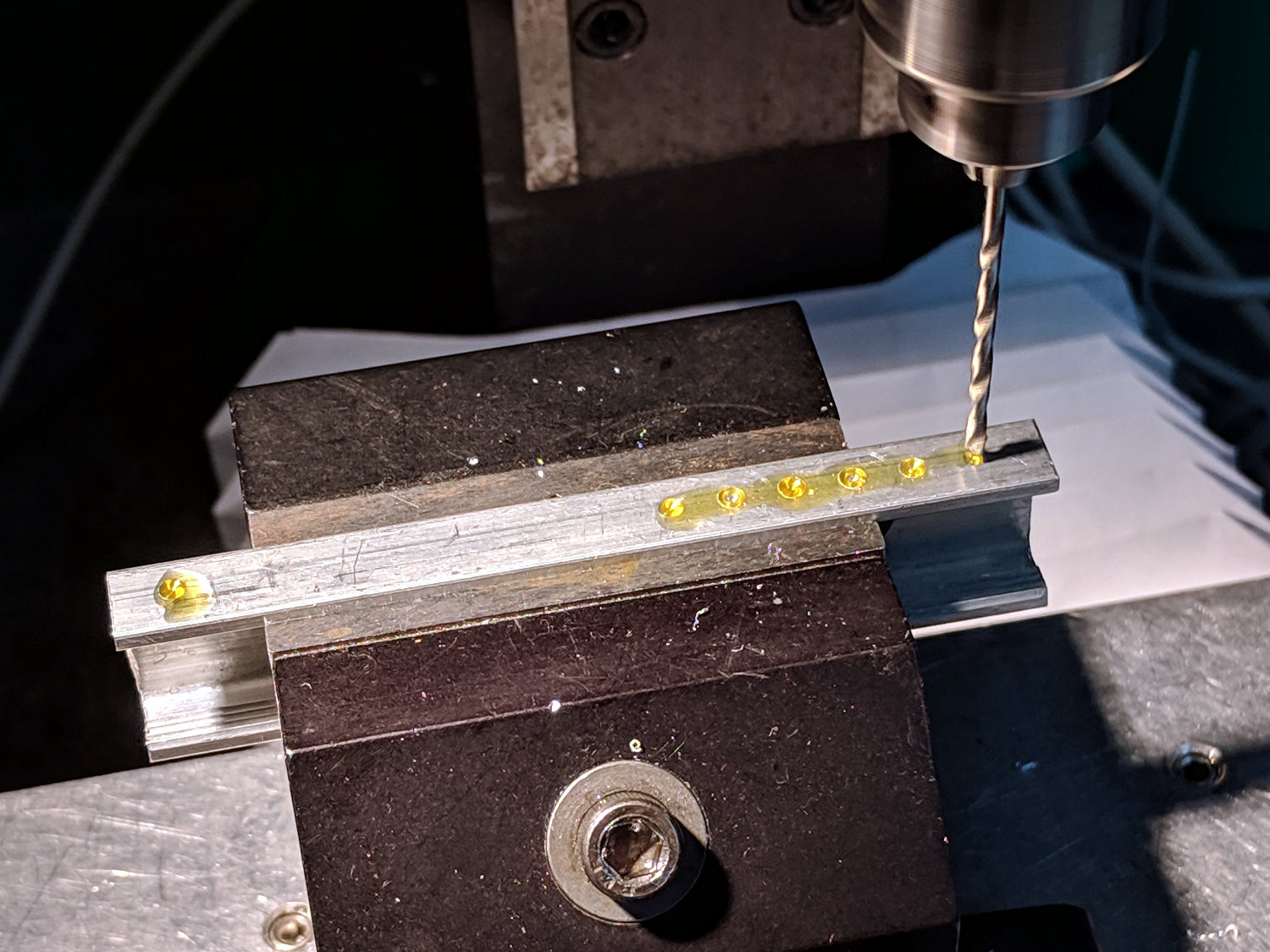
The holes are on 5 mm centers, in the expectation other battery holders will need different spacing.
Solder it up and stick the wires into the base:

Jam a battery in and It Just Works™:
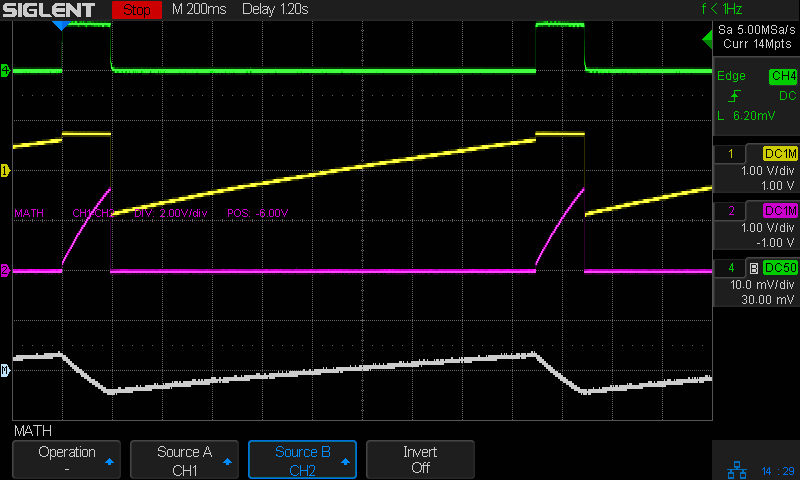
The traces:
The measurement setup was a bit of a hairball:

For completeness, here’s the schematic-and-layout diagram behind the circuitry:
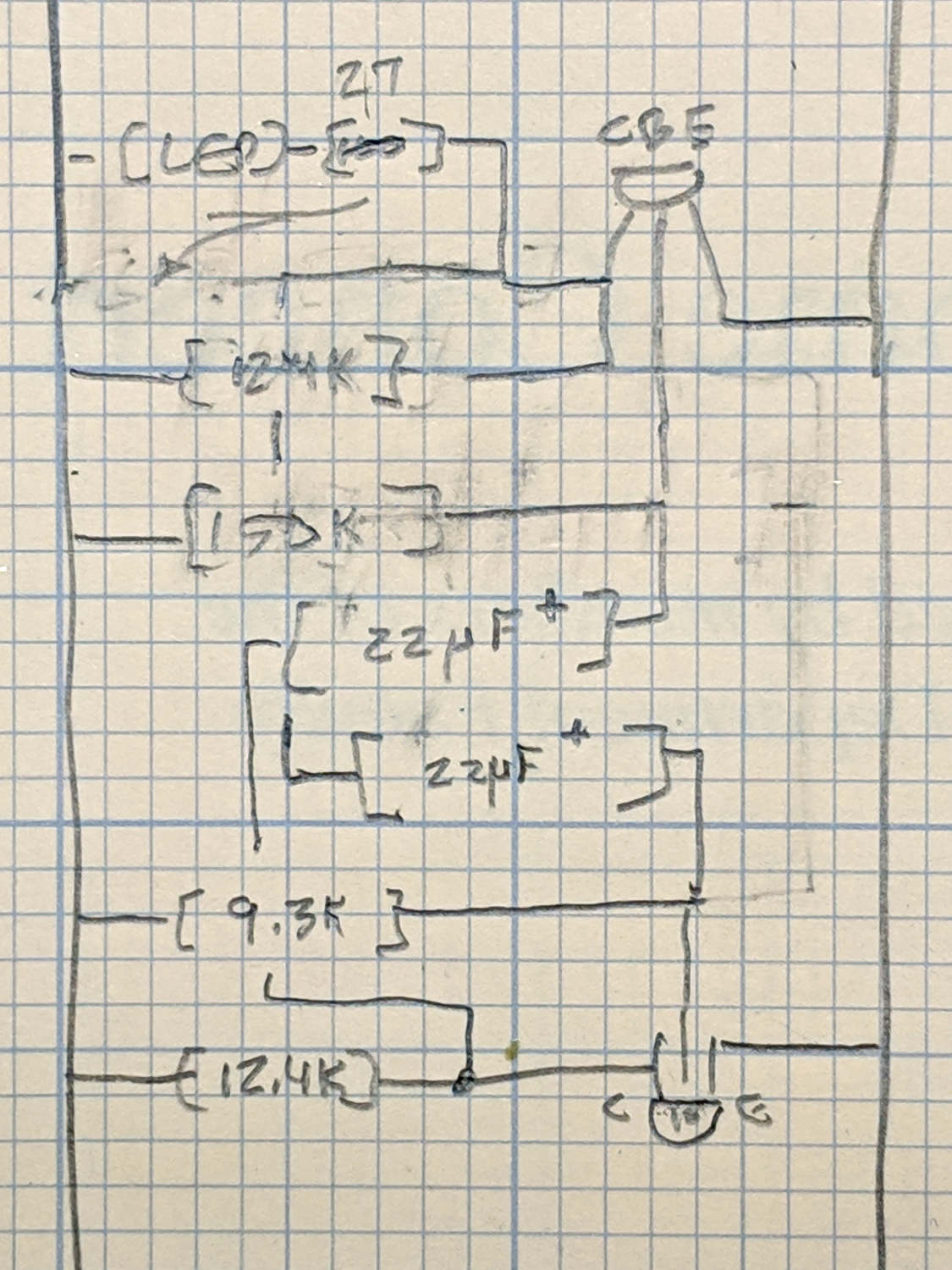
I love it when a plan comes together!
The OpenSCAD source code as a GitHub Gist:
| // Holder for Sony NP-BX1 Li-Ion battery | |
| // Ed Nisley KE4ZNU January 2013 | |
| // 2018-11-15 Adapted for wire leads from 1.5 mm test pins, added upright wire bases | |
| // Layout options | |
| Layout = "Fit"; // Show Build Fit Case Lid Pins | |
| //- Extrusion parameters – must match reality! | |
| // Print with +2 shells and 3 solid layers | |
| ThreadThick = 0.25; | |
| ThreadWidth = 0.35; | |
| HoleWindage = 0.2; | |
| function IntegerMultiple(Size,Unit) = Unit * ceil(Size / Unit); | |
| Protrusion = 0.1; // make holes end cleanly | |
| inch = 25.4; | |
| BuildOffset = 3.0; // clearance for build layout | |
| Gap = 2.0; // separation for Fit parts | |
| //- Basic dimensions | |
| WallThick = 4*ThreadWidth; // holder sidewalls | |
| BaseThick = 6*ThreadThick; // bottom of holder to bottom of battery | |
| TopThick = 6*ThreadThick; // top of battery to top of holder | |
| //- Battery dimensions – rationalized from several samples | |
| // Coordinate origin at battery contact face with key openings below contacts | |
| Battery = [43.0,30.0,9.5]; // X = length, Y = width, Z = thickness | |
| Contacts = [[-0.75,6.0,6.2],[-0.75,16.0,6.2]]; // relative to battery edge, front, and bottom | |
| ContactOC = Contacts[1].y – Contacts[0].y; | |
| ContactCenter = Contacts[0].y + ContactOC/2; | |
| KeyBlocks = [[1.75,3.70,2.90],[1.75,3.60,2.90]]; // recesses in battery face set X position | |
| //- Pin dimensions | |
| ID = 0; | |
| OD = 1; | |
| LENGTH = 2; | |
| PinShank = [1.5,2.0,6.5]; // shank, flange, compressed length | |
| PinFlange = [1.5,2.0,0.5]; // flange, length included in PinShank | |
| PinTip = [0.9,0.9,2.5]; // extended spring-loaded tip | |
| PinChannel = PinFlange[LENGTH] + 0.5; // cut behind flange for solder overflow | |
| PinRecess = 3.0; // recess behind pin flange end for epoxy fill | |
| echo(str("Contact tip dia: ",PinTip[OD])); | |
| echo(str(" .. shank dia: ",PinShank[ID])); | |
| OverTravel = 0.5; // space beyond battery face at X origin | |
| //- Holder dimensions | |
| GuideRadius = ThreadWidth; // friction fit ridges | |
| GuideOffset = 7; // from compartment corners | |
| ThumbRadius = 10.0; // thumb opening at end of battery | |
| CornerRadius = 3*ThreadThick; // nice corner rounding | |
| CaseSize = [Battery.x + PinShank[LENGTH] + OverTravel + PinRecess + GuideRadius + WallThick, | |
| Battery.y + 2*WallThick + 2*GuideRadius, | |
| Battery.z + BaseThick + TopThick]; | |
| CaseOffset = [-(PinShank[LENGTH] + OverTravel + PinRecess),-(WallThick + GuideRadius),0]; // position around battery | |
| LidOverhang = 2.0; // over top of battery for retention | |
| LidSize = [-CaseOffset.x + LidOverhang,CaseSize.y,TopThick]; | |
| LidOffset = [0.0,CaseOffset.y,0]; | |
| //- Wire struts | |
| StrutDia = 1.6; // AWG 14 = 1.6 mm | |
| StrutOC = 45; | |
| StrutSides = 3*4; | |
| StrutBase = [StrutDia,StrutDia + 4*WallThick,CaseSize.z – TopThick]; // ID = wire, OD=buildable | |
| //———————- | |
| // Useful routines | |
| module PolyCyl(Dia,Height,ForceSides=0) { // based on nophead's polyholes | |
| Sides = (ForceSides != 0) ? ForceSides : (ceil(Dia) + 2); | |
| FixDia = Dia / cos(180/Sides); | |
| cylinder(r=(FixDia + HoleWindage)/2,h=Height,$fn=Sides); | |
| } | |
| //——————- | |
| //– Guides for tighter friction fit | |
| module Guides() { | |
| translate([GuideOffset,-GuideRadius,0]) | |
| PolyCyl(2*GuideRadius,(Battery.z – Protrusion),4); | |
| translate([GuideOffset,(Battery.y + GuideRadius),0]) | |
| PolyCyl(2*GuideRadius,(Battery.z – Protrusion),4); | |
| translate([(Battery.x – GuideOffset),-GuideRadius,0]) | |
| PolyCyl(2*GuideRadius,(Battery.z – Protrusion),4); | |
| translate([(Battery.x – GuideOffset),(Battery.y + GuideRadius),0]) | |
| PolyCyl(2*GuideRadius,(Battery.z – Protrusion),4); | |
| translate([(Battery.x + GuideRadius),GuideOffset/2,0]) | |
| PolyCyl(2*GuideRadius,(Battery.z – Protrusion),4); | |
| translate([(Battery.x + GuideRadius),(Battery.y – GuideOffset/2),0]) | |
| PolyCyl(2*GuideRadius,(Battery.z – Protrusion),4); | |
| } | |
| //– Contact pins | |
| // Rotated to put them in their natural oriention | |
| // Aligned to put tip base / end of shank at Overtravel limit | |
| module PinShape() { | |
| translate([-(PinShank[LENGTH] + OverTravel),0,0]) | |
| rotate([0,90,0]) | |
| rotate(180/6) | |
| union() { | |
| PolyCyl(PinTip[OD],PinShank[LENGTH] + PinTip[LENGTH],6); | |
| PolyCyl(PinShank[ID],PinShank[LENGTH] + Protrusion,6); // slight extension for clean cuts | |
| PolyCyl(PinFlange[OD],PinFlange[LENGTH],6); | |
| } | |
| } | |
| // Position pins to put end of shank at battery face | |
| // Does not include recess access into case | |
| module PinAssembly() { | |
| union() { | |
| for (p = Contacts) | |
| translate([0,p.y,p.z]) | |
| PinShape(); | |
| translate([-(PinShank[LENGTH] + OverTravel) + PinChannel/2, // solder space | |
| ContactCenter, | |
| Contacts[0].z]) | |
| cube([PinChannel,(Contacts[1].y – Contacts[0].y),PinFlange[OD]],center=true); | |
| for (j=[-1,1]) // wire channels | |
| translate([-(PinShank[LENGTH] + OverTravel – PinChannel/2), | |
| j*ContactOC/4 + ContactCenter, | |
| Contacts[0].z – PinFlange[OD]/2]) | |
| rotate(180/6) | |
| PolyCyl(PinFlange[OD],CaseSize.z,6); | |
| } | |
| } | |
| //– Case with origin at battery corner | |
| module Case() { | |
| difference() { | |
| union() { | |
| difference() { | |
| union() { | |
| translate([(CaseSize.x/2 + CaseOffset.x), // basic case shape | |
| (CaseSize.y/2 + CaseOffset.y), | |
| (CaseSize.z/2 – BaseThick)]) | |
| hull() | |
| for (i=[-1,1], j=[-1,1], k=[-1,1]) | |
| translate([i*(CaseSize.x/2 – CornerRadius), | |
| j*(CaseSize.y/2 – CornerRadius), | |
| k*(CaseSize.z/2 – CornerRadius)]) | |
| sphere(r=CornerRadius/cos(180/8),$fn=8); // cos() fixes undersize spheres! | |
| hull() // wire strut bases | |
| for (j=[-1,1]) | |
| translate([0,j*StrutOC/2 + Battery.y/2,-BaseThick]) | |
| rotate(180/StrutSides) | |
| cylinder(d=StrutBase[OD],h=StrutBase[LENGTH],$fn=StrutSides); | |
| translate([0,Battery.y/2,StrutBase[LENGTH]/2 – BaseThick]) | |
| cube([2*StrutBase[OD],StrutOC,StrutBase[LENGTH]],center=true); | |
| } | |
| translate([-OverTravel,-GuideRadius,0]) | |
| cube([(Battery.x + GuideRadius + OverTravel), | |
| (Battery.y + 2*GuideRadius), | |
| (Battery.z + Protrusion)]); // battery space | |
| } | |
| Guides(); // improve friction fit | |
| translate([-OverTravel,-GuideRadius,0]) // battery keying blocks | |
| cube(KeyBlocks[0] + [OverTravel,GuideRadius,0],center=false); | |
| translate([-OverTravel,(Battery.y – KeyBlocks[1].y),0]) | |
| cube(KeyBlocks[1] + [OverTravel,GuideRadius,0],center=false); | |
| } | |
| translate([2*CaseOffset.x, // battery top access | |
| (CaseOffset.y – Protrusion), | |
| Battery.z]) | |
| cube([2*CaseSize.x,(CaseSize.y + 2*Protrusion),(TopThick + Protrusion)]); | |
| if (false) | |
| translate([(CaseOffset.x – Protrusion), // battery insertion allowance | |
| (CaseOffset.y – Protrusion), | |
| Battery.z]) | |
| cube([(CaseSize.x + 2*Protrusion),(CaseSize.y + 2*Protrusion),(TopThick + Protrusion)]); | |
| for (j=[-1,1]) // strut wires | |
| translate([0,j*StrutOC/2 + Battery.y/2,-(BaseThick + Protrusion)]) | |
| PolyCyl(StrutBase[ID],StrutBase[LENGTH] + 2*Protrusion,6); | |
| for (i=[-1,1], j=[-1,1]) | |
| translate([i*StrutBase[OD],j*StrutOC/2 + Battery.y/2,-(BaseThick + Protrusion)]) | |
| rotate(180/StrutSides) | |
| PolyCyl(StrutBase[OD],StrutBase[LENGTH] + 2*Protrusion,StrutSides); | |
| translate([(Battery.x – Protrusion), // remove thumb notch | |
| (CaseSize.y/2 + CaseOffset.y), | |
| (ThumbRadius)]) | |
| rotate([90,0,0]) | |
| rotate([0,90,0]) | |
| cylinder(r=ThumbRadius, | |
| h=(WallThick + GuideRadius + 2*Protrusion), | |
| $fn=22); | |
| PinAssembly(); | |
| translate([CaseOffset.x + PinRecess + Protrusion,(Contacts[1].y + Contacts[0].y)/2,Contacts[0].z]) | |
| translate([-PinRecess,0,0]) | |
| cube([2*PinRecess, | |
| (Contacts[1].y – Contacts[0].y + PinFlange[OD]), | |
| 2*PinFlange[OD]],center=true); | |
| } | |
| } | |
| // Lid position offset to match case | |
| module Lid() { | |
| difference() { | |
| translate([-LidSize.x/2 + LidOffset.x + LidOverhang,LidSize.y/2 + LidOffset.y,0]) | |
| difference() { | |
| hull() | |
| for (i=[-1,1], j=[-1,1], k=[-1,1]) | |
| translate([i*(LidSize.x/2 – CornerRadius), | |
| j*(LidSize.y/2 – CornerRadius), | |
| k*(LidSize.z – CornerRadius)]) // double thickness for flat bottom | |
| sphere(r=CornerRadius,$fn=8); | |
| translate([0,0,-LidSize.z/2]) // remove bottom | |
| cube([(LidSize.x + 2*Protrusion),(LidSize.y + 2*Protrusion),LidSize.z],center=true); | |
| translate([LidSize.x/8,0,0]) | |
| cube([LidSize.x/4,0.75*LidSize.y,4*ThreadThick],center=true); // epoxy recess | |
| } | |
| translate([0,0,-(Contacts[0].z + PinFlange[OD])]) // punch wire holes | |
| PinAssembly(); | |
| } | |
| } | |
| //——————- | |
| // Build it! | |
| if (Layout == "Case") | |
| Case(); | |
| if (Layout == "Lid") | |
| Lid(); | |
| if (Layout == "Pins") { | |
| color("Silver",0.5) | |
| PinShape(); | |
| PinAssembly(); | |
| } | |
| if (Layout == "Show") { // reveal pin assembly | |
| difference() { | |
| Case(); | |
| translate([(CaseOffset.x – Protrusion), | |
| Contacts[1].y, | |
| Contacts[1].z]) | |
| cube([(-CaseOffset.x + Protrusion), | |
| CaseSize.y, | |
| (CaseSize.z – Contacts[0].z + Protrusion)]); | |
| translate([(CaseOffset.x – Protrusion), | |
| (CaseOffset.y – Protrusion), | |
| 0]) | |
| cube([(-CaseOffset.x + Protrusion), | |
| Contacts[0].y + Protrusion – CaseOffset.y, | |
| CaseSize.z]); | |
| } | |
| translate([0,0,Battery.z + Gap]) | |
| Lid(); | |
| color("Silver",0.15) | |
| PinAssembly(); | |
| } | |
| if (Layout == "Build") { | |
| translate([-(CaseSize.x/2 + CaseOffset.x),-(CaseOffset.y – BuildOffset),BaseThick]) | |
| Case(); | |
| translate([CaseSize.x/2,-LidSize.x/2,0]) | |
| rotate(90) | |
| Lid(); | |
| } | |
| if (Layout == "Fit") { | |
| Case(); | |
| translate([0,0,(Battery.z + Gap)]) | |
| Lid(); | |
| color("Silver",0.25) | |
| PinAssembly(); | |
| } | |
A House Finch suffering from Finch Eye Disease prompted me to sterilize our feeder, which meant providing a temporary feeder to keep the birds flying. Having an abundance of lids from six gallon plastic cans / buckets, this made sense:

Which required an adapter betwixt pole and lid:

Which requires a bit of solid modeling:
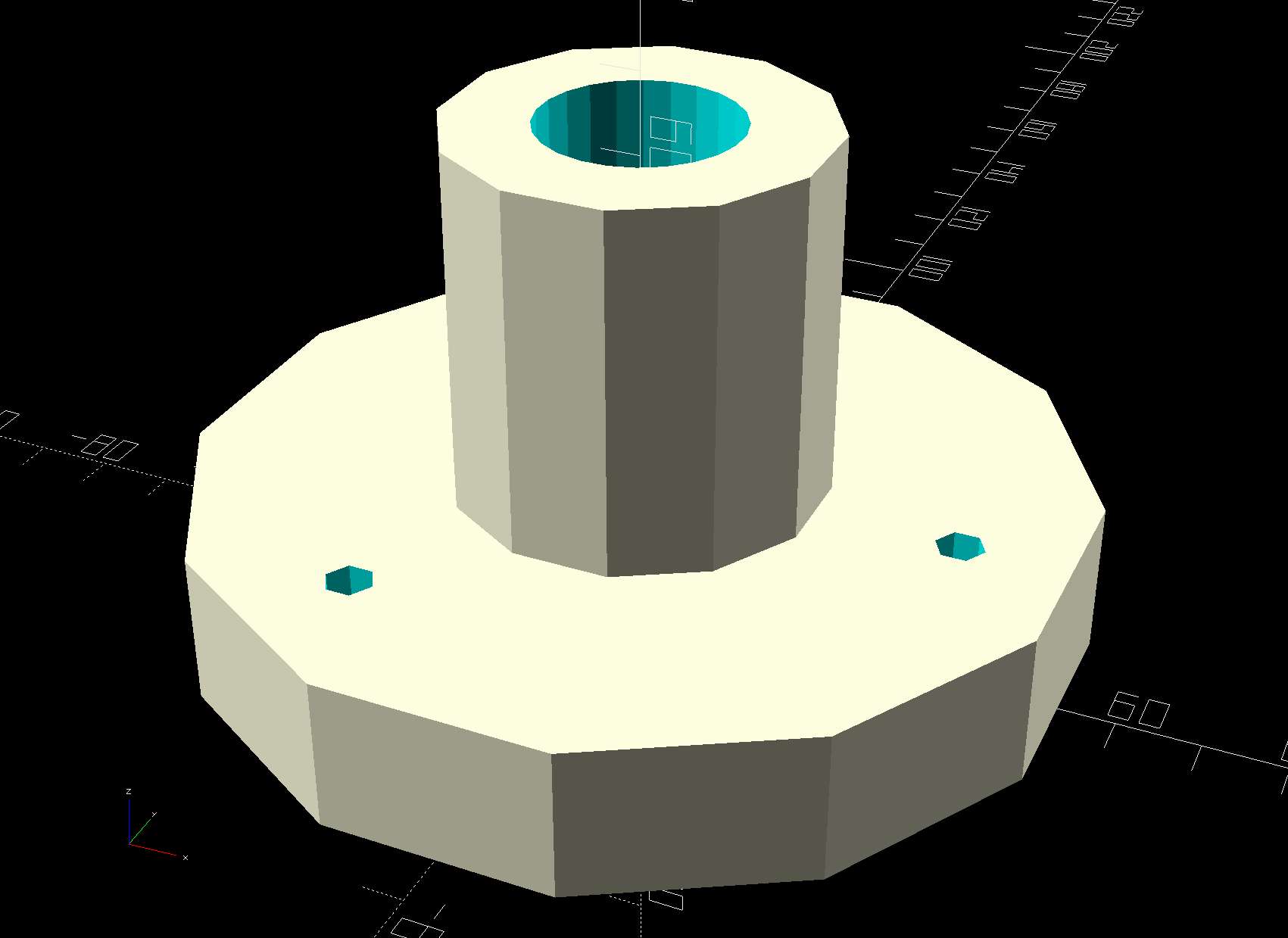
The lids have a central boss, presumably for stiffening, so the model includes a suitable recess:

As usual, automatically generated support fills the entire recess, so I designed a minimal support structure into the model and cracked it out with very little effort:

The tangle off to the right comes from a bridge layer with a hole in the middle, which never works well even with support:

Didn’t bother the birds in the least, though, so it’s all good.
I loves me my 3D printer …
The OpenSCAD source code as a GitHub Gist:
| // Adapter from steel pole to 5 gallon plastic can lid | |
| // Turns the lid into a improvised platform feeder | |
| // Ed Nisley – KE4ZNU – 2018-11 | |
| Layout = "Build"; // Show Build | |
| ThreadThick = 0.25; | |
| ThreadWidth = 0.40; | |
| HoleWindage = 0.2; | |
| function IntegerMultiple(Size,Unit) = Unit * ceil(Size / Unit); | |
| Protrusion = 0.1; // make holes end cleanly | |
| // Sizes | |
| ID = 0; | |
| OD = 1; | |
| LENGTH = 2; | |
| Wall = 10; // minimum thickness or width for anything | |
| Boss = [15,50,9]; // central boss on lie | |
| Flange = [50,110,Boss[LENGTH] + Wall]; | |
| echo(Boss); | |
| echo(Flange); | |
| Pole = [(23.5 + 4*HoleWindage),26,45]; // small end of steel pole | |
| Screw = [5.0,8.0,25.0]; // 5 mm or 10-32 | |
| ScrewOC = 80; // lid mounting screws | |
| NumScrews = 3; | |
| NumSides = NumScrews*2*4; | |
| $fn = NumSides; | |
| //———————- | |
| // Useful routines | |
| module PolyCyl(Dia,Height,ForceSides=0) { // based on nophead's polyholes | |
| Sides = (ForceSides != 0) ? ForceSides : (ceil(Dia) + 2); | |
| FixDia = Dia / cos(180/Sides); | |
| cylinder(r=(FixDia + HoleWindage)/2,h=Height,$fn=Sides); | |
| } | |
| //———————- | |
| // Build it | |
| module Bracket() { | |
| difference() { | |
| union() { | |
| rotate(180/(NumSides/2)) { | |
| cylinder(d=Flange[OD],h=Flange[LENGTH],$fn=NumSides/2); // fewer sides is OK | |
| cylinder(d=Pole[OD] + 2*Wall,h=Pole[LENGTH] + Flange[LENGTH],$fn=NumSides/2); | |
| } | |
| } | |
| translate([0,0,-Protrusion]) | |
| rotate(180/NumSides) | |
| cylinder(d=Boss[OD],h=Boss[LENGTH] + Protrusion,$fn=NumSides); | |
| translate([0,0,-Protrusion]) | |
| rotate(180/NumSides) | |
| cylinder(d=Pole[ID],h=2*(Pole[LENGTH] + Flange[LENGTH]),$fn=NumSides); | |
| for (i=[0:NumScrews-1]) | |
| rotate(i*(360/NumScrews)) | |
| translate([ScrewOC/2,0,-Protrusion]) | |
| PolyCyl(Screw[ID],2*Flange[LENGTH],6); | |
| } | |
| } | |
| module Support() { | |
| NumRibs = NumSides/2; | |
| Rib = [0.95*(Boss[OD] – Pole[ID])/2,2*ThreadWidth,Boss[LENGTH] – ThreadThick]; | |
| color("Yellow") { | |
| for (i=[0:NumRibs-1]) { | |
| a = i*360/NumRibs; | |
| rotate(a) | |
| translate([Pole[ID]/2 + Rib.x/2,0,Rib.z/2]) | |
| cube(Rib,center=true); | |
| } | |
| rotate(180/NumSides) | |
| difference() { | |
| cylinder(d=Pole[ID] + 10*ThreadWidth,h=1*ThreadThick,$fn=NumSides); | |
| translate([0,0,-Protrusion]) | |
| cylinder(d=Pole[ID],h=Rib.z + 2*Protrusion,$fn=NumSides); | |
| } | |
| } | |
| } | |
| if (Layout == "Show") | |
| Bracket(); | |
| if (Layout == "Build") { | |
| Bracket(); | |
| Support(); | |
| } |
It seems the DCW&WA SUV makes regular trips through the “No Motor Vehicles” bike access:

If it’s not them, then it’s somebody following their example.
Just because you can do something, doesn’t mean you should … but, of course, the ordinary rules apply only to little people, not public servants.
Someone in the bike advocacy apparat once told me I’m the most cynical, bitter person they’d ever met, at least on the subject of getting along with public servants. As I see it, I came by my attitude honestly.
A sterling knife followed me home after a Thanksgiving gathering:

The original cement, dating back to the middle of the last century, turned into friable dust around the blade tang:

I cleaned it out as best I could, buttered JB Quik epoxy around the tang and into the socket, joined the two, and let it cure in the natural position:
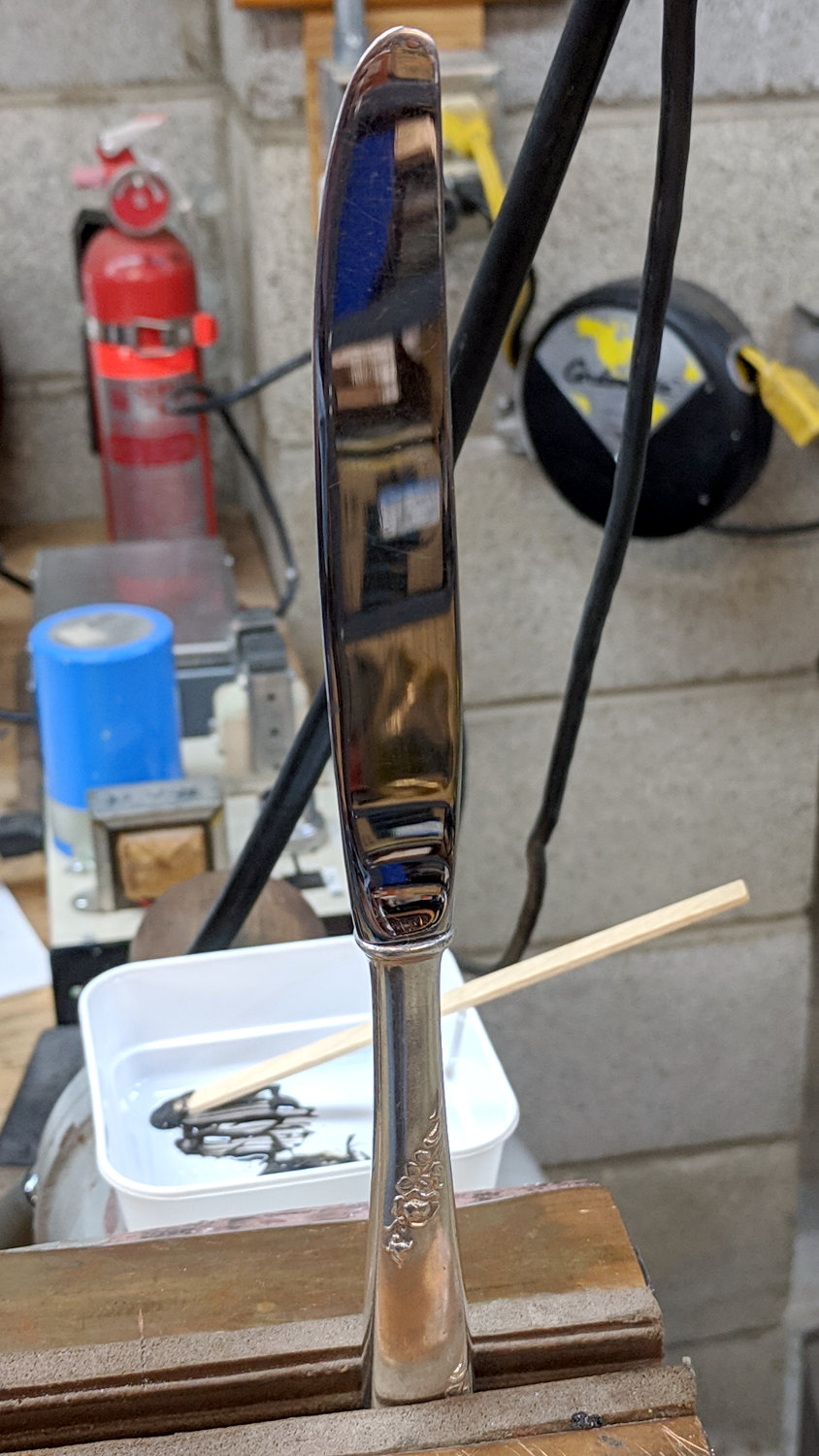
The rest of the knives in the set may need similar attention, but I’m not looking for trouble.
 The Smell of Molten Projects in the Morning