Ed Nisley's Blog: Shop notes, electronics, firmware, machinery, 3D printing, laser cuttery, and curiosities. Contents: 100% human thinking, 0% AI slop.
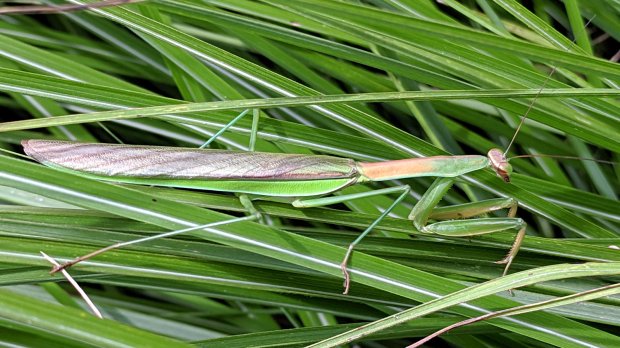
Several of this year’s praying mantises set up shop in the decorative grasses bracketing the front door:
Praying Mantis – brown wing covers – in grass
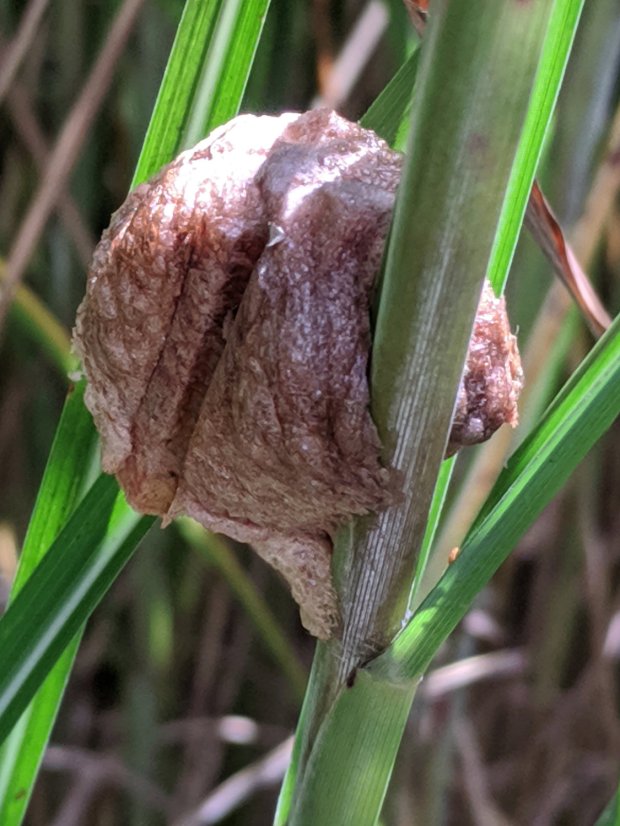
We found their egg masses, formally called ootheca, attached to the stems in mid-October:
Praying Mantis egg mass A
They feel like rigid urethane foam and seem eminently protective:
Praying Mantis egg mass B
We’ll cut around the masses when it’s time to clear out the dead grass next spring. I was tempted to bring one inside, but dealing with a gazillion tiny mantises in a few months would be daunting.
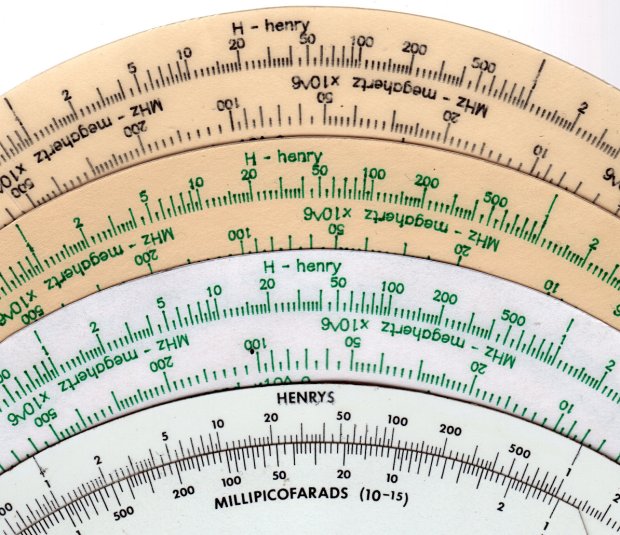
That’s a stack of three “Homage” Tek CC bottom decks under a Genuine Tektronix Circuit Computer.
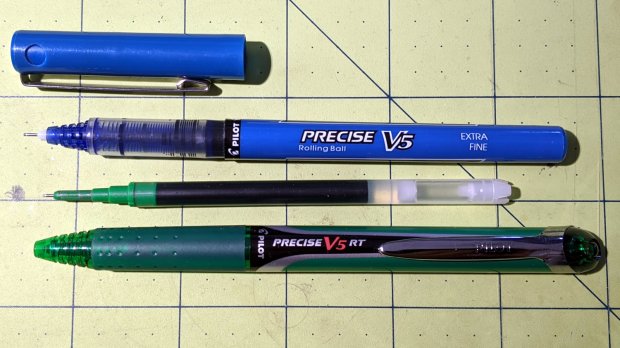
The black scale at the top of the picture (and the bottom of the stack) came from a 1 mm cheap pen in the collet holder, the two green scales come from a 0.5 mm Pilot V5RT cartridge in its new holder, and the Original is (most likely) laser-printed back when that was a New Thing.
As always, paper makes a big difference in the results. The brownish paper is 110 pound card stock with a relatively coarse surface finish. The white paper is ordinary 22 pound general-purpose laser / inkjet printer paper.
The 1.0 mm pen (top) doesn’t much care what it’s writing on, producing results on the low side of OK: some light sections, no blobs. Perfectly serviceable, but not pretty.
1.0 mm ball pen
The Pilot V5RT really likes better paper, as it bleeds out on the card stock whenever the CNC 3018XL so much as pauses at the end of a stroke. Using white paper slows, but doesn’t completely stop, the bleeding, making the blobs survivable.
0.5 mm ball Pilot V5RT pen
I’ve been using card stock to get stiffer, more durable, and more easily manipulated decks, but the improved line quality on the white paper says I should laminate the decks in plastic, just like the original Tektronix design.
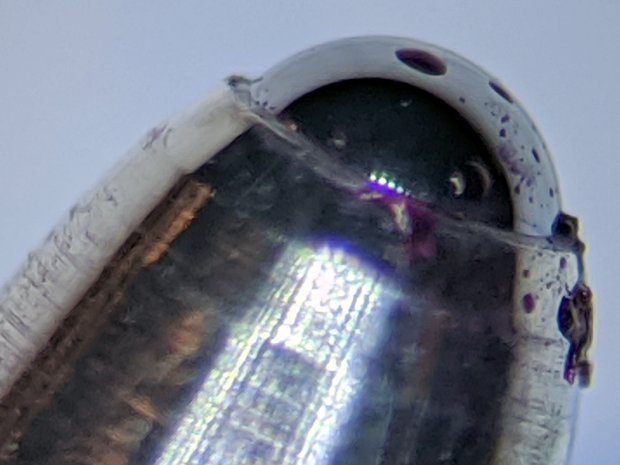
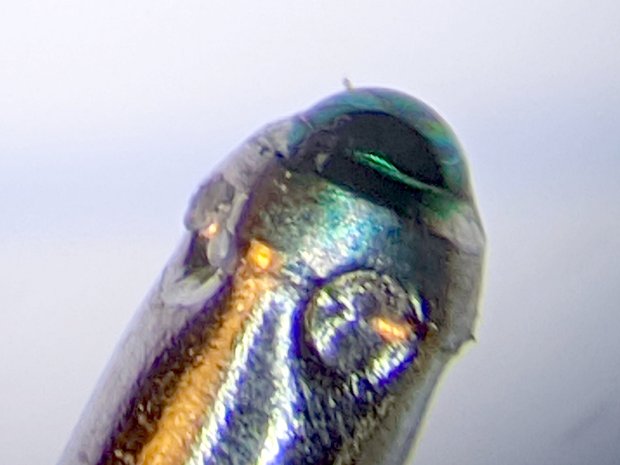
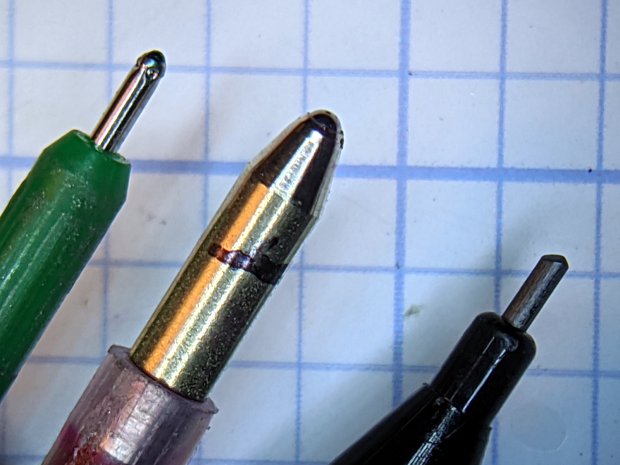
The Google Pixel 3a camera, unlike the camera in my older Google Pixel XL, takes spectacularly good images through a widefield 5X eyepiece on the stereo zoom microscope:
0.5 1.0 mm ball pens – 0.7 mm lead pencil
That’s hand-holding the phone against the eyepiece while manipulating it with the other hand. Definitely not the most stable arrangement, but the camera copes well with slight motions. I really need a gripping hand for the camera, to free up another for the microscope’s focus knob.
The cartridge is a nice 6 mm cylinder, eminently transformable into a plotter pen:
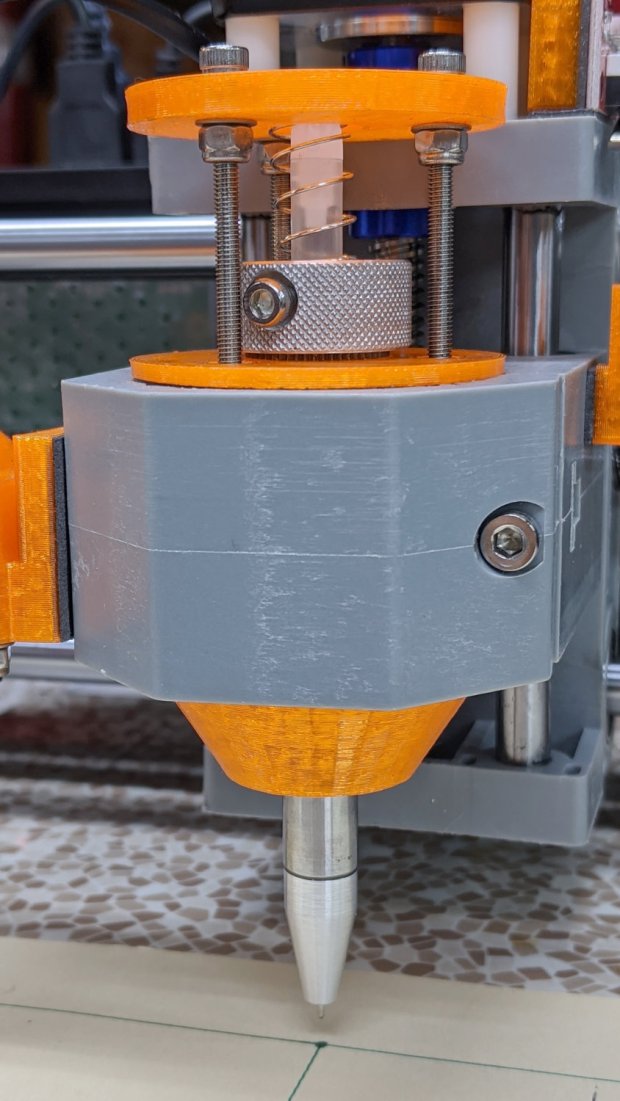
Pilot V5RT holder – installed
A few minutes with a caliper provides key measurements for a snout surrounding the business end:
Pilot V5RT Pen Holder – snout dimension doodle
The green letters & numbers give the nearest drill sizes. The “T” values along the bottom are the tailstock turns (at 1.5 mm/turn) required to poke the drills to the indicated depths, eyeballed when the body just enters the hole.
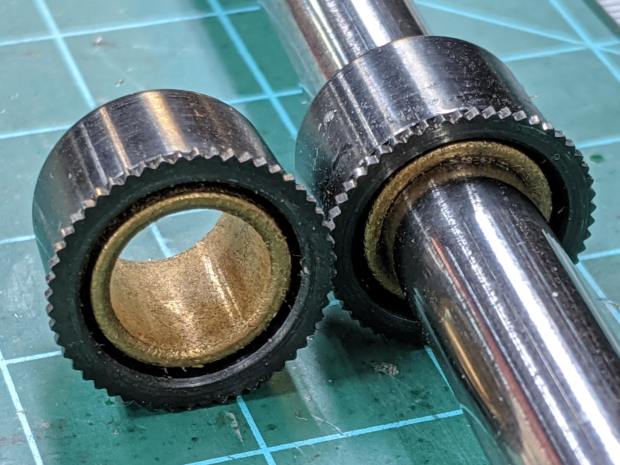
Having recently decomissioned the Thing-O-Matic and harvested its organs parts, I have a vast collection of 3/8 inch = 9.52 mm shafts and matching bronze bushings:
9.52 mm shaft and bushings
Bronze bushings have low stiction, at least when they’re co-axial, and are much shorter than linear ball bearings.
I chopped off a 70 mm length of shaft and faced the raw end:
Pilot V5RT holder – facing shaft
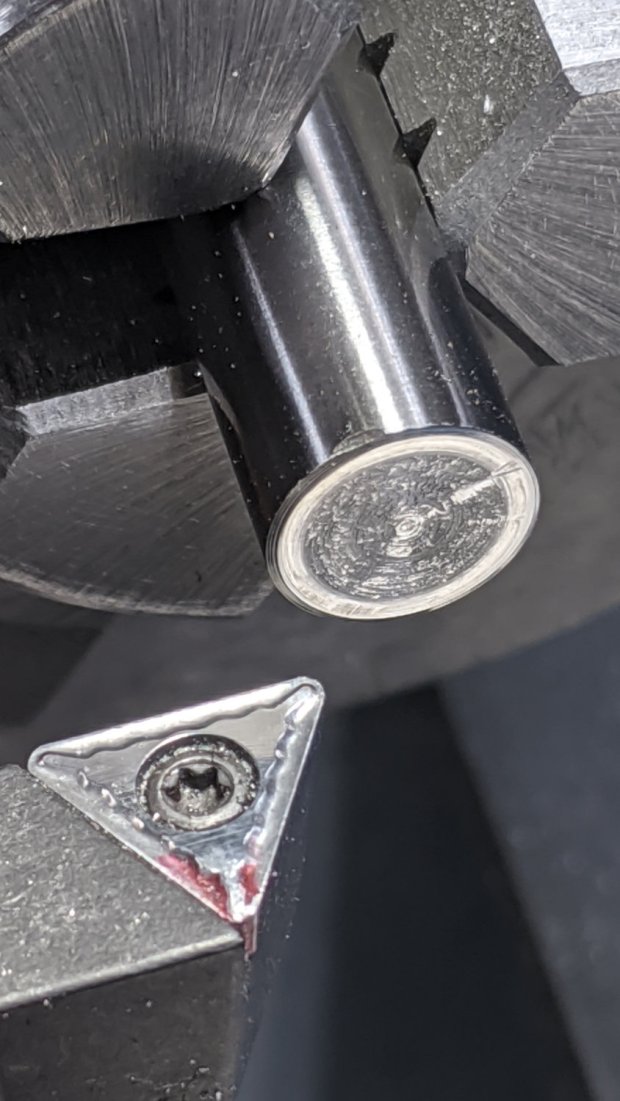
The other end had a maker’s logo, but I don’t recognize it:
Pilot V5RT holder – center drill
I really wanted an 8 mm bore around the snout, but it just didn’t work out. The ring around the 7.5 mm counterbore shows where the larger drill just … stopped:
Pilot V5RT holder – drilled shaft
A trial fit with the pen cartridge:
Pilot V5RT holder – pen in shaft
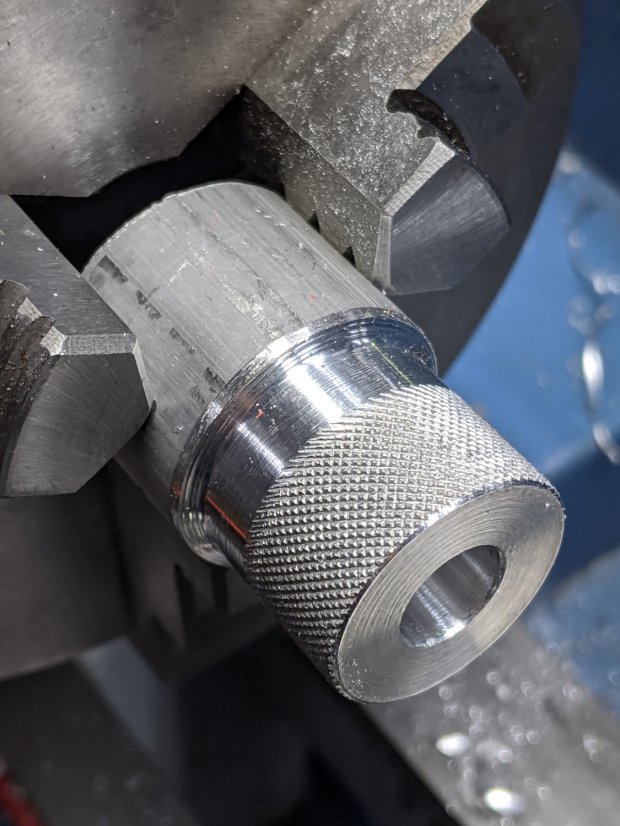
The top of the shaft gets a somewhat longer knurled ring for the 3 mm SHCS holding the cartridge in place:
Pilot V5RT holder – knurling pen clamp
The screw bears on a split collar turned and drilled from a Delrin rod:
Pilot V5RT holder – drilling Delrin clamp
The “split” came from a simple saw cut across one side and I milled a flat spot in the knurling to seat the screw. As usual, the knurled ring got epoxied to the shaft.
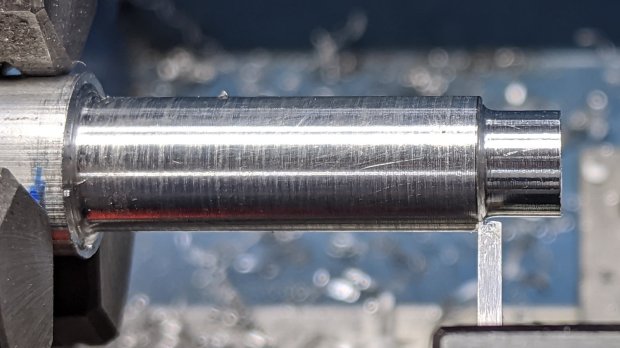
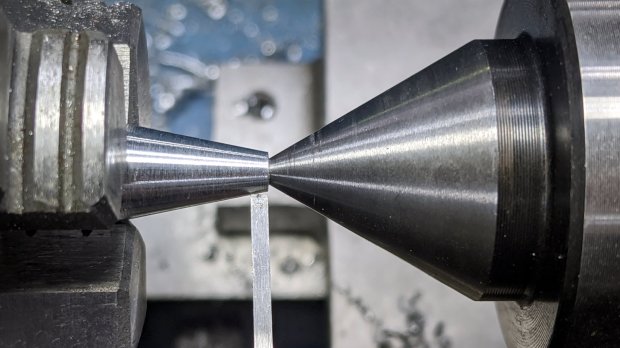
The snout started as a 3/8 inch aluminum rod, drilled as shown in the sketch, with a (scant) 7.5 mm section to fit the shaft. The carbide insert left a nicely rounded shoulder that required trimming to fit snugly into the shaft:
A trial fit showed the snout was a bit too long for comfort:
Pilot V5RT holder – snout test fit
Making something shorter doesn’t pose much of a challenge:
Pilot V5RT holder – trimming snout
Another trial fit shows it’s spot on:
Pilot V5RT holder – shaft snout pen test fit
The critical part is having the snout support the plastic around the pen tip to prevent wobbulation.
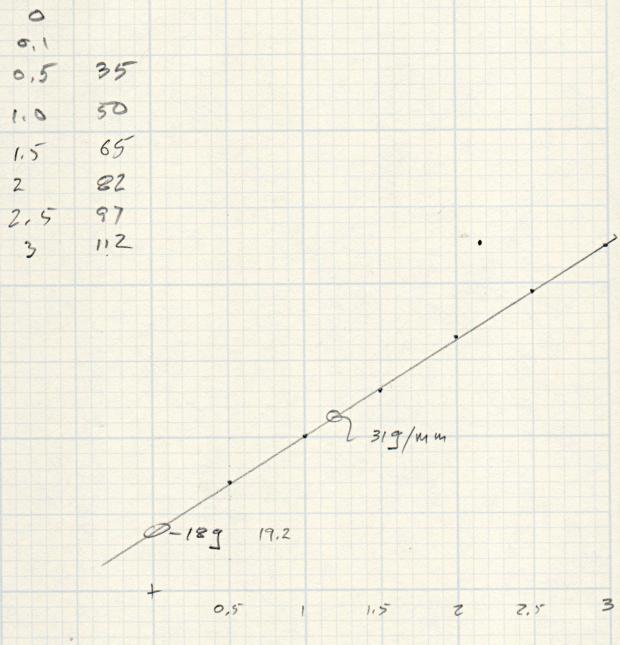
Epoxy the whole thing together, add a suitable spring, tighten the screws & nuts for the reaction plate, and it’s all good. I write with about 50 g of force for these pens, so a light preload seemed in order:
Pilot V5RT Pen Holder – initial downforce measurement
If I’d weighed the full-up shaft + snout + collar + cartridge, I’d know if the Y intercept matches that weight. It seems a little lighter, but I’m not taking the thing apart to find out.
The first version of the 3D printed holder (shown above) is a straightforward modification of the LM12UU diamond drag bit holder, but, after building enough of these things, I realized the circular reaction plate should be triangular to get more clearance in front of the Z-axis stepper motor when installing & removing the holder:
Pilot V5RT Pen Holder – solid model – show view
It also has a recess for the serrated top of the bearing, to prevent the knurled collar from clicking annoyingly as the Z-axis rises at the end of each stroke.
This file contains hidden or bidirectional Unicode text that may be interpreted or compiled differently than what appears below. To review, open the file in an editor that reveals hidden Unicode characters.
Learn more about bidirectional Unicode characters
As you might expect by now, I harvest various bits & pieces from the PCs falling off the trailing edge of my assortment. The bag of obsolete DRAM recently floated to the top of the heap:
DRAM Assortment – overview
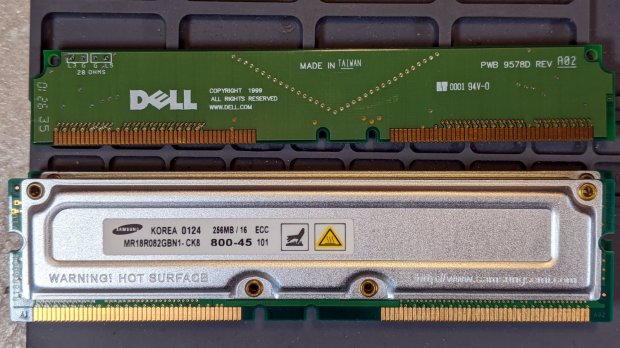
Half a gig of ECC RAM from what might have been a fire-breathing Pentium Pro box:
DRAM Assortment – 256 MB ECC
The PCBs along the top apparently filled vacant memory slots.
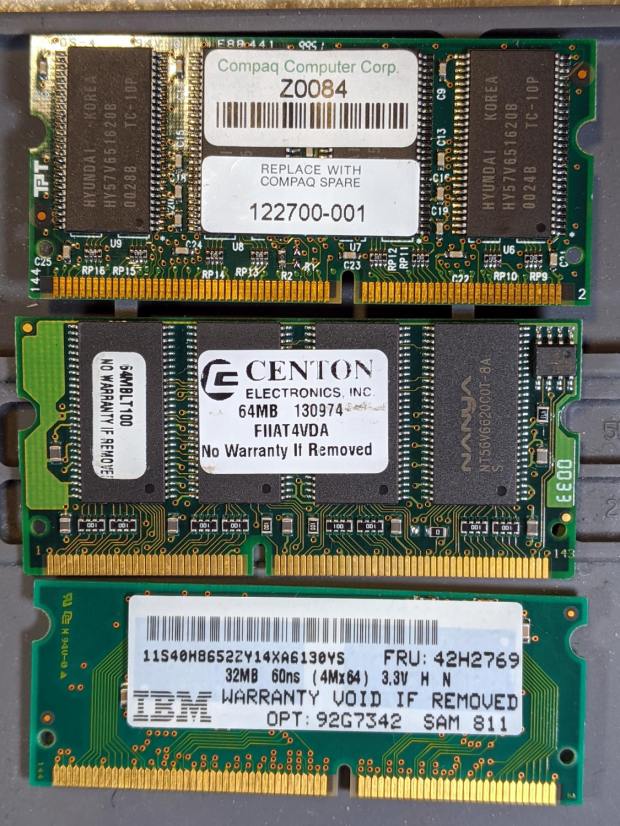
Some 32 and 64 MB DRAM from a few IBM laptops I turned into picture frames:
DDR2 DRAM in assorted sizes & speeds:
DRAM Assortment – PC2 DDR
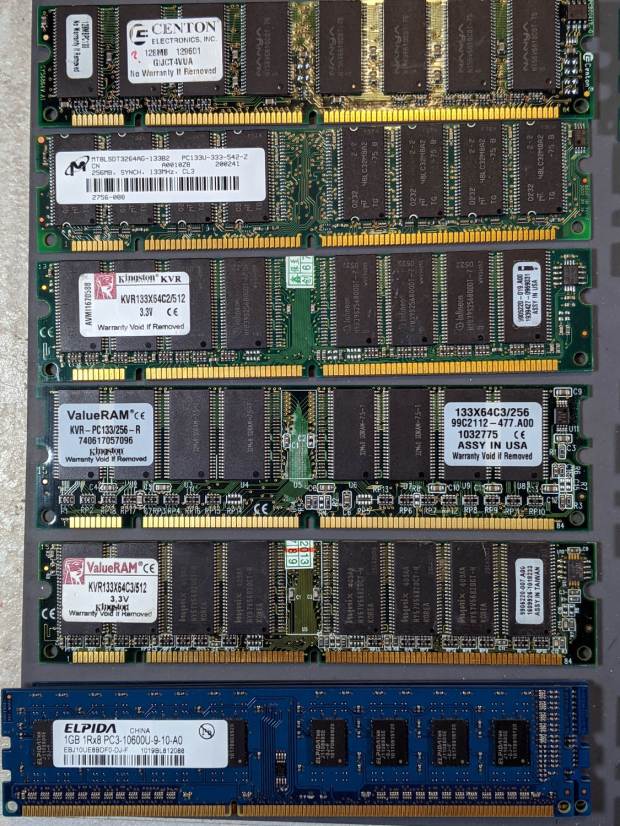
PC133 DDR DRAM, with four sticks of 1 GB PC3 along the bottom:
DRAM Assortment – PC133
If you look closely, you may see something you can use. No reasonable offer refused …
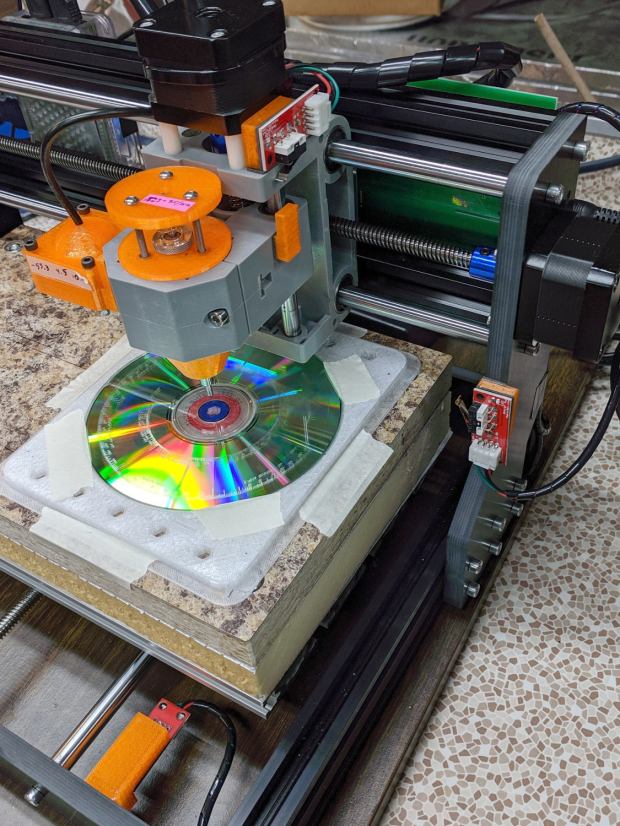
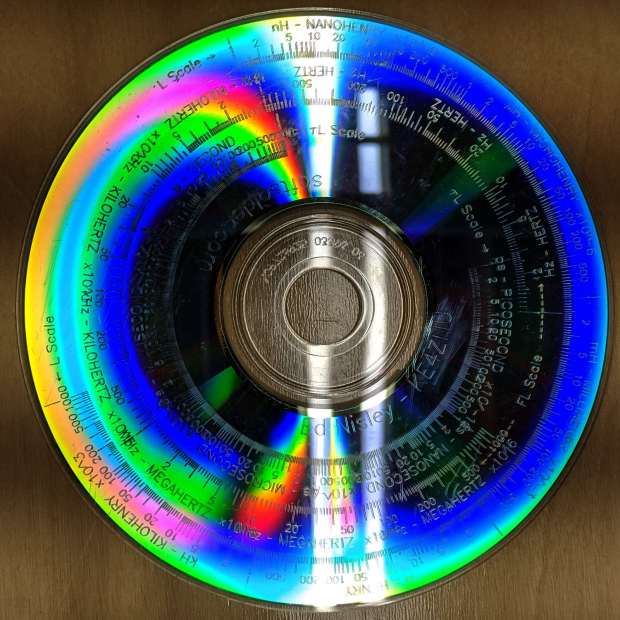
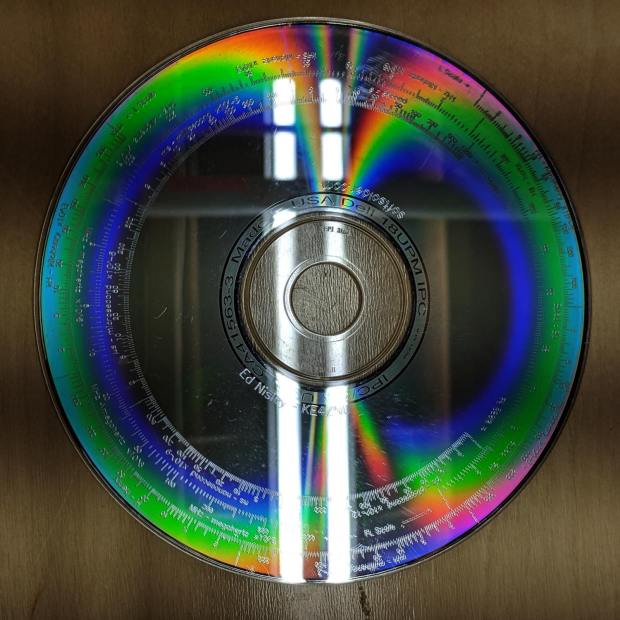
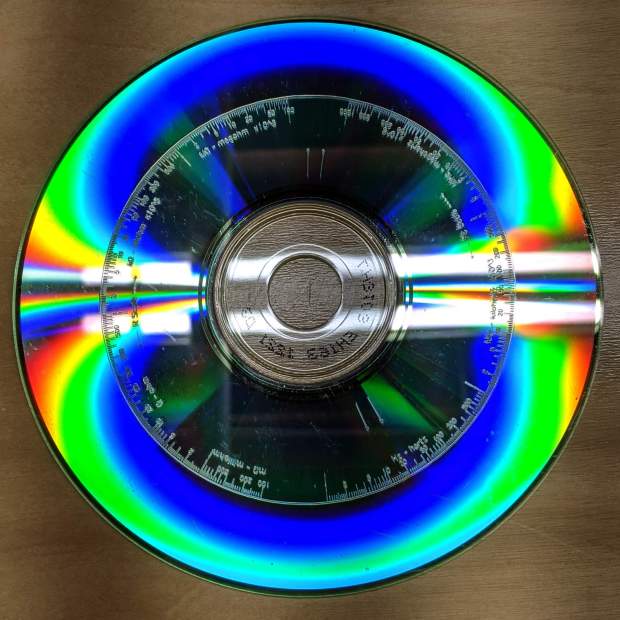
The tiny engravings don’t photograph well, because they’re floating atop the transparent disc and the rainbow patterns from the data layer, but they still come out OK even when scaled to fit on a hard drive platter:














 The Smell of Molten Projects in the Morning