The Smell of Molten Projects in the Morning

Ed Nisley's Blog: Shop notes, electronics, firmware, machinery, 3D printing, laser cuttery, and curiosities. Contents: 100% human thinking, 0% AI slop.

Author: Ed

  • Upconverting Baby Wipes

    Upconverting Baby Wipes

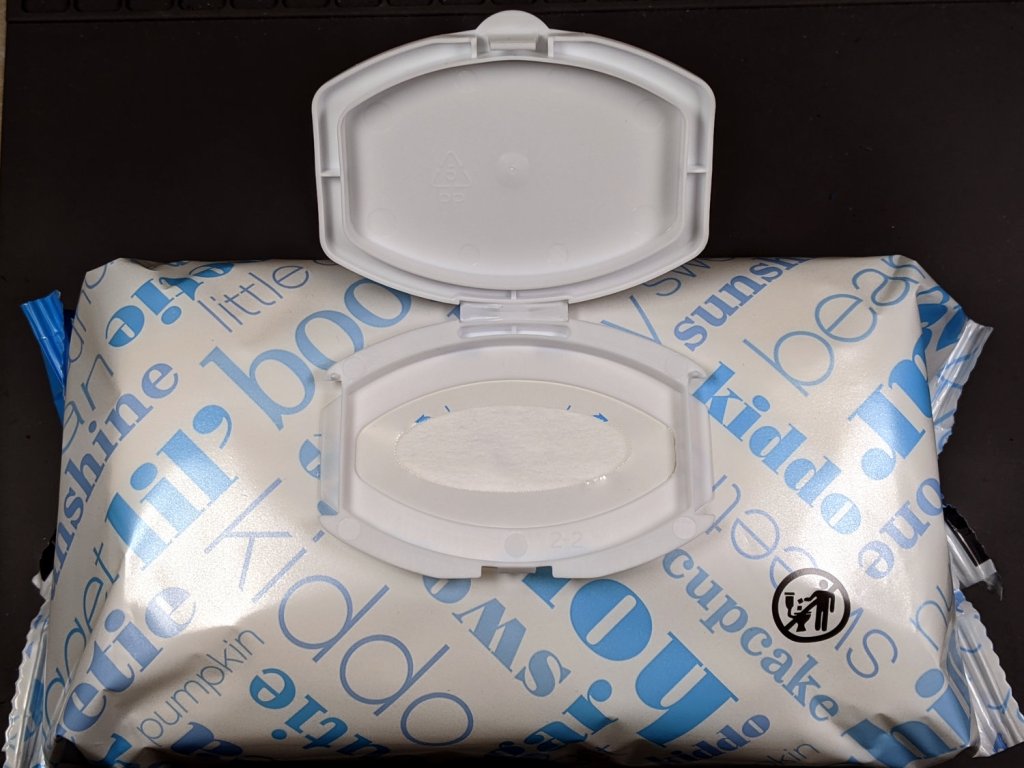
    As other folks have discovered, it’s straightforward to convert soft, soothing baby wipes into toxic sanitizing wipes by pouring harsh chemicals down the hatch:
    AmazonBasics Baby Wipes
    AmazonBasics Baby Wipes

    Ending up with the proper dilution, though, requires knowing how much liquid the wipes already have, so you can account for it in whatever recipe you’re following.

    Stand back, I’m going to use arithmetic!

    Gut a new package of wipes: 552 g total weight, with 80 wet wipes weighing 536 g, so the packaging amounts to 15.5 g and each wet wipe weighs 6.7 g.

    Hang five wipes in the breeze for a few hours to find they weigh 9.2 g. They’re still slippery, because of all the aloe & Vitamin E & whatever else Amazon specifies for the mix, but they’re dry. One dry wipe weighs 1.8 g, so all 80 weigh 150 g.

    The block o’ wet wipes holds 536 – 150 = 390 g = 390 ml of water.

    Should you want a 70% (by volume) isopropyl alcohol solution, pour 0.7/0.3 × 390 ml = 910 ml of 99% alcohol into the package and let it settle for a while. Each wipe will emerge dripping wet, but that’s not entirely a Bad Thing. Perhaps it’d be a good idea to start by letting the block dry out for a while, re-weigh, then calculate the alcohol dose from the reduced amount of water.

    Bleach dilutions for sanitation seem wildly varied, but the jug of 8.25% sodium hypochlorite on the shelf says 1/2 cup to a gallon, a 1:32 volume ratio. Starting with 390 ml of water-like substance in the package, pour 12 ml of bleach into the hatch, let things settle, then squish it around for good measure.

    None of the dosages seem particularly critical, given the slapdash way everybody applies wipes.

    You should, of course, conspicuously mark the packages, so as not to apply toxic wipes to sensitive parts of you or your baby …

  • COVID-19: Elephant Path Prediction

    We now have enough statistics from the USA to draw some useful graphs, so click the Logarithmic options to make the charts comprehensible:

    COVID-19 - USA Total Cases and Total Deaths - 2020-03-25
    COVID-19 – USA Total Cases and Total Deaths – 2020-03-25

    The penciled lines give an eyeballometric fit, but it’s pretty obvious the USA is now dealing with purely exponential infection rates.

    Total Cases, which is the patients tested = people already in the medical system, is growing by a factor of ten every eight days. By next weekend, the USA will have one million Total Cases: average it to 112,000 new cases, every day, over the next eight days.

    Which may not happen, if only because we may not have the intake / testing / recording capacity for that number of patients and maybe, just maybe, Social Distancing will have an effect. I expect the Total Cases line bend downward slightly during the week, but it won’t be anywhere near horizontal. Obviously, the extrapolation fails completely within the next 24 days, because we lack a factor of 1000 more people to infect.

    Total Deaths still equals Total Cases with a delay of fourteen days. By next weekend, the USA will have 10,000 Total Deaths: ramping up to average 1120 new deaths, every day, over the next eight days.

    The 9,000 patients who will die in the next week are already in the medical system (because you take about two weeks to die) and, at least in downstate NY, have essentially filled all available hospital beds; they’re getting the best care possible from the medical establishment.

    The next 900,000 cases, appearing “suddenly” during the next eight days, have nowhere to go; doubling hospital capacity and converting every flat surface into a mass ward are worthwhile goals, but they’re a linear solution to an exponential problem.

    Not every new case becomes a patient, but in the USA we seem to be testing only folks with obvious COVID-19 symptoms, so all the optimistic hospitalization estimates of 10% are off the table and 50% seems more believable. Pick any percentage you like.

    Eight days from now, the rate will ramp toward 10,000 deaths per day, to reach 100,000 Total Deaths in sixteen days, again, as an average.

    Nearly everybody will survive this pandemic, because the overall death rate seems to be a few percent. For those of us in the Boomer-and-up generations, (theme: Aqualung) well, this may be our contribution to solving the Social Security & Medicare budget problems.

  • Sherline: Diamond Drag Engraving Tool Holder

    Sherline: Diamond Drag Engraving Tool Holder

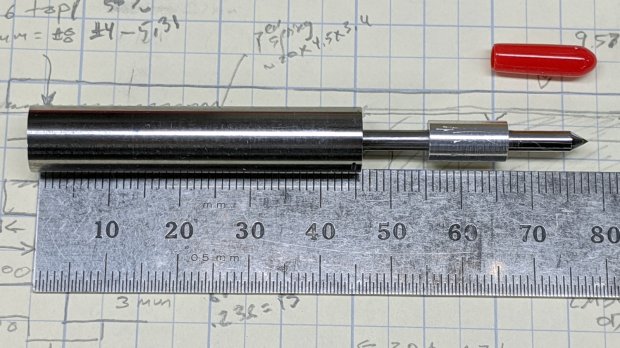
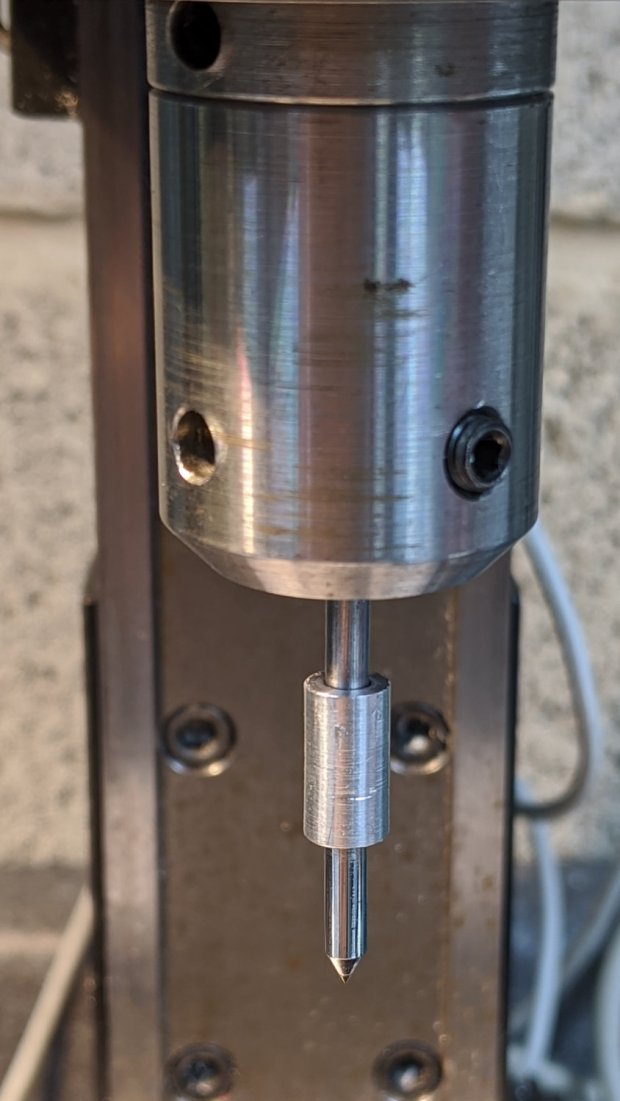
    Although I shouldn’t have used a hardened shaft for the case, the rest of the diamond drag tool holder worked out well enough:

    Sherline Diamond Drag Holder - assembled
    Sherline Diamond Drag Holder – assembled

    The dimension doodle shows what’s inside and gives some idea of the sizes:

    Sherline Diamond Drag Holder - dimension doodles
    Sherline Diamond Drag Holder – dimension doodles

    From left to right, it’s an M6×1.0 setscrew to adjust the spring preload, a spring harvested from a cheap clicky ballpoint pen, a machined cap, a 3 mm rod (which should be a hardened & ground shaft, but isn’t) surrounded by a pair of LM3UU linear bearings, a machined coupler, and the stub of a diamond engraving tool’s shank.

    Tapping 15 mm of M6×1.0 thread inside of the case took an unreasonable amount of grunt. Next time, brass.

    The setscrew gets a little boss to hold the spring away from the adjacent threads in the case:

    Sherline Diamond Drag Holder - setscrew spring boss
    Sherline Diamond Drag Holder – setscrew spring boss

    The little machined cap has a somewhat longer spring guide to prevent buckling:

    Sherline Diamond Drag Holder - shank cap spring guide
    Sherline Diamond Drag Holder – shank cap spring guide

    The spring fits snugly on the slightly enlarged section inside the last few coils, with the rest being a loose fit around the guide. When the spring is fully compressed, it’s just slightly longer than the guide and can’t buckle to either side.

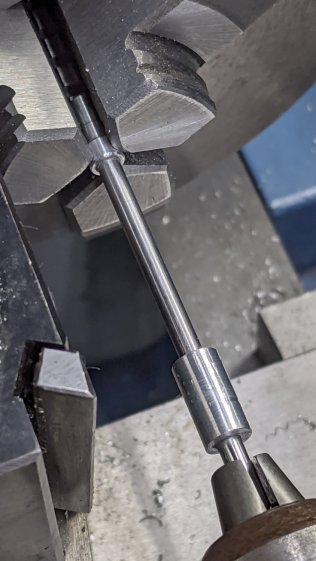
    The cap gets epoxied onto the 3 mm rod with some attention to proper alignment:

    Sherline Diamond Drag Holder - shank cap alignment
    Sherline Diamond Drag Holder – shank cap alignment

    The other end of the rod has a 3 mm thread, which would be a serious non-starter on a hardened rod.

    The shortened diamond tool shank gets epoxied into the gizmo connecting it to the now-threaded rod, again with some attention paid to having it come out nicely coaxial:

    Sherline Diamond Drag Holder - diamond tool alignment
    Sherline Diamond Drag Holder – diamond tool alignment

    The LM3UU bearings got epoxied into the case, because I don’t have a deep emotional attachment to them.

    Unscrew diamond tool, push spring onto cap, drop rod through bearings, crank setscrew more-or-less flush with the end of the case, screw diamond in place with some weak threadlock, add oil to rod, work it a few times to settle the bearings, and it’s all good.

    A quick spring rate measurement setup, with a brass tube holding the diamond point off the scale pan:

    Sherline Diamond Drag Holder - installed
    Sherline Diamond Drag Holder – installed

    The spring rate works out to 230 g + 33 g/mm for deflections between 1.0 mm (263 g) and 3.5 mm (346 g), so it’s in the same ballpark as the diamond tools on the MPCNC and CNC 3018.

    Note: WordPress just “improved” their post editor, which has totally wrecked the image alignment. They’re all set to “centered” and the editor says they are, but they’re not. It’s a free blog and I’m using one of their ancient / obsolete / unsupported themes, so I must update the theme. Bleh.

  • Mini-Lathe vs. Case-Hardened Shaft

    Mini-Lathe vs. Case-Hardened Shaft

    While doodling a drag knife holder for the Sherline, I figured a 3/8 inch shaft would hold all the parts and fit neatly into a standard Sherline tool holder, which it did:

    Sherline Diamond Drag Holder - installed
    Sherline Diamond Drag Holder – installed

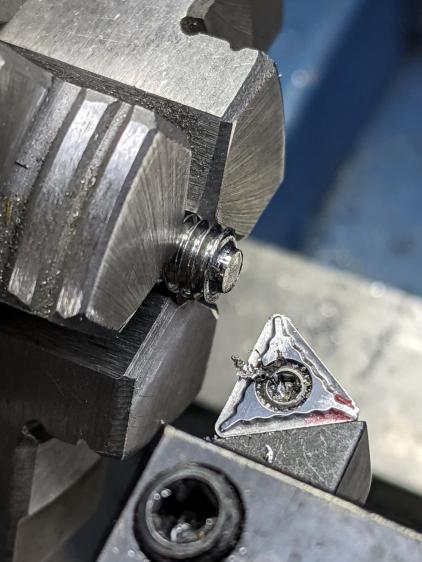
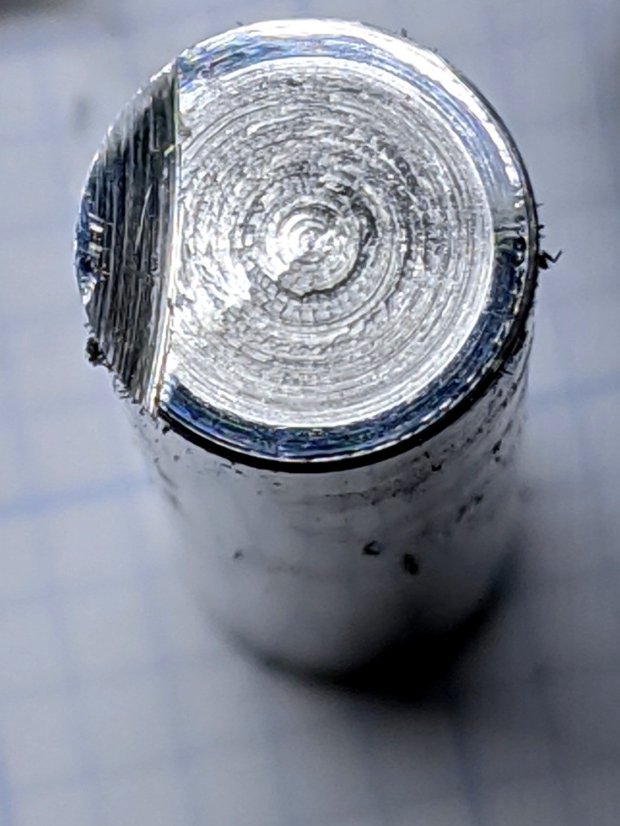
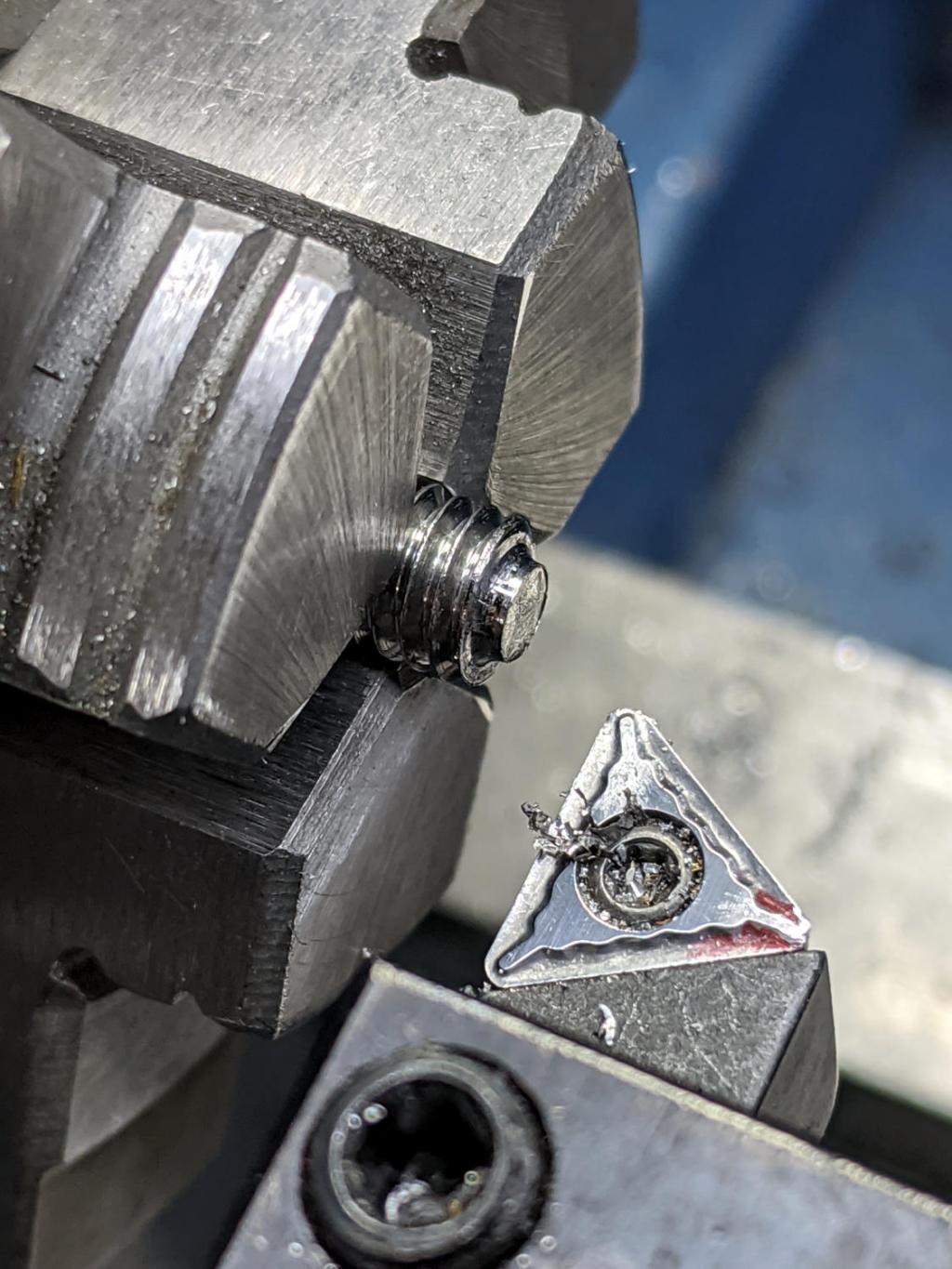
    Having recently upcycled a 3/8 inch shaft from the Thing-O-Matic into a pen holder for the CNC 3018-XL, I cut off another section with an abrasive wheel, then tried to face it off:

    Hardened shaft facing - abrasive step
    Hardened shaft facing – abrasive step

    Although the mini-lathe’s carbide insert gnawed at the shaft’s case-hardened shell, it obviously wasn’t making much progress against that step.

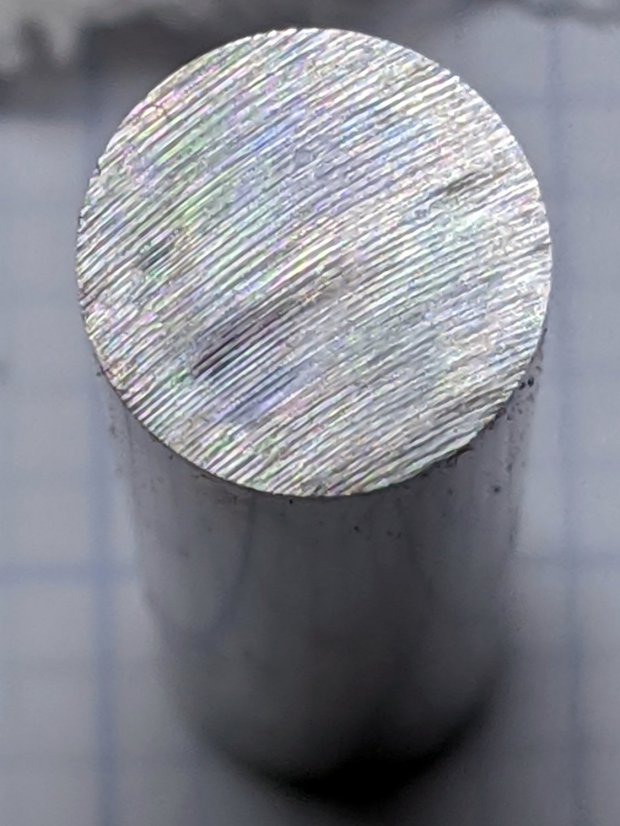
    Back to the abrasive cutoff saw:

    Hardened shaft facing - abrasive flattening
    Hardened shaft facing – abrasive flattening

    Which looked better, although it still wasn’t quite perpendicular to the shaft axis.

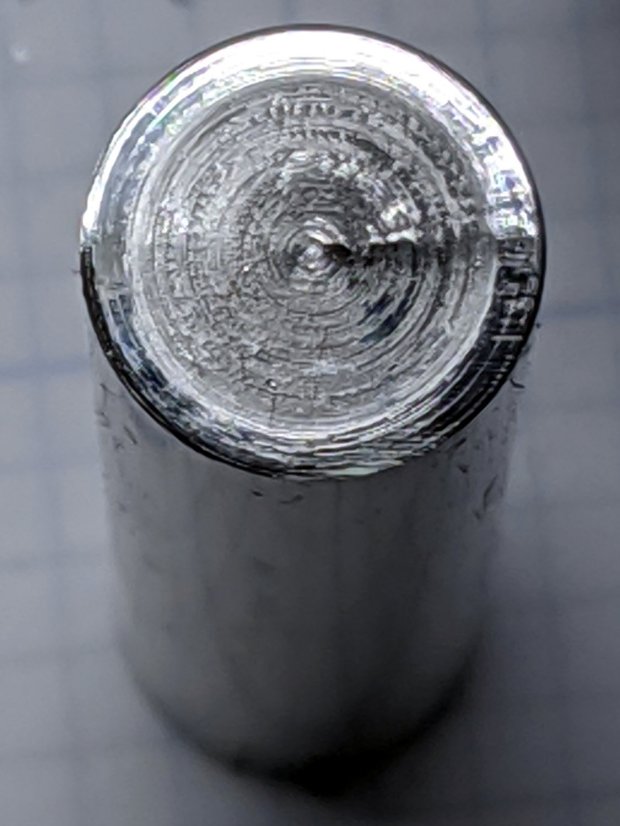
    Back to the lathe:

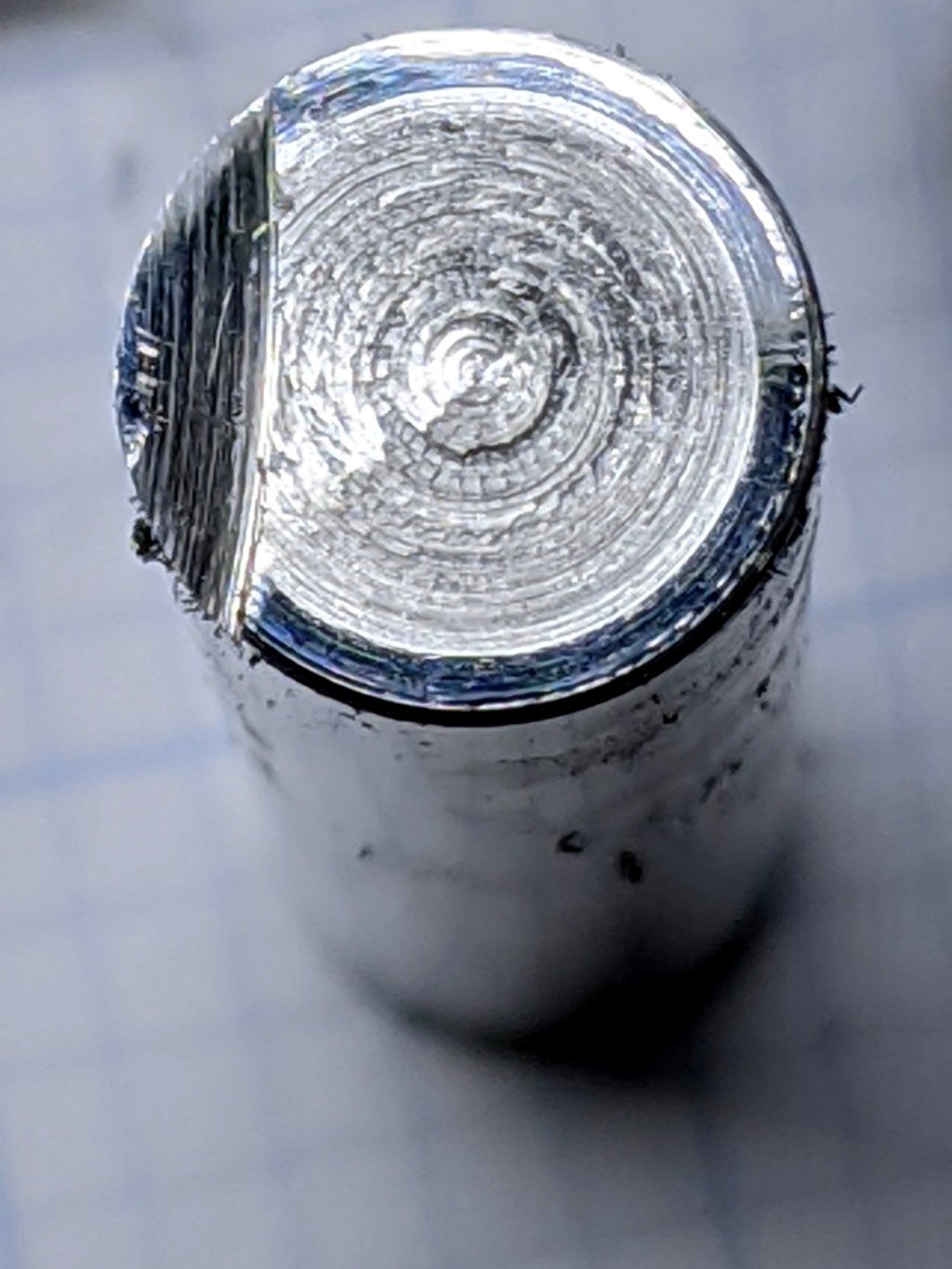
    Hardened shaft facing - lumpy face
    Hardened shaft facing – lumpy face

    Well, it’s better, but it sure ain’t pretty.

    Put gently, the mini-lathe’s lack of rigidity doesn’t help in the least. The compound was a-reelin’ and a-rockin’ on every revolution and eventually turned a slight tilt into a distinct radial step.

    Memo to Self: Dammit, use a brass rod!

  • COVID-19: Elephant Sighting

    As far as this engineer can tell, here’s about all you need to know about the COVID-19 pandemic:

    Total Deaths = Total Cases recorded two weeks earlier

    This also works forward in time: given the total number of cases “today”, I (and you) can predict the total number of deaths in two weeks, give or take a few days.

    Run the numbers for Italy, because it has a relatively long timeline and trustworthy data:

    • 2020-03-01: 1694 cases → 2020-03-15: 1809 deaths
    • 2020-03-02: 2036 cases → 2020-03-16: 2158 deaths
    • 2020-03-03: 2502 cases → 2020-03-17: 2503 deaths

    As the numbers become difficult to comprehend, the time difference slows to 16 days instead of 14:

    • 2020-03-06: 4636 cases → 2020-03-22: 4825 deaths
    • 2020-03-07: 5883 cases → 2020-03-23: 6077 deaths

    On 2020-03-23, Italy had 63,927 confirmed cases. Prediction: Easter will not be celebrated in the usual manner.

    Consider the data for the US, also in March 2020:

    • 2020-03-05: 175 cases → 2020-03-19: 174 deaths
    • 2020-03-06: 252 cases → 2020-03-20: 229 deaths
    • 2020-03-07: 353 cases → 2020-03-21: 292 deaths

    Pop quiz: Given that the US has 32,761 total cases as of today (2020-03-22), estimate the total deaths in two weeks.

    New York State will have similar statistics, although it’s too soon to draw conclusions from today’s 20,875 confirmed cases.

    In addition to the Wikipedia articles linked above, you may find these sites useful:

    Exhaustive tracking and mapping from Johns Hopkins (the GUID gets to reach the JHU data): https://www.arcgis.com/apps/opsdashboard/index.html#/bda7594740fd40299423467b48e9ecf6

    Comprehensive COVID-19 tracking, with logarithmic graph scales: https://www.worldometers.info/coronavirus/

    More raw data: https://virusncov.com/

    CDC National cases, with a per-day graph down the page: https://www.cdc.gov/coronavirus/2019-ncov/cases-updates/cases-in-us.html

    New York State COVID-19 info: https://coronavirus.health.ny.gov/home

    Perhaps more useful for me than you, but the Dutchess County information: https://www.dutchessny.gov/Departments/DBCH/2019-Novel-Coronavirus.htm

    The current recommendation: remain home unless and until you develop COVID-19 symptoms requiring urgent medical attention. Should that happen to me, I fully expect there will be no medical attention to be found and, certainly, all available medical equipment will be oversubscribed.

    Speaking strictly as an Olde Farte looking at the data, the future looks downright grim.

    On the upside, it’s amazing how little an order to remain home changed my daily routine: so many projects, so little time.

    Memo to Self: Wash your hands!

  • Drag Knife Calibration: Downforce and Speed

    Drag Knife Calibration: Downforce and Speed

    The drag knife faceplant suggested I must pay a bit more attention to fundamentals, so, with a 60° drag knife blade sticking out a reasonable amount, the next step is to see what effect the cutting “depth” (a.k.a. downforce) and speed have on the outcome.

    A smidge of GCMC code later:

    Drag Knife Cal - depth - overview - Camotics sim
    Drag Knife Cal – depth – overview – Camotics sim

    It’s not obvious, but each pattern steps downward by 0.5 mm from left to right. With the spring force equal to 375 g + 57 g/mm, the downforce ranges from 400 to 520 g over the five patterns.

    Laminated scrap, meet drag knife:

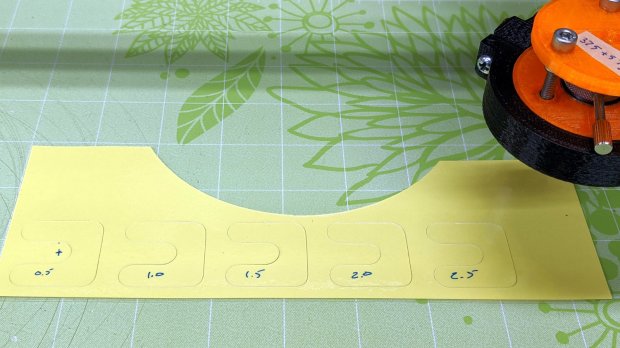
    Drag Knife Cal - Depth - as cut
    Drag Knife Cal – Depth – as cut

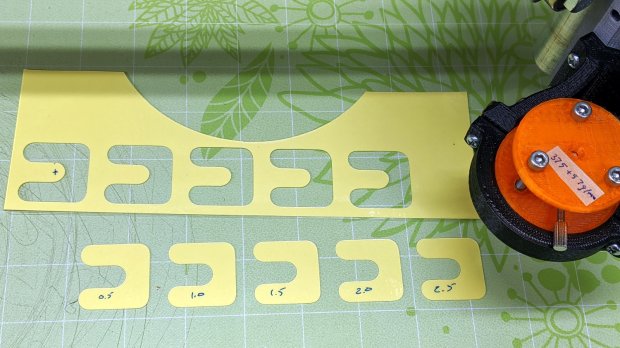
    Pulling up on the surrounding scrap left the patterns on the sticky mat:

    Drag Knife Cal - Depth - extracted
    Drag Knife Cal – Depth – extracted

    Which suggested any cutting force would work just fine.

    Flushed with success, I cut some speed variations at the minimum depth of Z=-0.5 mm = 400 g:

    Drag Knife Cal - Speed - 0.5 mm - as cut
    Drag Knife Cal – Speed – 0.5 mm – as cut

    The blade cut through the top laminating film, the paper, and some sections of the bottom film, but mostly just scored the latter.

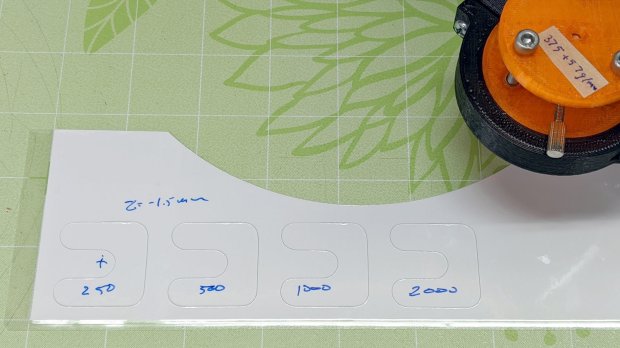
    Repeating at Z=-1.5 mm = 460 g didn’t look much different:

    Drag Knife Cal - Speed - 1.5 mm - as cut
    Drag Knife Cal – Speed – 1.5 mm – as cut

    However, the knife completely cut all the patterns:

    Drag Knife Cal - Speed - 1.5 mm - extracted
    Drag Knife Cal – Speed – 1.5 mm – extracted

    As far as I can tell, the cutting speed doesn’t make much difference, although the test pattern is (deliberately) smooth & flowy like the Tek CC deck outlines. I’d been using 1000 mm/min and 2000 mm/min seems scary-fast, so 1500 mm/min may be a good compromise.

    The GCMC source code as a GitHub Gist:

    // Calibrate Drag Knife – speed & feed
    // Ed Nisley – KE4ZNU
    // 2020-03 values for MPCNC
    //—–
    // Dimensions
    CutIncr = -0.5mm;
    BottomCutZ = -2.5mm;
    SpeedRatio = 2.0;
    MaxSpeed = 2000mm;
    MinSpeed = MaxSpeed / 8;
    StripWidth = 10mm;
    CornerRadius = StripWidth/2;
    PatternSize = StripWidth * [3,3];
    PatternSpace = 1.25;
    SafeZ = 10.0mm; // above all obstructions
    TravelZ = 2.0mm; // within engraving / milling area
    FALSE = 0;
    TRUE = !FALSE;
    if (!isdefined("TestSelect")) {
    TestSelect = "Depth";
    }
    comment("Test Selection: ",TestSelect);
    //—–
    // One complete pattern
    // Centered at ctr, ctr.z=cut depth
    function Pattern(ctr) {
    local d1 = CornerRadius; // useful relative distances
    local d2 = 2*d1;
    local d3 = 3*d1;
    local d4 = 4*d1;
    goto([-,-,TravelZ]); // set up for entry move
    goto(head(ctr,2) + [-d2,d3]);
    move([ctr.x + d2,-,ctr.z]); // enter to cut depth
    arc_cw_r([d1,-d1],d1);
    move_r([0,-d4]);
    arc_cw_r([-d1,-d1],d1);
    move_r([-d4,0]);
    arc_cw_r([0,d2],d1);
    move_r([d2,0]);
    arc_ccw_r([0,d2],d1);
    move_r([-d2,0]);
    arc_cw_r([0,d2],d1);
    move_r([d4,0]); // re-cut entire entry path
    goto([-,-,TravelZ]); // exit to surface
    // goto(head(ctr,2));
    }
    //—–
    // Start cutting!
    goto([-,-,SafeZ]);
    goto([0,0,-]);
    goto([-,-,TravelZ]);
    if (TestSelect == "Depth") {
    comment("Depth variations");
    s = MaxSpeed / 2;
    feedrate(s);
    c = [0,0,-]; // initial center at origin
    for (c.z = CutIncr; c.z >= BottomCutZ; c.z += CutIncr) {
    comment("At: ",c," speed:",s);
    Pattern(c);
    c.x += PatternSpace * PatternSize.x;
    }
    }
    if (TestSelect == "Speed") {
    comment("Speed variations");
    c = [0,0,-2mm]; // initial center at origin
    for (s = MinSpeed; s <= MaxSpeed; s *= SpeedRatio) {
    comment("At: ",c," speed: ",s);
    feedrate(s);
    Pattern(c);
    c.x += PatternSpace * PatternSize.x;
    }
    }
    goto([-,-,SafeZ]);
    goto([0,0,-]);

  • Drag Knife Blade Extension

    Drag Knife Blade Extension

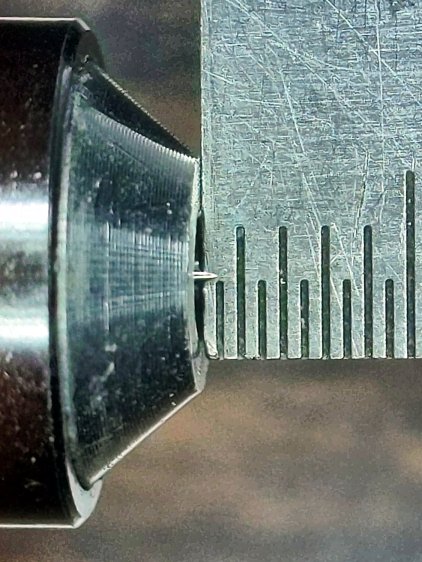
    The battered corner of my bench scale shows it’s been knocking around for quite a while, but the drag knife blade tip seems pretty close to the first 0.5 mm division:

    Drag Knife Blade - 0.5 mm
    Drag Knife Blade – 0.5 mm

    The blade extends from the LM12UU holder for the MPCNC.

    Scribbling the blade across a scrap of laminated yellow card stock (about 0.4 mm thick) showed it didn’t cut all the way through the bottom plastic layer, even with the spring mashed flat.

    So I screwed it out to 0.7 mm:

    Drag Knife Blade - 0.7 mm
    Drag Knife Blade – 0.7 mm

    The scale isn’t quite parallel to the blade axis and maybe it’s sticking out 0.8 mm; setting a drag knife’s blade extension obviously isn’t an exact science.

    In any event, another scribble slashed all the way through the laminated deck without gashing the sacrificial cardboard atop my desk, which seems good enough.