Having accumulated a bunch of used activated alumina desiccant, I figured now was a good time to try regenerating it. Industrial applications use dry gas and very high temperatures, but perhaps holding it over 100 °C for a few hours will suffice for my purposes.
I pressed our daily driver cast iron skillet and induction cooktop into service:

After an hour the surface temperature was around 150 °F, so I covered the pan with a water-cooled lid to see if any vapor condensed on it:
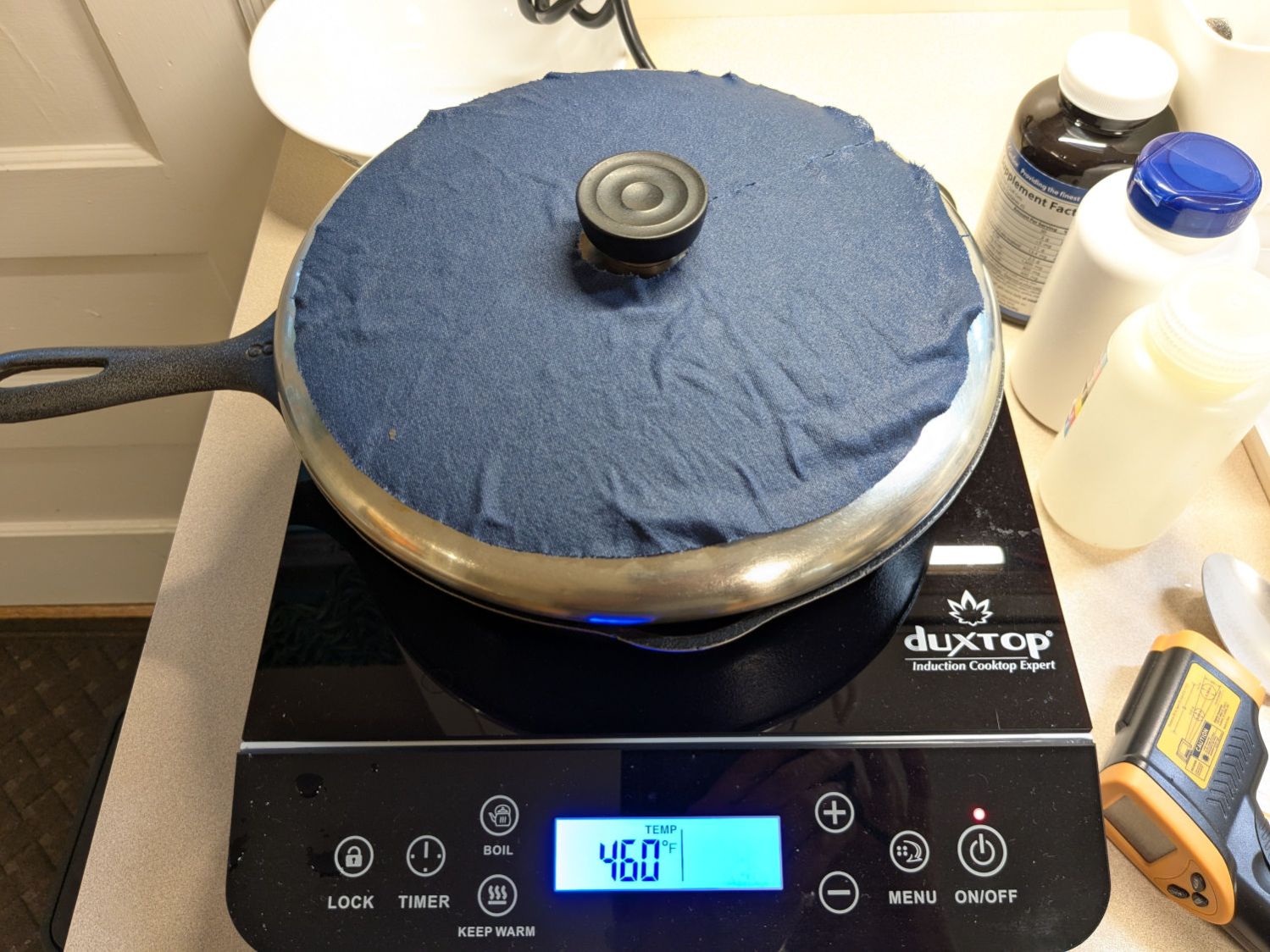
It did, indeed, so I alternated covering and exposing the pan, which was likely a waste of my time, until the alumina dried enough that the lid didn’t collect any condensation. The whole process took just under four hours with the cooktop set to its maximum of 460 °F for most of the time.
The beads then cooled to room temperature in a covered dish:

The beads weighed 626 g at the start of the adventure and sweated down to 593 g, parting with 33 g = 1.2 oz of water in the process for a loss of 5.6%. I have no idea how dry they are now, but they’re an ounce drier than before.
 The Smell of Molten Projects in the Morning
Comments
3 responses to “Activated Alumina Regeneration”
[…] very little of the energy: the dish, glass turntable, and metal walls got absurdly hot. I think using the induction cooktop and cast iron pan makes more sense, even if it takes […]
[…] OK-ish, maybe a little dark, but the fresh-from-the-bag beads in the right cup are crying out for regeneration after having adsorbed about all the water vapor they […]
[…] OK-ish, maybe a little dark, but the fresh-from-the-bag beads in the right cup are crying out for regeneration after having adsorbed about all the water vapor they […]